



Update — September 27, 2026: Companion technique guide — score a closed choice from one GLM-5.3-Flash token, Privatemode's head-to-head against Jev and Laya. This post still explains Jev's own RLCD mechanism.
The Jev launch post covered what TypeSafe AI announced on September 15, 2026: a model that returns typed decisions instead of text, claimed to be 20-200x faster and 40-400x cheaper than LLMs for structured tasks. That post is the news story. This one is the mechanism — the actual "how," for readers who want to understand why a single-forward-pass model can be that much faster, not just that TypeSafe says it is.
Founder Diogo Almeida built Jev after years working on the RLHF techniques behind ChatGPT — a background that matters here, because Jev's training objective (RLCD) is explicitly positioned as a departure from that same RLHF lineage. Understanding what changed, and what didn't, requires being precise about three separate things people tend to blur together: the output representation, the training objective, and the parallel-vs-sequential computation claim.
TL;DR: the mechanism in one table
| Question | Answer |
|---|---|
| What actually makes Jev fast? | Its output space is small and pre-enumerated, so it scores every possible answer in one forward pass instead of decoding tokens sequentially. |
| Is this the same "parallel" as Transformers? | No — Transformers parallelized training over a sequence via self-attention. LLM inference is still sequential, one token at a time. Jev parallelizes inference-time decision computation itself. |
| What is RLCD? | Reinforcement Learning for Calibrated Decisions — TypeSafe's training method, distinct from RLHF (human preference) and RLVR (verifiable correctness). |
| What does "calibrated" mean concretely? | If Jev says 70% confident across many answers, roughly 70% of those should be correct — the same bar used to grade weather forecasters. |
| Why are output tokens free? | There's no decode loop after the single forward pass, so there's nothing per-output-token to bill for. |
| Is the architecture public? | No. RLCD's name and the single-pass framing are confirmed; anything about layers, attention, or diffusion is Hacker News speculation, not TypeSafe disclosure. |
Why a fixed, small output space changes everything
Start with what an LLM actually does at inference time. Given a prompt, it predicts a probability distribution over its entire vocabulary — tens of thousands of possible next tokens — samples one, appends it to the context, and repeats. Every token depends on every token before it. This is why a 500-token answer takes roughly 500 sequential forward passes through the model, even though each individual pass is fast: the loop is the bottleneck, not any single step.
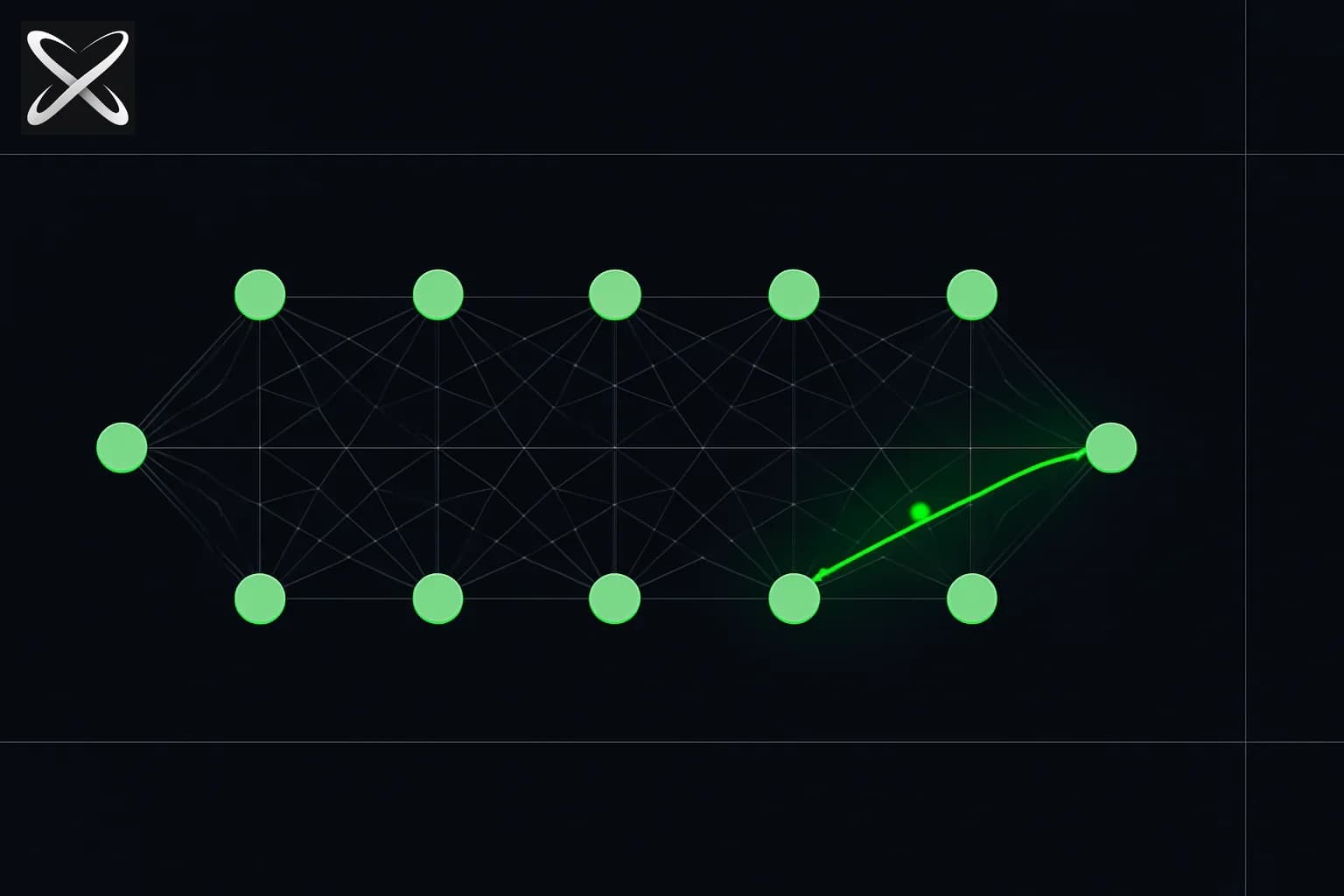
Jev's three output primitives — Choice (pick 1 of up to 255 predefined options), Score (a value on a scale), and Noul (a calibrated yes/no probability) — sidestep that loop entirely. Because the set of possible answers is fixed and known in advance, the model doesn't need to generate anything token by token. It can instead compute a probability for every option in the set during a single forward pass, then return whichever option scores highest along with its confidence.
That's the whole trick, and it's worth stating plainly because it explains multiple TypeSafe claims at once:
- The latency win (70ms-500ms vs. 3-329 seconds) comes directly from eliminating the decode loop — one pass instead of hundreds or thousands.
- The "free output tokens" pricing ($0.042/MTok input, $0 output) exists because there's no per-token decode step left to meter. An LLM's output cost is a proxy for how many decode passes it ran; Jev runs exactly one pass regardless of how the answer is framed.
- The "can't emit an invalid answer" guarantee follows from the same structure: if the only possible outputs are members of a predefined set, there's no way to produce a malformed string, because strings were never the output representation in the first place.
This is also precisely why Jev cannot generate open-ended text, code, or hold a conversation — those tasks have an effectively unbounded output space (any possible string), which cannot be exhaustively scored in one pass the way "pick 1 of 255" can. The mechanism that makes Jev fast for narrow decisions is the same mechanism that makes it structurally incapable of anything else.
The parallel-vs-sequential framing, done carefully
TypeSafe's own launch materials draw an explicit analogy to the Transformer's leap over RNNs — and it's a genuinely useful comparison, but only if you keep the two "parallel" claims separate, because conflating them is the single easiest way to misunderstand what Jev actually did.
What Transformers parallelized: RNNs process a sequence recurrently — token 2 can't be processed until token 1's hidden state is computed, token 3 needs token 2's, and so on. Training an RNN on a long sequence is therefore inherently sequential and slow. The Transformer's self-attention mechanism replaced that recurrence with a computation where every token in a sequence attends to every other token simultaneously, which meant an entire training sequence could be processed in parallel on a GPU. That parallelism is why Transformers scaled so much faster than RNNs during training — see explainx.ai's transformer architecture and attention guide for the full mechanism.
What Transformers did not parallelize: inference. Even a Transformer-based LLM still decodes autoregressively at inference time — one token generated, appended to the context, then the next token predicted, in sequence. This is true of every chat-style LLM in production, from early GPT models through today's reasoning models with long chain-of-thought traces. Training parallelism and inference parallelism are different properties, and the Transformer only solved the first one.
What TypeSafe claims Jev does: parallelize the second thing — inference-time decision computation — for the narrow class of problems where the output space is small enough to enumerate. In TypeSafe's own framing (quoted in the launch announcement thread), this is presented as an analogous leap to the Transformer's: replacing sequential computation with parallel computation, just at a different stage of the pipeline (decision-making at inference, rather than training over a sequence). It's a reasonable analogy for why it's a meaningful engineering idea, but it is not the same technical achievement — Jev isn't parallelizing token generation for arbitrary text, it's avoiding token generation altogether for a bounded set of answers. Readers should hold onto that distinction rather than repeating "Jev parallelized inference the way Transformers parallelized training" as if they solved the same problem — they solved adjacent but different bottlenecks.
There's actually a second, separate layer of parallelism worth distinguishing from both of the above: a single Jev API request can bundle multiple independent questions about the same state and have all of them evaluated together, rather than requiring one request per question. A request describing an incident could ask "is this urgent" (Noul), "which team owns this" (Choice), and "how severe is this" (Score) in one call, and get all three typed answers back together — instead of three sequential calls, or one LLM call trying to produce a single JSON object covering all three judgments at once, with the schema-adherence risk that carries. This is a request-shape optimization more than a deep architectural claim, but it's a genuinely practical one: it changes how you'd actually design a workflow around Jev, since independent judgments about the same input no longer need to be split across separate round-trips just because they're conceptually distinct decisions.
RLCD: what "calibrated" actually means and how it's trained
TypeSafe's training method for Jev is called RLCD — Reinforcement Learning for Calibrated Decisions. To understand what it optimizes for, it helps to line up all three reinforcement-learning approaches currently in use across the industry side by side:
| Method | What the reward signal measures | Where it's used |
|---|---|---|
| RLHF (Reinforcement Learning from Human Feedback) | Whether a human rater prefers this output over an alternative | Chat models, general-purpose LLM alignment — the technique Almeida helped pioneer at OpenAI |
| RLVR (Reinforcement Learning with Verifiable Rewards) | Whether the output is objectively, verifiably correct (a passing test case, a matching numeric answer) | Reasoning models on math and code, where ground truth exists to check against |
| RLCD (Reinforcement Learning for Calibrated Decisions) | Whether the model's stated confidence matches its actual accuracy across many decisions | Jev's structured Choice/Score/Noul primitives |
The distinction between RLHF and RLCD is the one worth dwelling on, because it's the direct continuation of the argument in TypeSafe's founder profile: RLHF rewards a model for producing an answer a human rater approves of, which trains the model to sound convincing — not necessarily to know when it's wrong. A model can be systematically overconfident under RLHF and still score well, because the reward signal never directly checks calibration. RLCD is designed to close exactly that gap by rewarding the model specifically for the match between its stated confidence and its real-world accuracy, independent of whether any single answer sounds persuasive.
Calibration, concretely. The standard illustration is weather forecasting, and it's worth working through because it's precise in a way "confidence score" alone isn't. A well-calibrated weather forecaster who says "70% chance of rain" on 100 different days should see rain on roughly 70 of them — not 95, not 40. If it rains on 95 of those 100 "70%" days, the forecaster is underconfident; if it rains on only 40, they're overconfident. Crucially, calibration is a property of the distribution of predictions, not any single one — a forecaster can be wrong about tomorrow's rain and still be perfectly calibrated, as long as their stated probabilities track reality across the full set of days they made that same call.
Applied to Jev: if the model outputs a Noul (boolean probability) of 0.7 across a large number of production decisions, RLCD's training signal is designed so that roughly 70% of those specific decisions turn out correct. That's a different, arguably more useful property than raw accuracy for a system meant to run unsupervised — a caller can act differently on a 0.55 confidence answer than a 0.95 one, but only if that confidence number is honest in the aggregate.
What's confirmed versus what isn't. TypeSafe has named RLCD, described its objective (calibration over human preference or verifiable correctness), and confirmed via its CEO on Hacker News that this is the training approach behind Jev. What TypeSafe has not published, as of this writing: a paper describing the loss function, the reward model construction, how calibration is measured during training, or how it interacts with the underlying architecture. That's a meaningful gap for anyone trying to independently evaluate the claim rather than take it as marketing copy — see the launch post's full rundown of what Hacker News pushed back on, including the "confidently wrong" distinction TypeSafe's own CEO acknowledged directly.
The architecture question: informed speculation, not fact
TypeSafe has not released an architecture paper for Jev. Everything beyond "RLCD" and "a single parallel forward pass over enumerated output primitives" is undisclosed by the company itself. In the absence of a paper, Hacker News commenters floated a few candidate architectures during the launch discussion — worth naming precisely because they are speculation, not confirmed technical facts:
- An encoder-only Transformer with classification heads. This would be a natural fit mechanically: encoder-only models (in the tradition of BERT-style architectures) already compute a representation of the full input in one pass and attach task-specific heads that output a fixed-size distribution — exactly the shape Choice, Score, and Noul need. This is plausible on paper, but TypeSafe has not confirmed it.
- A stripped-down text-diffusion model. Diffusion-style generation, which computes a full output in parallel refinement steps rather than left-to-right, was raised as another candidate given the "parallel, not sequential" framing — but text diffusion models typically still need multiple denoising steps, so this would need adaptation to hit the reported latency, and again, unconfirmed.
- Something else entirely, purpose-built for calibrated decision outputs. Given how narrow and specific Jev's three primitives are, it's plausible TypeSafe built something that doesn't map cleanly onto either existing category.
Treat all three as reader-generated hypotheses that fit the publicly disclosed behavior, not as a leaked or confirmed architecture. The responsible way to describe Jev's internals right now is: RLCD training objective (confirmed), single parallel forward pass over a fixed output set (confirmed via TypeSafe's own framing), specific model architecture (undisclosed).
Why "workflow evals" instead of public benchmarks
TypeSafe evaluated Jev using what it calls "workflow evals" rather than publishing scores on standard public benchmarks or leaderboards. The methodology: run Jev against multi-step decision graphs and compare its output to the average of two frontier LLMs' predictions (GPT-6 Astra and Fable 5.1) on the same graphs, rather than against an independently verified ground-truth answer.
This is a meaningfully different evaluation design from what the field typically expects, and it's worth being explicit about why some commenters found it unconventional:
- No ground-truth comparison. Averaging two other models' predictions and treating that average as the target measures agreement with other models, not correctness. If both reference models are wrong in the same direction, Jev could score well while still being wrong about the underlying decision.
- Not a public, reproducible leaderboard. Standard benchmarks (public test sets, fixed scoring scripts, third-party replication) let outside researchers check a claim. TypeSafe's workflow evals are internal and, as of this launch, not independently reproducible by outside parties.
- The reported comparison chart itself was mixed, per Hacker News discussion of the launch post — one plotted result reportedly showed Jev's raw accuracy below Sonnet 5's on the specific chart TypeSafe shared, even while TypeSafe highlighted its position on the cost/speed frontier overall.
None of this means the underlying speed and cost mechanism isn't real — the "one forward pass over enumerated primitives" argument for latency and pricing holds up on its own logic, independent of the evals methodology. But accuracy and calibration quality specifically are claims that rest on TypeSafe's own internal evaluation design, not an externally verifiable benchmark, and that's worth knowing before betting a production workload on the comparison numbers.
Named after Jevons — the short version
Jev's name nods to the Jevons paradox: cheaper access to a resource tends to increase total consumption of it, not just make existing use cheaper, because it unlocks previously uneconomical uses. TypeSafe applies that logic to AI decisions rather than coal. The launch post covers this economics argument in full — this post's job is the mechanism, not the naming, so it isn't repeated here.
Putting it together: what's confirmed vs. speculative
| Claim | Status |
|---|---|
| Output is one of three fixed primitives (Choice/Score/Noul) | Confirmed, TypeSafe's own materials |
| Single forward pass, no autoregressive decoding | Confirmed, TypeSafe's own framing |
| Training method is called RLCD, optimizes for calibration | Confirmed, TypeSafe CEO on Hacker News |
| RLCD's exact loss function / reward construction | Undisclosed |
| Underlying model architecture (encoder-only, diffusion, other) | Speculation from Hacker News, not confirmed by TypeSafe |
| $0.042/MTok input, free output, 70ms-500ms latency, 20-200x/40-400x claims | TypeSafe's own published figures, not independently verified |
| Workflow-eval accuracy claims vs. GPT-6 Astra / Fable 5.1 average | TypeSafe's own internal methodology, no public ground-truth benchmark |
That's the honest state of the record as of September 16, 2026. The mechanism behind the speed and pricing — small fixed output space, one forward pass, no decode loop — is sound engineering logic that explains the claimed numbers even without a published paper. The parts that require more scrutiny are the accuracy and calibration quality claims, which currently rest entirely on TypeSafe's own internal evals rather than a reproducible public benchmark.
FAQ
How does Jev compute an answer without generating text? Its output space is fixed and enumerated in advance — up to 255 choices, a scalar score, or a boolean — so the model computes a probability over every possible answer in one forward pass, instead of sampling tokens sequentially like an LLM.
What is RLCD and how is it different from RLHF or RLVR? RLCD optimizes for calibration — confidence matching real accuracy — rather than human preference (RLHF) or verifiable correctness (RLVR).
Does Jev parallelize the same thing Transformers parallelized? No. Transformers parallelized training via self-attention; LLM inference is still sequential token-by-token decoding. Jev parallelizes inference-time decision computation itself, for a narrow output-primitive class of problems.
What does "calibration" mean in plain terms? A model's stated confidence should match its real accuracy across many predictions — the same standard used to grade weather forecasters' "70% chance of rain" claims.
Has TypeSafe AI published the architecture behind Jev? No architecture paper exists as of this writing. RLCD and the single-pass framing are confirmed; specific architecture claims (encoder-only Transformer, text diffusion) are Hacker News speculation.
Why are Jev output tokens free while input tokens are priced? Because there's no decode loop to meter after the single forward pass — TypeSafe's pricing reflects that structural difference from LLM inference.
Related reading
-
Update — September 29, 2026: GPT Researcher v3.7.0 scores each scraped chunk with a Jev usefulness Score — the Score primitive from this explainer, used as a research-agent context filter.
-
Update — September 22, 2026: SemIf on LangSmith Gateway (free through Sept 28) — the same System One question types (noul, choice, score) over gateway.smith.langchain.com, with hosted open weights versus BYOK Jev on
typesafe/jev-*. -
Update — September 22, 2026: AgentRun, Grep.ai's harness, is built around Jev — a production example of typed Jev questions cutting AML alert review cost from $2.89 to $0.25 per case.
-
Learn Jev: self-paced Jev & TypeSafe AI course on Udemy, or the live Build with Jev workshop — full comparison.
-
Update — September 20, 2026: Top 10 ways to learn Jev — courses, workshops, and free resources, led by explainx.ai's own self-paced Jev course and live Jev workshop.
-
Update — September 19, 2026: Where Jev actually fails — the specific, sourced failure modes (type-valid but semantically wrong answers) that the RLCD mechanism described here doesn't fully prevent.
-
What is a "System One Model"? A new AI category, explained — the Kahneman framing, RLCD vs. RLHF vs. RLVR, and whether the category is more than a product name
-
TypeSafe AI's Jev launch: a "System One Model" that never hallucinates
-
He co-invented ChatGPT. Now he says it was a "weird detour."
-
What is Transformer architecture? Attention and LLMs explained
-
Official: TypeSafe AI launch post · TypeSafe AI docs
Architecture and training details in this piece reflect TypeSafe AI's own public statements as of September 16, 2026, plus clearly labeled Hacker News speculation. No independent architecture paper has been published; figures and benchmark claims are TypeSafe's own and have not been independently verified.