



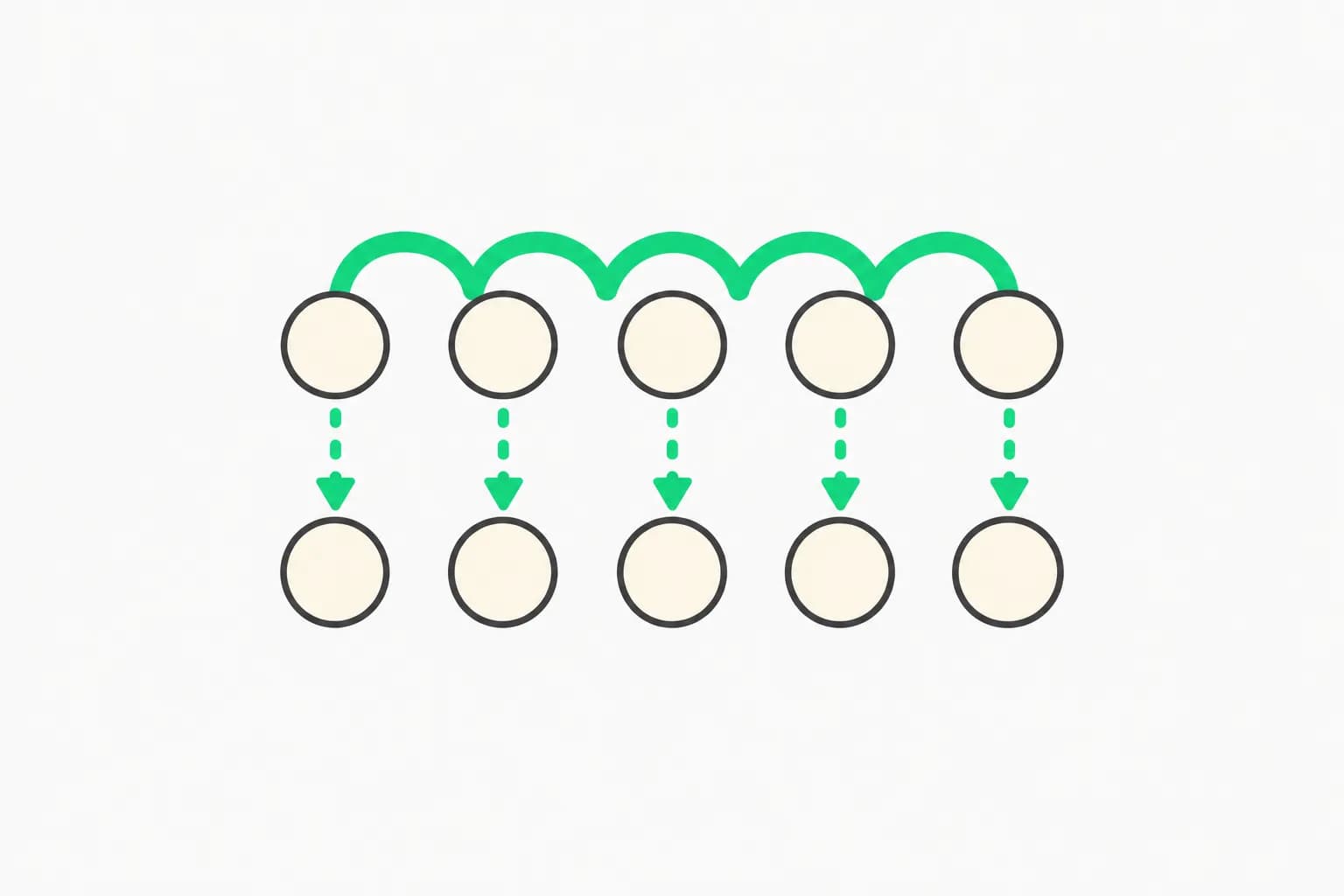
A Contrastive Language Model is a model that picks, it does not write. You give it a description of the current situation and a list of possible actions. It turns each into an embedding, compares them, and returns the action that matches the situation best.
That is the whole idea, and it is why the model can be small, cheap and fast. This guide explains how it works, what "contrastive" means, why the name collides with a causal language model, and when a Contrastive Language Model is the right tool for an agent.
The term is not a decades-old standard. It is the name of an open project released in September 2026, built around the idea above. We covered the launch and its benchmark numbers in CLM-8B, the open System One model that matches Jev. This post is the evergreen version: what the concept is, without the news cycle.
TL;DR
| Question | Answer |
|---|---|
| What is a Contrastive Language Model? | A model that scores candidate actions by how well their embeddings match the current state's embedding |
| Does it generate text? | No. It selects from a closed set of options you supply |
| What does "contrastive" mean? | Trained so matching pairs sit close and non-matching pairs sit far apart, usually with an InfoNCE loss |
| Is CLM the same as a causal LM? | No. Most NLP code uses CLM for causal language modeling (next-token prediction). This is a different design |
| Why is it fast? | One embedding pass per new state, plus a dot product per cached action |
| Real example | CLM-8B: Apache 2.0, trained on 60M Q&A pairs, 30M hard negatives and 1M agentic trajectories |
| Best uses | Routing, verification checkpoints, reranking best-of-N outputs, fast classification with changing labels |
| Worst uses | Open-ended writing, long-horizon planning, huge or unknown candidate sets |
What does "contrastive language model" actually mean?
Three words, three jobs. Language means the inputs are text: a customer message, a tool description, a coding task, a game state written out in words. Model means a trained neural network, here one built from a frozen LLM backbone plus a small trained head. Contrastive names the training objective, which we explain in the next section.
The phrase can mean two things depending on who says it:
| Reading | What it refers to |
|---|---|
| The project | CLM and CLM-8B, released by researcher Jacky Kwok (Stanford CS PhD, Berkeley EECS) on September 24, 2026, described as "an ultra-fast System One Model trained with a contrastive learning objective that connects states and actions" |
| The general recipe | Any language model whose job is to match texts to each other, trained by contrast, rather than to continue a text |
In this guide we use the second reading to teach the concept, and the first reading for concrete numbers. If you want the category it belongs to, read what a System One model is: a model built for the fast, intuitive kind of decision rather than slow deliberate reasoning.
How does a Contrastive Language Model work?
The CLM README describes three moving parts. We walk them in order.
1. Two encoders
CLM trains a state encoder and an action encoder. Each one maps text to a vector. A "state" is whatever the agent currently sees: a support ticket, a screen description, a pull request, a partial trajectory. An "action" is one candidate choice, written as text with a short description.
In the reference setup, each encoder is a frozen LLM backbone plus a trainable projection head of about 20M parameters. The backbone is Qwen3-8B, served through vLLM in pooling mode, and the CLM head (roughly 75 MB) downloads on first run. Most of the compute is therefore an ordinary embedding forward pass. See our explainers on what an embedding is and embeddings and vector search if the vector part is new.
2. Contrastive training
Training shows the model a batch of pairs: a state, and the action that was actually taken in it. The loss, InfoNCE, does two things at once:
- It pulls each state toward its ground-truth action.
- It pushes each state away from every other action in the batch.
The CLM authors use a bidirectional version, so actions are also pulled toward their states. This is contrastive learning applied to decisions. The model never learns to write an action. It learns a space where the right action is the nearest neighbor of its state.
3. Zero-shot scoring
At deployment you pass a state and a set of candidates. The model embeds them, computes a similarity score for each state and action pair, and applies a softmax. The highest score is the pick, and the softmax gives a probability-like distribution over your options. Because the options are described in plain text, you can change a label's description without retraining.
Here is the toy math, written as code so you can see the shape of it:
state_vec   = state_encoder("Customer: my invoice was charged twice")
action_vecs = [action_encoder(a) for a in ["billing", "technical", "retention"]]

scores = [dot(state_vec, v) for v in action_vecs]   # one dot product per action
probs  = softmax(scores / temperature)
pick   = argmax(probs)                              # no tokens are generated
Try it yourself in the lab below. Choose a state, move the temperature slider, and watch the cache toggle change the number of embedding calls.
The lab uses invented 2-D vectors for teaching. The takeaway is the shape of the computation: a similarity per option, a softmax, and an argmax.
How is a CLM different from a causal language model?
This is the confusion that sends most readers to this page. In Hugging Face Transformers and in a lot of research code, CLM stands for causal language modeling: train a model to predict the next token given the tokens before it. GPT-style chat models and most open LLMs are trained this way, usually followed by instruction tuning and reinforcement learning.
A Contrastive Language Model shares the letters and little else.
| Causal language model | Contrastive Language Model | |
|---|---|---|
| Training signal | Predict the next token | Match a state to its correct action, against negatives |
| Output | A stream of generated tokens | A score per candidate you provide |
| Can it write? | Yes | No |
| Cost per decision | Grows with output length | One state embedding plus a dot product per action |
| Candidate set | Open-ended | Closed and enumerable |
| Typical job | Chat, code, reasoning, writing | Routing, verifying, reranking, classifying |
| Where it sits | System Two style deliberation when it reasons | System One style fast choice |
The two are complements. A causal model can generate five candidate solutions to a coding task. A contrastive model can then pick the best one in tens of milliseconds. The CLM-8B results show exactly this pattern, which we cover below. When a document uses "CLM" without context, check which one it means.
Is it just CLIP for text?
Close, but not the same. OpenAI's CLIP (2021) trains an image encoder and a text encoder with a contrastive loss so a photo and its caption land near each other. That idea powers much of modern multimodal search; see our multimodal AI guide.
A Contrastive Language Model borrows the recipe but changes the pairing. Instead of image and caption, it pairs a description of a situation with a description of the action taken in it. That makes it a decision model rather than a retrieval model, even though the math is the same family.
Here is how it relates to other models you may already use:
| Model type | What it matches | Trained how | Output |
|---|---|---|---|
| CLIP-style | Image to caption | Contrastive across modalities | Similarity between an image and a text |
| Bi-encoder embedder | Query to document | Contrastive on retrieval pairs | A vector you search with |
| Cross-encoder reranker | Query plus document, read together | Supervised relevance labels | A relevance score, slower, usually more precise |
| Contrastive Language Model | State to action | Contrastive on states and the actions taken | A score per candidate action |
A useful rule of thumb from the retrieval world applies here too. Bi-encoder style models are fast because the two sides are encoded independently and cached. Cross-encoders read both sides together, which can be more accurate but costs a full forward pass per pair. A CLM sits on the fast side. If you want embedding model options for the backbone side of things, see our ranking of open and closed embedding models.
Why is it so fast?
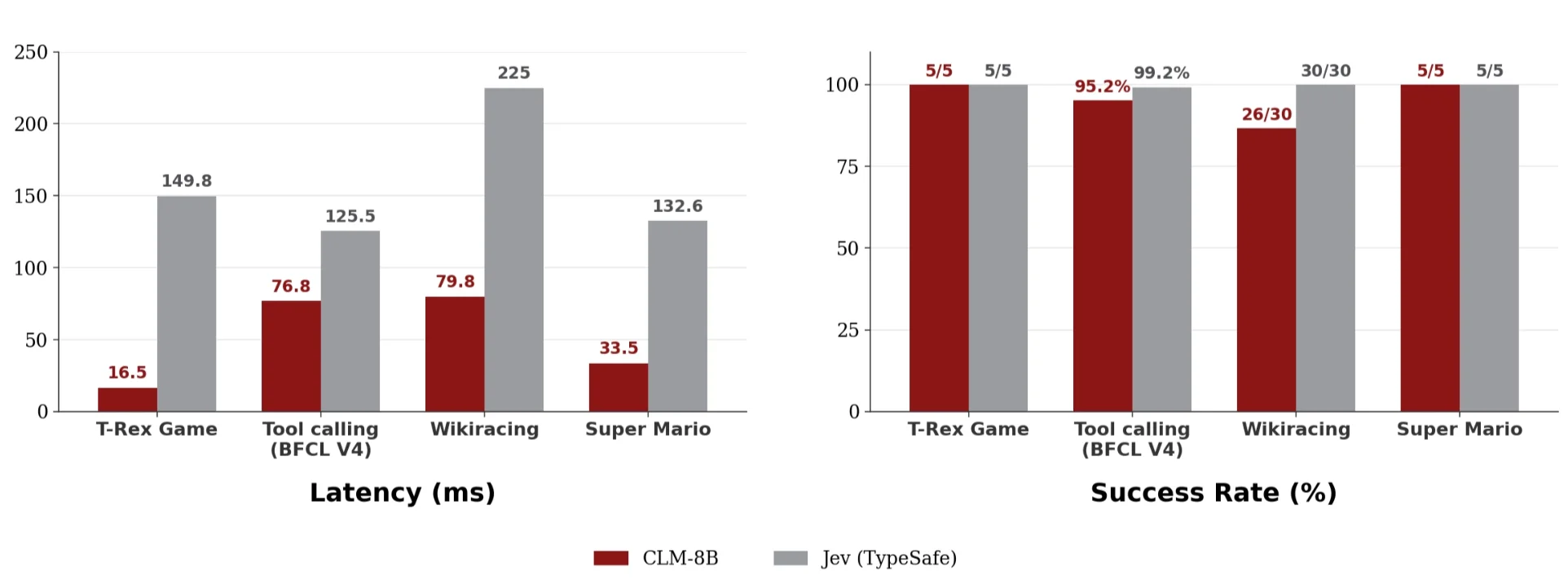 Bar charts comparing CLM-8B and Jev latency in milliseconds across the T-Rex game, BFCL V4 tool calling, WikiRacing and Super Mario
Figure: zero-shot latency and success rate, CLM-8B vs Jev. Source: the Contrastive-LM GitHub repository (Apache 2.0), reproduced with attribution.
The speed comes from disaggregation. Because the state encoder and the action encoder are independent, their outputs can be cached separately. If the state keeps changing but the menu of actions stays fixed, as in a game, a tool router or a fixed list of intents, you embed each action once and only re-embed the new state.
| Scenario | Embedding calls per new state, no cache | With cached actions |
|---|---|---|
| 3 actions | 4 | 1 |
| 30 actions | 31 | 1 |
| 300 actions | 301 | 1 |
The dot products still scale with the number of actions, but they are cheap compared with a forward pass through an 8B model. This is why the README reports its largest speedups when there are many candidate actions, or when actions are reused across states.
In the published charts, the T-Rex game runs at 16.5 ms for CLM-8B against 149.8 ms for Jev, about 9x. Other tasks show smaller gaps: tool calling at roughly 1.6x, WikiRacing about 2.8x and Super Mario about 4x. "Up to 9x" is the best case, not the typical case. Jev, TypeSafe's System One model, was a little more accurate on tool calling (99.2 percent against 95.2 percent) and WikiRacing (30 of 30 against 26 of 30). For background on Jev, see how Jev works.
What does the training data teach it?
CLM-8B is trained in three stages, per the README:
- Pre-training on 60M Nemotron Q&A pairs gives broad question-to-answer alignment.
- Mid-training on 30M synthetic hard negatives teaches it to tell near-miss options from correct ones.
- Post-training on 1M agentic trajectories adapts it to states and actions from tool use, browsing and coding.
The middle stage is the important one to understand. A hard negative is a wrong answer that looks right: a "refund" option when the correct one is "chargeback dispute", a nearly identical function call with the wrong argument. A contrastive model trained only on easy negatives learns shallow features and fails on exactly the decisions agents care about. Hard negatives force the encoders to separate the small differences that matter.
The authors also report that test InfoNCE loss falls as a predictable power law with training compute, dataset size, head size and encoder size, and that scaling the encoder gives the strongest gains. Predictable scaling is useful because it lets a team estimate whether a bigger encoder is worth paying for before training one.
Where do Contrastive Language Models fit in an agent pipeline?
The best use is verification and routing, not generation. Three patterns come up.
Best-of-N verification. A strong generator produces several candidate solutions and a fast verifier picks one. In the CLM-8B README, a fine-tuned CLM verified best-of-4 candidates from Opus 5 on DeepSWE and reached 81.6 percent, against a pass@1 baseline of 73.7 percent. On Terminal-Bench 2.1 it verified best-of-5 candidates from Fable 5 and reached 87.6 percent against 84.0 percent. Verifier latency was 79 ms and 32 ms.
Routing. Pick a tool, a queue, an intent or a model. The options are small and known, and a decision is needed on every turn. This is the classic System One job. Our guide to Jev-style agent routing shows the pattern with a sibling model.
Reranking. Take a shortlist from retrieval and order it by fit to the state.
For the verification pattern in a full pipeline, see cheap verification checkpoints for agent pipelines.
How do I try one?
The README shows a serving setup with vLLM and a small API. In outline:
git clone https://github.com/Contrastive-LM/CLM.git && cd CLM
pip install -r requirements.txt

# 1. encoder: Qwen3-8B via vLLM in pooling mode
vllm serve Qwen/Qwen3-8B --served-model-name qwen3-8b --runner pooling \
     --enable-prefix-caching --max-model-len 2048 --gpu-memory-utilization 0.35 --port 8090

# 2. CLM API
clm-serve --port 8700 --emb-url http://127.0.0.1:8090/v1/embeddings
Requirements are Linux, Python 3.10 or later and an NVIDIA GPU. A typed question then looks like this:
from clm import CLMClient, Choice

client = CLMClient()
r = client.system_one(
    state="Customer: my invoice was charged twice and nobody answers the phone!",
    questions={
        "department": Choice(
            instructions="Which team should handle this?",
            criteria={"billing": "Charges, invoices, refunds",
                      "technical": "Bugs and outages"},
        ),
    },
)
A prompt you can adapt: write the state as a short factual paragraph, write each action as a label plus one sentence of criteria, and keep criteria mutually exclusive. Ambiguous option text is the most common cause of a weak pick, because the model matches meaning, not your intent.
What are people asking about CLMs?
Is it a new chat model? No. You cannot hold a conversation with it. It is a decision component you place inside a larger system.
Do I need to fine-tune it? Not to start. Zero-shot works with described options. The verifier results above used light fine-tuning on the task distribution, which is a fair method but limits how far those numbers generalize. The project ships a fine-tuning tutorial for your own data.
Can the scores be trusted as probabilities? Treat them as scores. A softmax over similarities is not automatically calibrated. Check calibration on your own data before you use a threshold such as "act when the top option exceeds 0.9".
What is the license? Apache 2.0, with code on GitHub and weights and data on Hugging Face.
How many candidates can it handle? The method scales well to many cached candidates, but it needs them to be enumerable. If the correct action is not in your list, the model still picks the closest one.
What are the limits?
Be honest about three caveats:
- Small evaluations. The README reports 38 held-out DeepSWE tasks and 30 held-out Terminal-Bench 2.1 tasks, so 81.6 percent is 31 of 38. One or two tasks move the percentage by several points.
- Self-reported results. We have not seen independent replication or a head-to-head against other rerankers or reward models on the same tasks.
- Closed choice sets only. A CLM cannot invent an action you did not list, and it will not plan a long task by itself.
For the failure modes that this whole class of model shares, read where Jev actually fails, and for the clone ecosystem around it, see six Jev clones in two days.
Should you use a Contrastive Language Model?
| If your decision looks like this | Use a CLM? |
|---|---|
| Pick one of 3 to 300 known options, many times per second | Yes |
| Choose the best of N generated answers | Yes, as a verifier |
| Route a message to a queue, tool or model | Yes |
| Write or edit prose or code | No, use a causal LLM |
| Plan a 40-step task | No, use it only to verify steps |
| Options change per request and are unbounded | Probably not |
Bottom line
A Contrastive Language Model replaces "think and write an answer" with "embed and compare". That trade gives up generation and gains speed, low cost and a steady output you can cache and score. If your agent makes many small choices, it is worth benchmarking against the LLM calls you use today. If it needs to write, stay with a causal model and let the CLM check its work.
Details reflect the Contrastive-LM GitHub repository and the author's announcement of September 24, 2026, and may change. Benchmark figures are self-reported by the project and were accurate as of the publication date.
Related reading
- LLM vs CLM vs decision models: which one should you use?
- CLM-8B launch: the open System One model that matches Jev
- What is a System One model?
- How does Jev work? RLCD explained
- What is an embedding? Examples
- Embeddings and vector search: complete guide
- Top open and closed embedding models
- What is multimodal AI?
- Cheap verification checkpoints in agent pipelines
- Official: CLM on GitHub, CLM data and models on Hugging Face