



So you want to use Claude Code, and you need to know what it will actually cost.
The honest answer is: it depends on how you use it. Claude Code has two completely different billing paths—a monthly subscription through claude.ai, or bring-your-own API key with pure pay-per-token pricing. Neither is universally better. The right choice depends on whether you are an individual developer, a team, or running automated pipelines.
This guide breaks down every option with real numbers, a comparison table against competitors, and a straightforward ROI calculation so you can make the call quickly.
The Two Ways to Pay for Claude Code
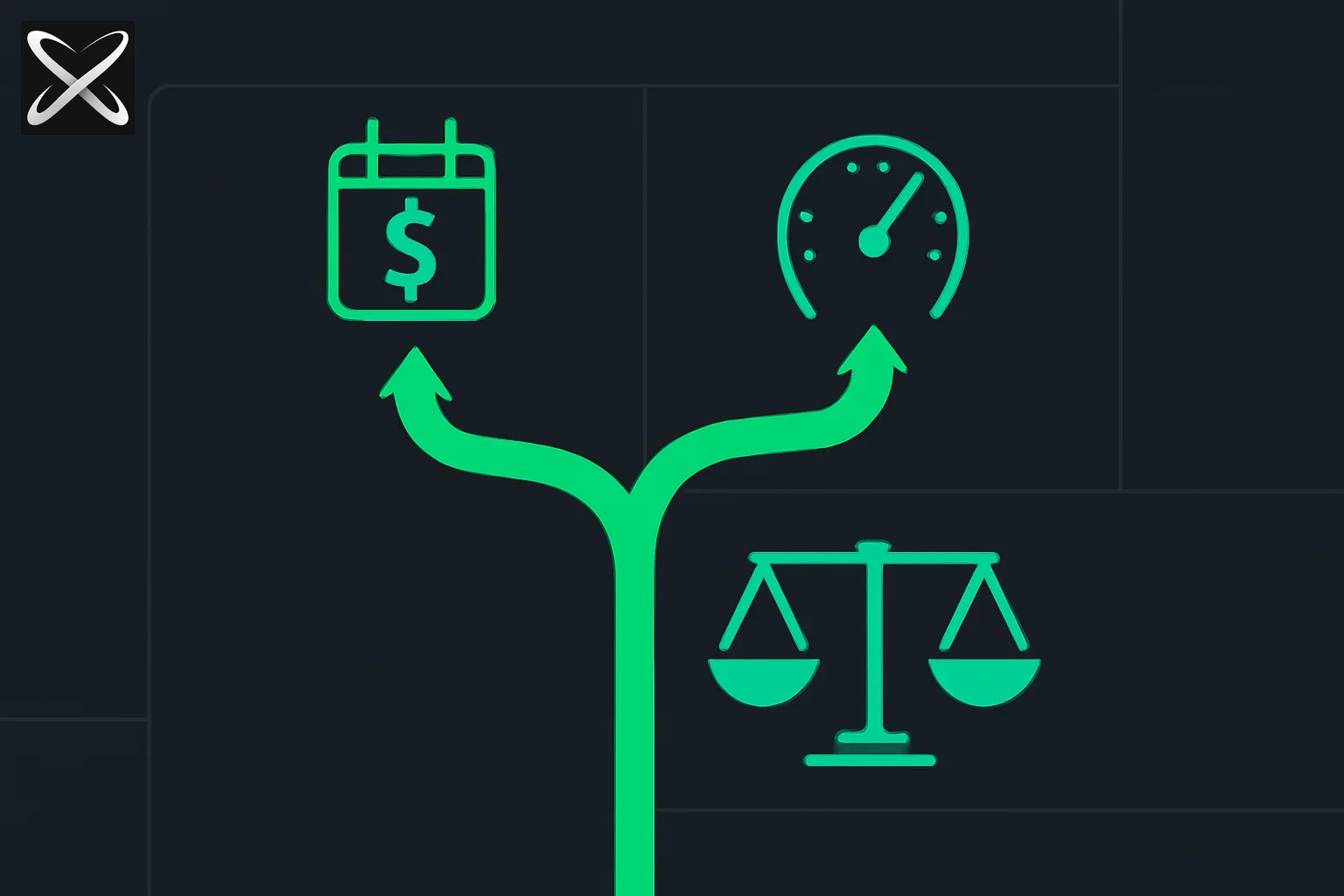 Claude Code pricing diagram: a fork between a subscription calendar path and a pay-per-token meter path converging on a value scale
Option 1: Subscribe through claude.ai
You pay a flat monthly fee and get Claude Code (the CLI, web app, and IDE extensions) bundled in. Usage is metered against plan limits—not per token in the traditional sense, but by how intensively you use the tool.
Option 2: Bring Your Own API Key (BYOK)
Set ANTHROPIC_API_KEY in your environment before launching Claude Code. All usage bills to your Anthropic API account at standard per-token rates. No monthly fee, no usage limits imposed by Claude Code itself—just tokens.
Subscription Plans: What Each Tier Gets You
All subscription plans are available at claude.ai and include the Claude Code CLI, the claude.ai web interface, and IDE extensions for VS Code and JetBrains.
Claude Pro — $20/month
The entry-level plan. Claude Pro includes Claude Code access with usage limits calibrated for light to moderate use—roughly 1–4 hours of active coding per day depending on task complexity. The primary model is Claude Sonnet 4.6, which handles most coding tasks very well. Good for individual developers, students, and professionals who use Claude Code as one tool among several.
Claude Max (5x) — $100/month
Five times the usage limits of Pro. You also get access to Claude Opus 4.7—Anthropic's most capable model—which matters for complex refactors, multi-file reasoning, and long autonomous sessions. Designed for developers who hit Pro limits regularly and need Claude Code as their primary coding environment throughout the workday.
Claude Max (20x) — $200/month
Twenty times the Pro limits, plus the highest request priority on Anthropic's infrastructure—meaning less queuing during peak hours. Built for power users doing 8+ hour agentic sessions, small teams sharing an account, or anyone for whom a limit interruption has a real business cost.
API Key (BYOK): Pay-Per-Token Rates
When you use your own API key, Claude Code uses whichever model you configure (defaulting to Claude Sonnet 4.6). You pay standard Anthropic API rates:
| Model | Input (per 1M tokens) | Output (per 1M tokens) |
|---|---|---|
| Claude Sonnet 4.6 | $3.00 | $15.00 |
| Claude Opus 4.7 | $15.00 | $75.00 |
Prompt caching drops input costs significantly—cached tokens on Sonnet 4.6 run about $0.30/1M (a 90% discount). For sessions that re-use large system prompts or repository context, caching changes the math dramatically.
BYOK works best for:
- Teams tracking AI spend per project or client
- CI/CD pipelines and automated code review workflows
- Developers who want full control over model selection per task
- Organizations with existing Anthropic API contracts or volume pricing
Cost Comparison: Which Plan Makes Sense at Each Usage Level
| Usage Level | Description | Best Option | Estimated Monthly Cost |
|---|---|---|---|
| Light (1–2 hrs/day) | Occasional coding help, quick questions | Claude Pro | $20/month |
| Moderate (4–6 hrs/day) | Daily driver, most coding done with Claude | Claude Pro or Max 5x | $20–$100/month |
| Heavy (8+ hrs/day) | Full-time agentic sessions, large repos | Claude Max 5x or 20x | $100–$200/month |
| Team / CI pipelines | Multiple users or automated runs | BYOK (API key) | Usage-based; typically $50–$300+/month |
| Sporadic power use | Occasional intense sessions, no daily habit | BYOK (API key) | Pay only for what you use |
For reference: a heavy interactive session using Claude Sonnet 4.6 might consume 100,000–300,000 tokens per hour across input and output. At $3/$15 per million, that is roughly $0.90–$2.10 per hour before caching. An 8-hour day of heavy Sonnet use without caching could run $7–$17. Opus sessions cost 5x more per token.
What Counts Toward Subscription Usage Limits
Anthropic does not publish exact token budgets per plan tier—limits are enforced holistically and can vary by demand. In practice, the following activities consume usage faster:
- Long context sessions: loading large repositories or files into context
- Heavy tool use: file edits, bash commands, and search loops all generate output tokens
- Extended autonomous runs: multi-step agentic tasks with many back-and-forth model turns
- Opus model usage: higher-capability requests draw more against limits on Max plans
The /usage command inside Claude Code shows your current session consumption. If you regularly hit limits before your workday ends, that is a reliable signal to move up a tier—or switch to BYOK if you want granular control.
5 Tips to Reduce Your API Key Bill
If you are on BYOK billing, these five habits will meaningfully cut your costs:
1. Use --model claude-sonnet-4-6 for lighter tasks
Sonnet 4.6 is 5x cheaper than Opus 4.7 per token and handles the vast majority of everyday coding tasks—refactoring, bug fixes, writing tests, explaining code—extremely well. Reserve Opus for genuinely complex reasoning tasks.
2. Use /clear to reset context regularly
Claude Code carries conversation history into each new request. Long histories mean large input payloads on every turn. Clearing context between distinct tasks prevents you from paying to re-send irrelevant previous conversation dozens of times.
3. Use --print mode for scripted one-shot tasks
If you are running Claude Code in a script or pipeline where you do not need an interactive session, --print mode executes a single prompt and exits. No session overhead, no accumulated context.
4. Enable prompt caching for repetitive large-context tasks
If you consistently load the same large files or system prompts, prompt caching cuts input costs by up to 90%. This is especially powerful for repository-wide tasks where Claude Code reads the same set of files at the start of each session.
5. Use --no-session-persistence for throw-away sessions
For exploratory or one-off tasks where you do not need to resume the session later, disabling session persistence avoids storing context you will never reuse and keeps each session lean.
Hidden Costs to Watch For
The headline subscription or per-token price is not the whole story. A few costs catch developers off guard after the first billing cycle:
- Retry and revision overhead. A single "fix this bug" prompt that goes sideways can trigger several full-context reloads as Claude Code re-reads files to re-orient itself. On BYOK billing, each of those reloads is a fresh input-token charge unless caching is active.
- Idle session drift on Max plans. Usage limits reset on a rolling window, not a hard monthly quota, so leaving long sessions open with large loaded context can burn through a day's allowance faster than the hours you actually spent typing.
- Multi-model routing. If your workflow defaults to Opus for tasks Sonnet could handle just as well, you are paying a 5x per-token premium for no accuracy gain. The
/modelcommand exists specifically so you can downgrade per-task instead of per-session. - Forgotten CI runs. BYOK pipelines that run Claude Code on every pull request add up fast—100 PRs a month at even $0.50 each is $50/month you might not have budgeted separately from your subscription spend.
None of these are large individually, but they explain why some developers report BYOK bills 2–3x higher than their back-of-envelope estimate. Track actual spend with /usage (subscription) or your Anthropic Console billing dashboard (API key) for at least two weeks before committing to a tier.
Team and Enterprise Pricing
If your team needs shared usage, SSO, audit logs, or volume pricing, Anthropic offers team and enterprise tiers. Pricing is negotiated directly with Anthropic's sales team and typically involves:
- Volume discounts on API token rates
- Centralized billing across multiple seats
- Higher rate limits and priority infrastructure
- Compliance and data handling agreements
Contact Anthropic sales for a quote. For teams already deep in Anthropic's API, a managed enterprise API contract will almost always beat per-seat subscription pricing at scale.
Is Claude Code Worth It? A Simple ROI Calculation
Developer time is the most useful benchmark here.
If you are billing or earning at $50/hour and Claude Code saves you 1 hour per day on average—through faster debugging, quicker refactors, less context-switching—then:
- Claude Pro ($20/month) pays for itself in 24 minutes of saved work per month (less than half a workday)
- Claude Max 5x ($100/month) pays for itself in 2 hours of saved work per month
- Claude Max 20x ($200/month) pays for itself in 4 hours of saved work per month
Even at a conservative estimate of 15 minutes saved per day, Pro is deeply in positive ROI territory within the first week. The question is not whether it is worth the base cost—it almost certainly is for any developer doing more than casual use. The real question is which tier matches your actual usage volume.
Claude Code vs. Competitors: Quick Pricing Comparison
| Tool | Price | Model Access | Agentic Capability |
|---|---|---|---|
| GitHub Copilot | $10–$19/month | GPT-4o, Claude | Autocomplete + chat; limited agentic |
| Cursor | $20/month | Multiple including Claude | Strong in-editor agentic with Composer |
| Codeium / Windsurf | Free tier + paid | Multiple | Free tier available; strong autocomplete |
| Claude Code (Pro) | $20/month | Sonnet 4.6 primarily | Full terminal-based agentic, long context |
| Claude Code (Max 5x) | $100/month | Sonnet + Opus 4.7 | Same, higher limits + best model |
| Claude Code (Max 20x) | $200/month | Sonnet + Opus 4.7 | Same, highest limits + priority |
The key differentiator for Claude Code is its terminal-native, autonomous workflow. Cursor is the closest competitor in agentic capability and matches the Pro price point exactly. The decision often comes down to whether you prefer working inside the editor (Cursor's strength) or working from the terminal with full repository and shell access (Claude Code's native mode).
The Bottom Line
Here is how to decide quickly:
- Try Claude Pro first ($20/month). If you consistently hit limits within a workday, move to Max 5x.
- Use BYOK if you are running pipelines, tracking costs per project, or have sporadic but intense usage patterns where a monthly subscription would mostly go unused.
- Go Max 20x only if you are doing full-time autonomous agentic sessions and interruptions have real business cost.
- Contact Anthropic sales if you are scaling across a team of 5 or more developers—volume API pricing will likely be cheaper than per-seat subscriptions at that scale.
Note: Anthropic adjusts pricing and plan features regularly. Always verify current rates at anthropic.com/pricing before making a purchase decision. The numbers in this guide reflect June 2026 pricing.
Update — July 14, 2026: Claude INR pricing in India — Pro ₹2,000/mo annual, Max from ₹11,999; GST included, no UPI yet.
Update — July 5, 2026: Since this guide was written, Anthropic permanently doubled Claude Code's 5-hour usage limits and removed peak-hour throttling for Pro and Max (May 6, 2026). For the full dated history of every limit change — including the weekly caps and the March 2026 off-peak promo — see Claude Usage Limits in 2026: Every Change Explained.
Read next: Claude Code Model vs Effort: Knowing More vs Trying Harder (July 2026) · Claude Fable 5 Mythos 5 Launch Guide · When Claude Code Wobbled on Pro: April 2026 Pricing Test · Claude Managed Agents Guide