



Update — August 14, 2026: The deal has officially closed — Cursor confirmed it joined the SpaceXAI/Grok team, and developer reaction split between congratulations and worries over Claude model access and Cursor branding.
Update — July 17, 2026: Lee Robinson AI Engineer recap — how Cursor trains models on Colossus, recursive improvement loops, and the path to joint SpaceXAI releases like Grok 4.5.
Update — July 8, 2026: The first joint SpaceXAI + Cursor model — Grok 4.5 — goes public July 9. Built on 1.5T V9 with Cursor supplemental training data.
Update — June 30, 2026: Ben Lang's "Big day for Cursor" was Cursor for iOS — cloud agents, remote control, and PR merges from your phone. Not the Colossus model (still pending). Full breakdown: Cursor for iOS launch (June 29).
The Filing Is Real
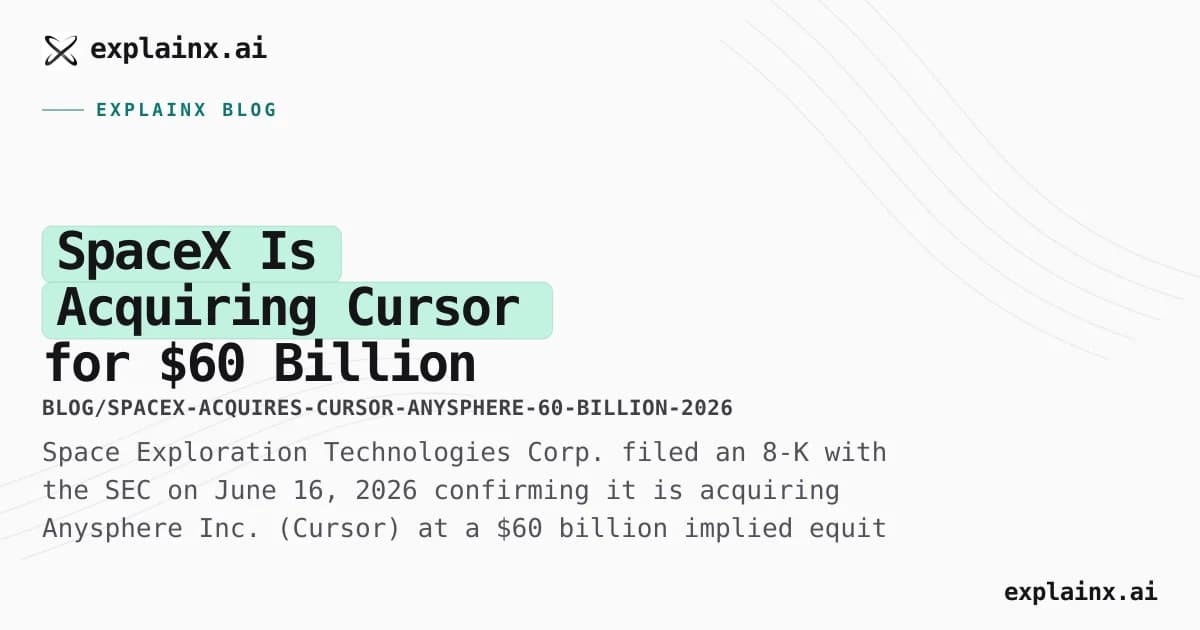
On June 16, 2026, Space Exploration Technologies Corp. filed a Form 8-K — a "Current Report" disclosing a material definitive agreement — with the United States Securities and Exchange Commission.
The filing is signed by Bret Johnsen, Chief Financial Officer of SpaceX, dated June 16, 2026. It discloses that SpaceX, via a wholly owned subsidiary called X67 Inc. ("Merger Sub"), has entered into an Agreement and Plan of Merger with Anysphere, Inc. — the company behind Cursor.
The headline number: an implied equity value of $60.0 billion.
This is not a rumour, a leak, or a term sheet. It is a legally required public disclosure filed with the SEC. The acquisition of Cursor by SpaceX is happening.
What the 8-K Actually Says
Under Item 1.01 – Entry into a Material Definitive Agreement, the filing states:
"On June 16, 2026, Space Exploration Technologies Corp. (the 'Company'), X67 Inc., a wholly owned subsidiary of the Company ('Merger Sub'), and Anysphere, Inc. ('Cursor') entered into an Agreement and Plan of Merger (the 'Merger Agreement'), pursuant to which Merger Sub will merge with and into Cursor, with Cursor surviving the merger as a wholly owned subsidiary of the Company (the 'Merger')."
The transaction structure is a reverse triangular merger: SpaceX creates a subsidiary (X67 Inc.), that subsidiary merges into Cursor, and Cursor emerges as the surviving entity — now wholly owned by SpaceX.
The consideration:
"At the effective time of the Merger, each share of Cursor's common stock and each share of Cursor's preferred stock outstanding immediately prior to the Effective Time of the Merger will be automatically converted into the right to receive shares of the Company's Class A common stock based on an implied equity value of Cursor of $60.0 billion and the price of the Company's Class A common stock equal to the volume-weighted average closing price thereof over the seven consecutive trading days immediately preceding the closing of the Merger."
Translation: no cash. Every Cursor shareholder — common and preferred — receives SpaceX Class A stock (ticker: SPCX, traded on Nasdaq). The conversion ratio will be set using SpaceX's VWAP over the seven trading days before close.
Expected close:
"The Company currently expects the Merger to close during the third quarter of 2026."
Subject to regulatory approval and standard closing conditions.
$60 Billion: Putting the Number in Context
At $60 billion, this is the largest acquisition of an AI software company in history — eclipsing Microsoft's $13 billion OpenAI investment and any other single deal in the generative AI era.
For context on how Cursor got here:
- 2022: Anysphere founded
- 2024: Cursor launches its AI-native IDE, gaining rapid adoption among professional developers
- Early 2026: Cursor reaches multi-million user scale, displacing GitHub Copilot as the dominant AI coding companion for many teams
- June 16, 2026: $60B acquisition announced
The valuation reflects both the product's current market position and SpaceX's view of where AI-assisted development is heading. For a company with no public revenue disclosures, $60B signals that SpaceX is paying for market share, talent, and trajectory — not trailing metrics.
Why SpaceX
This is the question the 8-K doesn't answer. An SEC filing discloses what happened, not why. But the strategic logic isn't hard to reconstruct:
1. SpaceX already lives at the intersection of software and hardware scale. Starship, Starlink, and the Colossus compute cluster represent some of the most complex software-dependent engineering programs on the planet. An AI-native coding tool — used by the developers building those systems — is not a tangential acquisition.
2. The Anthropic-SpaceX relationship. In early 2026, Anthropic and SpaceX announced that Anthropic's training workloads would run on SpaceX's Colossus 1 supercomputer, effectively doubling Claude's available compute. That partnership already put the two companies in close operational proximity. Cursor's deep integration with Claude (it is one of the highest-volume consumers of Anthropic's API) makes the acquisition a natural extension of that relationship.
3. The AI coding market is consolidating fast. GitHub Copilot, Claude Code, Windsurf, Devin, and a sprawling ecosystem of AI coding plugins are all competing for developer mindshare. A $60B bet on Cursor is SpaceX staking a claim in that consolidation while Cursor still has pricing power.
4. Elon Musk's history with developer tools. Musk has long argued that AI will dramatically accelerate software development timelines. Owning the tool that sits at the centre of that acceleration — used by millions of developers, deeply integrated with the best AI models — fits his pattern of vertical integration.
Cursor also acquired Continue — the same week
Alongside the SpaceX deal, Cursor quietly completed a second acquisition: Continue, the open-source VS Code / JetBrains extension that was one of the most widely used self-hosted GitHub Copilot alternatives.
Continue had 34,300 GitHub stars, 4,800 forks, and had raised approximately $5 million as a Y Combinator alum. It was model-agnostic, free, and let developers run any LLM locally — the anti-Copilot for developers who did not want their code sent to Microsoft's servers.
The deal is an acqui-hire. Cursor did not announce it; Continue's homepage updated with a brief notice stating the team was joining Cursor. Existing users had until July 15 to export their data, after which it would be deleted. Recurring billing was disabled immediately.
The handoff to the community was deliberate: the Continue team pushed a final v2.0.0 release before closing — removing telemetry, cleaning the codebase — under its Apache 2.0 license so anyone can fork it. The product is shutting down; the code is not.
This is Cursor's third known acquisition in the AI coding space, after Supermaven (AI autocomplete) and Graphite (code review). The pattern is clear: consolidate the teams and technology that were eating into Cursor's market before SpaceX's ownership closes. Continue's engineers and the model-agnostic architecture they built now sit inside Cursor — and by extension, inside SpaceX.
For the open-source developer community that relied on Continue specifically because it was not a commercial product, the shutdown is a meaningful loss. The Apache 2.0 fork remains; a maintained successor has not yet emerged at scale.
What This Means for Cursor Users
The 8-K offers no product or operational details beyond the merger mechanics. A few things worth watching:
Model integrations. Cursor's power comes from its deep integration with frontier AI models, primarily Claude and GPT-4o. Under SpaceX ownership, those integrations could be maintained, deepened (via the Anthropic-SpaceX compute partnership), or complicated (if SpaceX develops its own model preferences). The leaked Cursor system prompt already gives a window into how tightly Cursor's behavior is tuned at the model layer — that tuning will now sit under SpaceX's engineering roadmap.
Pricing. All-stock deals this large typically require significant regulatory review. Until the Q3 2026 close, Cursor operates as an independent company. Post-close pricing changes would be SpaceX's call.
Competition with Claude Code. Cursor and Claude Code have been the two dominant professional AI coding tools in 2026. Claude Code is Anthropic's native CLI product; Cursor is the IDE that runs on top of multiple models including Claude. SpaceX owning Cursor while Anthropic's compute runs on SpaceX infrastructure creates a genuinely unusual competitive dynamic — rivals at the product layer, partners at the infrastructure layer.
The Bigger Picture
SpaceX acquiring Cursor at $60B is the clearest signal yet that the AI coding market is not a feature — it is an industry. When the company that launches rockets and operates the world's largest satellite constellation concludes that owning an AI code editor is worth $60 billion, the category has achieved a kind of legitimacy that no amount of developer enthusiasm could confer.
For the broader AI industry, the acquisition continues a week of extraordinary news: Anthropic's engineers in Washington fighting to restore Fable 5, the Claude Agent SDK billing rollback, loop engineering going mainstream, and now the most expensive AI software deal ever filed with the SEC.
The developer tools market just got a new owner. The implications will take months to fully understand.
Related Reading
- Update — August 29, 2026: OpenAI says it will stop serving its models through Cursor on November 12, 2026, invoking a change-of-control clause after the acquisition — with a practitioner migration plan for GPT-5.x and Codex users.
- Update — August 14, 2026: The acquisition officially closed — Cursor now sits inside the SpaceXAI/Grok team.
- Update — July 29, 2026: Cursor launched Start for India — ₹649/mo with UPI, Grok 4.5, Composer, and cloud agents (no third-party model pool).
- Update — July 23, 2026: Cursor launched Router — automatic per-request model selection, 60% lower cost claimed, live on Teams/Enterprise.
- Musk vs Altman scammer feud — space datacenter vs OpenAI (July 2026)
- Grok 4.5 Public Launch — first joint SpaceXAI + Cursor model (July 9, 2026)
- Cursor Big Day — Ben Lang teases Composer 3 and SpaceX (June 29, 2026)
- Anthropic Secures SpaceX Colossus 1 Supercomputer — Rate Limits Doubled
- Claude Code vs Cursor vs GitHub Copilot: The Full Comparison
- 140K Stars: Every Major AI Coding Tool's Leaked System Prompt
- The AI Coding Plugins Ecosystem: 185+ Tools
- Big Tech Copies Startups: The $100B Beta Testing Era