



Muse Wonder Full leads this five-model field on long-horizon coding, scoring 79.0 on DeepSWE 1.1 and 57.5 on SWE-Marathon in Meta's own table, but it is not the best at everything and it is not cheap. Claude Opus 5.5 still wins ProgramBench and the Artificial Analysis Index, GPT-6.1 Sol is far cheaper per task, and Grok 4.7 has the lowest price per token. This post lines up Muse Wonder, GPT-6.1 Sol, Claude Opus 5.5, GPT-6 Astra and Grok 4.7 so you can pick by workload.
One limit up front: no neutral party has run all five in the same harness. Every number below comes from a lab's own table or from Artificial Analysis, and we say which where it matters.
TL;DR: the five models at a glance
| Model | Input / output per 1M tokens | Context | Best at | Weak spot |
|---|---|---|---|---|
| Muse Wonder (Full is subscription only) | $4 / $20 | 1M | Long-horizon coding, memory, legal and automation agents | Price per task, factual knowledge, ProgramBench |
| GPT-6.1 Sol | $2 / $10 | 500k default, 1M max | Cost efficiency, near-Astra agent work | Not a flagship on raw scores |
| Claude Opus 5.5 | $4 / $20 | n/a in sources | ProgramBench, Terminal-Bench, computer use, AA Index | Higher sticker than Sol and Grok |
| GPT-6 Astra | $10 / $50 | n/a in sources | GDP.pdf, HealthBench, science tasks | Price: five times Sol |
| Grok 4.7 | $2 / $6 | n/a in sources | Cheapest tokens, EEBench, Harvey Legal | Terminal-Bench 4.0 (38.0%) |
Prices are list rates as reported in each launch post and may change. Wonder Full has no public per-token price; it comes with Muse Code Power ($50/month) and Maximum ($200/month) plans.
Benchmarks: Muse Wonder against Opus 5.5 and Astra
Meta's launch table is the only one that puts three of our five models side by side, so start there. Scores are Meta's, at maximum effort.
| Benchmark | Wonder Full | Wonder | Opus 5.5 | GPT-6 Astra |
|---|---|---|---|---|
| DeepSWE 1.1 (long-horizon coding) | 79.0 | 78.8 | 74.2 | 74.1 |
| SWE-Marathon (ultra-long horizon) | 57.5 (xhigh) | 53.1 | 46.3 | 42.5 |
| Terminal-Bench 4.0-AA | 57.1 | 52.0 | 59.6 | 59.1 |
| ProgramBench | 59.0 | 50.0 | 70.5 | 52.5 |
| Harvey LAB-AA (legal agents) | 13.1 | 10.0 | 4.2 | 8.6 |
| AutomationBench-AA | 45.4 | 39.1 | 41.2 | 41.6 |
| MemoryBench | 85.5 | 85.6 | 81.5 | 81.4 |
| OSWorld V2.1 (partial) | 78.4 | 72.6 | 81.8 | 75.8 |
| HealthBench Pro | 62.3 | 60.5 | 65.6 | 65.3 |
| GDP.pdf | 33.2 | 30.8 | 30.6 | 34.2 |
| Artificial Analysis Index | 56 | 52 | 58 | 53 |
The pattern is clear. Wonder leads where tasks run for hours (DeepSWE, SWE-Marathon), where memory matters (MemoryBench) and on Meta-picked agent suites. Opus 5.5 leads where a single sharp from-scratch result counts (ProgramBench by 11.5 points) and on computer use and health queries. Astra only wins GDP.pdf. For the full 14-row table, including Fable 5.1, see our Muse Wonder launch post.
A caution on Terminal-Bench: Anthropic reported 66.4% for Opus 5.5 on Terminal-Bench 4.0 and 57.9% for Astra at its own settings, while Meta's table lists 59.6 and 59.1 on "Terminal-Bench 4.0-AA". Different harnesses and effort settings give different numbers, so only compare within one table.
Where GPT-6.1 Sol and Grok 4.7 fit
Neither model appears in Meta's table, so the comparison has to go through other sources.
GPT-6.1 Sol shipped on September 29 at $2 input and $10 output per million tokens, with $0.10 cached input. OpenAI calls it near-Astra on agentic coding, computer use and professional work at one-fifth of Astra's list price. Artificial Analysis puts it one point below Astra on its Intelligence Index, and measures cost per Index task at $0.72 against $3.26 for Astra, roughly 78% cheaper. Our GPT-6.1 Sol vs Astra cost breakdown has the math. Since Astra scores 53 on the Index in Meta's table, Sol is plausibly near 52, which is level with plain Muse Wonder (52) at a fraction of the cost per task.
Grok 4.7 launched on September 21 at $2 input and $6 output. SpaceXAI's table shows it behind Fable 5.1 on Terminal-Bench 4.0 (38.0% vs 57.9%) and CursorBench, but ahead on EEBench (64.0%) and Harvey Legal Agent Benchmark (19.6%). On Harvey's legal benchmark, Grok's 19.6 is not directly comparable to Wonder Full's 13.1 in Meta's table, because the two labs used different harnesses and variants. Our Grok 4.7 vs Opus 5.5 vs GPT-6 Sol comparison covers the one overlapping benchmark in more depth.
Price per token versus cost per task
Token price is only half the picture, because models differ in how many tokens they burn.
| Model | List price (in/out) | Reported cost per task |
|---|---|---|
| Grok 4.7 | $2 / $6 | Viral test reported heavy token burn on a Three.js task |
| GPT-6.1 Sol | $2 / $10 | $0.72 per AA Index task (max effort) |
| Claude Opus 5.5 | $4 / $20 | Anthropic says about 20% of Astra's cost on FrontierCode |
| Muse Wonder | $4 / $20 | About $4.52 per AA Index task, per The Decoder |
| GPT-6 Astra | $10 / $50 | $3.26 per AA Index task (max effort) |
Muse Wonder has the same list price as Opus 5.5, but The Decoder reports roughly $4.52 per Index task, higher than Astra's $3.26 and more than six times Sol's $0.72. These come from different write-ups and we have not reproduced them, so treat the table as directional. The takeaway: Wonder buys capability on long tasks, and it spends tokens to do it. If you run high-volume agents, the cached-input rate and your own cost per completed task matter more than the headline price.
The lava-lamp test: fun, but not a benchmark
After launch, a side-by-side circulated on X giving the same lava-lamp prompt to GPT-6 Astra, Claude Opus 5.5, GPT-6.1 Sol and Muse Wonder. The labels on the image show cost and time for each run.
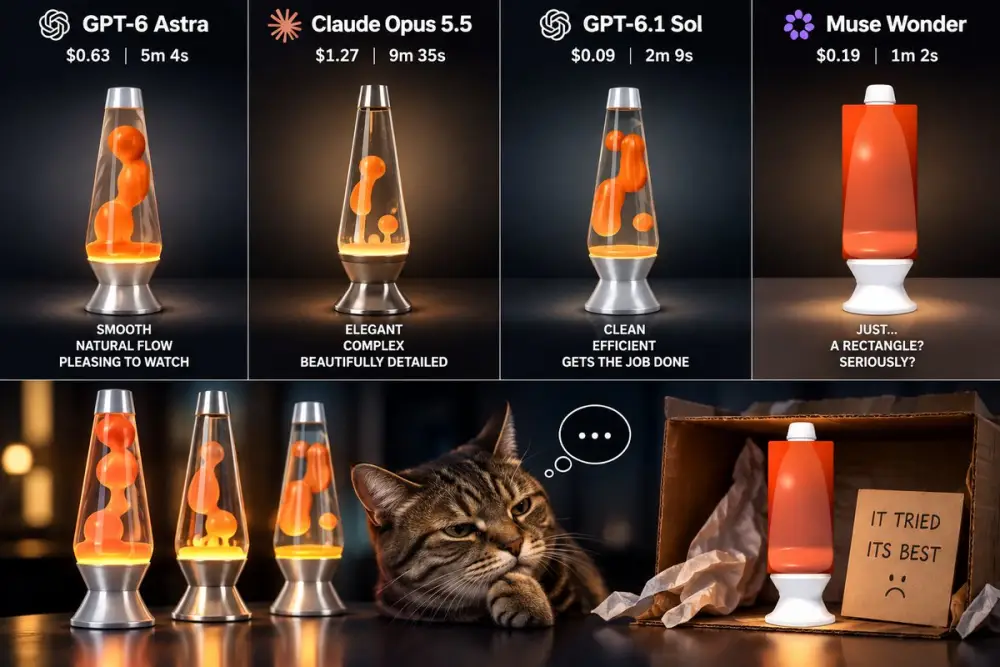 Side-by-side lava lamp outputs from GPT-6 Astra ($0.63, 5m 4s), Claude Opus 5.5 ($1.27, 9m 35s), GPT-6.1 Sol ($0.09, 2m 9s) and Muse Wonder ($0.19, 1m 2s), where Wonder produced a flat orange rectangle
A community test from X, not an official benchmark. The poster's cost and time labels are shown as posted; we have not re-run them.
What it shows:
- GPT-6 Astra ($0.63, 5m 4s) produced a smooth, natural-looking lamp.
- Claude Opus 5.5 ($1.27, 9m 35s) produced the most detailed one, and cost the most.
- GPT-6.1 Sol ($0.09, 2m 9s) produced a clean lamp for a fraction of the price, which matches its efficiency pitch.
- Muse Wonder ($0.19, 1m 2s) finished fastest but returned a flat rectangle with no lamp structure.
One prompt on one day tells you little about a model, and it is the sort of from-scratch visual task where Wonder's ProgramBench score (59.0 against Opus 5.5's 70.5) hints at a real gap. Still, it is a useful reminder that Meta's best rows are long-horizon agent work, not one-shot front-end generation. Run your own prompt before you decide.
Which model for which job
| If you need... | Pick | Why |
|---|---|---|
| Long repo-wide refactors and multi-hour agent runs | Muse Wonder Full or Opus 5.5 | Wonder leads DeepSWE and SWE-Marathon; Opus leads Terminal-Bench and ProgramBench |
| The lowest bill for a coding agent | GPT-6.1 Sol | $2/$10 and about $0.72 per Index task |
| Cheapest possible tokens | Grok 4.7 | $2/$6, but check token burn and Terminal-Bench gap |
| From-scratch programming and polish | Claude Opus 5.5 | ProgramBench 70.5, AA Index 58 |
| Legal or business-workflow agents | Muse Wonder Full or Grok 4.7 | Both lead Harvey-style benchmarks in their own tables |
| Hardest reasoning where cost is secondary | GPT-6 Astra | Still OpenAI's flagship, though Sol is near it for one-fifth of the price |
| Persistent memory across long sessions | Muse Wonder | MemoryBench 85.5 against 81.5 for Opus 5.5 |
What is claimed and what is verified
- Meta-run: the Wonder, Opus 5.5 and Astra scores in the table above come from Meta's launch table, run at maximum effort. They are not an independent re-run.
- Artificial Analysis: the Index scores and Sol/Astra cost per task are third-party, but we did not reproduce them. The Wonder cost per task is from The Decoder's coverage.
- Missing: no table includes Sol 6.1 and Wonder together, and no single run covers Grok 4.7 next to Wonder. Where we infer, we say so.
- Moving targets: all five vendors are shipping updates weekly, so rerun on your own tasks.
A simple way to decide
Pick ten tasks from your backlog: a bug fix, a multi-file refactor, a test suite and one from-scratch build. Run them on two finalists, record pass rate, tokens and wall-clock time, and compare cost per completed task. For most teams the answer will be a split: a cheaper model like Sol for routine loops, and Wonder Full or Opus 5.5 for the hard long-running jobs.
Related reading
- Muse Wonder launch, pricing and full benchmarks
- GPT-6.1 Sol launch, pricing and benchmarks
- GPT-6.1 Sol vs Astra cost efficiency
- Claude Opus 5.5 launch and benchmarks
- GPT-6 Astra launch and pricing
- Grok 4.7 launch and pricing
- Grok 4.7 vs Opus 5.5 vs GPT-6 Sol
- Gemini 4 Argon vs Opus 5.5 vs Grok 4.7 vs GPT-6 Astra
Prices and scores are as reported on October 13, 2026 and may change; check each vendor's page before buying.