



The digest headline says OpenAI GPT-6.1 Sol cuts Astra cost by 81% and leads the efficiency frontier. That number is inflated if you read it as a new list-price cut — and it is slightly high even as cost-per-task savings.
Here is the verified math, in the first paragraph, with the source. Artificial Analysis (September 29, 2026) measured cost per Intelligence Index task at max effort: GPT-6.1 Sol $0.72 versus GPT-6 Astra $3.26. That is $0.72 ÷ $3.26 ≈ 22% of Astra's cost — about 78% cheaper, which AA phrases as "less than one quarter of the Cost per Task." OpenAI's list card is still $2/$10 vs Astra's $10/$50 (exactly one-fifth, an 80% sticker discount), documented on the OpenAI GPT-6.1 Sol model page and in explainx.ai's DevDay launch file. The "81%" line is a rounded mash of those two stories. This post is only the efficiency claim — not a second launch recap.
TL;DR: what the 81% claim actually means
| Question | Direct answer |
|---|---|
| Is 81% an OpenAI list cut? | No. List is still $2/$10 vs Astra $10/$50 (80% off sticker / 1/5 price) |
| Verified AA cost/task? | $0.72 (6.1 Sol max) vs $3.26 (Astra max) on Intelligence Index |
| Real savings vs Astra? | ~78% cheaper per Index task (22% of Astra's cost) |
| AA's own wording? | "less than one quarter of the Cost per Task" |
| Vs GPT-6 Sol cost/task? | $0.72 vs $1.05 — 31% less per Index task |
| Vs GPT-5.6 Sol? | $0.72 vs $1.99 — 64% less per Index task |
| Intelligence gap? | 1 point below Astra on AA Intelligence Index (near-parity composite) |
| Output tokens vs Sol? | ~10–30% more than GPT-6 Sol across effort levels |
| Pareto claim? | AA: all 6.1 Sol effort levels push the cost-efficiency frontier |
| Primary source URL | artificialanalysis.ai GPT-6.1 Sol article |
Three different "81%" stories (only one is roughly true)
Builders keep collapsing three measurements into one viral percentage. Keep them separate or you will mis-price a migration.
1. List price (OpenAI rate card)
| Model | Input / 1M | Output / 1M | Cached input / 1M |
|---|---|---|---|
| GPT-6.1 Sol | $2.00 | $10.00 | $0.10 (95% off $2) |
| GPT-6 Astra | $10.00 | $50.00 | $1.00 (typical AA table) |
Sticker math: $2/$10 is exactly 20% of $10/$50 on both legs — an 80% list discount, which OpenAI and the DevDay launch post already called "one-fifth." That is not a new October price cut. GPT-6 Sol hit $2/$10 on September 22 (Sol/Luna pricing); 6.1 kept the sticker and raised capability.
If someone says "81% cheaper tokens," they are rounding 80% badly. Prefer "one-fifth the list rates" — it is exact.
2. Cost per Intelligence Index task (Artificial Analysis)
This is the number the efficiency-frontier headlines should cite.
At max effort, AA reports:
- GPT-6.1 Sol: $0.72 per Index task
- GPT-6 Astra: $3.26 per Index task
- Ratio: ≈22% of Astra → savings ≈78%
- AA headline language: "less than one quarter"
That measurement is not "output-token list price alone." AA's methodology weights input, cache hit, cache write, reasoning, and answer tokens across the Index evaluations, then averages cost per task. It is a harness bill, not a sticker screenshot.
So: the viral 81% is closest to this ~78% cost-per-task gap — and still slightly inflated. Say ~$0.72 vs $3.26 or "about 78% cheaper per Index task" and link AA. Do not invent 81%.
3. Token efficiency vs GPT-6 Sol (same sticker, different burn)
AA also reports that 6.1 Sol uses ~10–30% more output tokens than GPT-6 Sol across effort levels on the Index. That is the opposite of a pure "fewer tokens" story. The efficiency win versus Sol is mostly quality per dollar: Index score up 4 points, cost per task down 31% ($0.72 vs $1.05) even with wordier traces. Low and medium effort settings are still Pareto optimal for token efficiency on AA's chart because the intelligence gain outruns the extra tokens.
What "leads the efficiency frontier" actually means
Artificial Analysis's claim is specific: "All effort levels of GPT-6.1 Sol push out the cost efficiency frontier: for a given level of intelligence, there is no cheaper model."
That is a Pareto statement on their Intelligence Index vs cost-per-task plane — not a claim that 6.1 Sol wins every vendor chart, every Claude comparison, or your private SWE suite.
Companion AA points that matter for builders:
- Near-Astra intelligence: 6.1 Sol lands 1 point below Astra on the Index after a +4 jump from GPT-6 Sol.
- Coding Agent Index: 6.1 Sol (xhigh) scores 1 point above Astra at less than 15% of Astra's cost per task on that coding axis — a stronger efficiency story than the overall Index ratio, and a different chart.
- vs GPT-5.6 Sol: 64% less cost per Index task ($0.72 vs $1.99).
If you need the Index methodology backdrop (held-out weighting, v4.2 changes), use explainx.ai's Artificial Analysis Intelligence Index v4.2 and how to read AI benchmarks. Index versions move; treat $0.72 / $3.26 as the September 29 AA snapshot, not a forever constant.
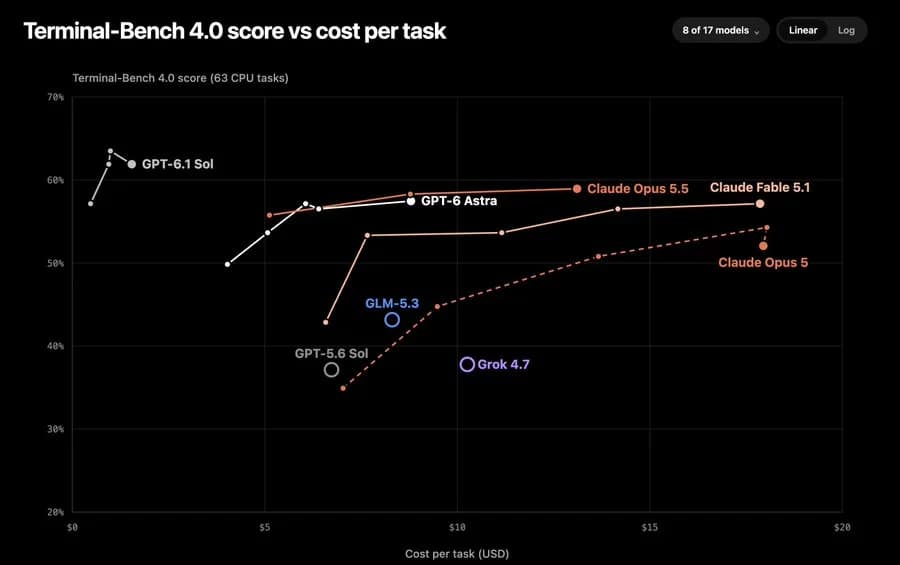
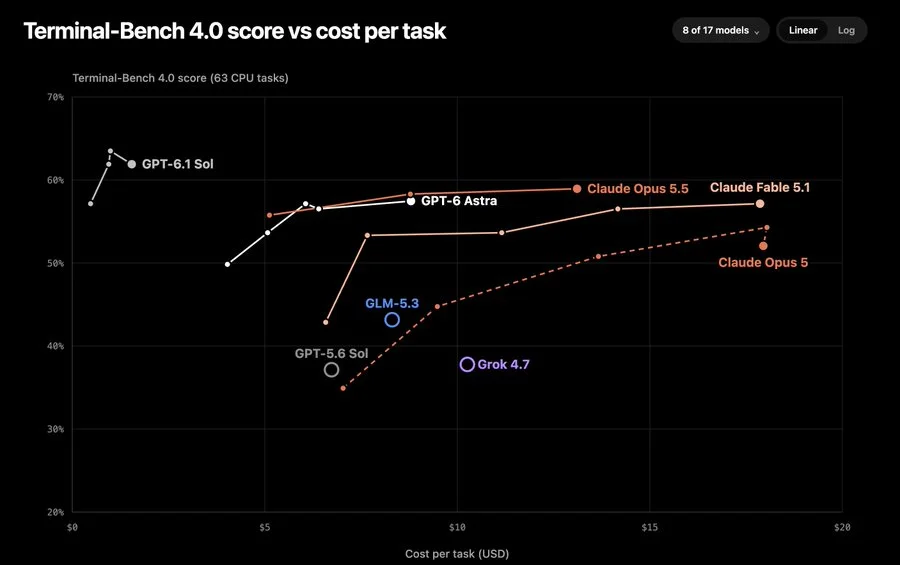 Scatter chart of Terminal-Bench 4.0 score versus estimated cost per task: GPT-6.1 Sol sits far left at low cost while GPT-6 Astra and other flagships sit farther right
Community / third-party Terminal-Bench 4.0 score-vs-cost scatter that circulated after DevDay. Useful as a visual of the same "cheap side of the cloud" story AA tells with Index dollars — not a substitute for the $0.72 / $3.26 AA figures above.
OpenAI's own price card (still the invoice)
For procurement, start with OpenAI's documented rates for gpt-6.1-sol (developers.openai.com model card):
| Line | Standard (≤272K input) | Notes |
|---|---|---|
| Input | $2.00 / 1M | Same as GPT-6 Sol list |
| Cached input | $0.10 / 1M | 95% cache-read discount (AA notes Sol was 90%) |
| Cache writes | $2.50 / 1M | 1.25× uncached input |
| Output | $10.00 / 1M | Same as GPT-6 Sol list |
| Long prompts | 2× input/cache, 1.5× output for the whole request above 272K input | Breakpoint pricing |
| Fast / Batch / Flex | Fast 2× standard; Batch & Flex 50% lower | Confirm on OpenAI pricing before modeling |
Astra's standard card remains $10 / $50. That ratio is the 80% list story. AA's $0.72 / $3.26 is the efficiency story. Quote both; never merge them into a single fake 81%.
What this means for what you build or pay
If you already run GPT-6 Sol at $2/$10: list price does not drop again. Your win is fewer failed tasks and a lower AA cost-per-solved-Index-task ($1.05 → $0.72 in AA's harness) — if your own suite tracks that direction. Budget for slightly higher output tokens (AA's 10–30%) when you forecast invoice lines.
If you currently default to Astra: A/B 6.1 Sol on the same tools and stop conditions. Keep Astra where quality still fails, where Ultrafast latency is the product, or where a customer contract names the flagship. Do not "save 81%" on a loop that then needs two retries — retries destroy cost-per-task math faster than sticker math.
If you price against Claude: Sonnet 5.5 is also $2/$10. Opus 5.5 is $4/$20. List parity with Sonnet means the tie-break is harness fit and cache hit rate, not OpenAI's efficiency-frontier slide. For the older Astra-vs-Fable cost-per-task template, see Astra vs Claude Fable 5.1.
If finance asks for a single percentage: give them a table with three rows — list ratio, AA Index $/task, your own $/passed-task — and refuse a one-line "81%."
Worked arithmetic you can paste into a sheet
Assume a million-in / million-out agent turn (no cache, standard rates, under 272K input):
| Model | Cost |
|---|---|
| GPT-6.1 Sol | $2 + $10 = $12 |
| GPT-6 Astra | $10 + $50 = $60 |
| Ratio | $12 / $60 = 20% of Astra (80% list savings) |
That is sticker math. Now suppose your Astra run finishes in one pass, but 6.1 Sol needs a second full turn of the same shape:
| Scenario | Cost |
|---|---|
| Astra, 1 pass | $60 |
| 6.1 Sol, 2 passes | $24 |
| Still cheaper? | Yes — but savings fall from 80% to 60% of Astra |
AA's Index dollars already bake in real token mixes. Your production loop may sit between sticker (80%) and AA (~78%) — or worse if retries explode. Measure cost per passed task, the same discipline the launch post recommended for migration.
Copy-paste logging fields for a week of dual-run:
model_id, effort, pass_fail, input_tokens, cached_input_tokens,
output_tokens, tool_calls, retries, usd_estimated, task_id
Estimate usd_estimated from the OpenAI card above. Compare medians only on passed tasks. That is the number that should replace any digest percentage.
What people are asking
Is the 81% figure from Epoch or OpenAI's price card?
Neither. The independent source that publishable numbers attach to is Artificial Analysis's September 29 article: $0.72 vs $3.26 per Index task, framed as less than one quarter. OpenAI's price card supports the one-fifth list story (80% sticker discount), not 81%. If Epoch publishes a matching chart later, treat it as a separate measurement — do not backfill it into this week's digests without a URL.
Did 6.1 Sol get cheaper than GPT-6 Sol on list rates?
No on input/output list ($2/$10 unchanged). Slightly yes on agentic blend if your cache-read rate is high: AA notes cache-read discount moved from 90% (Sol) to 95% (6.1 Sol), i.e. $0.10 cached input. That is a real but narrow line item.
Why does AA say 6.1 Sol is cheaper per task if it uses more output tokens?
Because score rose faster than token burn. Paying 10–30% more output tokens at the same $10/M while finishing harder Index tasks with fewer dead ends can still cut total $/task. That is efficiency frontier logic: dollars per unit of measured intelligence, not tokens for tokens' sake.
Does Coding Agent Index change the Astra decision?
On AA's Coding Agent Index vs cost plane, 6.1 Sol at xhigh is reported 1 point above Astra at under 15% of Astra's $/task. That is a stronger relative efficiency claim than the overall Index 22% ratio. It still does not retire Astra for every coding agent — it means the cheap coding default is now extremely hard to ignore. Run your Codex/Claude Code suite; do not promote xhigh vs max without checking AA's note that xhigh beat max by 3 points on that coding axis in their observation.
Should I rewrite last week's launch post as "81% cheaper"?
No. The GPT-6.1 Sol launch coverage correctly led with one-fifth list and DevDay positioning. This companion post adds the AA $/task numbers and corrects digest inflation. Update banners, don't rewrite history.
Honest limitations
- explainx.ai did not re-run Artificial Analysis's Index harness. Figures are cited from AA's public article.
- $0.72 / $3.26 is max-effort Index cost, not your ChatGPT Plus bill and not every effort knob.
- Index versions (v4.x) change weights; compare like-for-like dates when you re-quote.
- Community Terminal-Bench scatter is visual context only — not AA's dollar figures.
- Ultrafast, Batch, Flex, and long-context breakpoint multipliers can move invoices without touching the Index chart.
- No claim that 6.1 Sol is Astra on every eval — AA itself puts it 1 point below on the composite Index.
Recap
The digest 81% headline is a bad merge of two real facts: OpenAI's $2/$10 vs $10/$50 list (exactly 80% / one-fifth), and Artificial Analysis's $0.72 vs $3.26 cost per Intelligence Index task (~78% cheaper, "less than one quarter"). GPT-6.1 Sol does push AA's cost-efficiency frontier, including a Coding Agent Index point where xhigh beats Astra's score at a small fraction of Astra's $/task — while using more output tokens than GPT-6 Sol. Price your stack with sticker + $/passed-task, not a rounded viral percent.
Related reading
Primary sources: Artificial Analysis — GPT-6.1 Sol replaces GPT-6 Sol · OpenAI — GPT-6.1 Sol model docs · AA comparison: GPT-6.1 Sol vs GPT-6 Astra
Cost-per-task figures and list rates are as published around DevDay 2026 (September 29) and verified for this October 3, 2026 correction. OpenAI and Artificial Analysis can revise prices, Index versions, and charts. Re-check the linked sources before you treat a percentage as procurement truth. This is explainx.ai's efficiency correction, not an OpenAI document.