



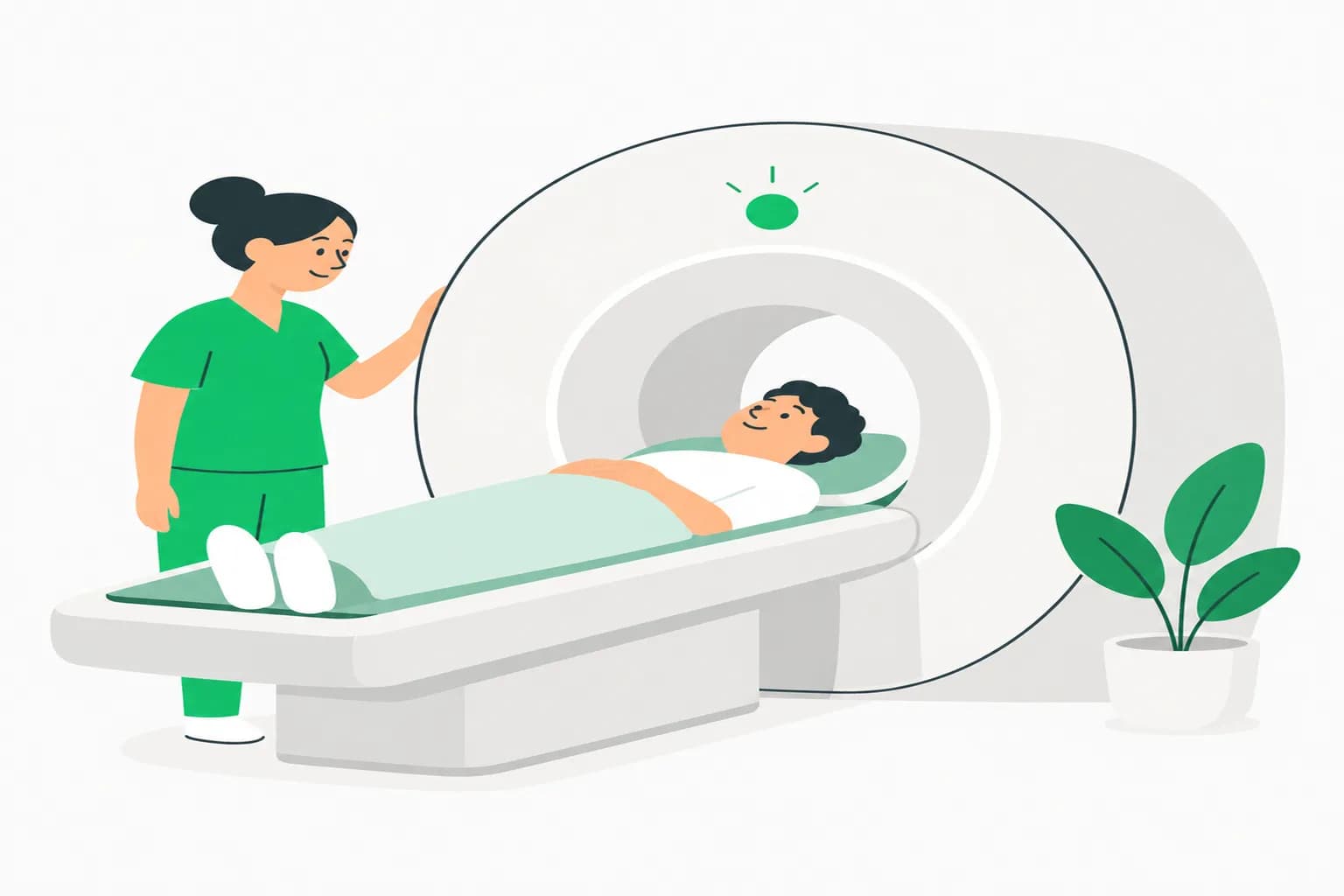
Two-thirds of the world's people lack access to diagnostic imaging such as ultrasound, according to the World Health Organization figures Google cites, and the WHO estimates more than 250,000 preventable pregnancy-related deaths each year. In a post dated October 21, 2026, Google Research describes a study aimed at one slice of that gap: an AI system that lets people without sonography training date a pregnancy from a low-cost handheld probe, with accuracy that matched expert sonographers in two very different clinics.
This article walks through the method, the numbers, and the caveats, and places the work in the stream of medical-AI research from big labs. The underlying paper, "Generalization of AI-Based Gestational Age Assessment Using Blind Sweep Ultrasonography," was published in JAMA Network Open, where the DOI listing gives a July 2026 publication date; Google's post is its explanation of the study for a general audience.
TL;DR: the results
| Measure | AI on blind sweeps | Expert sonographer biometry |
|---|---|---|
| Mean absolute error, both sites combined | 4.18 days | 4.48 days |
| Chicago (adapted model) | 4.10 days | not broken out in the post |
| Nairobi (no local tuning) | 4.27 days | not broken out in the post |
| Primary cohort | 385 participants, 16 to 36 weeks | same participants |
| Training set | 1,968 participants (North Carolina and Zambia) | n/a |
| Fine-tuning | 120 Chicago participants (about 6% of the training set) | n/a |
The model was judged non-inferior to the expert approach, according to Google. The paper's abstract, as reported by the DOI listing, gives intervals around the two errors and a significant non-inferiority test.
How does a blind sweep work, and why does it matter?
Standard obstetric ultrasound depends on a sonographer finding specific cross-sections of the fetus, for example the head and abdomen, and taking precise measurements that a formula turns into an age estimate. It is accurate when done well, hard to scale, and highly operator-dependent; training takes years.
A blind sweep replaces that with a fixed motion. A health worker glides a portable probe across the abdomen in a standardized pattern and records the video, without needing to know what they are looking at. The AI then reads the footage. Gestational age, the number of weeks since the start of pregnancy, matters because Google's clinical lead describes it as the master timeline for screening, treatment and decisions about delivery. If community health workers can capture usable sweeps, the expert bottleneck moves from the scan to reading the result, and software can handle that part.
 Stethoscope curving around a small heart, illustrating AI-assisted maternal care with blind sweep ultrasound
How was the study designed?
The earlier work validated the model on unseen patients drawn from the same retrospective cohort it learned from, which is a weaker test. This study is prospective: the system ran live on mobile devices in real clinics, with novice operators and ultrasound hardware it had not seen.
The model was originally trained on data from North Carolina and Zambia using several commercial probes (Sonosite, GE and Butterfly Networks). For the new study it was paired with a Clarius C3 handheld transabdominal probe. To adapt it, the team fine-tuned on a pilot set of 120 Chicago participants, about 6 percent of the original training set, which also extended the model's prediction range beyond 36 weeks. It was then tested in Chicago (192 participants) and Nairobi (193), with no Nairobi data used for tuning. The sites differ in when women first seek prenatal care, how many routine ultrasounds they get, and how pregnancies are usually dated, which is the point: a model that only works at the site it was built for would not help much.
The study also included multiple-gestation pregnancies, which are harder for both humans and software, and Google reports that in exploratory analysis the model did better than traditional biometry formulas for fetal weight above the 90th percentile.
What do the numbers mean?
An average error of about four days is small compared with the several-week range of the window being measured, and the fact that the AI's number was slightly lower than the expert's (4.18 versus 4.48 days) is best read as "equivalent within the margin", which is what non-inferiority means, not as "AI is better than experts." The combined figure also hides how the error behaves at the tails: for a clinician the useful question is how often the estimate is far off, and whether the model flags those cases. The Google post says the system produces confidence estimates that could reject poor-quality sweeps and convey uncertainty, but frames this as a safeguard to build into an app, not as a validated feature.
Trade press such as AuntMinnie has covered the same paper. Google's post says the model was originally trained on data from North Carolina and Zambia, so this study tests how far that earlier work carries over.
Why is gestational age the right first target?
Gestational age is a good first problem for three reasons. It has a clear ground truth in the clinical standard, so non-inferiority can be tested directly. Errors in it ripple through care: a pregnancy dated wrongly by a couple of weeks can lead to missed preterm risk, an unnecessary induction, or a mistaken judgment that a baby is growing poorly. And it is needed early and often, so even a modest increase in the number of women who get a reliable date would change decisions at scale.
In many low-resource settings, dating still relies on the date of the last menstrual period, which many women cannot recall precisely, or on a fundal height measurement with limited accuracy. An ultrasound-based estimate that a community health worker can obtain, without referral to a distant hospital, would replace guesswork with a measurement. That is the access argument Google is making, and it is the part of the study that matters most for a reader outside the research field.
How does this fit the way Google builds health AI?
The post describes a progression common to medical AI programs: first a retrospective validation on held-out patients, then a device study, and now a prospective multi-site study that tests generalization. Each step adds a harder question. Retrospective results can hide dataset quirks; a prospective test with new hardware and new operators exposes them. Google's choice to fine-tune on a small local sample, only 120 participants, speaks to a practical deployment model, where a base model is adapted cheaply to each new probe or region instead of retrained from scratch.
That model also has a cost worth naming: someone must collect and label the local pilot data, and the post does not say who would do that in a country without existing research partners. The role of partners such as Jacaranda Health, which supplied the Nairobi sites, suggests that clinical networks, not just software, are the scarce resource.
What are the caveats?
- Two sites, one test probe. Generalization across more countries, climates, patient populations and devices is still unproven.
- Operators were trained, if minimally. "Novice" means no sonography background, not no instruction. The study protocol defined the sweeps, and real-world adherence may vary.
- One task. Dating a pregnancy is valuable but is not the same as detecting complications such as placenta problems or abnormal presentation, which matter for the mortality figures in the post.
- A research system. Neither the post nor the abstract describes regulatory clearance, pricing or a launch.
- Workflow lessons. Google reports practical findings such as the value of swappable batteries over docking stations for keeping a probe charged between patients, a reminder that field deployment is mostly logistics.
- Trust. Google notes that clinicians and patients must trust the system, and that safeguards should be built into the app.
Why does it matter for AI more broadly?
Most of the medical-AI headlines in 2026 involve language models and agents: drug-discovery assistants, lab agents and clinical copilots. This study is a different and older kind of AI, a specialized vision model, applied where it can substitute for scarce human expertise rather than speed up experts who already exist. That framing is worth keeping when comparing it with agentic work such as OpenAI's thousands of GPT-Rosalind agents on brain-cell data or DeepMind's agentic antimicrobial discovery: the ultrasound result is about access, not discovery. For other clinical AI stories, see our report on an AI-assisted brain surgery first at UCLH and our explainer on whether AI can cure cancer.
The Google post ties the work to its "next-generation, multimodal medical intelligence research," suggesting the blind-sweep model could feed larger systems that combine imaging with other data. Whether that results in a product, a partnership with ministries of health, or an open release is not stated.
What to watch next
Watch for three things: a regulatory filing or clearance in any market; results from additional countries and probes, ideally run by independent groups; and a study of outcomes, such as whether using the tool changes referrals or deliveries, which is what ultimately decides whether the accuracy translates to saved lives. Until then, this is a well-controlled demonstration that the core technical problem, generalizing across clinics and hardware with novice operators, is solvable.
Related reading
Details reflect Google Research's October 21, 2026 post and the cited paper; this is research, not medical advice.