



Google Research says the tuberculosis chest X-ray AI it first published in 2019 is now doing routine work in clinics. In a post on October 23, 2026, it reports that partner Nexus AI has turned the model into a certified diagnostic tool used in about 40 healthcare facilities, where more than 90 clinicians have evaluated over 25,000 chest X-rays with results in under 45 seconds. The post also points to open health models, MedGemma and MedSigLIP, that countries such as Indonesia can fine-tune on their own data.
This is a deployment story, not a new-model story, and the distinction matters. The strongest evidence behind the model is older peer-reviewed work. The newest numbers are operational and come from the deploying company. This article separates the two, explains how the pieces fit, and lists what readers should still ask for.
TL;DR: what Google Research reported
| Question | Answer from Google Research's post |
|---|---|
| What is it? | An AI system that reads chest X-rays to flag TB and other lung findings, deployed by Nexus AI |
| Where is it live? | South Africa, Sierra Leone and Cote d'Ivoire; expanding in the DRC, Zambia and Cameroon |
| How big is the deployment? | About 40 facilities, 90+ clinicians, 25,000+ chest X-rays evaluated |
| How fast? | Turnaround cut from weeks to under 45 seconds (Nexus AI report) |
| Free screenings? | More than 3,000 for under-resourced public clinics; goal of 10,000 sponsored screenings a year |
| Regulatory status? | CE MDR Class IIb and ISO 13485; WHO prequalification and FDA clearance not yet confirmed |
| Open models? | MedSigLIP, CXR embeddings and MedGemma (4B and 27B) through Health AI Developer Foundations |
| New accuracy numbers? | None in the post |
How did the TB model get here?
Google Research frames the project as a chain of validations rather than a single launch.
- 2019, Radiology. A benchmark paper reported that the deep learning model performed comparably to experienced radiologists at detecting active pulmonary TB on chest X-rays.
- 2021, The Lancet Digital Health. The Stop TB Partnership independently ranked the model among the top-performing TB screening algorithms (paper). The same year, the World Health Organization recommended computer-aided detection for TB screening and triage.
- 2024, NEJM AI. A multi-site prospective study found high sensitivity across diverse populations, and also surfaced incidental lung and heart abnormalities (paper).
- 2026, deployment. Nexus AI, a company based in Pretoria, packaged the algorithms into a certified product, with FIND as a partner on the WHO prequalification process.
The pattern is worth noticing. Medical AI often stalls between a good paper and a product a clinic can legally and practically use. Here the middle steps, independent benchmarking and a WHO recommendation for the technology class, came before the company deployment.
What does the deployment look like on the ground?
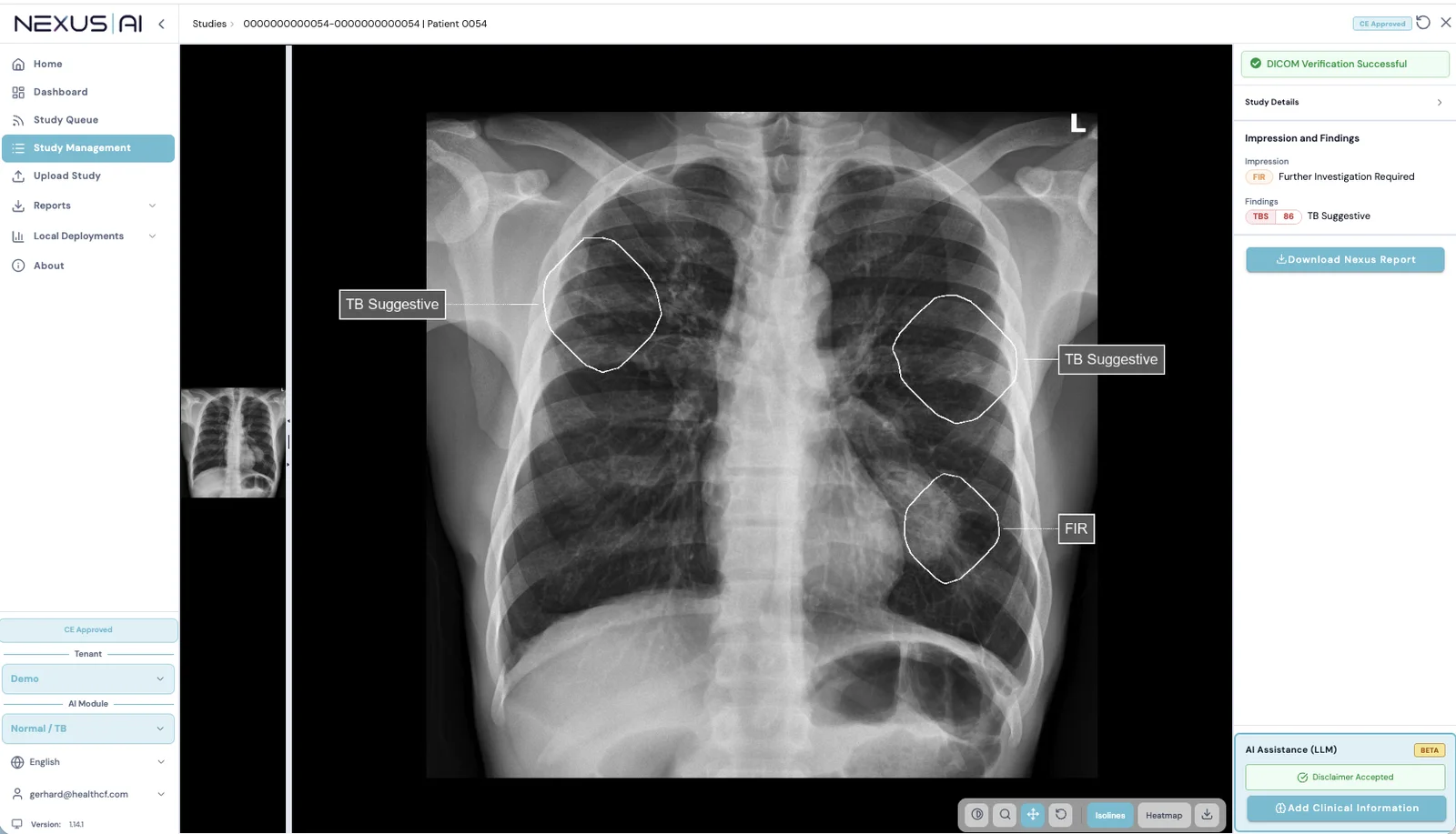 TB screening software marking three lung areas as TB suggestive on a chest X-ray
Image: Google Research
The screenshot Google Research published shows the clinician-facing side: a chest X-ray with three circled lung regions labeled as TB suggestive. The tool flags areas and suggests; the post is explicit that final decisions remain with healthcare professionals.
Nexus AI's reported results are:
- Reach: live in South Africa, Sierra Leone and Cote d'Ivoire, with expansion under way in the DRC, Zambia and Cameroon.
- Volume: over 25,000 chest X-rays evaluated by more than 90 clinicians across about 40 facilities.
- Speed: turnaround reduced from weeks to under 45 seconds.
- Free access: more than 3,000 free screenings for under-resourced public clinics, with a target of 10,000 sponsored screenings annually.
The Mponeng gold mine example
The most vivid case is the Mponeng gold mine in South Africa, run with the Stop TB Partnership, Harmony Gold and the South African Department of Health. Ultra-portable X-ray kits and offline AI operate roughly four kilometres underground, so screening, triage and confirmatory molecular testing can happen in a single visit. Miners are a well-known high-risk group for TB, and a one-visit workflow removes the follow-up gap where patients are lost.
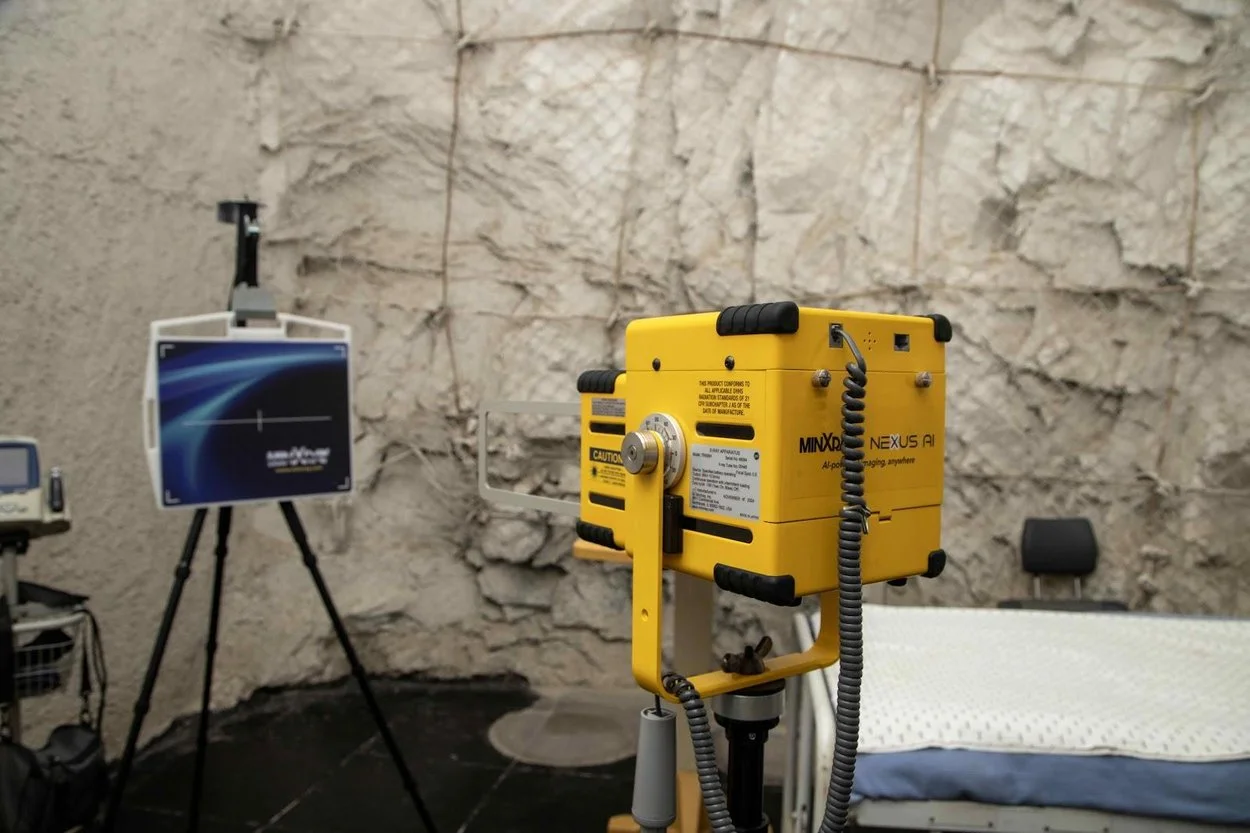 Portable Nexus AI X-ray device used for chest X-ray TB screening in the field
Image: Google Research
The portable yellow device pictured sits next to a display; the AI reads the image locally. Offline operation is not a detail. Clinics far from a data center cannot depend on a cloud call, and many health ministries prefer that scans never leave the country.
Why are MedGemma and MedSigLIP in a TB story?
The post pivots from one certified product to a toolkit. Google open-sourced chest X-ray embeddings and MedSigLIP through Health AI Developer Foundations, and describes MedGemma, with 4B and 27B open-weight multimodal versions, as adding clinical reasoning that can run on-device without internet. Google says MedGemma has over 10 million downloads. See Google's earlier MedGemma post for the model details.
The practical use is national fine-tuning. Indonesia's Ministry of Health is fine-tuning MedGemma and MedSigLIP on domestic X-rays, with models running on local infrastructure so patient data stays in the country. The country's stated goal is screening 50 million citizens annually. That is an ambition, not a result, and the post does not report any Indonesian performance numbers.
For builders, this is the interesting takeaway. A closed, certified product like Nexus AI's and an open model family sit side by side: the first for a clinic that needs a regulated tool now, the second for a government or research group that needs to adapt a model to local scanners and populations. The same open-versus-closed tension appears across our coverage of health AI, including Google's AMIE clinic study and Meta's Muse health research push.
What about screening TB from a cough?
Google's HeAR model, trained on over 300 million audio segments, targets disease screening from smartphone-recorded cough sounds (HeAR preprint). The post says this remains research. The Centre for Infectious Disease Research in Zambia and the Aurum Institute in Ghana, backed by a $250,000 Google.org grant, are building the clinical evidence, alongside a $1.5 million regional collaborative called HELINA.
A cough screen could reach people without any X-ray equipment, which is why it draws attention. It is also the least proven part of the story. Nothing in the post says cough-based triage has been validated for clinical use, so treat it as a research direction.
Claimed versus verified
| Claim | Where it comes from | Status |
|---|---|---|
| Comparable to experienced radiologists (2019) | Peer-reviewed, Radiology | Published, older and on a benchmark dataset |
| Top-performing TB algorithm (2021) | Stop TB Partnership, Lancet Digital Health | Independent evaluation, published |
| High sensitivity across populations (2024) | NEJM AI prospective study | Published |
| 25,000+ X-rays, 40 facilities, under 45 seconds | Nexus AI via Google Research | Company-reported, no audit or paper |
| Weeks reduced to under 45 seconds | Nexus AI via Google Research | Company-reported; baseline not defined |
| CE MDR Class IIb, ISO 13485 | Nexus AI | Stated in the post; check the certificate registry |
| WHO prequalification, FDA clearance | Nexus AI | Pursued, not confirmed |
| Cough-based screening | Google Research | Research stage |
The headline speed claim deserves care. Reading an X-ray in 45 seconds is believable for software. "Weeks to under 45 seconds" compares the whole old pathway, which probably included transporting films, waiting for a scarce radiologist, and reporting back, with the machine step alone. The post does not break that down.
What is missing from the post
The post gives no sensitivity, specificity or AUC figures for the deployment, no subgroup performance by age, HIV status or prior TB, no description of failure modes, and no false-positive rate. These matter for a screening tool because the cost of a false positive, confirmatory molecular testing and patient anxiety, differs from the cost of a miss, an untreated infectious patient. A high-prevalence mine population and a general clinic will produce very different positive predictive values from the same model.
It also does not say how many of the 25,000 scans were flagged, how many flagged patients were confirmed, or what happened to them afterward. Those are the numbers that would turn an activity count into an outcome.
What this means for builders and health teams
- If you build health AI, the sequence here is a template: benchmark publicly, get an independent evaluation, align with WHO guidance for the technology class, then partner with a regulated manufacturer. The model alone was never the product.
- If you run a clinic or ministry, ask Nexus AI for local validation data on your scanners, the certificate numbers, and a data-residency statement before you rely on the speed claim.
- If you want to experiment, MedSigLIP and MedGemma are open. Fine-tuning on your own labeled X-rays is the realistic route, with the clear caveat that a research fine-tune is not a certified medical device.
- If you follow AI agents and automation, note the safety framing: the AI flags, a clinician decides. Our coverage of Microsoft's diagnostic orchestrator shows how quickly lab-benchmark claims can outrun clinical evidence.
How this fits Google's wider health push
Google Research has been publishing a run of health deployments. Its blind-sweep ultrasound work for gestational age lets novice operators in Chicago and Nairobi take usable scans, and its VERID digital twin for autonomous wet labs pushes the research side. The common thread is moving models out of the paper and into places where specialists are scarce. TB screening is arguably the most mature of the three, because the first validation is seven years old.
The post also appeared in a week when Google is promoting its general models heavily; for the other side of the company, see our Gemini 4 Argon launch breakdown.
Bottom line
The TB screening AI looks like one of the more credible health AI deployments: a model with independent evaluation, a WHO recommendation for its technology class, a certified manufacturer and an offline workflow that matches the setting. What the October 23 post adds is scale and speed claims, not proof of patient outcomes. Until Nexus AI or Google publishes deployment-level sensitivity, specificity and follow-up results, read the 25,000 and 45-second figures as promising, company-reported activity.
Details, deployment figures and regulatory status are accurate as of October 23, 2026, as reported by Google Research and Nexus AI; check the original post for updates.
Related reading
- Google AMIE clinic study at BIDMC: 90 percent differential
- Blind-sweep ultrasound AI for gestational age in Chicago and Nairobi
- Google Research VERID digital twin for autonomous wet labs
- Meta Muse health research: ten manuscripts in four weeks
- Microsoft diagnostic orchestrator: claimed versus verified
- Gemini 4 Argon launch, benchmarks and pricing
- Official: Google Research TB post, MedSigLIP docs