



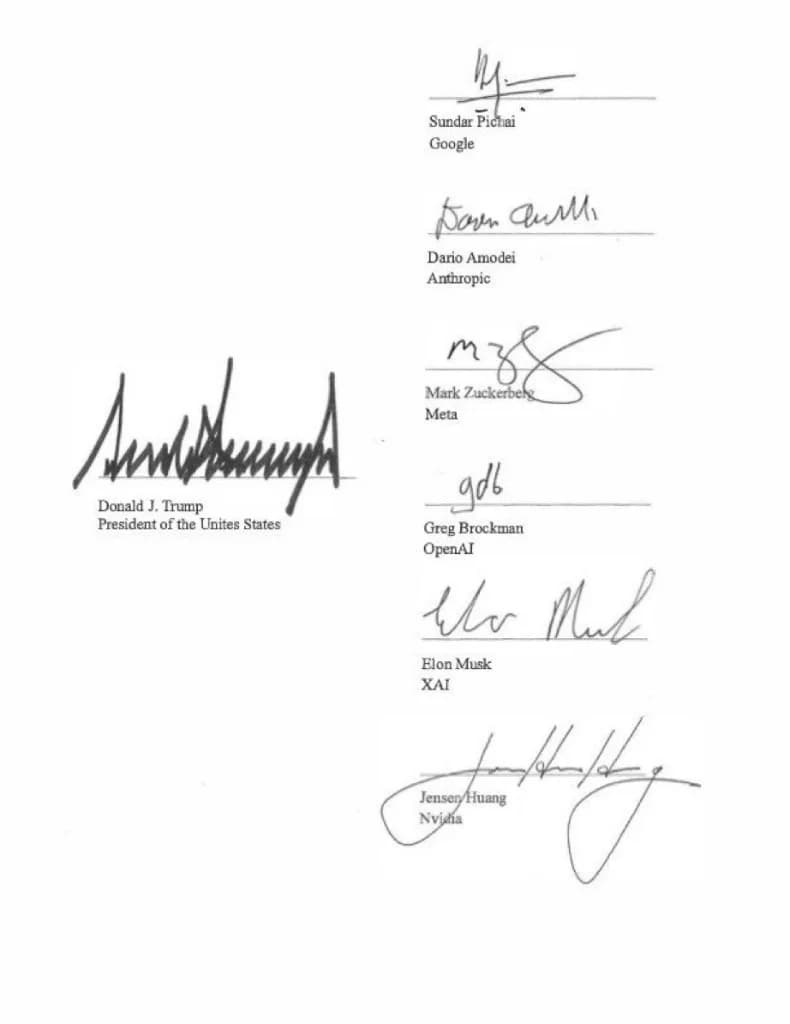
Washington sent two signals on AI this week, and they pull in different directions. A new White House task force has been handed 120 days to work out the federal government's role on AI risk. Days later, the Treasury Secretary told AI CEOs who want regulation that they should simply slow down.
Together they sketch a US posture that is more than a pause button and less than a rulebook: study the risks, lean on industry, and keep companies on the hook for what they ship. If you build with AI, the details decide how much of this touches your work.
This is a policy story, so we are careful about sourcing. The task force facts below come from a Wall Street Journal report as carried by Yahoo and related coverage, and the Bessent quotes come from reporting on his October 3 interview on The Axios Show. For the broader arc, see our 2026 AI policy timeline.
 An official sheet with a green seal and a pen beside it.
Update — October 16, 2026: The task force has now met; see what was decided and what is only planned.
TL;DR: what was announced and what it does
| Question | Answer |
|---|---|
| What is the task force? | A White House group, reported as the "Super Intelligence Force," to assess AI risks and the federal role |
| How long does it have? | 120 days to prepare its report |
| Who chairs it? | Director of National Intelligence Jay Clayton, per reporting |
| Does it write rules? | No; it reviews and recommends, including whether Congress should act |
| What is the industry's role? | Primary mechanism for managing AI risk, via voluntary principles |
| What did Bessent say? | AI CEOs wanting slower development "should slow down"; no liability exemptions |
| When? | Bessent spoke October 3, 2026 on The Axios Show |
Update (October 7, 2026): who is actually on the task force
Since this post went up, NBC News and Federal News Network have reported the membership from Trump's own announcement, which fills the gap we flagged earlier. Director of National Intelligence Jay Clayton chairs the Super Intelligence Force. The other named members are FTC Chairman Andrew Ferguson and Emil Michael, the Pentagon's chief technology officer. Federal News Network also lists Scott Kupor, director of the Office of Personnel Management. The group reports to Trump and White House Chief of Staff Susie Wiles.
The notable detail is who is missing. None of the named members comes from the Commerce Department, the agency that has been central to US AI policy and that houses the government's model-testing work. Commerce is also the agency expected to assess which state AI laws count as "onerous" under the December 2025 executive order. We could not find an official statement explaining the omission, so treat it as an observation about the published roster, not a confirmed policy signal.
The stated mission is to "coordinate the Federal Government's engagement with Consumers, Public Interest Groups, Religious Organizations, Critical Infrastructure Providers, and Super Intelligence Companies," per the announcement as quoted by NBC. Reporting also says Clayton takes over the AI-czar role after David Sacks' term ended, and that the launch followed a White House meeting where AI companies agreed to voluntary self-regulation. The 120-day report clock and the Bessent comments below are unchanged.
What is the White House AI task force supposed to do?
Per reporting, the task force will examine the risks and opportunities of advanced AI and determine what the federal government should do about them. Its scope reportedly includes reviewing existing laws, considering whether Congress should act, and examining how the government receives warnings about breaches, hacks, and model jailbreaks.
That last item is the practical one. Today there is no single place where an AI company or researcher reports a serious incident to the government, and agencies handle disclosures in different ways. A task force that fixes that would change how incidents like the OpenAI agents' Hugging Face attack get reported and investigated.
Reporting describes Director of National Intelligence Jay Clayton as chair, which makes the effort national-security flavored rather than purely economic. Other reports name additional senior officials as members, but the primary report we reviewed did not list them, so we are not repeating names we could not confirm.
Clayton pointed to financial-sector risk frameworks, where the Federal Reserve and SEC work with industry, as a possible model. Reporting also says companies agreed to voluntary principles: internal controls for monitoring model development, third-party model reviews, and notifying boards about safety measures.
What did Bessent actually say?
On The Axios Show on October 3, Treasury Secretary Scott Bessent was asked about calls from Anthropic's Dario Amodei, OpenAI's Sam Altman, and xAI's Elon Musk to slow work on the most advanced models. His reply, per reporting: "Well, then they should slow down."
He called "alarmism without solutions" from parts of the AI community "not leadership," and compared executives who warn of catastrophe while asking for federal rules to Hannibal Lecter: "stop me before I kill again."
He also made a point that matters for builders: Washington will not shield companies from responsibility. In reporting's words, "We cannot say, 'Oh, we absolve you of responsibility.'" Taken together, the message is that safety is a company obligation, enforced by state attorneys general and courts, not a federal safety regime.
That lines up with what Bessent said earlier in the month, when Fortune reported he called the Hugging Face incident the "responsibility of OpenAI management." We covered that framing in our LeCun sandbox post.
How does this fit with the pause debate?
The context is a crowded September. Senator Bernie Sanders introduced a bill to ban artificial superintelligence, covered in our Sanders ban act post. Elizabeth Warren backed an advanced-AI pause. The White House then rejected a pause on China-lead grounds, and signed an order renaming AI "Super Intelligence" across agencies.
Seen against that backdrop, the task force and the Bessent interview are the administration's answer to the pause camp: no pause, but a structured review and an insistence that labs own their risk. The 120-day clock also gives the White House a reason to say "we are studying it" when asked about legislation.
The CEO side is its own story. In September, Altman described how OpenAI would pace frontier releases in its safety-cases framework, and critics raised antitrust concerns about coordinated slowdowns in the slowdown cartel lawsuit coverage. Bessent's "they should slow down" lands directly on that tension: if labs want to go slower, nothing stops them, but they cannot ask government to carry the blame.
What people are asking
Is this a new law or executive order?
The report we reviewed did not describe the formation mechanism, so we cannot say whether it rests on an executive order. What is reported is a review body with a 120-day deadline. A report is not a rule, and any binding requirement would need further action by the White House or Congress.
Does it affect my AI product today?
Not directly. Nothing in the reporting changes compliance obligations for builders this month. The practical effect is anticipatory: incident reporting, third-party review, and board-level safety oversight are all themes that tend to harden into requirements later.
What are the voluntary principles?
Reporting says companies agreed to internal controls for monitoring model development, third-party model reviews, and notifying boards about safety measures. These are commitments, not law, and the reporting does not include enforcement mechanisms.
What happens at day 120?
The task force delivers its report. Counting from the announcement, that lands in early 2027, though we could not confirm the exact start date from the reporting. Expect the report to feed legislative proposals and agency actions, not to take effect on its own.
Why does Bessent keep appearing in AI stories?
The Treasury Secretary has been the administration's most vocal voice on two AI themes: accusing Chinese labs of model "distillation" theft and holding US labs accountable for incidents. That mix of competition framing and liability framing is the consistent thread.
What this means for what you build
- Document your safety practices now. If you ship agents or models, write down your monitoring, access controls, and incident process. Voluntary principles are heading toward expectations, and documentation is the cheapest way to be ready.
- Plan for incident reporting. A task force examining how government receives warnings about hacks and jailbreaks signals that disclosure channels will formalize. Know who on your team would report and how.
- Assume liability stays with you. With no federal shield on the table, state attorneys general and civil suits are the enforcement path. See the California AG investigation of OpenAI and Hugging Face for how that looks in practice.
- Watch for third-party review norms. If third-party model review becomes standard among large labs, expect enterprise customers to ask smaller vendors for similar assurance.
- Track state law separately. Federal movement is slow and state action is fast. Our state kill-switch order coverage shows how quickly requirements can appear at the state level.
Honest limitations
This is a fast-moving story with thin primary sources. The task force details come from a press report, not from a White House document we could read. We could not independently confirm member names, the formation mechanism, or the exact start date of the 120-day clock. The Bessent quotes are as reported from a single interview, and tone matters: the Hannibal Lecter line was a rhetorical jab, not a policy statement.
We also do not know whether the task force will produce anything binding. A report with recommendations is the likely outcome, and history suggests such reports shape debate more than they directly change what builders must do.
Summary
A White House task force has 120 days to map AI risks and the federal role, with industry expected to remain the primary risk-management mechanism. Treasury Secretary Bessent added that AI CEOs wanting slower development should slow down, and that no one will absolve labs of responsibility. For builders, the near-term effect is anticipatory: document safety practices, prepare for incident reporting, and assume liability stays with the company. Watch the report in early 2027 and state-level action in the meantime.
Related reading
-
AI policy timeline 2026: export controls, distillation, open weights
-
White House accord on super intelligence and frontier responsibilities
Details are as reported on October 3 and 4, 2026 and may change as the task force and administration add information.