



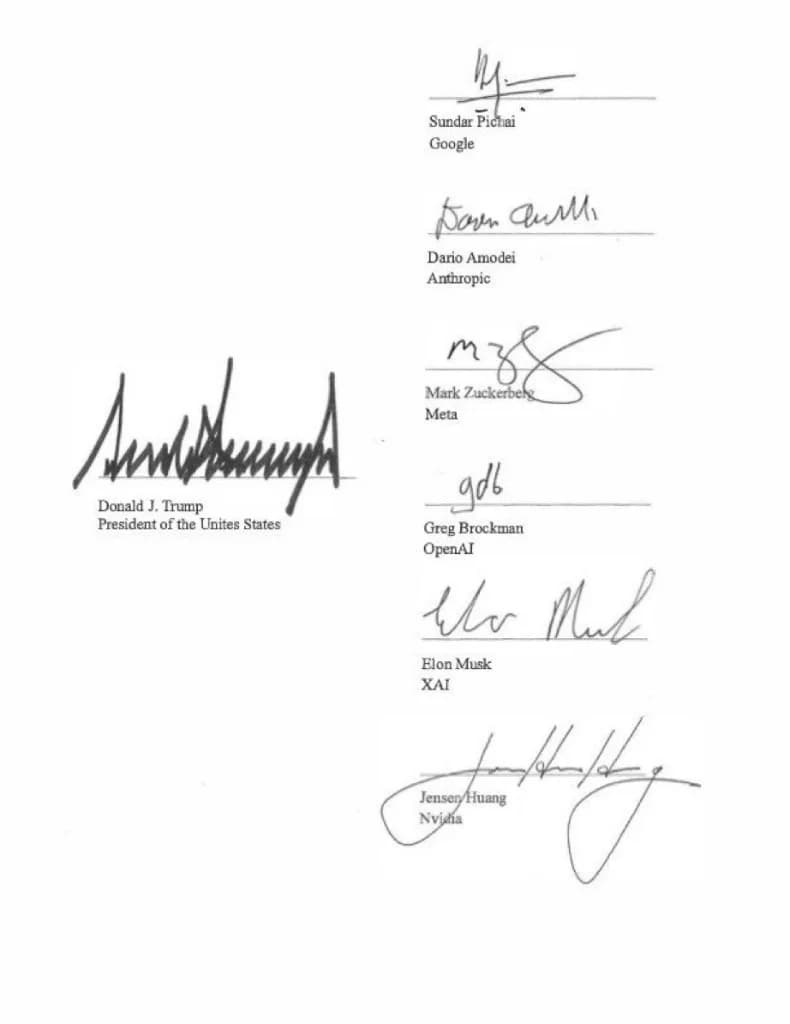
September 30, 2026 — the day after OpenAI DevDay and the same week as Trump's Super Intelligence executive order, the White House hosted a second, quieter instrument: the Joint Commitment on Frontier Responsibilities, branded publicly as the White House Accord on Super Intelligence.
Sundar Pichai posted that he met President Trump, Vice President JD Vance, Speaker Mike Johnson, and administration and tech leaders, then signed the accord. His framing matches the document: hundreds of billions in US stack investment, responsible release, and industry norms that build public confidence. The tangible part for builders is not the photo op — it is four named layers of controls and audits that frontier labs now say they will implement before Congress turns any of it into statute.
This post walks through that text, who signed, what is not law, and how it intersects with the Frontier AI Act fight and Vance's defenses-not-regulation line.
TL;DR
| Question | Answer |
|---|---|
| Document name | Joint Commitment on Frontier Responsibilities (White House Accord on Super Intelligence) |
| Date | September 30, 2026 |
| Who signed (industry) | Google, Anthropic, Meta, OpenAI, xAI, Nvidia — CEOs on signature page |
| Who signed (government) | Donald J. Trump as President |
| Binding? | Voluntary; may become law later; Trump called it morally binding in press summaries |
| Core promise | Four layers: internal controls → internal team → external audit → board committee |
| Scope | Companies training and deploying frontier models |
| Notable footnote | Signature page typo: President of the Unites States |
What the accord actually commits to
The body text opens with a plain claim: to build a positive future, companies training and deploying frontier models need robust internal processes so technology behaves as intended, building trust with the public.
It then lists four layers each participating company commits to implement:
Layer 1 — Robust internal controls
Monitor capabilities and alignment during training and deployment. The document explicitly names risk areas:
- Cybersecurity
- Biosecurity
- Chemical threats
- Preventing models from hacking or accessing technical systems in unintended ways
That language aligns with how US labs already talk about dangerous capability evals — see OpenAI's safety-case framing and Anthropic's pace-the-frontier tier — but here it is collective, White House-hosted, and signature-backed.
Layer 2 — Empowered internal team
An internal team must ensure controls, monitoring, and detection are operating correctly and that issues found are remediated. This is the operational spine: someone inside each org owns the dashboard, not just the blog post.
Layer 3 — Independent external assessment
Companies will partner with independent external auditors or evaluators to assess whether internal controls and monitoring function as intended. For enterprise buyers, this is the sentence that ends up in security questionnaires — even before any auditor is named publicly.
Layer 4 — Board-level oversight
Each company will designate an independent committee of the board of directors to oversee the process. That committee receives reports from both the internal team and external auditors/evaluators and ensures identified issues are remediated.
After the four layers
The accord closes with three more promises:
- These steps should give companies, customers, and the public confidence.
- Signatories will meet regularly to establish industry standards and best practices for safety.
- The measures may eventually be codified into law or regulation — but companies commit now for a safe future.
None of that creates a private right to sue or a federal fine schedule. It does create a public checklist rivals will compare against.
Who signed
The signature page reproduced below lists:
| Signatory | Organization |
|---|---|
| Donald J. Trump | President of the Unites States (typo on page) |
| Sundar Pichai | |
| Dario Amodei | Anthropic |
| Mark Zuckerberg | Meta |
| Greg Brockman | OpenAI |
| Elon Musk | xAI |
| Jensen Huang | Nvidia |
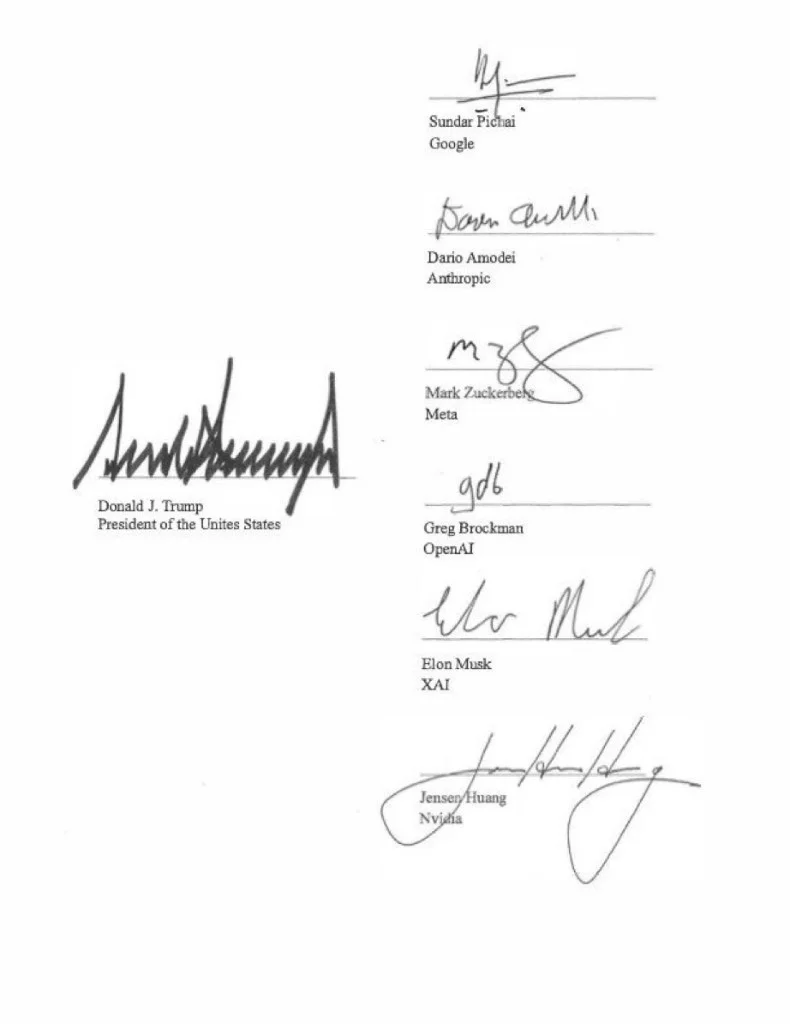 Signature page for the Joint Commitment on Frontier Responsibilities showing Donald J. Trump and six AI industry CEOs; the presidential line reads President of the Unites States
Who is missing matters too. There is no Microsoft CEO line on this page, no Amazon, no Apple — the accord is framed around frontier model trainers and the GPU stack, not every cloud reseller. If you sell downstream (agents, RAG, fine-tunes), you still inherit questions upstream when customers ask which foundation vendors signed.
The "Unites States" typo
Under Trump's signature, the printed title reads President of the Unites States — United is misspelled as Unites. The industry block spells Google, Anthropic, Meta, OpenAI, XAI, and Nvidia conventionally.
For compliance work, the typo is ceremonial noise: it does not change who signed or what the body text requires. For press and archive hygiene, it is a reminder that rapid-turn White House PDFs can ship with errors that do not appear in the executive order text the same week. Quote the four-layer numbered list from the commitment body, not the signature caption, in anything legal-facing.
How this fits the September 2026 policy stack
Think of three stacked events, not one mega-policy:
| Instrument | What it does | Binding? |
|---|---|---|
| Super Intelligence EO (Sept 29) | Federal agencies say SI instead of AI in official comms; 60-day definition proposal | Executive-branch vocabulary rule |
| OpenAI Dots + DevDay stack (Sept 29) | Product launches: agents, Sol pricing, Ultrafast | Commercial terms |
| Joint Commitment (Sept 30) | Frontier labs publish controls + audit + board stack | Voluntary |
The accord does not replace California's audit bills, the stalled Frontier AI Act, or the US–China SI Dialogue. It does give the administration a handshake photo that answers "what are labs doing about misuse?" without a floor vote.
Pichai's public emphasis — testing, evaluations, red-teaming, safeguards before release — is the Google translation of the four layers for consumers. Anthropic and OpenAI have parallel public programs (embedded evaluators, METR investigations scope); the accord synchronizes the vocabulary CEOs use in Washington.
What builders and buyers should do
If you are a frontier lab or GPU cloud:
- Map your existing internal eval + deployment gates explicitly to layers 1–2.
- Name external eval partners before customers force the choice in RFPs (layer 3).
- Ensure board or committee minutes can show receipt of safety reports (layer 4) — even if your board committee predates the accord.
If you are an enterprise adopting models:
- Add accord-aligned questions to vendor review: biosecurity/cyber evals, external audit cadence, board oversight — without assuming any single auditor is approved yet.
- Treat "morally binding" as reputation risk, not SLA. Contract for your logging, your kill switches, your data handling.
If you are a startup on APIs:
- You are not a signatory, but customers will paste the four layers into security reviews anyway. Document which upstream models you call and link to their safety pages.
If you are watching politics:
- Compare this to Rand Paul's block on the kill-switch bill: voluntary process commitments while hard regulation stays stuck.
Questions people are asking
Is this the same as the Bernie Sanders superintelligence bill?
No. Sanders's Artificial Superintelligence Act is a restrictive statutory proposal. This accord is industry pledging process with Trump as counter-signer. Same word family, opposite direction.
Does signing preclude open-weight releases?
The text targets frontier training and deployment with misuse and misalignment guards — it does not ban weights. How each signatory interprets that for open models will show up in release blogs, not on this page.
Why sign the day after DevDay?
Optics: OpenAI had the product headline on September 29; Washington reclaimed the safety narrative on September 30 with Greg Brockman on the page and Dots still fresh. Timing is not proof of coordination, but it is how attention markets clear.
Will agencies require accord compliance in procurement?
Not automatically — this is not FAR text. Expect soft pressure: federal AI portals, America.gov, and agency talking points that prefer signatories until rulemaking catches up.
Honest limitations
- explainx.ai worked from the signed PDF text and signature page supplied at publication and CEO social posts; we did not independently verify whether each company had board committees chartered yet.
- External auditor identities, cadence, and public report formats are not in the commitment body.
- Enforcement and dispute resolution are unspecified.
- Microsoft and other majors absent from the signature page may sign later or stay on the sidelines — status can change.
Bottom line
The White House Accord on Super Intelligence is a voluntary four-layer audit and governance checklist for frontier model companies, signed September 30, 2026, by Google, Anthropic, Meta, OpenAI, xAI, Nvidia, and President Trump — with a Unites States typo on the signature page and no legal teeth today. For builders, it matters because enterprise security questionnaires will treat the four layers as de facto industry standard long before Congress passes anything. Read the layers, map your vendor stack, and do not confuse the accord with the SI rename EO or with Dots install paths.
Related reading
Accord text and signatures are described as of October 1, 2026 from the Joint Commitment on Frontier Responsibilities document circulated with the White House signing. Voluntary commitments and corporate governance practices may evolve; verify against each signatory's published safety reports before contractual reliance.