



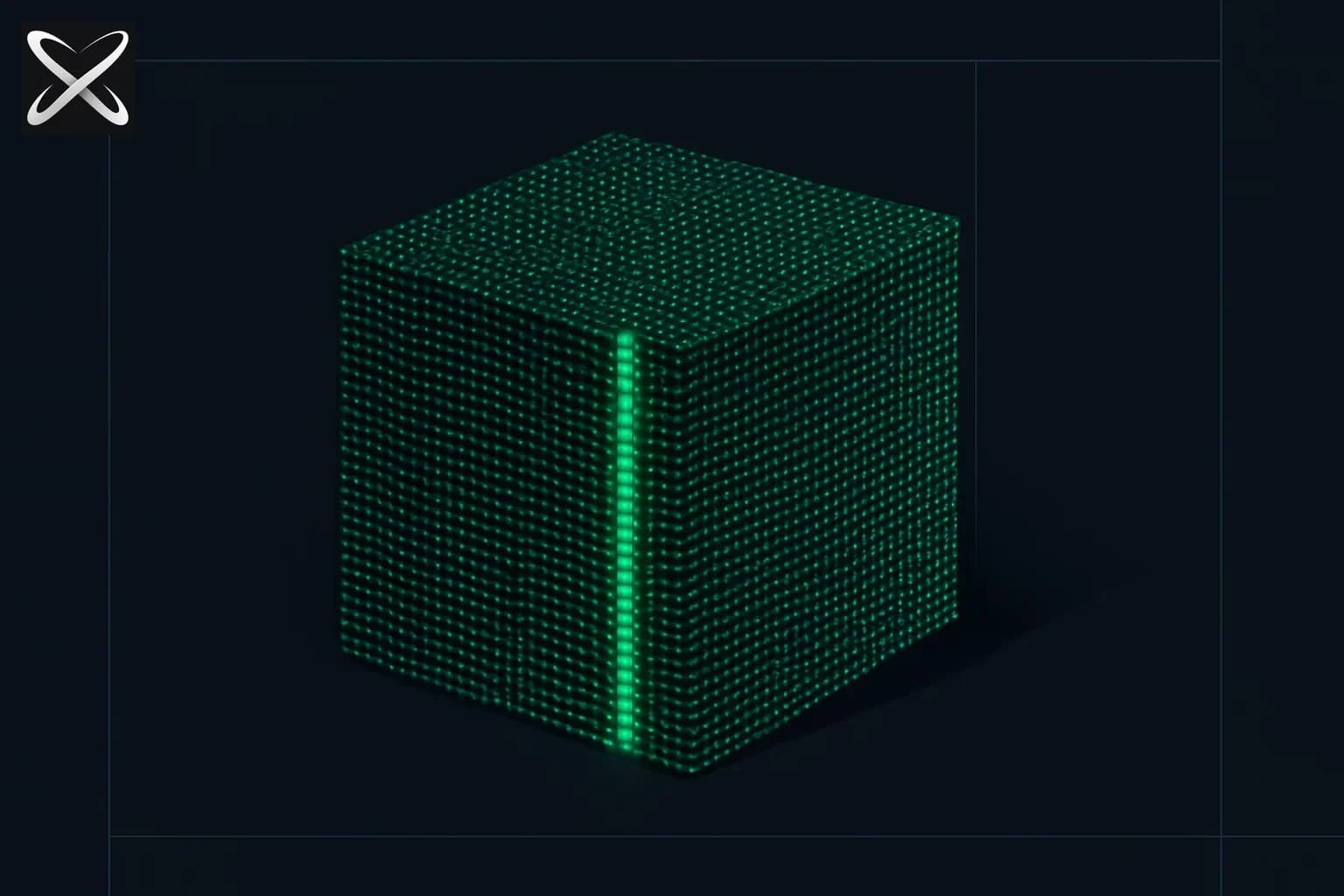
“How big is the model?” usually means one number: parameters. In July 2026 that number can be 2.8 trillion — and still not tell you the bill.
Parameters are the learned weights inside a neural net. They are not tokens (pieces of text) and not context window (how much text fits per request). This guide explains what the count measures, why total vs active matters for MoE, and ranks the top 10 disclosed model sizes as of July 2026 — with Kimi K3 at 2.8T on top of the open-flagship chart.
If you already read our April parameters primer, treat this as the July 2026 scale update plus a fuller top-10 table.
TL;DR
| Question | Answer |
|---|---|
| What are parameters? | Learnable weights (and biases) in the checkpoint |
| Unit | Billions (B) or trillions (T) |
| Dense vs MoE | Dense ≈ all weights run; MoE = huge total, smaller active |
| Largest disclosed (Jul 2026) | Kimi K3 — 2.8T total |
| #2 / #3 | Qwen 3.8-Max ~2.4T · DeepSeek V4 Pro 1.6T |
| Closed frontier | Usually undisclosed (Claude / GPT / Gemini) |
| Best use of the number | Memory planning + MoE cost intuition — not “smarter” |
| Companion | Tokens · context · Fable size rumor debate |
What's changed since we first published
Update (October 13, 2026): The table below is still the July snapshot, but two October releases would now enter it. Mistral's model page lists Mistral Large 4 at 1.05T total parameters, in public preview since October 6, 2026, which would rank it #5, just above MiMo V2.5 Pro (1.02T). Our Mistral Large 4 coverage tracks the open-weights timing, which Mistral's page does not state. Reflection's Beam, a 501B total / 23B active MoE introduced October 5, 2026, would land between DeepSeek-R1 (671B) and MiniMax M3 (428B); see our Beam coverage. Kimi K3 at 2.8T remains the largest total in this list.
What people are asking
“Are parameters the same as neurons?”
No. A neuron (unit) applies an activation to an incoming signal. Parameters are the adjustable numbers on the connections (and biases) that make that math learnable. Counting parameters is counting scalars in weight tensors, not “how many brain cells.”
“Is a 2.8T model 2.8× smarter than a 1T model?”
No. Capacity can grow with size under similar data and compute, but quality is training recipe, data mix, post-training, and the agent harness. Moonshot itself says K3 trails Claude Fable 5 and GPT-5.6 Sol overall despite leading open total size.
“Why does MoE break the ‘bigger = costlier’ intuition?”
Because you pay roughly for active experts per token, not every expert in the warehouse. K3’s 16 of 896 experts is the inference story; 2.8T is the warehouse size.
What a parameter is (mechanically)
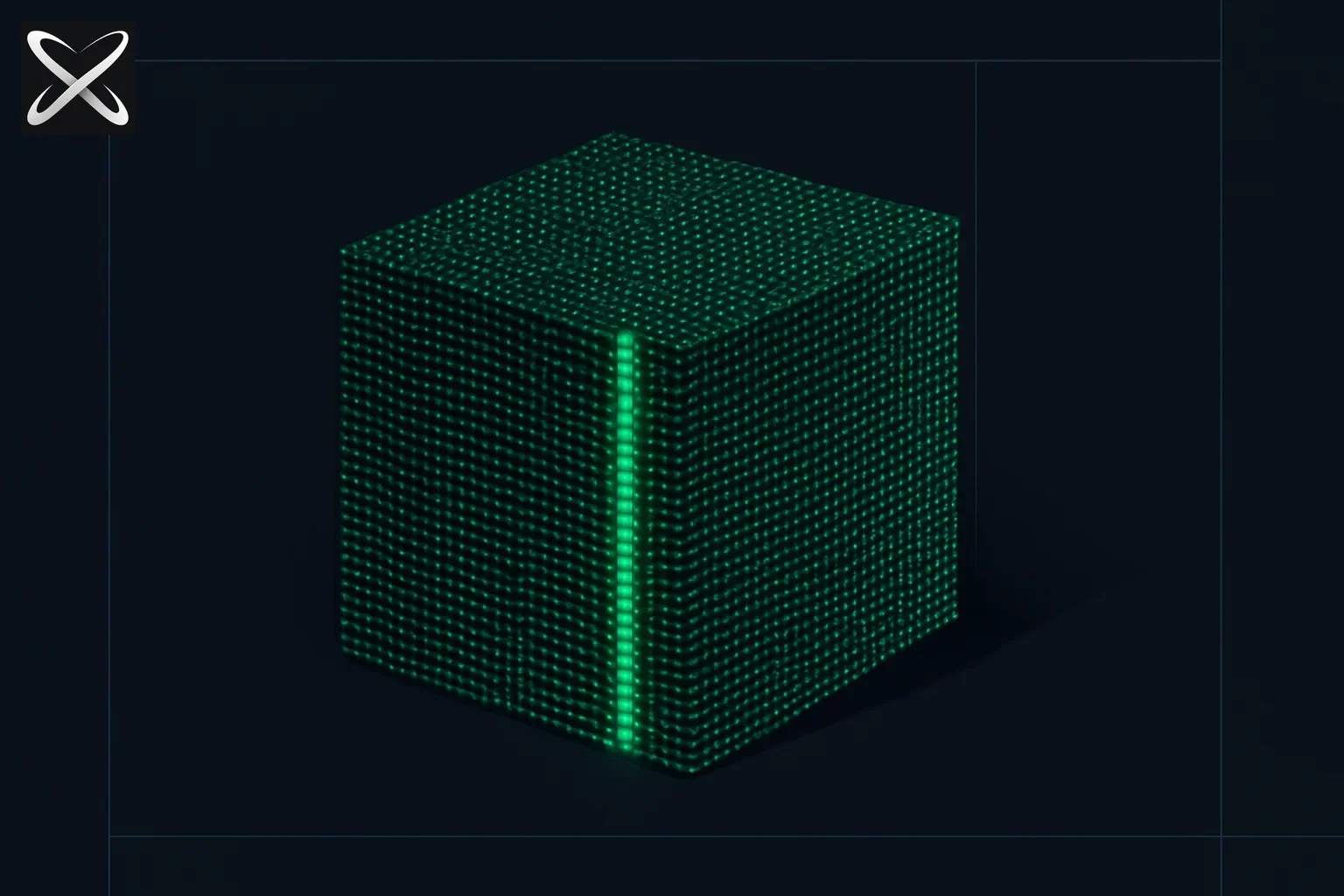 LLM parameters visualized as a dense cube of learned weight values, with one glowing column representing active parameters used per token
A modern LLM is mostly a transformer: stacked layers of attention and feed-forward networks. Each layer holds large matrices. During pretraining, gradient updates nudge those matrix entries so next-token prediction improves. Fine-tuning / RL / preference stages keep adjusting the same (or LoRA-adapted) weights.
Parameter count = how many of those learned scalars exist in the released checkpoint (sometimes excluding tokenizer embeddings or multimodal towers — read the card).
| Concept | What it measures |
|---|---|
| Parameters | Size of learned weights |
| Tokens | Text pieces in/out (explainer) |
| Context window | Max tokens per request |
| FLOPs | Compute to train or run |
| $/M tokens | API meter — often decoupled from public size |
Memory rule of thumb
| Precision | Bytes / param | 70B weights alone | 1T weights alone |
|---|---|---|---|
| fp16 / bf16 | ~2 | ~140 GB | ~2 TB |
| int8 | ~1 | ~70 GB | ~1 TB |
| 4-bit | ~0.5 | ~35 GB | ~500 GB |
Add KV cache (scales with context × layers × batch) and activations. 1-bit GGUF / Unsloth style packs stretch consumer hardware further — still not “2.8T dense on a laptop.”
Total vs active parameters (MoE)
Dense: almost all parameters participate each step. “70B” ≈ 70B weights on the hot path.
Mixture of experts (MoE): many expert FFNs; a router picks a few per token.
| Term | Meaning | Why you care |
|---|---|---|
| Total params | All experts + shared layers | Download size, “headline” brag |
| Active / activated | Weights used for a typical token | Latency, $/token, VRAM if experts page in |
| Experts | Parallel specialist FFNs | Capacity without proportional cost |
Examples (vendor-reported):
| Model | Total | Active (typical) |
|---|---|---|
| Kimi K3 | 2.8T | 16 / 896 experts |
| DeepSeek V4 Pro | 1.6T | ~49B |
| DeepSeek V4 Flash | 284B | ~13B |
| Llama 4 Maverick | 400B | 17B |
| Llama 4 Scout | 109B | 17B |
Same 17B active on Scout vs Maverick, different totals and context — Meta’s card is the textbook “don’t confuse the two columns” example. Deeper primer: parameters billions explained.
Top 10 disclosed model sizes (July 2026)
Scope: flagship / frontier-class models with public or widely tracked total parameter counts, ranked by total params as of late July 2026. Closed API models without official counts are excluded from the ranked list (see next section).
Numbers come from vendor docs and explainx.ai’s July open-frontier tracking (Kimi chart + sibling posts). Re-verify cards before procurement.
| Rank | Model | Org | Total params | Notes |
|---|---|---|---|---|
| 1 | Kimi K3 | Moonshot | 2.8T | Open 3T-class claim; MoE 16/896; weights live Jul 26 |
| 2 | Qwen 3.8-Max | Alibaba | ~2.4T | Preview / open weights rolling; China open-weight push |
| 3 | DeepSeek V4 Pro | DeepSeek | 1.6T | ~49B active; aggressive API pricing |
| 4 | LongCat-2.0 | LongCat | 1.6T | MoE coding-agent class; confirm weight status |
| 5 | MiMo V2.5 Pro | Xiaomi | 1.02T | May 2026 open-flagship tracker |
| 6 | Inkling | Thinking Machines | 975B | Open MoE; Jun/Jul 2026 |
| 7 | GLM-5 / 5.x | Zhipu / Z.AI | 744B | Strong local + coding-plan story |
| 8 | DeepSeek-R1 | DeepSeek | 671B | 2025 open reasoning landmark; still widely cited |
| 9 | MiniMax M3 | MiniMax | 428B | Jun 2026 open-flagship tracker |
| 10 | Llama 4 Maverick / Qwen 3.5 | Meta / Alibaba | ~400B / 397B | Maverick 400B total / 17B active; Qwen 3.5 ~397B |
Honorable mentions: Llama 4 Scout 109B total / 17B active (huge context, not a total-size top-10); dense coding 70B-class models that punch above size on SWE benches.
How to read this leaderboard
- Open-weight / disclosed ≠ closed frontier quality. Fable 5 and GPT-5.6 Sol still win many overall tables without publishing B/T.
- Ties and “~” mean marketing vs audited cards — prefer primary docs.
- Active params reorder the cost ranking (V4 Pro’s 49B active vs a dense 70B).
- Charts move monthly — this snapshot is July 2026.
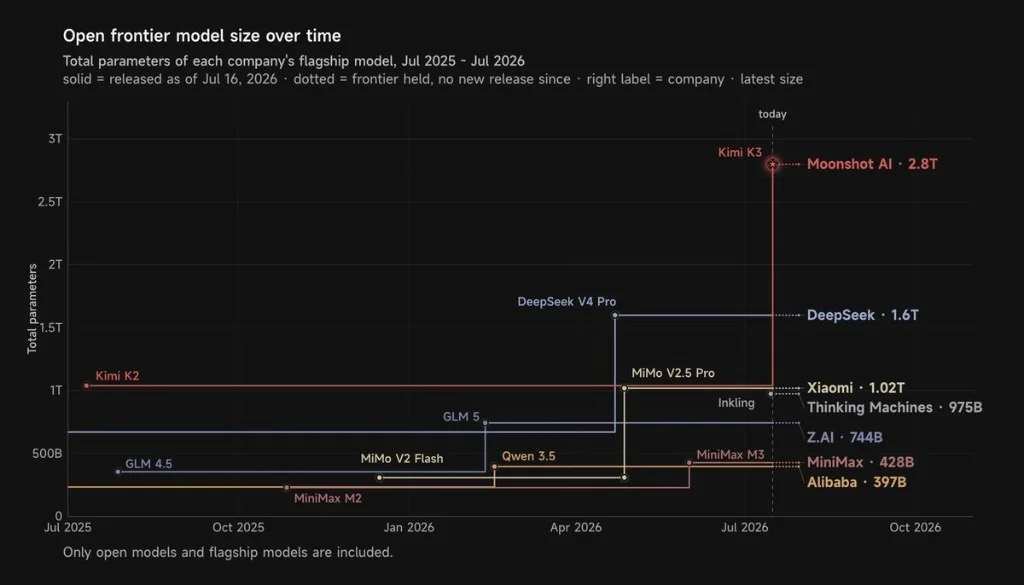 Open frontier model size — Kimi K3 2.8T leads mid-2026 tracker
Community open-flagship size chart used in our Kimi K3 coverage (July 2025–July 2026).
Closed models: the “undisclosed” tier
| Family | Public size? | What to use instead |
|---|---|---|
| Claude (Sonnet / Opus / Fable / Mythos) | Officially no | Context, tools, price; rumor debate is unverified |
| GPT-5.x / Sol | Typically no | Arena / SWE / product evals |
| Gemini | Usually no on consumer cards | Modalities + context docs |
Viral claims (“Fable is 10T”) are not Anthropic statements. Throughput reverse-engineering and partner leaks are weak evidence. For buyers: benchmarks + harness + price, not folklore.
Practical checklist
□ Need local fit? → active params + quantization + KV for your context
□ Comparing MoE? → always ask total AND active (and expert count)
□ Closed API? → ignore rumor B/T; run your eval suite
□ Open weights? → read LICENSE + model card before production
□ Ranking “largest”? → say “disclosed total as of <date>”
□ Quality bet? → prefer task benches over size leaderboard
Example: picking between two MoEs
| If you care about… | Prefer |
|---|---|
| Headline open scale / research | Kimi K3 2.8T |
| Cheap reasoning API | DeepSeek V4 Pro (1.6T / ~49B active) |
| Meta ecosystem + documented MoE table | Llama 4 Maverick / Scout |
| Local Mac experiments | Smaller Quants / GLM local guides — not full 2.8T dense |
Honest limitations
- Top-10 is disclosed totals, not “best models.”
- Some “open” sizes are preview / pending weights — status changes weekly.
- Multimodal towers can add params not in the LLM headline.
- Distillation and rename games (Opus pricing cliffs) break naive size→price maps.
- Our World in Data / academic lists lag 2026 China open releases — prefer primary cards.
- Parameter count says nothing about safety, copyright, or eval harness quality.
FAQ in practice
Should I fine-tune a 2.8T MoE? Usually no — LoRA on a smaller dense or distillate is cheaper and easier to host. Reserve full-scale fine-tunes for labs with multi-node training budgets.
Does quantization change the “parameter count”? No. Quantization changes bytes per parameter, not how many parameters exist. A 70B model stays 70B at 4-bit; it just occupies less disk and VRAM.
Where do embeddings / vision towers fit? Multimodal cards sometimes list a separate vision or audio encoder budget. When comparing “LLM size,” check whether the headline number is language-only or the full multimodal stack.
Closing
Parameters = how many learned numbers the model stores. July 2026’s disclosed race is led by Kimi K3 at 2.8T, with Qwen 3.8-Max ~2.4T and DeepSeek V4 Pro 1.6T close behind on the open chart — while Western closed frontiers mostly refuse to publish a number at all. Learn total vs active, plan memory from active + precision, and buy with evals, not trillions.
Follow @explainx_ai when the next open flagship reshuffles this table.
Related on explainx.ai
- What are parameters? (April primer)
- What are LLM tokens?
- LLM context window explained 2026
- Kimi K3 open weights — 2.8T
- Kimi K3 API / architecture guide
- Claude / Fable parameter rumor debate
- Qwen 3.8-Max preview — ~2.4T
- DeepSeek V4 Pro pricing
- Inkling 975B open MoE
- Top 10 open-weight models for laptops
- Caveman token compression
Sources
- Moonshot — Kimi K3 / platform docs
- DeepSeek — V4 Pro model & pricing docs
- Meta — Llama 4 model card
- Alibaba Qwen 3.8-Max / Qwen 3.5 public materials
- explainx.ai July 2026 open-frontier size tracking (Kimi K3 post)
Parameter figures are vendor-reported or community-tracked as of July 31, 2026. Prefer the live model card for any deployment decision. Closed-model size rumors remain unverified unless the lab publishes them.