



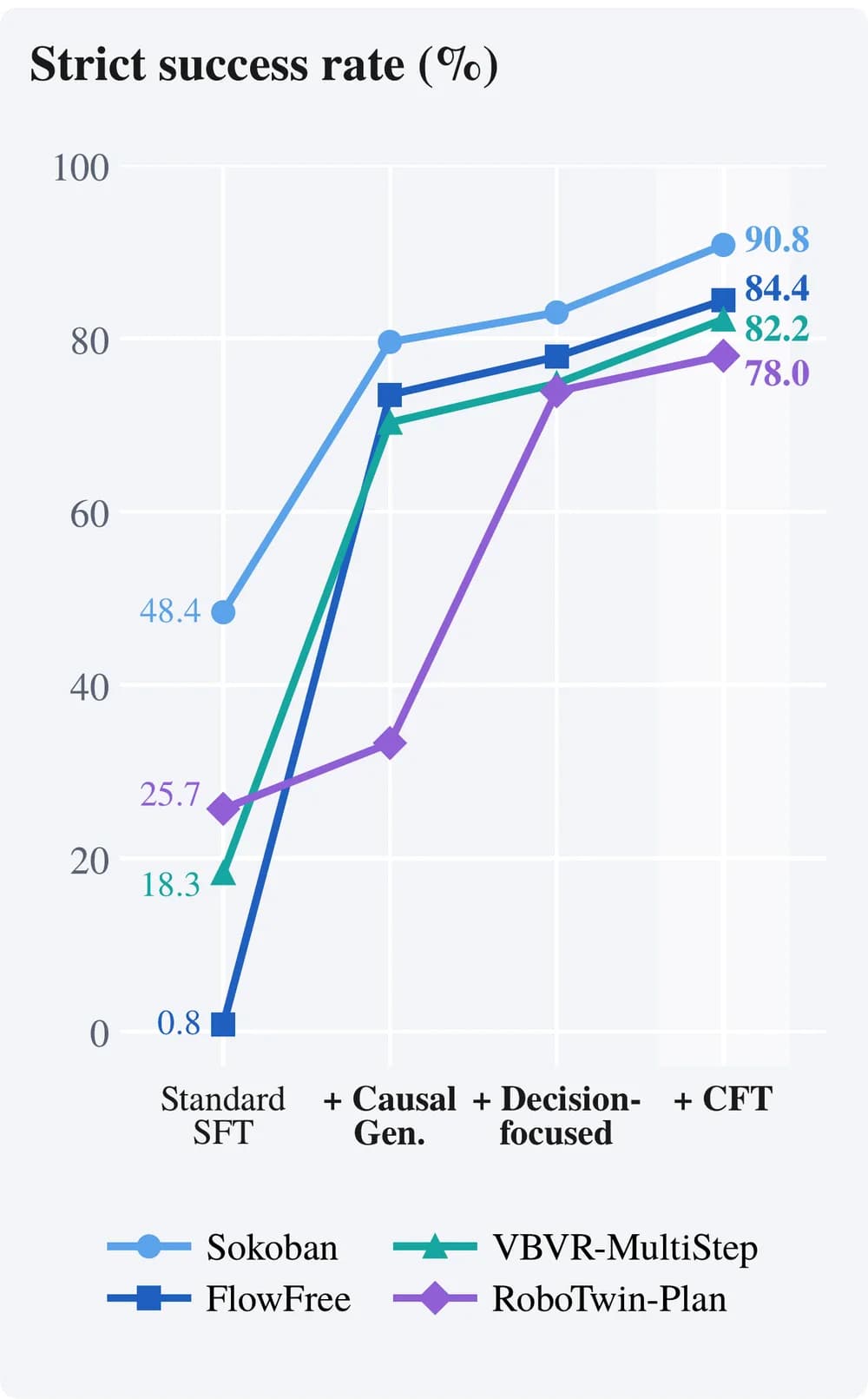
ViDecide is a November 2026 research release that treats video diffusion as step-by-step planning instead of one fixed clip, targeting failures where final frames look realistic but mid-clip physics or logic break. The arXiv paper and Hugging Face page report 83.8% average strict success across VideoRLVR, VBVR, and a new RoboTwin-Plan robot benchmark, with code at Kevin-thu/ViDecide.
The problem with one-shot video training
Leading video generators optimize pixel realism. Planning tasks need state validity after every step. The ViDecide authors argue diffusion RL and large reasoning datasets still leave models that violate constraints during multi-step tasks because training forces a single horizon.
| Paradigm | What the model learns | Failure mode |
|---|---|---|
| Fixed-length clip | Entire solution at once | Pretty ending, illegal middle |
| ViDecide causal steps | Next transition plus stop | Errors surface per step |
That framing aligns with WorldLeague physical agency benchmarks and Embo robot policy recipes: judges care about trajectories, not screenshots.
Where fixed-length training shows up in products
If you have shipped storyboard-to-video pipelines, you already felt this failure mode: frame N looks fine while frame N-3 breaks a rule (inventory count, chess legality, robot joint limit). Teams often patch with prompt engineering or post-hoc filtering, which does not scale when verifiers need dense temporal logic. ViDecide's bet is to change the objective so each step is diffused and scored before the model commits to the next segment.
Why diffusion RL was not enough for the authors
Diffusion policy-gradient methods can move a model toward higher reward, but the Hugging Face author note warns about inaccurate credit assignment and unstable gradients when rewards apply to whole clips. Corrective Fine-tuning instead performs a local repair: take the noise realization that produced a bad transition, then map it toward the noise that the same checkpoint would use for a known-good continuation. That keeps updates on-manifold relative to the base generative model, similar in spirit to preference fine-tunes that avoid catastrophic style drift—but specialized for autoregressive video chunks.
Decision-focused training schedule
ViDecide spends capacity on high-noise timesteps because those timesteps are where the next discrete decision (which move, which object interaction, whether to stop) is effectively chosen. Low-noise refinement still matters for texture, but planning errors tend to lock in early. Builders porting the idea to other modalities should ask: which noise band controls the discrete choice in your simulator? For language, the analogue is often early token slots in a tool call, not the final punctuation.
Visual end-of-sequence (EOS) frames
Adaptive termination means the model learns a visual EOS—a frame pattern that means no further transitions are required. That is important for games with variable depth and robot tasks where success arrives after different counts of actions. Fixed horizons waste compute on padding or encourage hallucinated motion after the task is already solved.
| Without visual EOS | With ViDecide EOS |
|---|---|
| Generator runs to max length | Stops when goal state reached |
| Verifier must ignore tail junk | Tail frames are meaningful stop signal |
| Hard to compare episodes | Episode length becomes data |
Three mechanisms
Authors summarize three changes on Hugging Face November 24, 2026:
- Causal generation with adaptive termination — one state transition per segment, visual EOS when done.
- Decision-focused training schedule — emphasize high noise timesteps where the next move is chosen.
- Corrective Fine-tuning (CFT) — realign failed decision noise toward successful continuations from the same model, skipping policy-gradient diffusion RL.
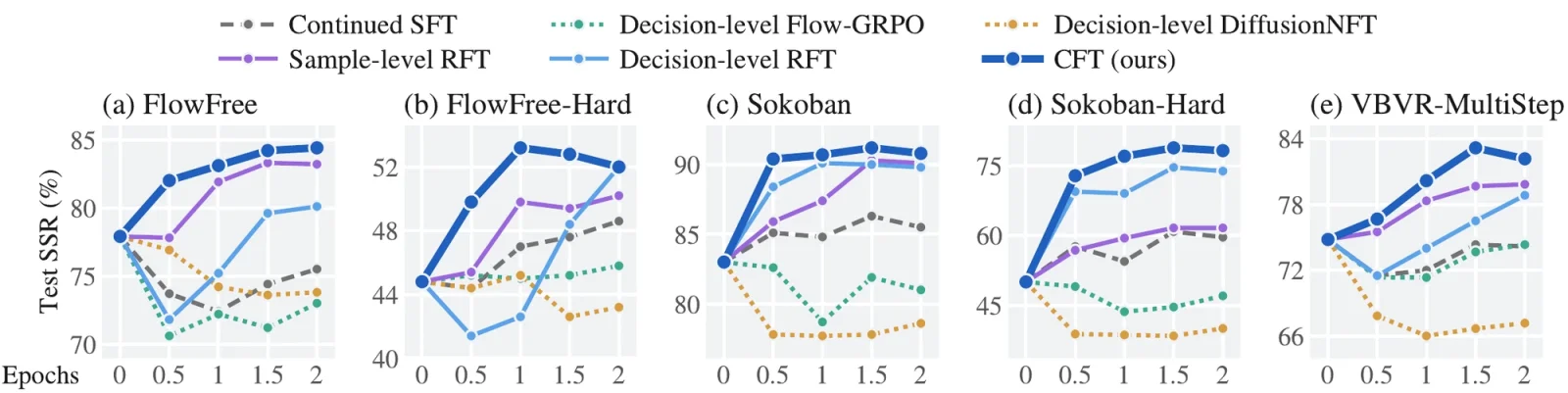 ViDecide test strict success during post-training with corrective fine-tuning
Image: MMLab@NTU ViDecide
CFT matters for builders tired of unstable RL fine-tunes on video foresight models. You get a post-training hook that does not require a full RL stack.
Reported benchmark numbers
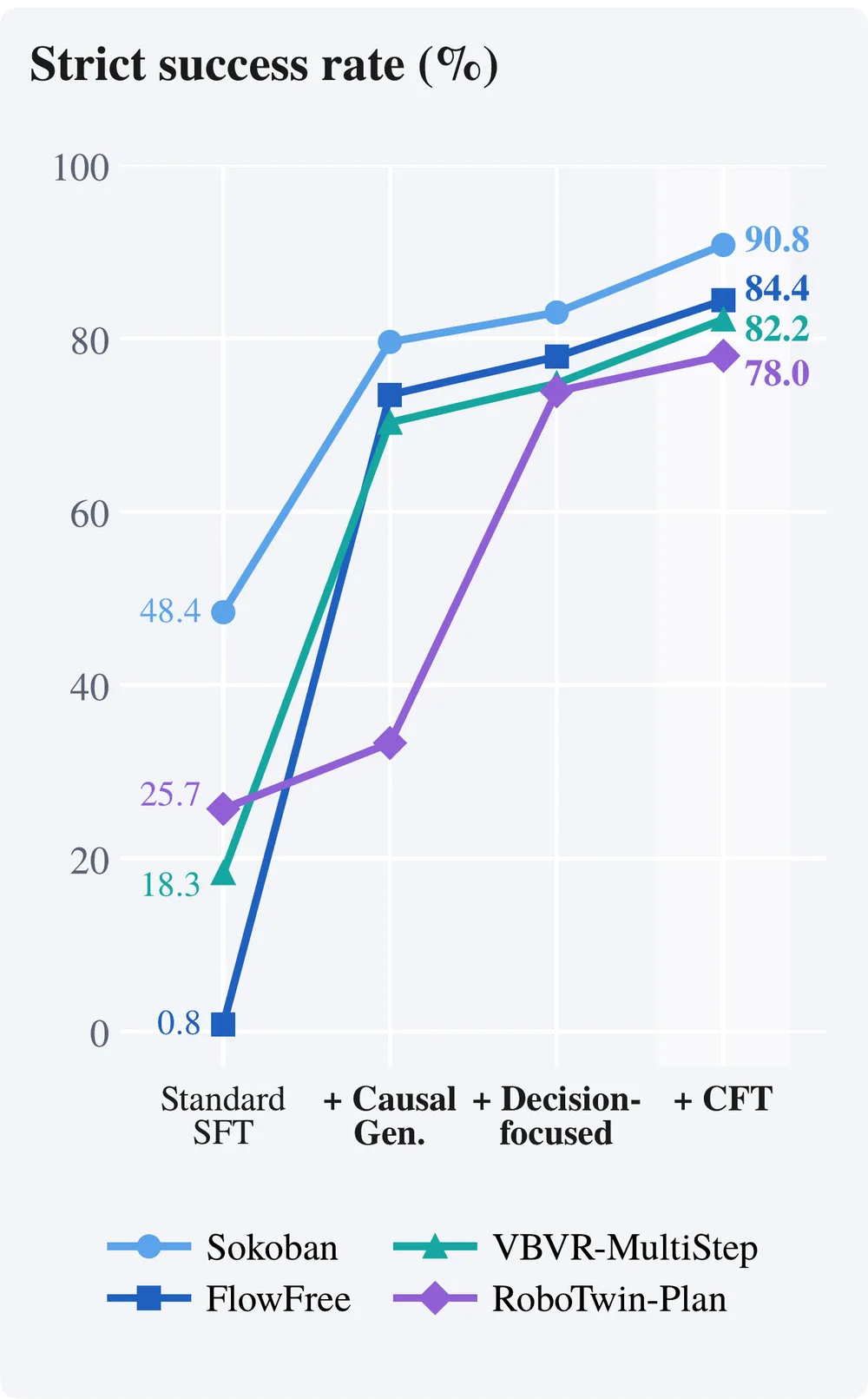 ViDecide strict success rates from standard fine-tuning through causal steps and corrective fine-tuning
Image: MMLab@NTU ViDecide
From the abstract and author thread ( self-reported until replicated ):
| Method | Average strict success |
|---|---|
| Standard fine-tuning | 23.3% |
| Strongest prior method cited | 67.8% |
| ViDecide | 83.8% |
Suites include:
- VideoRLVR — rule-based games with verifiable outcomes.
- VBVR — multi-step planning tasks.
- RoboTwin-Plan — robot planning sequences in video.
Authors also claim generalization to larger puzzles and unseen layouts. Treat that as hypothesis until open eval scripts get third-party runs.
How to try ViDecide
- Open https://kevin-thu.github.io/ViDecide for tasks and checkpoints.
- Clone https://github.com/Kevin-thu/ViDecide and follow README install steps.
- Start with VideoRLVR tasks if you lack robot sim assets; move to RoboTwin-Plan when GPU budget allows.
- Log strict success versus perceptual quality separately—pretty frames can still mask plan failure.
Robotics and embodied AI angle
 Storyboard frames linked to stepwise video planning
RoboTwin-Plan connects ViDecide to humanoid control research and NanoAstra manipulation VLMs. If video models become planners, teams can synthesize training curricula before touching hardware—but only if step validity is measurable. ViDecide's strict metric is aimed at that gap.
Designing your own strict success metric
The authors emphasize strict success: a run fails if any intermediate state violates rules, even when final imagery looks persuasive. That is the same discipline as SciResearch eval for scientific judgment and TASISR text super-resolution reasoning: verifiers first, aesthetics second.
When you adapt ViDecide:
- Define state variables your simulator can read (board arrays, joint angles, inventory counts).
- Freeze a JSON schema for per-step states exported from generated frames (manual labels or auxiliary perception).
- Reject runs where any step fails, even if users would not notice visually.
- Report both strict and lenient scores so stakeholders see beauty vs correctness gap.
Economics and compute
Autoregressive video diffusion costs more forwards than one clip, but you may save overall by terminating early and skipping long tails. Profile GPU-seconds per solved puzzle rather than seconds per megapixel. On small clusters, start with smallest released checkpoint on VideoRLVR only; RoboTwin-Plan can wait until strict success on toy domains is stable.
Connection to Google and platform video bets
While ViDecide is academic, it lands the same week as Google's personalized AI TV patent filing—platforms want infinite episodic content. Planning reliability determines whether generated crime capers respect continuity or become Joan Is Awful-style consent nightmares. Research stacks that verify steps are prerequisites for any long-horizon consumer video product.
Paper details worth skimming
Beyond benchmarks, skim the PDF for:
- Which base video backbone they fine-tune (affects your VRAM plan).
- How RoboTwin-Plan episodes are seeded (transfer to your robot sim).
- Ablations on CFT versus diffusion RL—even if you do not reproduce numbers, the trend informs post-training budget.
Limits
- MMLab@NTU authors report all headline numbers; no independent leaderboard yet.
- GitHub showed low star count on release day—expect rough edges in docs.
- Not a replacement for closed APIs on Hollywood-grade visuals.
- CFT hyperparameters may not transfer to your custom environment without tuning.
Week-one replication checklist
Teams that want citable results on November 24, 2026 should document:
- GPU model and driver used for each suite (games vs robot plan differ).
- Random seeds and whether visual EOS fired early (log frame counts).
- Strict vs lenient verifier outcomes side by side—screenshot pretty failures.
- CFT on/off ablation on at least one task family (even a small subset).
- License for any third-party assets bundled in RoboTwin-Plan if you redistribute videos.
Publish a short thread or issue on the GitHub repo with JSON summaries; that helps the field move faster than another hype carousel.
FAQ for engineering managers
Should we pause our generative video pilot? Not necessarily—use ViDecide as a red-team suite on continuity-critical clips (tutorials, safety training, robot teleop previews) while keeping marketing teasers on single-shot models.
Does strict success correlate with user satisfaction? Unknown publicly; run paired user tests if your product implies stepwise instructions (cooking, assembly, fitness).
Can we distillation-transfer to our domain? Possibly via CFT if you can simulate legal transitions; you still need labeled success continuations.
What to do next
- Reproduce one VideoRLVR task end-to-end and publish seed logs.
- Compare ViDecide against your baseline diffusion fine-tune on the same verifier.
- If you work on agents, pair results with Hugging Face Harbor eval guidance.
- Watch the Hugging Face discussion for checkpoint updates.
Related reading
- Future-OPSD video foresight with Qwen VLMs
- WorldLeague physical agency benchmark
- Embo harness for robot policies
- Plan4D generative 4D worlds from Alibaba
- WeMM-Video open Tencent video models
- 3AGameFactory motion agentic rigging
Sources: arXiv 2611.26389, project page, GitHub, Hugging Face paper page
Historical note
Stepwise video planners sit in a long line of hierarchical RL and options frameworks; ViDecide's contribution is tying those ideas to modern diffusion video backbones with open artifacts. Even if numbers shift after peer review, the evaluation packaging (strict success plus RoboTwin-Plan) is likely to outlive any single 83.8% headline. Download the demo tasks before you commit roadmap slides to leadership.
Accurate as of November 24, 2026. Benchmark claims are author-reported.