




PhysLoop is a new research harness from ByteDance Seed, Peking University, and international partners that treats large language models as physics-aware planners inside a simulator-backed harness. The team published arXiv:2611.16748 and demos on the PhysLoop project site. The paper promises 100,000 physics-focused videos, repair benchmarks, and generation tools. Caveat: the GitHub repo currently says the code release is pending company policy review, and the project site lists the datasets as not yet released.
Video models already look convincing frame by frame. They still fail causality: objects duplicate, collisions ignore momentum, and poured liquids break gravity. PhysLoop attacks that gap by forcing LLM proposals through executable physics, then keeping only clips that pass verification.
TL;DR
| Piece | What shipped |
|---|---|
| Paper | PhysLoop on arXiv, posted November 2026 |
| Labs | ByteDance Seed, PKU, UCSB, MIT, and others |
| Code | DAGroup-PKU/PhysLoop on GitHub: README only, code pending policy review |
| Data | 100K physics videos plus Gen/Repair eval sets: announced, not yet released |
| Simulators | Unreal Engine primary; Taichi and Genesis supported |
| Use cases | Controllable training-data construction and localized video repair |
The problem PhysLoop targets
The paper opens with a simple failure mode: visual realism without physical law. A glass can shatter beautifully while violating contact forces. Collecting ground-truth physics video in the real world is slow and hard to vary. Finetuning on more random internet video does not isolate which physical variable failed.
Recent language-model work such as SEAL and Absolute Zero (cited in the paper) shows models can propose and grade their own tasks when a verifier exists. Video generation lacked a verifier tight enough for dynamics. General multimodal judges miss subtle physics errors.
PhysLoop's bet: LLMs already know physics in text, but cannot consistently apply it across space and time. Put the model inside a simulator with collision meshes, timelines, and multi-camera captures, and you get executable feedback instead of vibes.
How the harness works
The workflow has five conceptual modules the paper names explicitly:
- Task manager — turns a user prompt into a structured task specification with assumptions written down (for example release height for a falling glass).
- Asset and scene construction — retrieves or generates meshes, checks scale and collision proxies, and builds a scene program.
- Simulator execution — runs physics in Unreal Engine, with adapters for Taichi and Genesis.
- Verifier — checks whether observed motion matches the intended physical outcome before accepting a clip.
- Video refiner — improves appearance after physics passes, with another verification pass at the end.
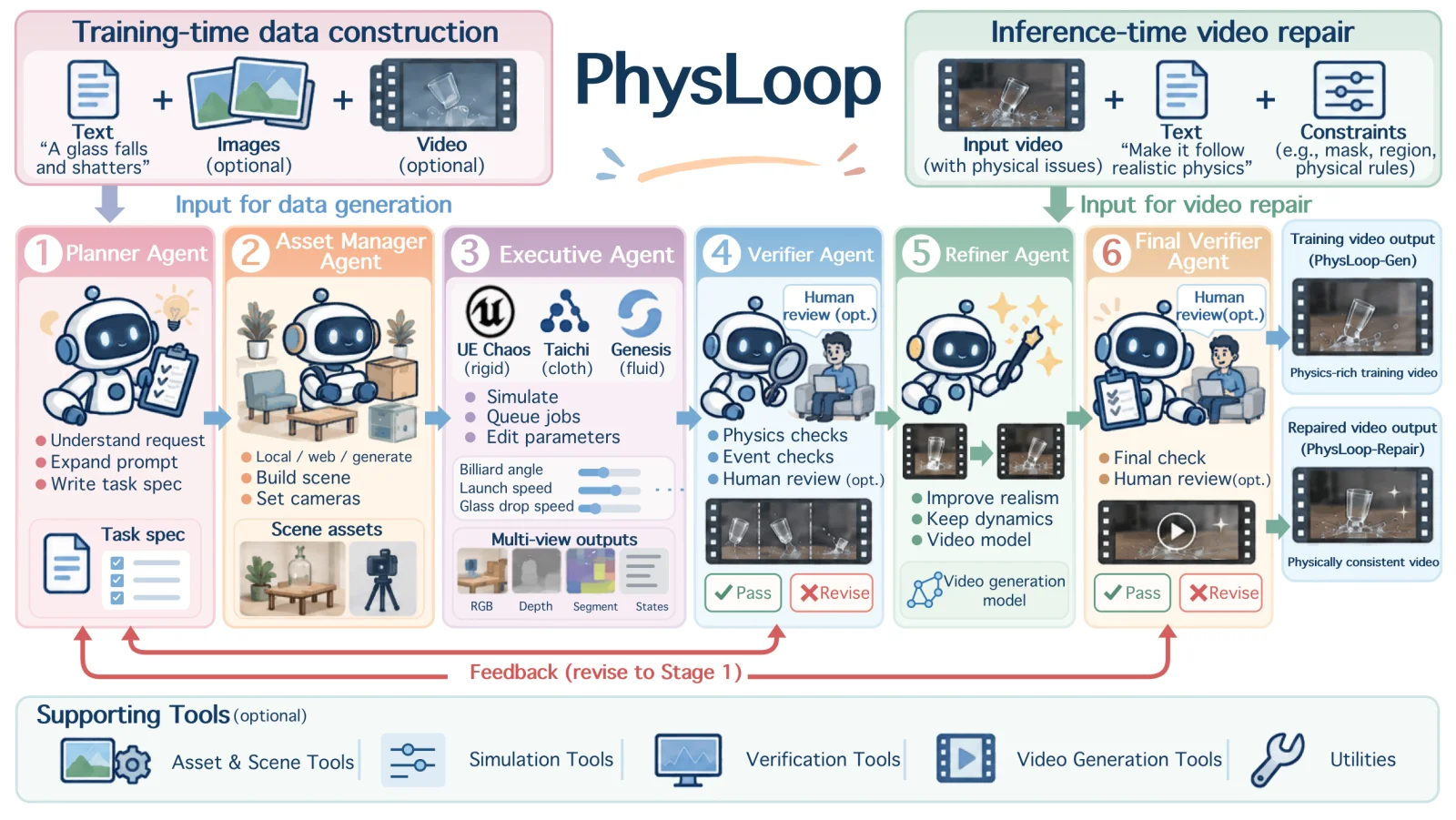 PhysLoop harness diagram showing LLM-guided physics simulation for self-improving video generation
Image: PhysLoop project (ByteDance Seed, PKU, and collaborators)
The project site hosts side-by-side repair demos (glass, dominoes, support structures) where a broken generative clip becomes physically consistent after harness-guided correction. Those MP4s are the fastest way to see what "repair" means here: localized fixes, not a full reshoot.
Two applications: build data or fix video
PhysLoop supports two loops on the same machinery:
Training-data construction. The agent proposes diverse physical scenarios, simulates them, verifies outcomes, and exports multi-view RGB plus depth, segmentation, and state traces linked to simulation time. That is the path toward recursive self-improvement for video models: each round should produce better supervision, not just more pixels.
Video repair. Given an existing flawed clip, the harness diagnoses the physical inconsistency, adjusts the scene program or initial conditions, and re-renders while trying to preserve untouched regions. The paper places this next to inpainting and correspondence-editing methods, but insists appearance coherence is not physical correctness.
What the 100K-video release promises
The abstract says the team releases 100K videos spanning common physical phenomena in realistic indoor and outdoor scenes, plus the items below. On November 13 the project site listed PhysLoop-Gen, PhysLoop-Repair, and PhysLoop-100K as "Not released", with Hugging Face hosting planned.
- PhysLoop-Gen — controllable generation evaluation
- PhysLoop-Repair — localized repair evaluation
- Generation tools for building more data
For builders, the important part is paired structure: videos come with task specs, simulation records, and verification outcomes, not just MP4 files. That is closer to robotics dataset practice than to scraped short-form video.
Simulation stack and why Unreal Engine
Unreal Engine is the primary simulator because the harness needs rich rendering, articulation, and contact events with multiple calibrated cameras on one timeline. Taichi and Genesis extend coverage for specific material or fluid setups the adapters translate into UE-aligned motion.
The paper is explicit that visual meshes and collision proxies separate. A decorative glass mesh can sit on a simpler collision body. That detail matters when you port the idea to your own sim: never grade physics on render fidelity alone.
Evaluation claims
The authors evaluate controllable generation, localized repair, and physical behavior on PhysLoop-Gen, PhysLoop-Repair, and an external benchmark they cite from prior work. Scores mix human judgments and automatic metrics. explainx.ai has not rerun those evals; treat numbers in the PDF as author-reported until independent reproductions land.
Still, the evaluation design is instructive for teams building agent benchmarks: separate did the physics error get fixed from did unrelated pixels drift.
How PhysLoop fits the wider research map
Several explainx.ai threads connect here:
- Self-improvement without humans — Sakana MASS trains a 27B model through agent teams; PhysLoop applies a similar instinct to video plus simulators.
- World models for driving — Nvidia BirdDreams chases spatial consistency in automotive settings; PhysLoop generalizes contact and inertia lessons to everyday objects.
- ByteDance video products — Our Seedance 2.5 Flash claimed-vs-verified piece tracks commercial video APIs; PhysLoop is the research-side tooling that could feed future price-per-second offerings if physics quality becomes a selling point.
- Causal reasoning interpretability — ACM causal abstraction asks whether we can understand LLM reasoning; PhysLoop instead forces reasoning into executable scenes where failure is visible.
 Film strip illustrating frame-by-frame AI video generation
What you can do now
- Read the paper PDF for task definitions and verifier rules.
- Watch repair and construction videos on the project site.
- Watch github.com/DAGroup-PKU/PhysLoop for the code release. The README already points to Unreal Engine setup docs, so expect UE and GPU requirements; this is not a laptop-only demo.
- When the datasets land, compare your current physics-error rate on PhysLoop-Repair against generic VLM judges you already use.
Paper metrics worth reproducing
The PhysLoop PDF reports human and automatic evaluations across PhysLoop-Gen, PhysLoop-Repair, and external physics-behavior suites. explainx.ai has not rerun them, but three design choices matter for anyone porting the harness:
- Verifier-before-refiner ordering — appearance polish runs only after physics checks pass, reducing the classic failure mode where a beautiful render hides a wrong collision.
- Multi-view capture — RGB, depth, segmentation, and object states share one simulation timeline, which is what robotics datasets expect but most scraped video lacks.
- Task specs as artifacts — assumptions like drop height are written into the task record, making failures searchable instead of buried in prompt logs.
If you maintain a video model, benchmark one repair slice before you benchmark one aesthetic metric. Consumers notice physics glitches in product demos even when FVD improves.
Connecting PhysLoop to product roadmaps
ByteDance ships consumer video inside CapCut, Douyin, and enterprise APIs tracked in our Seedance pricing verification coverage. PhysLoop is upstream research, not a SKU, but it shows where ByteDance invests when competitors fight on seconds per dollar alone.
Western labs chase similar sim-to-video paths through Nvidia Cosmos and world-model narratives (BirdDreams driving work). The differentiator here is explicit LLM orchestration inside the sim rather than finetuning on passive clips.
For embodied AI teams, PhysLoop-Gen looks closer to data flywheels for humanoids than to TikTok effects. Pair it mentally with Physical Intelligence's RoboColosseum eval, which also argues partial-credit metrics beat binary success rates.
Limitations the paper acknowledges
The paper's limitations section says PhysLoop depends on the coverage of its simulators, assets, and verification conditions. Repairing a video requires assumptions about unobserved geometry, materials, and initial states, so a valid simulation may not recover the original physical process. Appearance refinement can introduce new errors, and local replacement may fall short when a mistake has already changed later events. Ambiguous cases may need human review.
None of that diminishes the release. It defines where open replication should focus next.
Why ByteDance shipping open physics tooling matters
ByteDance competes on consumer video products globally. A multi-university paper with planned open code and data fits the wider open-research pressure from labs such as Tencent. The release is still pending, so judge it by what ships. For compliance teams, note dual-use: better synthetic physics also helps robotics and defense sims. Treat future downloads like any other large dataset: license review, storage policy, and sandboxed execution.
Licensing and compute expectations
The repo README says original project code uses the MIT license and third-party components keep their upstream licenses. Dataset terms are not published yet. Expect Unreal Engine install weight, GPU time for rendering, and storage for multi-view dumps. This is a research harness, not a one-click Colab notebook.
Teams already running Hugging Face Trellis 3D workflows may have asset pipelines that snap into PhysLoop's mesh retrieval stage. Teams running only API video generators should still study the repair benchmark to know which failure classes your vendor ignores.
FAQ-style comparisons readers ask in chat
Is PhysLoop a new video foundation model? No. It is infrastructure that produces or repairs clips used to train or evaluate other generators.
Does it replace VLM judges? Partially for physics-labeled errors, not for aesthetic quality or toxicity.
Can I use only the repair tools? The project site demos suggest yes, but read the paper's repair section for input formats and verifier dependencies.
Repository status, figure URLs, and benchmark names reflect arXiv v1, the GitHub README, and the project site as of November 13, 2026.