



Vision-language models can learn to anticipate the useful part of a future video clip — without human labels, without GPT-written rationales, and without an LLM judge scoring every token. Future-OPSD, from Jingchen Sun, Jiaxing Zhang, Qingqiao Hu, and colleagues at University at Buffalo, Stony Brook, Johns Hopkins, Duke, and Maryland, trains Qwen3-VL and Qwen3.5 backbones with on-policy self-distillation on past→future video pairs. The paper reports up to +14.2 points on open-ended prediction and +15.9 on closed-ended planning, while general video understanding scores stay largely flat. Code and checkpoints are linked from future-opsd per the Hugging Face paper page.
Why video foresight is hard to supervise
Foresight — predicting what happens next in egocentric or third-person video — underpins world models, robot planners, and autonomous driving stacks. Recent VLM methods often need:
- Human captions of future segments,
- LLM-generated rationales, or
- LLM judges for reinforcement learning.
That does not scale when your corpus is millions of unstoppable kitchen clips and warehouse pov feeds.
Future-OPSD's bet: the future clip itself is the supervision signal, if you teach the model which seconds matter.
Not all future pixels are equally important
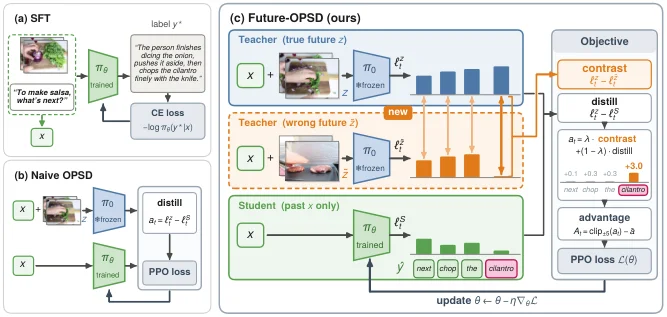 Future-OPSD on-policy self-distillation diagram for video foresight VLM training
Image: Sun et al., arXiv 2611.26954
The paper's Figure 1 kitchen example: to answer "what will I do next?", only "rinse the knife" is content; tap, dish rack, sponge are context that should not dominate the loss.
Older pipelines often fit the entire future transcript or frame sequence, which dilutes gradients on the decision-critical tokens.
How Future-OPSD works (builder view)
| Piece | Role |
|---|---|
| Student π | Sees past clip only, generates reasoning + answer tokens on-policy. |
| Teacher π₀ | Frozen copy of the initial student, also sees the true paired future. |
| Reference future z̃ | A random future from another video — contrast target. |
| Foresight score | How well the student matches the true future; optimized via a tractable lower bound. |
| Privilege advantage | Contrasts teacher scores under true vs reference futures to suppress shared context. |
| Distillation advantage | Standard teacher–student token gap on the true future. |
| PPO update | Uses clipped, centered advantages; inference uses student only. |
Naive OPSD (teacher–student only) is the ablation baseline. Future-OPSD wins on both open and closed foresight suites in the paper's Tables 1–2.
Case study numbers readers can cite
On an EgoPlan-IT example with Qwen3-VL-8B, the authors show Future-OPSD up-weights content tokens (e.g., cilantro) and down-weights context (next / chop / the) compared with Naive OPSD, using λ = 0.75 on the context term.
Benchmark lifts (author-reported)
Treat these as preprint scores:
| Task family | Reported gain over base (max in paper) |
|---|---|
| Open-ended prediction | +14.2 points |
| Closed-ended planning | +15.9 points |
| General video understanding | Mostly preserved (per paper text) |
Stronger teachers and more data help further — the paper frames foresight as data-limited, not architecture-limited.
Who should try this
| Use case | Why Future-OPSD fits |
|---|---|
| Egocentric assistants | Kitchen / workshop next-action hints without hiring annotators. |
| Robot data lakes | Pair teleop past with executed future from the same episode. |
| Autonomy sim export | Split logged trajectories when labels exist only at episode level. |
Pair with Hugging Face's agentic evaluation guide when you move from offline foresight to closed-loop agents.
Limits and honest caveats
- Backbone coverage — main tables center on Qwen3-VL / Qwen3.5; other VLMs are not the headline.
- Benchmark scope — gains are on paper-selected foresight suites; your domain shift may differ.
- Compute — on-policy PPO with two future conditioners is heavier than SFT on captions.
- Peer review — arXiv only as of November 2026.
If you need labeled foresight today, see Merlin-style trajectory pretraining cited in the paper's related work — Future-OPSD is the unlabeled path.
How to run it (starting points)
- Read 2611.26954 and the HTML figures.
- Open jingchensun.github.io/future-opsd/ for repo + checkpoint links announced on Hugging Face.
- Start from Qwen3-VL-8B if you want to match paper EgoPlan-IT cases.
- Log Naive OPSD vs Future-OPSD on your validation split before shipping.
For Qwen ecosystem context, compare GLM-5.4 coding quotas (product) vs this research training recipe (self-hosted).
Prior art the paper improves on
Future-OPSD is not the first video foresight trainer, but it attacks two bottlenecks earlier lines leave open:
| Approach (cited in paper) | Supervision source | Future-OPSD difference |
|---|---|---|
| Merlin trajectory pretraining | Curated trajectories + instructions | No curated foresight captions required |
| Next-Event Prediction | Future captions + LLM rationales | No external LLM for labels or judging |
| TwiFF / FUTURE-L1 / IVT | Future frames or embeddings + judges | Privilege advantage down-weights irrelevant future pixels |
| Naive OPSD | Teacher–student on same future | Adds contrast with random reference future |
If you already run SFT on future text, try Future-OPSD as a second stage when caption budgets stall — especially on egocentric corpora where actions are visible but narrators are not.
Mathematics in builder language
The foresight score asks how well student tokens align with the true future. Averaging over all possible futures is intractable, so the authors optimize a lower bound combining:
- Contrastive privilege advantage — teacher log-probs under true future z minus log-probs under reference future z̃ from another video.
- Distillation advantage — teacher minus student on the true future.
The interpolation parameter λ (e.g., 0.75 in the case study) controls how aggressively you suppress context tokens that both futures share. Tokens like "the" or "next" should score low advantage; tokens like "cilantro" or "rinse" should score high.
PPO then uses clipped, centered advantages on on-policy rollouts. At inference, you deploy only the student — no teacher, no reference future clip.
Where foresight shows up in production stacks
| Domain | Foresight use | Why unlabeled training helps |
|---|---|---|
| Warehouse cobots | Predict grasp trajectory after partial observability | Millions of uncaptioned RGB streams |
| Kitchen egocentric | Next action for AR hints | RoboTrack-class data without narrators |
| Ride-hail autonomy | Short-horizon intent before merge | Sim logs pair past dash cam with executed path |
Future-OPSD does not ship a foundation world model ready for closed-loop control. It is a fine-tuning recipe you apply when you already picked a Qwen-VL backbone.
Training cost and failure modes
Expect more GPU hours than caption SFT:
- Two forward passes through teacher pathways (true and reference futures).
- On-policy PPO instead of static cross-entropy.
- Hyperparameters (λ, clip ranges, teacher EMA) tied to EgoPlan-IT-style tasks in the paper.
Failure modes to log in your fork:
| Symptom | Likely cause |
|---|---|
| General video QA drops | Overfit foresight — reduce steps or mix general SFT |
| No gain over Naive OPSD | Reference futures too easy — sample hard negatives from same scene type |
| Gibberish planning answers | Student capacity — try Qwen3.5-9B tier per paper tables |
Evaluation checklist before you trust gains
- Reproduce Naive OPSD baseline on your validation split.
- Hold out entire video sources not seen in training (not only random frame crops).
- Report open-ended and closed-ended tasks separately — the paper shows different deltas.
- Track general video understanding benchmarks cited in supplement so you do not trade away caption QA.
When you move to agents, wire foresight checkpoints into Hugging Face Harbor-style evals before customer betas.
Hugging Face release status
The Hugging Face papers page for 2611.26954 includes a community note from submitter Jingchen Sun stating code and checkpoints are released, with a TL;DR mirroring the arXiv abstract (+14.2 open-ended, +15.9 closed-ended on Qwen3-VL-8B and Qwen3.5-9B). Treat Hugging Face as a discovery pointer only; cite arXiv and the project site as primary sources in your own docs.
If you mirror weights, pin commit hashes and dataset splits — foresight metrics move when reference-future sampling changes. Document whether you drew random futures from same dataset or cross-dataset pools; the paper's contrastive term assumes mismatched futures carry overlapping kitchen verbs but different action content.
Connecting to Qwen roadmap readers follow
explainx.ai readers already track ChatGPT and GPT-6.2 rollouts and Clover diffusion MoE agents. Future-OPSD is not a rival product — it is post-training you can apply when you standardize on Qwen-VL locally or through Together-style hosted endpoints for non-foresight tasks.
| If you already use Qwen for… | Try foresight fine-tune when… |
|---|---|
| OCR + chart QA | You need proactive UI hints before users ask |
| Warehouse QA bots | Clips include repeated pick-place without narrators |
| Sports analytics | Broadcast footage lacks play-by-play labels |
Start with short horizon (3–5 second) futures before minute-long prediction; the paper's privilege advantage assumes paired futures from the same episode.
 Multimodal reasoning path across sequential video frames
Image: Library reference — foresight training assumes temporally ordered clips, not isolated frames.