



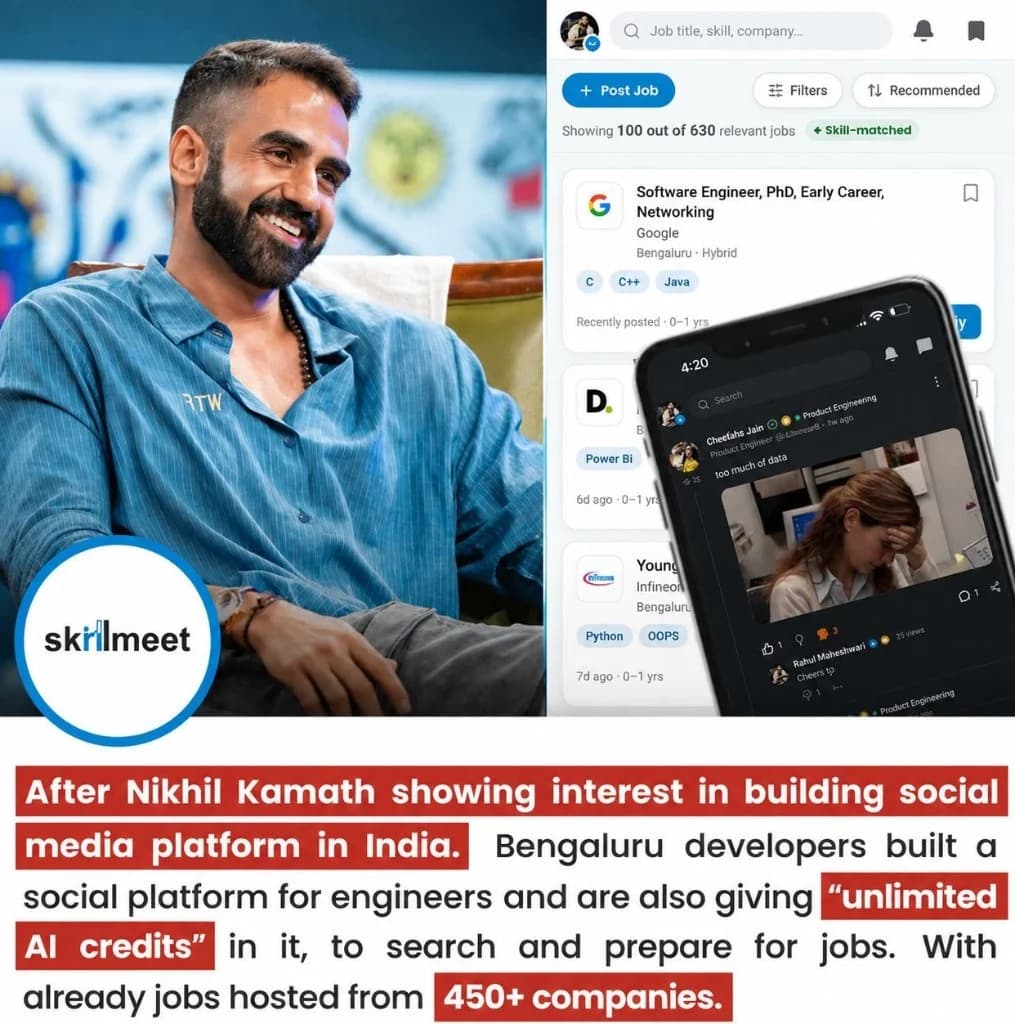
India has spent more than a decade trying to own its social graph — ShareChat launched in 2015, crossed ₹1,000 crore in operating revenue in FY26, and is now eyeing a $400M IPO while pivoting hard into microdramas. Koo, the Twitter-alternative wave of 2021, shut down in 2024 after funding dried up. Into that long arc walks Skillmeet.ai: not a general-purpose feed for a billion users, but a Bengaluru-built career OS that merges jobs, coding, live project proof, and squad-based social rooms — with unlimited AI credits (per the product's marketing) for interview prep through an agent called Locus.
The timing overlaps with a separate story. On the People by WTF podcast in March 2026, Zerodha co-founder Nikhil Kamath told ElevenLabs CEO Mati Staniszewski he is building an India-focused social platform designed for curiosity and structured debate, not outrage loops — and warned that foreign-controlled algorithms should not define "the mood, nature and evolution of the youth of my country" (Fortune India). Skillmeet is not that platform. It is something narrower and, for builders, arguably more immediately useful: entropy reduction in a job market where good engineers and good companies routinely fail to find each other.
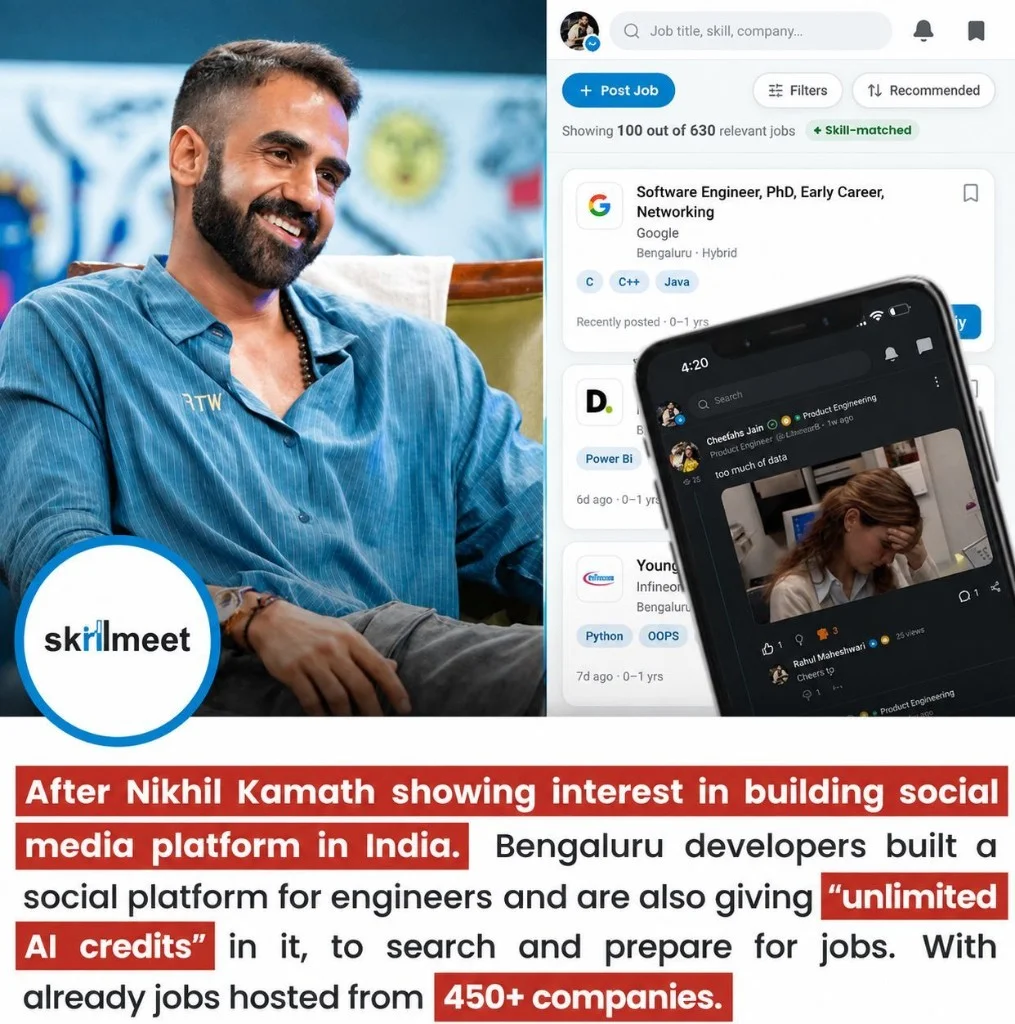 Skillmeet.ai promotional graphic showing job board UI, squad social feed, and India engineer career platform positioning
TL;DR — what Skillmeet actually ships
| Question | Direct answer |
|---|---|
| What is it? | Engineer-focused career OS: jobs + AI prep + coding + live projects + social squads |
| Scale (Aug 30, 2026) | 478 companies · 14,657 live jobs · 130,998 interview questions · 24 certificates |
| Unlimited AI? | Locus agent marketed as unlimited for job parsing, question ranking, and prep roadmaps |
| Who built it? | Bengaluru team; site copy says developers who've been through hiring themselves |
| Funding | $1M seed reported by StartupHub.ai (July 2026 profile) |
| vs LinkedIn/Naukri? | Vertical engineer loop with proof-of-skill, not generalist identity or mass listings |
| Kamath connection? | Thematic only — no confirmed tie to his separate social project |
Why the "11 years" framing is not hype — and why Skillmeet is different
ShareChat's CFO told Inc42 that February 2025 was the first cash-breakeven month in the company's eleven-year history (Inc42, March 2026). That is the honest backdrop: India has homegrown social products, but monetizing vernacular feeds at scale took more than a decade, and the winners pivoted away from chasing Instagram.
Skillmeet sidesteps the super-app trap Kamath explicitly rejected. On skillmeet.ai, the pitch is not "replace WhatsApp." It is replace the scattered tab stack — Naukri for listings, LeetCode for DSA, LinkedIn for signaling, Telegram for referrals, a PDF resume for proof — with one loop tuned to how Indian engineers actually get hired.
Three design choices stand out for builders evaluating whether this category has legs:
-
Local behavior, not Silicon Valley cosplay. Jobs refresh from company career pages (Google, EY, IBM, Dodo Payments, and hundreds more appear in live listings). Squads like "Frontend Engineers India" (1,284 members in the product mock) mirror how Indian devs already organize in WhatsApp and Discord — but with Meets, ranks, and recruiter visibility baked in.
-
Profile as living proof, not a two-page PDF. Exposure spins up live containers, grades against rubrics, and writes verified scores back to your profile. Code ranks DSA problems by real interview frequency — "LRU Cache, asked at 40+ companies" — not random problem count. The resume builder and Resume Fit layer sit on top of that proof, not instead of it.
-
Identity as reputation layer. Leaderboards, squad ranks (Sergeant → Lieutenant → Squadron), referral graph via Locus, and recruiter hub views ("3 recruiters viewed your profile this week") accumulate signals that are expensive to fake — closer to GitHub commit history than LinkedIn endorsement spam.
That third point is the explainx.ai read: in a market where 66% of AI/ML workers in India report layoff anxiety — and entry-level hiring pressure is real — discoverability beats credentialing. Platforms that compress proof, community, and matching reduce entropy for both sides of the market.
Product walkthrough — the six modules on one stack
Skillmeet's homepage stacks six pinned sections. Here is what each does, with numbers pulled from the live site on August 30, 2026.
Locus — unlimited AI for job prep
Locus is the AI mentor. Paste a job link and it parses the role, matches questions from a 130,000+ database, ranks them by frequency, and outputs a round-by-round roadmap (OA → DSA → LLD → system design for a typical Amazon SDE-2 track). Hero copy also promises "Apply unlimited" resume tailoring per job.
For builders, the interesting design is job-conditioned retrieval — not a generic chatbot. The product positions Locus as "like a senior who's cracked every interview." Whether the underlying models are hosted in India or routed through third-party APIs is not disclosed on the marketing site; if you are evaluating this for a fintech or regulated employer, ask before pasting confidential JDs.
Jobs — verified listings, skill-matched
The jobs board pulls 14,657 live openings from 478 companies, refreshed every 24 hours. Listings show skill tags (Go, Kafka, Postgres, system design) and location (Bengaluru hybrid roles appear frequently). A separate hire.skillmeet.ai recruiter hub scouts candidates off leaderboards — distribution inverted: companies come to ranked engineers, not only the reverse.
The promotional graphic you may have seen claims 450+ companies; the live counter had already moved to 478 by late August — a small but useful reminder to cite primary product stats, not stale ad copy.
Squad — social rooms, not a global feed
Squad is Skillmeet's social layer: topic rooms (e.g., "Frontend Engineers India") where posts, memes, interview write-ups, and Meets live together. Members earn ranks through active days and posting streaks; higher ranks unlock video, voice notes, and PDFs.
This is the piece that rhymes with Kamath's stated interest in community designed for a specific emotion — here, solidarity and prep accountability rather than viral outrage. It is also the hardest module to scale without moderation debt; treat early squads as curated seeds, not proof of nationwide engagement yet.
Exposure — live containers, graded proof
Exposure assigns real-world engineering tasks — rate limiters on Kubernetes, webhook HMAC validation, observability setups — in live containers, grades against rubrics, and surfaces scores on your profile. Domains listed include security, LLM engineering, data engineering, cloud/IaC, system design, and QA.
That is the module most differentiated from Naukri or LinkedIn. It is also the most expensive to operate; uptime and grading consistency will determine whether Exposure becomes a trusted signal or a demo gimmick.
Code — interview-frequency-ranked DSA
The Code section is a LeetCode-class judge with weekly contests, a live leaderboard, and mock mode that hides the topic — practice closer to real loops. Problems are tagged by how often they appear in interviews, aligning with the platform's "entropy reduction" thesis: fewer, better problems beat infinite random grind.
Dev Connect — mentor cohorts (waitlist)
Dev Connect is mentor-led live cohorts; the site showed 1,240 people on the waitlist with a live join feed. Still pre-launch as of August 2026 — relevant if you learn better from humans than from Locus alone.
Nikhil Kamath's India social push — source, not sponsor
The Kamath angle matters for market context, not product ownership. On People by WTF (March 12, 2026), Kamath said:
"I think there's an emotion you can design for that sits further right on the spectrum—curiosity, the pleasure of sounding smarter, the thrill of genuine debate."
He also said he does not want foreign nations controlling algorithms that shape Indian youth, and described a platform focused on verified individuals rather than a WeChat-style super-app (Fortune India). Indian Startup News separately reported he is recruiting CXO talent from companies like Snapchat for that project — still under wraps, with no launch date.
Skillmeet promotional creative references Kamath because the narrative collided: India wants its own networks, Bengaluru keeps shipping vertical ones. conflating the two in headlines is lazy; Skillmeet is live today at skillmeet.ai, Kamath's debate network is not.
How Skillmeet compares — honestly
| Surface | Naukri | GitHub | Skillmeet | |
|---|---|---|---|---|
| Primary job | Professional graph + content | Mass job listings | Code artifact hosting | Engineer hiring loop |
| Proof of ability | Endorsements, posts | Resume keywords | Repos, contributions | Exposure grades, contests, leaderboard |
| Social | Global feed | Minimal | Follow graph | Squad rooms + Meets |
| AI prep | Premium coaching products | Resume services | Copilot (code) | Locus — job-linked, marketed unlimited |
| India depth | Broad | Broad | Global | Engineer-vertical, Bengaluru-centric listings |
None of these are strict substitutes. A senior engineer with a dense GitHub graph may not need Skillmeet. A 2025–2026 grad navigating referrals, OA pipelines, and Bengaluru hybrid roles gets a tighter bundle — if the Exposure and Locus claims hold under load.
For the broader "should I certify or build?" question, see explainx.ai's case against AI certificates before building. Skillmeet's Exposure module is essentially trying to productize the portfolio side inside the job platform.
What people should ask before signing up
Fair-use on "unlimited" AI. Marketing says unlimited Locus credits; check terms once you authenticate. Job descriptions from stealth startups may contain material you should not paste into third-party agents.
Grading trust. Exposure scores only matter if recruiters recognize them. Early signal: watch whether hire.skillmeet.ai customers cite Exposure in screening rubrics.
Concentration risk. Like any startup job board, listings skew toward companies actively partnering with the platform. Cross-check dream employers on official career pages.
Not sovereign AI. Skillmeet is an application-layer play in India's stack — complementary to, not a replacement for, compute and model sovereignty work covered in India's sovereign AI status and the August 2026 startup roundup.
Career meta-skills still apply. Loop-based agent workflows — designing systems that observe, act, and self-correct — are becoming hiring signals themselves. If you are prepping for 2026–2027 loops, pair platform practice with loop engineering career fundamentals.
What this means if you build in India
Skillmeet is an experiment in vertical social — community, proof, and marketplace in one graph for a single profession. That is a pattern Indian founders keep retrying because horizontal social is brutally expensive and ad markets are thin.
If you are building adjacent tools (interview agents, referral marketplaces, skills graphs), the wedge is not "another AI chatbot." It is structured reputation: make ability legible faster than a hiring manager can scroll a PDF. Skillmeet bets that legibility comes from graded containers, ranked DSA, squad activity, and recruiter-side search — not from a viral feed.
Kamath's separate project, if it ships, will test whether intellectual curiosity can be a product emotion at scale. Skillmeet tests a narrower hypothesis: engineers will join a network where getting hired is the main plot. Both belong in the same chapter of India's platform history; they are not the same book.
Related on explainx.ai
- 66% of India's AI workers expect layoffs — what the Blind survey actually says
- AI certifications vs building a portfolio — the 2026 case for proof
- Loop engineering career guide 2026
- India's sovereign AI status and IndiaAI Mission
- India AI progress — top 15 startups since Independence Day 2025
- Forward Deployed Engineer — the hottest tech role of 2026
- AI skills employers actually want in 2026
Official sources: skillmeet.ai · StartupHub Skillmeet profile · Fortune India on Kamath + ElevenLabs · ShareChat eleven-year turnaround (Inc42)
Company counts, job totals, and feature availability on Skillmeet.ai are accurate as of August 30, 2026, per the live marketing site. Funding figures come from third-party startup databases, not audited filings. Nikhil Kamath's social platform remains unannounced; treat media reports as directional.