




Huawei is reported to be telling some customers to find the memory for its next AI chip on their own. The Decoder, summarizing a report by The Information on November 3, 2026, says Huawei's suppliers in China cannot make enough high-bandwidth memory (HBM), and US export rules block direct purchases from Samsung and SK hynix. The result, according to the report, is a black market that prices smuggled HBM3E at about $4,000 a unit.
All of this rests on anonymous sources in a report we could not read in full. Below, we mark each claim with who made it.
TL;DR: reported claims and their status
| Claim | Who says it | Status |
|---|---|---|
| Huawei asked some customers to source HBM themselves | The Information, via The Decoder and TrendForce | Reported, sources anonymous |
| Reason: Chinese suppliers cannot make enough; US rules block Samsung and SK hynix sales | Same | Reported |
| Smugglers bundle HBM with cheap server CPUs and route via Hong Kong | Same | Reported |
| Workshops melt solder to separate the memory | Same | Reported |
| Smuggled HBM3E rose from a few hundred dollars to about $4,000 per unit | A Shenzhen broker quoted by The Information | One anonymous broker |
| Each AI chip needs six to eight units, so up to $32,000 | The Decoder's arithmetic from the report | Calculated |
| Ascend 960DT due early 2027, doubling the current chip | Huawei claim, per The Information | Target, untested |
| South Korea found $560M in trade violations by May | The Decoder, citing Korean customs | Reported, we did not open the customs source |
What is the loophole?
Export rules in this case judge a package by the computing power of its processor, not by the memory attached to it. TrendForce, relaying the report, says smugglers exploit rules that "assess the packages' computing power based on the processors rather than the memory."
So the steps reported are:
- Pair expensive HBM with a cheap, low-performance server processor below the export threshold.
- Ship the package through Hong Kong to China as a legal export.
- In China, technicians heat the package to soften the solder, lift off the HBM stacks, and discard the processor.
The Decoder adds that the error rate is high and the process is fragile, but the margins justify it. We cannot verify any of this independently.
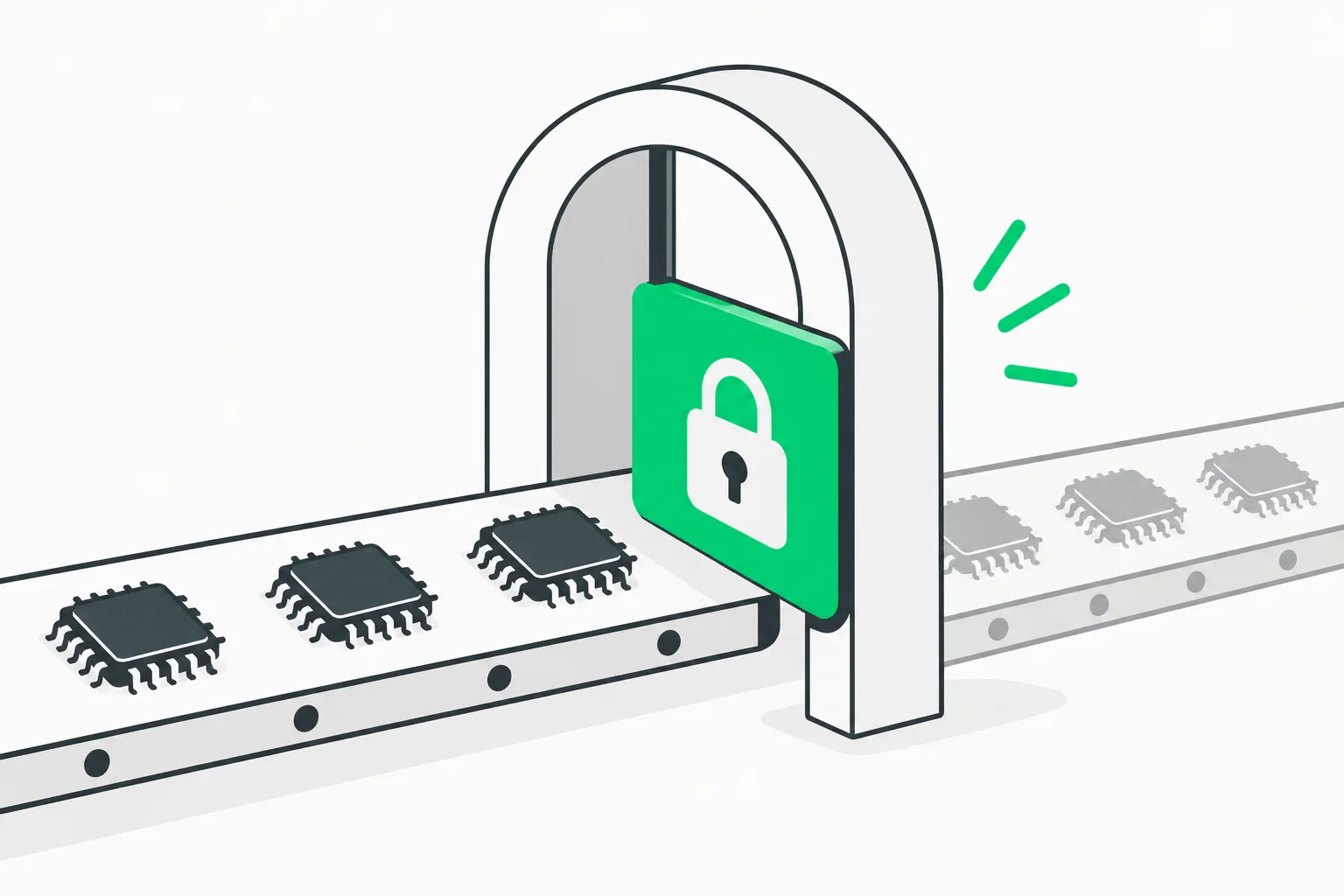 Export control gate over a stream of chips, illustrating the HBM smuggling loophole and Huawei Ascend 960DT supply
Why Huawei needs this memory
HBM is stacked memory placed beside an AI processor. Its capacity and bandwidth set how fast a chip can feed a large model. TrendForce says the Ascend 960DT is expected in the first quarter of 2027 and is set to double the memory bandwidth and capacity of Huawei's current AI processor. The Decoder reports that Samsung and SK hynix together control over 80 percent of the global HBM market.
Domestic supply is not close. TrendForce cites Reuters saying CXMT's HBM3E yields sit at about 20 to 30 percent, against roughly 70 percent at SK hynix. We covered that report in CXMT's HBM3E production, claimed vs verified. The report also says Fujian Jinhua, a US-sanctioned memory maker that has supplied Huawei for years, trails Korean rivals and lacks capacity.
Memory shortage shows up in price. TrendForce, citing The Information, says Huawei told some customers it was raising the suggested price of the Ascend 950DT to more than RMB 250,000, about US$37,000. It adds that the chip delivers roughly half the raw compute of Nvidia's H100 yet now costs as much as a B200. Those price and performance comparisons are the report's, and we have not tested them.
The DeepSeek connection
TrendForce also says Huawei is working with DeepSeek to optimize the chip for pre-training, a job DeepSeek previously did only on Nvidia hardware. We examined that co-design claim separately in DeepSeek and Huawei chip co-design, claimed vs verified. If the memory problem is real, it limits how many 960DT accelerators can be built, however good the design is.
Background: why memory became the choke point
Export controls first targeted the processors themselves. High-bandwidth memory became a target later, because a top accelerator is close to useless without it. In December 2024 the US Commerce Department added HBM to its controls on advanced computing items, to our knowledge, which is why Samsung and SK hynix cannot ship the newest stacks to Chinese buyers directly. Check the Bureau of Industry and Security rules for the exact text before relying on that date.
That left China with three sources of HBM:
- Domestic production. CXMT is ramping HBM3E, but with low reported yields. Low yield means many failed stacks per good one, which limits volume and raises cost.
- Stockpiles. Earlier purchases and parts stripped from older Nvidia GPUs. The Decoder says stripped older Nvidia GPUs and excess inventory from chip designers who scrapped projects also feed the black market.
- Smuggling. The package trick described above.
For Huawei the third path is awkward because a public company cannot openly buy smuggled parts. Pushing the sourcing step to customers, as reported, moves the legal and logistical risk onto them. That is why The Decoder describes it as "effectively outsourcing procurement to the black market." The phrase is The Decoder's interpretation of the report, not a Huawei statement.
Questions readers are asking
Is Huawei itself smuggling? The reports say Huawei asked customers to obtain memory. They do not say Huawei ran the smuggling. Huawei has not, in the sources we read, commented.
Does this mean US export controls failed? It means one route leaks, according to anonymous sources. Controls can slow a competitor even when they leak, because smuggled supply is costly and unpredictable. How much they slow it is a policy argument we cannot settle from this report.
Why not just buy older HBM? Older generations carry less bandwidth and capacity, and Huawei's stated goal for the 960DT is to double both. A weaker memory part would undercut the design target.
Does the price rise matter outside China? Indirectly. High Chinese compute prices push more demand toward open-weight models and efficiency work, such as the DeepSeek inference engine we covered in DeepSeek's open-source DeepInfer engine. Memory-light model designs become more valuable when memory is scarce.
How reliable is TrendForce here? TrendForce's write-up is also a relay of The Information, so it is not independent confirmation. Two outlets repeating one report count as one source.
Enforcement is moving too
Governments are tightening around this route. Taiwan moved to criminalize shipping AI chips and servers to China, covered in Taiwan's Foreign Trade Act plan. Malaysia seized servers worth RM49.5 million in its fifth case, in Malaysia's KLIA customs seizure. Market-share claims for Huawei and Nvidia in China are checked in Nvidia 34%, Huawei 28%.
The Decoder says South Korea's customs authority uncovered trade violations worth $560 million by May, passing the previous full-year record, and that a third of the total involved strategic goods such as chips exported without authorization or with false declarations. We did not open the Korean customs data.
What this means if you build with AI
- Capacity, not design, may cap Chinese accelerators. A chip is only as available as its memory. Watch HBM yields from CXMT as the real signal.
- Prices will follow memory. If the reported Ascend price rise is accurate, expect domestic Chinese compute to stay costly.
- Compliance risk rises for anyone in the chain. Packagers, freight forwarders and distributors face growing enforcement.
- Do not read "smuggled" as "large scale." The report gives per-unit prices, not volumes. We do not know how many chips this route can feed.
- Use caution with numbers. The $4,000 figure comes from one broker. Treat it as a data point, not a market price.
Claimed vs verified
| Item | What we checked | Result |
|---|---|---|
| The Information article | Paywalled, could not open | Relied on The Decoder and TrendForce summaries |
| Huawei statement | None found | No public Huawei confirmation or denial in the sources we read |
| Samsung or SK hynix statement | Search snippets mention an SK hynix compliance statement | Not confirmed from a primary document |
| US or Korean government confirmation | None found for this specific route | Open |
| $4,000 per unit | One broker, per the report | Unverified |
To check yourself, look for Huawei and memory-maker statements, Korean customs releases, and US Commerce Department notices about HBM rules.
What would change our read
Three developments would move this from a reported story to a confirmed one. A Huawei or customer statement would confirm the sourcing guidance. A government seizure or indictment naming the package method would confirm the smuggling route. And a memory maker's disclosure about diverted shipments would show how the parts leave Korea. Until at least one of those appears, the right stance is attribution: "The Information reports," never "Huawei is smuggling."
What is still open
- Whether Huawei will confirm its guidance to customers.
- How much smuggled HBM actually reaches Huawei customers.
- Whether regulators close the processor-rating loophole.
- Whether CXMT yields improve enough to replace Korean supply.
Related reading
- CXMT HBM3E yields: what Reuters reports
- DeepSeek and Huawei co-design AI chips
- Malaysia seizes 30 AI servers
- Taiwan to criminalize AI chip exports to China
- Nvidia vs Huawei China AI chip share
- China 24 GW compute vs US 56 GW
Details are accurate as of November 3, 2026. Claims are reported by The Information and relayed by other outlets.