




Satya Nadella turned a Morgan Stanley Hyperscale ROIC PDF into a governed Fabric app — and used the earnings-call stage to argue this is the opposite of vibe coding.
On July 30, 2026, after Microsoft’s FY2026 earnings narrative (Azure past $100B, Copilot seats in the tens of millions, a promised Copilot “super app” stitching chat, code, Cowork, and Autopilot), Nadella posted a build diary for ROIC Intelligence. Source material: Brian Nowak’s Morgan Stanley Hyperscale ROIC note. Method: Copilot code (shipping in the new superapp) + skill /drill-me → plan → autopilot (auto) → full app → /rubber-duck to test. Home for artifacts: Copilot (app), GitHub Enterprise (code), Microsoft Fabric (pipelines / lake / semantic models), all under Agent 365 IT/Sec/FinOps.
His punchline: not Tokenmaxxing or vibe coding — rails engineered so every step becomes a long-term reusable asset. Critics on X countered that needing Copilot + GitHub + Fabric + Agent 365 to “emulate baby’s first vibe code” is exactly Microsoft’s AI problem. Both readings are useful. This explainx.ai post walks the app, the architecture diagram, the skill workflow, and how it fits Nadella’s broader enterprise learning moat and MAI / Copilot hill-climbing story.
TL;DR
| Question | Answer |
|---|---|
| What shipped? | Demo ROIC Intelligence app + end-to-end Fabric architecture |
| When? | Built ~Jul 29; detailed on X Jul 30, 2026; tied to earnings call |
| Input | Morgan Stanley Hyperscale ROIC PDF (Brian Nowak) + public SEC/IR |
| Build path | /drill-me plan → autopilot app → /rubber-duck test |
| Stack | Copilot + GitHub Enterprise + Fabric + Agent 365 |
| Thesis | Governed reusable assets > disposable vibe code |
| Caveat | Illustrative / public sources — not financial advice |
What people are asking
“Did the CEO really build this in a day?”
Nadella’s claim: PDF → plan with one prompt + /drill-me → autopilot generated history, lookups, scenarios, what-ifs → /rubber-duck for testing. Treat it as a CEO-grade demo of the upcoming Copilot code surface, not a reproducible CI benchmark. The architecture diagram shows non-trivial Fabric medallion work; whether every notebook was hand-authored vs agent-emitted is not independently audited.
“What is /drill-me?”
In Nadella’s telling, an agent skill that expands a single prompt into a structured plan before codegen. Same family as agent skills / SKILL.md workflows: named procedures the harness invokes so the model doesn’t invent process from scratch. /rubber-duck is framed as a testing / critique skill — force the agent to explain and poke holes before you trust the app.
“Isn’t this just Power BI with marketing?”
The Executive Story UI runs in the Power BI / Copilot host, but the diagram is the story: ingest → bronze/silver/gold → Direct Lake semantic model → Rayfin React app, with evidence classes kept separate. That’s closer to a governed analytical product than a one-off dashboard paste.
The app: what the Executive Story shows
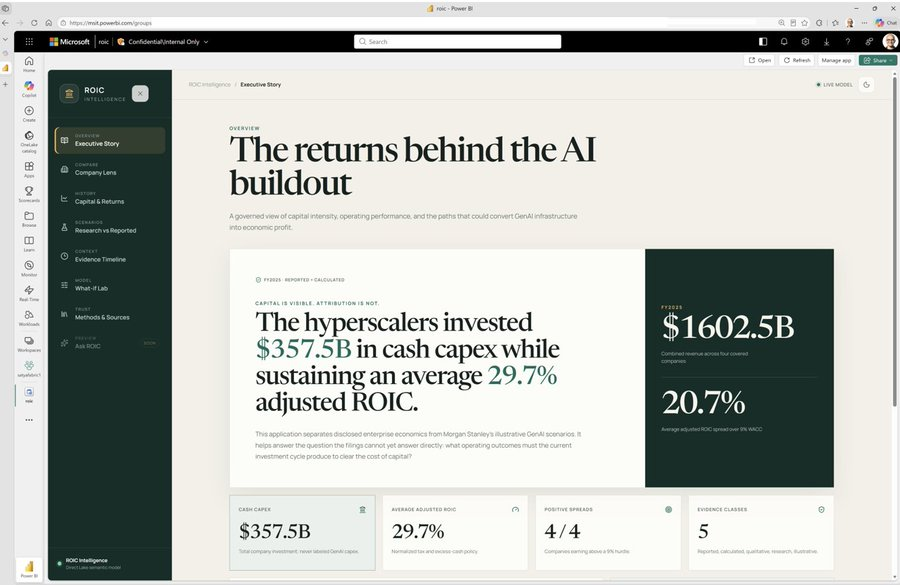 ROIC Intelligence Executive Story — hyperscalers $357.5B cash capex, 29.7% average adjusted ROIC, Live Model in Power BI / Fabric
Screenshot from Nadella’s post: ROIC Intelligence → Executive Story (“The returns behind the AI buildout”), Live Model, Direct Lake semantic model via Fabric.
Headline metrics (illustrative, per UI):
| Metric | Figure shown |
|---|---|
| Hyperscaler cash capex | $357.5B |
| Average adjusted ROIC | 29.7% |
| Combined FY2025 revenue (4 cos.) | $1,602.5B |
| Avg. adjusted ROIC spread vs 9% WACC | 20.7% |
| Positive spreads | 4 / 4 companies above hurdle |
| Evidence classes | 5 (reported, calculated, qualitative, research, illustrative) |
Nav modules match a research-analyst “superapp”: Executive Story, Company Lens, Capital & Returns, Research vs Reported, Evidence Timeline, What-If Lab, Methods & Sources, and Ask ROIC (Copilot-style Q&A). Status chip: LIVE MODEL.
Architecture: Fabric medallion → Direct Lake → Rayfin
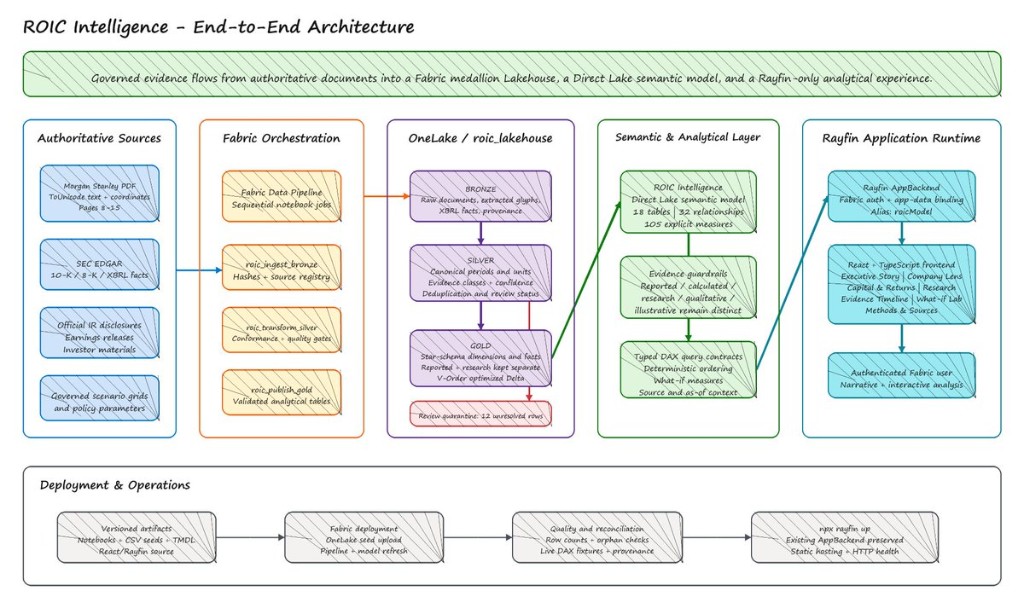 ROIC Intelligence end-to-end architecture — sources, Fabric bronze/silver/gold, Direct Lake semantic model, Rayfin app runtime
Architecture card from the same post: governed evidence → Fabric lakehouse → Direct Lake model → Rayfin analytical experience.
| Stage | What’s in it |
|---|---|
| Sources | Morgan Stanley PDF (ToUnicode text + coords), SEC EDGAR 10-K/8-K/XBRL, IR disclosures, scenario grids |
| Fabric orchestration | Pipelines / notebooks: roic_ingest_bronze → roic_transform_silver → roic_publish_gold |
| OneLake medallion | Bronze raw+provenance; Silver canonical periods + confidence; Gold star schema (reported vs research separated); review quarantine |
| Semantic layer | Direct Lake model (~18 tables, ~32 relationships, ~105 measures), evidence guardrails, typed DAX contracts |
| App runtime | Rayfin AppBackend + React/TS modules; authenticated Fabric user |
| Ops | Versioned notebooks/TMDL/React; Fabric deploy; DAX fixtures; npx rayfin up |
This is the material content behind “my pipelines/lake/semantic models are in Fabric.” It also explains why critics see five systems: chat/codegen host, git, lakehouse, semantic model, governance plane. Nadella’s bet is that enterprises already pay for those planes — so compounding inside them beats a single disposable sandbox.
The workflow: skills before autopilot
Morgan Stanley Hyperscale ROIC PDF
        │
        ▼
Copilot code + /drill-me  →  structured plan
        │
        ▼
Autopilot (auto)  →  app (history, lookups, scenarios, what-ifs)
        │
        ▼
/rubber-duck  →  test / critique pass
        │
        ▼
Artifacts land in:
  Copilot (experience) · GitHub Enterprise (code)
  Fabric (pipelines / lake / Direct Lake model)
  Agent 365 (IT / Sec / FinOps)
Why skills matter here
Without /drill-me, “build me an ROIC app” invites unstructured thrash. With it, the agent is steered into plan → implement → test — the same discipline we cover in agent skills and agent harness design. Autopilot without a skill scaffold is closer to classic vibe coding; autopilot after a skill-produced plan is closer to Nadella’s “rails” claim.
Contrast with open multiplayer harnesses like YC’s QM: different stack, same industry move — company-scoped agents with policy, not lone chat windows.
Earnings-call context: the Copilot superapp
Nadella used the call to preview stitching Copilot experiences — including Code — into one super app for consumer and commercial. The ROIC post is the receipts slide: here’s what Code + Autopilot + skills look like when the data plane is Fabric and the control plane is Agent 365.
Pair with:
- Reverse Information Paradox — enterprises that keep learning loops inside their tenancy win.
- MAI hill-climbing in Copilot & Excel — route work to the right model; externalize harness/memory/skills.
ROIC Intelligence is the data-app chapter of that control-plane story.
The critique: five systems to vibe code?
A common X pushback: if the CEO needs Copilot + GitHub Enterprise + Fabric + Agent 365 (+ Power BI host) to ship a PDF app, Microsoft is papering over product fragmentation.
| Critic read | Nadella read |
|---|---|
| Too many products | Those products are the enterprise OS customers already buy |
| Emulates vibe code badly | Vibe code without git/lake/governance creates shadow IT |
| Demo theater | Earnings proof that Capex → software ROIC narrative is operational |
Honest middle: the demo is optimized for Microsoft’s installed base. A startup on Postgres + one agent harness will not recreate this tomorrow. A Fortune 500 already on M365 + Fabric might. Neither side should confuse a CEO screenshot with a TCO study.
Builder checklist (steal the pattern, not the logos)
□ Start from an authoritative document + public filings (provenance first)
□ Force a /plan-style skill before codegen (/drill-me equivalent)
□ Land code in a real repo with review (GitHub Enterprise or equivalent)
□ Separate evidence classes: reported vs research vs illustrative
□ Put metrics in a semantic layer with tests (DAX fixtures / row counts)
□ Run a rubber-duck / red-team skill before sharing numbers
□ Put FinOps + security on the agent identity (Agent 365-class controls)
□ Label illustrative apps as non-advice — especially ROIC / capex stories
For token cost discipline while you build, see what are LLM tokens and enterprise token governance — Nadella’s anti-tokenmaxxing line only works if you measure outcomes, not raw completions.
Honest limitations
- Screenshots and architecture are vendor-published; we did not re-run the pipelines.
- Figures ($357.5B capex, 29.7% ROIC, etc.) are illustrative UI content, not explainx.ai valuations.
/drill-me//rubber-duckare described by Nadella; public skill specs may lag the superapp GA.- “Built yesterday” is a narrative device — Fabric gold tables and 105 measures imply significant agent (or human) iteration.
- Agent 365 “nearly 40M agents registered” style metrics from earnings coverage are Microsoft claims — verify primary IR decks for procurement.
How to read this demo
The post blends three kinds of material, and separating them keeps the takeaway honest.
- Nadella's stated claims: the PDF-to-app workflow using
/drill-me, autopilot, and/rubber-duck; the "not vibe coding" framing; and the idea that every step becomes a reusable asset. - What the screenshots show: the Executive Story metrics and the architecture card, including the Fabric medallion layers and the Direct Lake semantic model. These are vendor-published and the UI figures are illustrative.
- What nobody has audited: how much of the work was agent-generated versus hand-authored, how long it really took, and what the total cost of ownership looks like outside Microsoft's installed base.
The reusable part is the pattern rather than the logos: start from a source document with provenance, plan before generating code, keep evidence classes separate, and test before sharing numbers. Whether you need five Microsoft products to do that is the open question, and the critique table above lays out both sides.
Closing
Nadella’s ROIC Intelligence post is less about one dashboard and more about a thesis: Copilot skills + autopilot + Fabric + GitHub + Agent 365 should turn research PDFs into governed analytical products, not chat debris. Whether you buy the anti–vibe-coding framing or the fragmentation critique, the architecture diagram is a clean template for medallion evidence → Direct Lake semantics → app — and a live pointer to the Copilot superapp Microsoft promised on the earnings call.
Follow @explainx_ai when /drill-me-class skills ship broadly outside the CEO demo.
Related on explainx.ai
- Microsoft 365 Copilot pricing and licensing: what it actually costs in 2026 — the $30/user/month add-on, base plan requirements, and what utilization data says about ROI
- GitHub Copilot: 87% of LLM Calls Are Now Agent-Initiated — Microsoft production data on how the coding-agent surface behind Copilot code actually behaves at scale
- Satya Nadella — Reverse Information Paradox
- Microsoft MAI hill-climbing — Copilot, Excel, Nadella
- What are agent skills?
- What is an agent harness?
- YC QM — company multi-agent harness
- AI token costs — enterprise governance
- What are LLM tokens?
- How AI agents work end to end
- DESIGN.md for AI agents
- Open weights & American AI leadership (Nadella cosign)
Sources
- Satya Nadella on X / LinkedIn — ROIC Intelligence App + architecture (Jul 30, 2026)
- Microsoft FY2026 earnings coverage — Copilot superapp, Azure $100B context
- Brian Nowak / Morgan Stanley — Hyperscale ROIC research (public-source basis per Nadella disclosure)
App metrics, architecture counts, and skill names reflect Nadella’s July 30, 2026 post and public earnings reporting as of August 1, 2026. Illustrative only — not financial advice. Verify Fabric/Copilot GA docs before production builds.