



OpenAI's Luna, Terra, Sol and Astra are ordered by size, with Luna smallest and Astra largest, according to OpenAI's Ted Sanders. He wrote that on Hacker News in a comment that Simon Willison later quoted and that The Decoder summarized on October 27. It is one of the clearest explanations of the lineup yet, and it came in reply to people confused by the launch of GPT-6.1 Terra, which we covered in the Terra launch post.
This is a staff comment, not an official policy page. Treat it as a useful rule of thumb from someone at OpenAI, with the caveats Sanders himself gives.
TL;DR: how to read an OpenAI model name
| Question | Sanders' answer |
|---|---|
| Order of tiers? | Luna < Terra < Sol < Astra |
| What drives that order? | Mostly model size |
| Bigger means? | More performant and reliable, higher cost per token, better recall of esoteric facts |
| What does 6.1 signal? | Release order, shared lineage with other 6.1 models, and the size of the leap |
| Quality only? | Astra |
| A bit price sensitive? | Sol |
| Very price sensitive? | Terra or Luna |
What did Sanders actually say?
Starting from the premise that "LLM performance is incredibly multidimensional," Sanders wrote that there is no guarantee of a fixed ordering where the model best at math is also best at jokes. Even so, "much of the variation in performance is explained by just a single variable: model size." He then states the ordering, and recommends it "even today, as a general starting point for picking models."
His decision rule is short: if you care about quality only, pick Astra; if you are a bit price sensitive, Sol; if you are very price sensitive, Terra or Luna.
He then adds the important caveat. Size does not capture all variation, because models trained later may have newer data, techniques, or architectures. His examples cross vendors: Sonnet 5.5 outperforms Fable 5.1 in some ways, and Gemini 3.8 Flash outperforms 3.1 Pro in some ways. In other words, a newer small model can beat an older large one on specific jobs.
What does the version number mean?
Sanders explains that "these days, version number signifies a few things at once: the order of release, the relationship to other releases, and the magnitude of improvement." His example: 6.1 indicates a launch after 5.6, a model that may share similarities with other 6.1 models in training data and personality (which is why it is not called 5.7), and a leap not big enough to merit "the headlines and expectations that would come with a 7."
Note the hedge: he says 6.1 models "may share some similarities," not that they share a cut-off or architecture, and he gives no specifics. For how this plays out in practice, our Tibo "6.1 coming soon" analysis tracks the staggered 6.1 rollout across tiers.
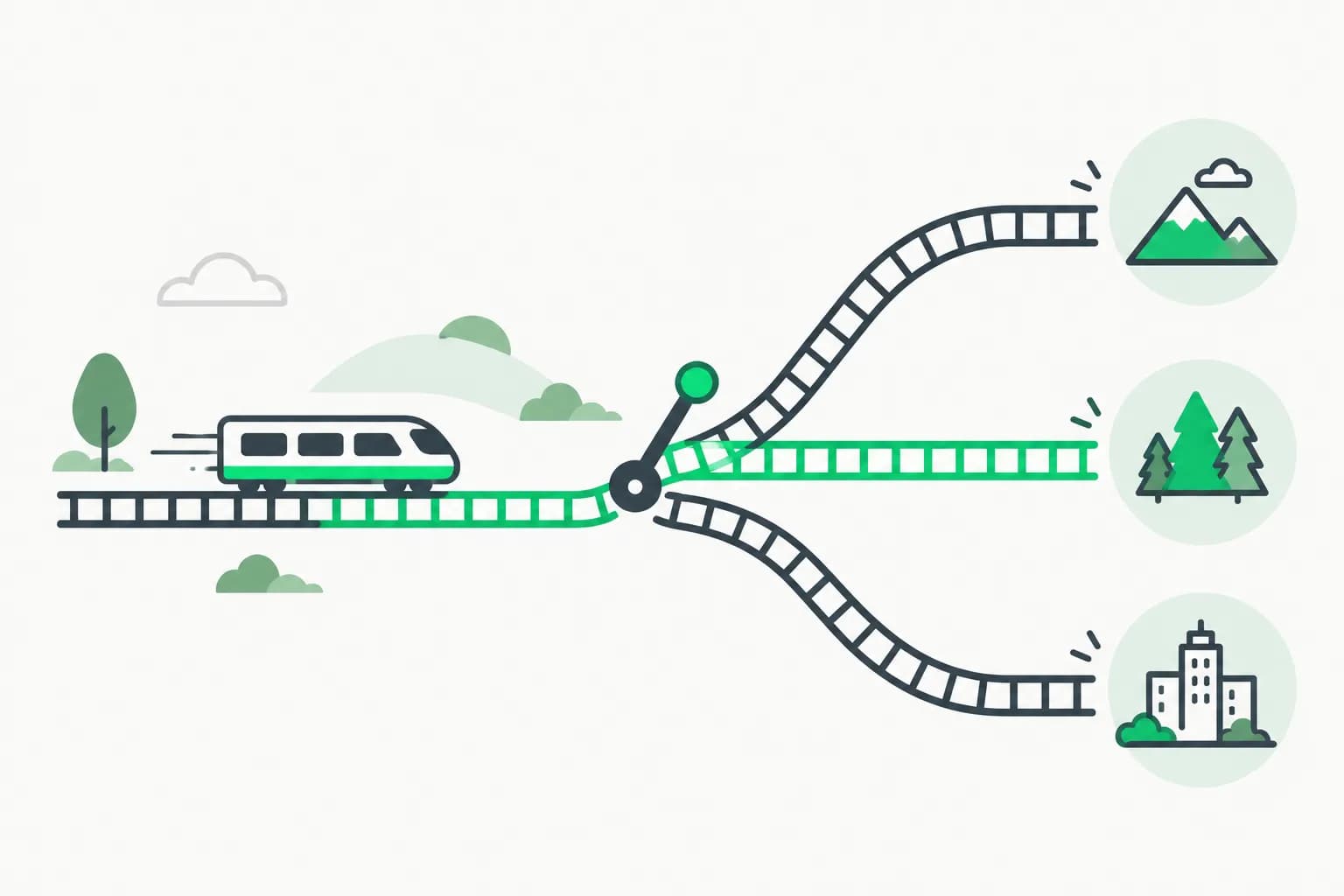
 Rail switch sending a green track to one of three destinations, illustrating OpenAI model names routing to different GPT-6 tiers
Where does GPT-6.1 Terra fit?
Sanders called Terra "probably better than Astra and Sol at technical communication, similar on vision and computer use (but much faster!), and a bit worse on most other things." For API developers he described it as "a nice midrange option if you want something cheaper than Sol but a lot smarter than Luna," especially for vision, computer use, and communication.
For subscribers he was deliberately modest: "it's not a bombshell release." If you hit usage limits, it may help you go a bit further, and if you want clearer communication or faster computer use, it can be a good option to select.
On price, our launch post covers Terra at $1 per million input tokens and $5 per million output tokens, and the numbers there come from OpenAI. For a cost comparison between the two bigger tiers, see GPT-6.1 Sol versus Astra cost per task.
A practical model-picking guide
Here is how we would turn the comment into a workflow. This is our reading, not OpenAI's guidance.
- Start with Sol as the default if you are building an agent and cost matters at all, then test one tier up and one down on your own tasks.
- Use Astra for the hard, low-volume steps: planning, final review, or tasks where a mistake is expensive.
- Use Terra for high-volume steps that depend on reading screens, drafting clear explanations, or operating a computer, where Sanders says it is competitive and faster.
- Use Luna for routing, classification, and formatting, where the job is simple and volume is high.
- Treat reasoning effort as a second dial. Sanders says size, effort, and multi-agent count are different axes. A hard task may need more effort on a small model, or a bigger model at low effort. Measure both.
- Pin the exact model ID and re-test when a new version lands, since a later release can shift which tier is best for a job.
For cross-vendor context on where these tiers sit, see our five-model comparison with Muse Wonder and Gemini 4 Argon versus Opus 5.5, Grok 4.7 and GPT-6 Astra. A caching angle on Astra agents is in AWS Bedrock prompt caching with GPT-6 Astra.
How does this compare with other labs' ladders?
OpenAI is not alone in shipping a size ladder. Anthropic's Haiku, Sonnet and Opus 5.5 tiers follow the same logic of small, middle and large, and mi_lk pointed out in the HN thread that Opus, Sonnet and Haiku 5.5 arrived weeks apart, as did Sol 6.1 and Terra 6.1, and asked what stops a lab from releasing every tier at once.
The staggered cadence is exactly why the version number matters. If a 6.1 Terra arrives while Sol and Astra are still on an earlier release, a mid-sized model can look newer than a large one. That mirrors Sanders' point that later training can beat raw size on specific tasks. For a Haiku-tier example on the Anthropic side, see Claude Haiku 5.5 launch pricing and benchmarks.
 Three-step podium with a green star over the top, picturing OpenAI model tiers ranked by size from Luna to Astra
The practical lesson is to compare within a release and across releases separately. Within one release, expect the size ladder to hold. Across releases, run your own test before assuming a bigger name wins.
Why not just one score?
Sanders defended the multi-name approach: "Scaling model size is different from scaling reasoning effort which is different from scaling multi-agent count. So if we just swept all of those under a single name of 'more IQ', it would make the naming simpler but the experience much worse, as important details would be obfuscated from end users." He also wrote that "a lot of the complexity is somewhat irreducible" and invited suggestions for better naming.
That is a real design tension. The same dials show up in how usage limits and speeds are sold, which we followed in the OpenAI Astra 28-day update log.
What developers are saying
The thread had well over fifty comments. These are commenters' reports and opinions, not verified facts.
- Effort versus class is the real gap. torben-friis asked whether a high-effort Terra sits above a low-effort Sol, and whether an old Astra beats a new Terra. miki123211 counted about twenty options once each of four tiers has four or more reasoning levels.
- Specificity of comparisons. pmcarlton noted that saying Terra beats Sol at communication leaves open which Sol version is meant, and called that blur a source of confusion.
- Plain-label proposals. Closi suggested Small, Medium, Large, Very Large or parameter counts, and osigurdson proposed a version-size scheme such as 6.1-sm. pavlus suggested calendar-style versions with role aliases.
- Defenders. elxr argued four tiers are about as clear as naming gets, and ksec said OpenAI's scheme is conceptually easier than Claude's.
- Tone of the reply. GodelNumbering praised the candid, low-hype style and said developers want honest lows as well as highs, while avazhi said the clarity goal was missed badly.
- Practical workload questions. krmmalik asked whether a system-design step currently on Astra could move to Sol or Terra, a question that, as far as we saw, was not answered.
- A production report. jl wrote that internal evals were still running but Terra looked like a strong release for cost-sensitive agentic API use.
What this means for what you build or pay
Two takeaways. First, treat the names as a coarse size ladder and the version number as a release marker, then verify on your own evals, because Sanders himself says newer small models can win specific jobs. Second, do not assume the label tells you effort or pro-mode behavior, since those settings multiply the choices. A short written model-selection policy for your team, with a default, an escalation tier and a cheap tier, will save more money than any naming scheme.
What is not confirmed
This is a single employee's comment, and OpenAI has not published it as a naming policy. Sanders does not disclose parameter counts. Check OpenAI's model pages before relying on any tier being available.
Related reading
- GPT-6.1 Terra launch: pricing and benchmarks
- GPT-6.1 Sol versus Astra cost per task
- Tibo's "6.1 coming soon": what it means
- OpenAI Astra 28 days of updates
- Five-model comparison: Muse Wonder, GPT-6.1 Sol, Opus 5.5, Astra, Grok 4.7
- Gemini 4 Argon versus Opus 5.5, Grok 4.7 and Astra
- Sources: Simon Willison's quote, The Decoder, and the original Hacker News comment
Names, tiers, and prices are accurate as of October 29, 2026 and may change.