




July 30, 2026: @OpenAI cut GPT-5.6 Luna pricing 80% and GPT-5.6 Terra pricing 20%, and shipped a Fast mode for GPT-5.6 Sol that runs up to 2.5x faster at 2x the rate. Sam Altman confirmed the numbers directly: Luna now $0.20 input / $1.20 output per 1M tokens; Terra now $2 / $12.
The cuts land automatically inside Codex and ChatGPT Work usage accounting — no account changes needed to benefit.
TL;DR — what changed
| Model | Old price (per 1M tokens) | New price | Change |
|---|---|---|---|
| GPT-5.6 Luna | $1.00 in / $6.00 out | $0.20 in / $1.20 out | −80% |
| GPT-5.6 Terra | $2.50 in / $15.00 out | $2.00 in / $12.00 out | −20% |
| GPT-5.6 Sol | $5.00 in / $30.00 out | Unchanged | — |
| GPT-5.6 Sol Fast mode | n/a | 2.5x speed at 2x rate | New option |
Prices are per 1M tokens, API list rates. See explainx.ai's GPT-5.6 Sol/Terra/Luna preview coverage for the original June 2026 launch pricing this replaces.
Official statements
"We are committed to pushing the model frontier across cost efficiency, capability, and speed. Starting today, we are reducing prices for GPT-5.6 Luna by 80% and GPT-5.6 Terra by 20%, and offering a faster option for GPT-5.6 Sol in the API. Luna and Terra's lower prices are reflected in how usage is counted in Codex and ChatGPT Work, so your usage goes further."
*"major price cuts today: *80% drop for GPT-5.6 Luna, now $0.20 per million input tokens and $1.20 per million output *20% drop for GPT-5.6 Terra, to $2/$12 GPT-5.6 Sol gets Fast mode in the API, up to 2.5x the speed for 2x the price, same intelligence"
Tibo Sottiaux (@thsottiaux): the cuts extend beyond raw pricing to auto-approve mode ("review for me" in the app), which OpenAI says now runs on Luna at roughly 10x lower cost.
Why this matters: cost per task, not just cost per token
Per-token pricing understates the real story. OpenAI's headline claim is about cost per completed task — and the chart it published to back that up is the Artificial Analysis Intelligence Index v4.1.
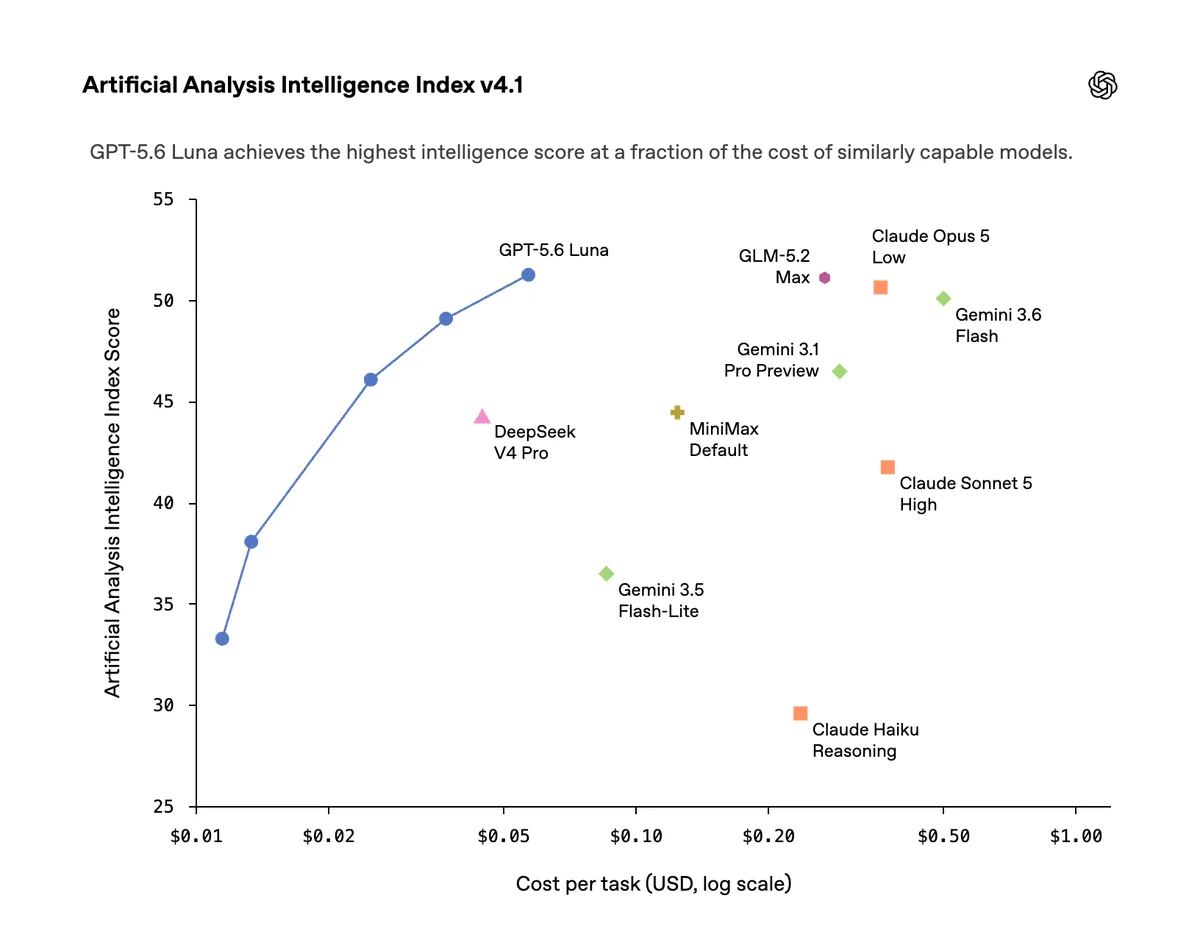 GPT-5.6 Luna achieves the highest intelligence score at a fraction of the cost of similarly capable models — Artificial Analysis Intelligence Index v4.1
Chart: OpenAI, citing Artificial Analysis Intelligence Index v4.1, July 2026.
Reading the chart
| Model | Approx. AA Index score | Approx. cost/task |
|---|---|---|
| GPT-5.6 Luna | ~51.3 | ~$0.055 |
| Claude Opus 5 (Low) | ~51 | ~$0.35 |
| Gemini 3.6 Flash | ~50.5 | ~$0.45 |
| GLM-5.2 Max | ~51 | ~$0.28 |
| Gemini 3.1 Pro Preview | ~46.5 | ~$0.25 |
| Claude Sonnet 5 (High) | ~42 | ~$0.33 |
| MiniMax Default | ~44.5 | ~$0.12 |
| DeepSeek V4 Pro | ~44.5 | ~$0.045 |
| Gemini 3.5 Flash-Lite | ~36.5 | ~$0.085 |
| Claude Haiku (Reasoning) | ~29.5 | ~$0.22 |
The gap that matters: Luna scores essentially the same as Claude Opus 5 (Low) on the index while costing roughly 6x less per task. On this specific chart, no other model on the frontier line beats Luna's intelligence-per-dollar — every comparison point sits above and to the right of OpenAI's Sol → Terra → Luna curve on the log-scale cost axis.
Two caveats worth stating plainly: this is a vendor-published chart citing a third-party index, not an independent audit, and cost-per-task depends heavily on the task mix Artificial Analysis used to build it. For workload-specific comparisons, see explainx.ai's guide to reading AI benchmarks before treating any single chart as decisive.
Sol Fast mode: what it actually buys
Fast mode is not a price cut — it's a new lever:
- Up to 2.5x faster responses than standard Sol
- 2x the standard per-token rate
- Same intelligence, per OpenAI — no distillation or quality tradeoff claimed
That makes Fast mode a latency purchase, not a cost purchase. It targets interactive or user-facing paths where thinking-budget and latency tradeoffs already mattered before this update — real-time agents, voice, or anything where a slow Sol response degrades UX more than a 2x token bill does.
Where this leaves the pricing map
| Tier | Best for | Cost posture after July 30 cuts |
|---|---|---|
| Luna | High-volume, cost-sensitive tasks | Now the cheapest capable frontier tier OpenAI offers — 80% cheaper than June launch |
| Terra | Mid-tier workloads, GPT-5.5-class performance | Moderately cheaper — 20% off, still a step above Luna in capability |
| Sol | Flagship reasoning, complex agentic work | Unchanged — pay for capability, now with an optional speed multiplier |
| Sol Fast | Latency-critical Sol workloads | New — speed at a 2x premium |
Compare this against Claude Fable 5's own usage-credit economics and DeepSeek V4 Pro's earlier disruption of AI pricing — 2026 has been a year of repeated downward pricing pressure across every frontier lab, not a one-off OpenAI move. See explainx.ai's GPT-5.6 vs Claude Fable 5 comparison for the fuller capability-vs-cost picture, and the ChatGPT Work vs Codex guide for how these tiers surface inside OpenAI's own products.
Why cut Luna 80% and Terra only 20%?
The asymmetry is a signal, not an accident. Luna is OpenAI's high-volume, cost-sensitive tier — the model most likely to be used for bulk classification, agentic sub-tasks, and the kind of "review for me" auto-approve workloads Tibo Sottiaux referenced. Cutting it 80% is a volume play: at $0.20/$1.20, Luna becomes cheap enough to use as the default model for tasks that previously got routed to smaller, less capable open-weight models purely on cost grounds.
Terra sits in a different competitive position — priced to compete directly with GPT-5.5-class output at roughly half of GPT-5.5's original rate, per OpenAI's own June 2026 framing. A 20% cut keeps that positioning intact rather than triggering a race-to-the-bottom against Luna from the tier immediately above it. Sol, unchanged, remains the pure-capability tier where customers are already paying for frontier reasoning and aren't primarily price-sensitive — the value-add there is Fast mode, not a lower base rate.
Read together, the three moves describe a barbell pricing strategy: get dramatically cheaper at the high-volume end (Luna), hold steady in the middle (Terra), and add optionality rather than discounts at the top (Sol Fast mode). That's a different shape than an across-the-board price war, and it matches how OpenAI has talked about GPT-5.6 since its June 26, 2026 preview — three durable capability tiers advancing on separate cadences rather than one model getting cheaper over time.
What this pressures other labs to do
OpenAI's Luna cut lands in a year that's already seen repeated downward pricing moves — DeepSeek V4 Pro's disruptive launch pricing earlier in 2026, and Anthropic's own usage-credit restructuring around Fable 5. A price move this steep on a usable, non-toy tier (not a limited free preview) puts pressure on:
- Google, whose Gemini 3.5 Flash-Lite and Gemini 3.6 Flash sit well above Luna on the AA Index cost-per-task chart despite comparable or lower intelligence scores
- Anthropic, whose Claude Haiku (Reasoning) tier scores meaningfully lower than Luna at a higher cost per task on the same chart
- Chinese labs (DeepSeek, Zhipu/GLM, MiniMax) who had been competing primarily on price — Luna's cut narrows that gap considerably at the low end
Whether competitors respond with matching cuts or lean harder into differentiated capability claims is the thing to watch over the following weeks. Historically in 2026, aggressive tier-specific price cuts from one major lab have been followed by a comparable move from at least one competitor within 4-6 weeks.
What to check in your account
- API users — new Luna/Terra rates apply to requests immediately; no migration needed.
- Codex / ChatGPT Work users — usage-allowance math already reflects the lower Luna/Terra costs; the same weekly/monthly allowance now covers more requests.
- Auto-approve / "review for me" — now running on Luna at ~10x lower cost per Tibo Sottiaux; worth re-enabling if you'd turned it off over cost concerns.
- Fast mode — opt-in only; don't assume standard Sol calls got faster by default.
- Benchmark claims — the AA Index v4.1 chart is a strong directional signal, not a guarantee for your specific workload; benchmark your own task mix before a wholesale model switch.
Summary
OpenAI cut GPT-5.6 Luna pricing 80% (to $0.20/$1.20 per 1M tokens) and GPT-5.6 Terra 20% (to $2/$12) on July 30, 2026, while adding an optional 2.5x-faster Fast mode for Sol at 2x cost. The cuts apply automatically inside Codex and ChatGPT Work usage accounting. OpenAI backed the move with an Artificial Analysis Intelligence Index v4.1 chart showing Luna matching Claude Opus 5 (Low)'s intelligence score at roughly one-sixth the cost per task — the strongest cost-per-task position of any model shown, ahead of Gemini 3.6 Flash, GLM-5.2 Max, and Claude Sonnet 5 (High) on the same chart.
Update — August 7, 2026: OpenAI followed the pricing cuts with a product change — GPT-5.6 Sol now handles both Instant and reasoning replies for Plus/Pro, and GPT-5.6 Luna became unlimited for text chat on Free and Go plans. Full breakdown: GPT-5.6 Sol Now Runs All of ChatGPT — Free Users Get Unlimited Chats.
Update — August 22, 2026: Sol itself finally got a direct price cut — over 20% off API and credit pricing for three months, the first time OpenAI has repriced Sol's own rate rather than adding an unchanged-price fast tier. Full breakdown: OpenAI Cuts GPT-5.6 Sol API Pricing Over 20% for 3 Months.
Update — August 28, 2026: Calvin French-Owen's essay "Small Models Have Arrived" hit #2 on Hacker News citing this exact Luna price tier — his own research-agent eval dropped from about $1 to about $0.10 per run after switching to it. Full breakdown: Small Models Have Arrived: Calvin French-Owen on Luna Economics.
Update — September 4, 2026: The naming scale gained a new top tier — see GPT-6 Astra's launch and the Astra > Sol > Terra > Luna confirmation.
Update — September 7, 2026: Unconfirmed reports say OpenAI has already begun internal testing of a next-generation model referred to as "GPT-6 Sol" — a name that overlaps confusingly with the Sol tier covered here. See the naming confusion and honest caveats, addressed directly.
Related on explainx.ai
-
Reports Say OpenAI Started Testing "GPT-6 Sol" Days After Astra (unconfirmed)
-
PhoneLLM: an open voice-agent model claiming GPT-5.6 Terra quality at 1/18th the cost — an open-weights Nemotron fine-tune from Daily/Pipecat measuring itself directly against this Terra pricing
-
GPT-5.6 Sol "50% Off" on OpenRouter: Promo, Not a Price Cut — a later Hacker News thread contrasted Luna's real cut here against a Sol "discount" that turned out to be an OpenRouter promo, not an OpenAI repricing
-
DeepSeek V4's new pricing is live — does it really match GPT-5.6? — Luna's cut price now undercuts DeepSeek V4 Pro's new peak rate
-
Anthropic makes Claude Sonnet 5 pricing permanent at $2/$10 — Anthropic's answer to these cuts: cancel the September increase
-
Sonnet 5 vs GPT-5.6 Luna Max: cost chart and hands-on comparison — a viral r/ClaudeAI usage chart and explainx.ai's own medium-effort testing, both favoring Luna Max
-
GPT-5.6 Sol now unifies ChatGPT chat; Luna goes unlimited for free users (Aug 6-7 update)
-
GPT-5.6 Sol, Terra, Luna preview — original June 2026 launch pricing
Official sources: @OpenAI announcement · @sama pricing breakdown · @thsottiaux on Sol and auto-approve
Pricing and benchmark figures reflect OpenAI's public statements and the cited Artificial Analysis Intelligence Index v4.1 chart as of July 31, 2026. Verify current API pricing in the OpenAI dashboard before budgeting production workloads.