




Nvidia's November 16, 2026 press release ties IBM quantum hardware, Fermilab high-energy physics, and GPU supercomputing into one roadmap — with a decoder NVIDIA says can run up to 13,000x faster on error-correction research and new Slurm hooks so quantum processors sit beside GPUs in production schedules. It is not a consumer product launch, but it matters for builders tracking how Nvidia's data-center narrative expands beyond LLM training chips.
TL;DR — Nvidia vs IBM quantum computing (this announcement)
| Layer | Nvidia contribution | IBM contribution |
|---|---|---|
| Compute | DGX B200 colocated with IBM quantum systems | Quantum Nighthawk processors |
| Software | CUDA-Q QEC 0.9.0 with TCBP-JOBS decoder | Quantum Resource Management Interface for Slurm |
| Science host | Accelerated decoding and simulation | Hardware and enterprise quantum stack |
| Mission partner | Codesign platform engineering | Fermilab leadership on HENP use cases |
What Nvidia published
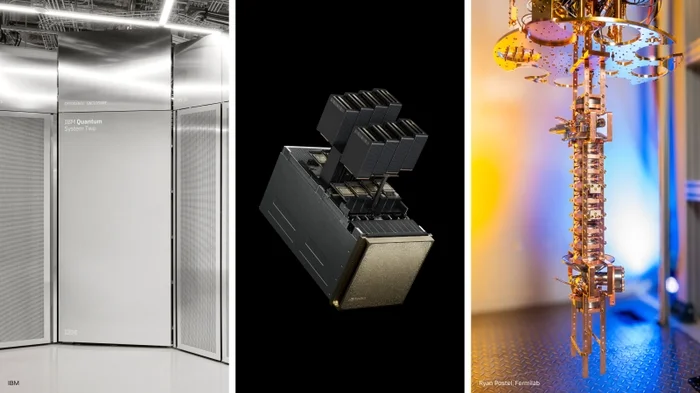 IBM NVIDIA and Fermilab quantum collaboration
Image: NVIDIA
The official newsroom post lists four pillars:
Modular quantum-classical codesign with Fermilab
IBM and Nvidia will colocate DGX B200 systems with IBM quantum computers, including systems powered by IBM Quantum Nighthawk, which Nvidia describes as IBM's fastest processor to date. Fermilab joins to steer high-energy and nuclear physics (HENP) applications and error-correction requirements.
Fermilab CTO Anna Grassellino said accelerated computing and superintelligence will matter for designing algorithms, studying errors, and coordinating complex quantum systems — language that parallels Nvidia Nemotron for Science messaging earlier the same weekend.
TCBP-JOBS decoding in CUDA-Q QEC 0.9.0
 Quantum processor inside a cryogenic enclosure illustration
Quantum processors lose coherence quickly; quantum error correction (QEC) spreads logical information across physical qubits and uses classical decoders to interpret measurement syndromes.
Nvidia says TCBP-JOBS, available today in CUDA-Q QEC 0.9.0, speeds the heavy parts of decoder research by up to 13,000x while keeping accuracy high. The headline comparison transforms a 12-week research decode effort into 45 minutes in Nvidia's example — always treat vendor benchmarks as hypotheses until you reproduce them on your own cluster.
Gordon Bell finalist chemistry work
The same release highlights IBM and RIKEN quantum-classical chemistry running on Japan's ROQUO supercomputer with NVIDIA GB200 and Quantum-X800 InfiniBand, named a finalist for the 2026 ACM Gordon Bell Prize. They modeled protein-ligand complexes up to 12,635 atoms, more than 40x prior quantum-classical benchmarks cited in the post — relevant to drug-discovery readers following OpenAI healthcare computer use, but still research-grade.
Slurm scheduling for quantum processors
Data centers today glue quantum control planes onto HPC stacks with one-off scripts. Nvidia plans open-source Slurm extensions with a quantum interface; IBM feeds its Quantum Resource Management Interface so operators can schedule QPUs like another accelerator tier.
That is practical news for national labs already running Slurm at scale, and it rhymes with AWS multi-agent manufacturing patterns only in the sense that orchestration keeps becoming the bottleneck as exotic accelerators multiply.
Why error correction speed matters for AI builders
Most LLM engineers will never touch a decoder. Three second-order effects still land on your roadmap:
- GPU demand narrative: Nvidia positions CUDA-Q as another reason to keep buying accelerated nodes, adjacent to Rubin throughput claims and DGX Spark kits.
- Hybrid scheduling skills: If your org shares a supercomputer, quantum jobs may soon appear in the same Slurm queues as your fine-tuning arrays — capacity planning gets harder.
- Scientific AI branding: Nemotron-for-science and quantum-chemistry wins reinforce Nvidia's discovery story beyond gaming GPUs, useful context while Jensen Huang's succession drama dominates headlines.
Quotes worth keeping straight
Nvidia VP Krysta Svore framed the collaboration as giving scientists better tools to investigate quantum designs. IBM Fellow Jerry Chow emphasized modular architectures interconnecting quantum and classical machines. Grassellino stressed that hardware alone is insufficient without algorithm co-design — a polite rebuttal to hype that quantum alone will fix AI power limits.
All three quotes come from Nvidia's press release; IBM and Fermilab did not publish separate releases in the sources we fetched for this post.
How to read competitor positioning
| Question | Honest answer |
|---|---|
| Nvidia vs IBM quantum computing — who leads? | IBM ships QPUs and enterprise quantum cloud; Nvidia sells the classical decode and simulation stack. This news deepens partnership, not a winner-take-all fight. |
| IBM quantum pricing | Enterprise contracts vary; this announcement does not change public price lists. |
| When is fault tolerance real? | Nvidia positions faster decoding as shortening research cycles, not declaring fault-tolerant machines production-ready. |
What to do this week
HPC admins: Read the CUDA-Q QEC 0.9.0 release notes and plan a small decoder benchmark before promising capacity to physics groups.
ML engineers: No change to your Llama or Claude pipelines. File this under infrastructure awareness.
Investors parsing open checkbook financing stories: Quantum collaboration is a long-dated optionality story, not near-term revenue like Blackwell shipments.
Error correction basics for software engineers
Quantum bits are noisy. A practical quantum computer needs logical qubits built from many physical qubits, plus constant syndrome measurements and classical decoding to guess which physical qubit flipped.
Think of decoding as an anomaly classifier running at megahertz rates on GPUs — exactly Nvidia's pitch for TCBP-JOBS. Faster decoding does not by itself create logical qubits, but it shrinks the calendar time researchers need to compare surface code variants, color codes, and other layouts before anyone fabricates the next processor generation.
If you come from LLM infra, analogies help:
| LLM concept | Quantum analog in this release |
|---|---|
| Tensor parallel sharding | Encoding logical state across physical qubits |
| Checkpointing | Syndrome extraction rounds |
| Log replay debugging | Decoder guessing error patterns |
| Job scheduler (Slurm) | New quantum interface beside GPU queues |
Fermilab science goals in plain language
Fermilab's SQMS and high-energy physics communities care about simulations classical supercomputers still struggle with — lattice QCD corners, neutrino flux modeling, materials for cryogenic RF. Quantum advantage remains hypothetical, but codesign lets physicists state hard requirements ("need this logical error rate to simulate X") before hardware teams commit billions.
Nvidia wins either way: GPUs simulate quantum circuits today, and GPUs decode tomorrow's machines. That dual revenue line is why quantum news still appears beside Nemotron for Science agent launches on the same newsroom day Jensen Huang's succession drama dominated social feeds.
Slurm operators: what to pilot
IBM's Quantum Resource Management Interface feeding Slurm is the detail HPC admins should screenshot. Pilot steps:
- Identify one dev partition with spare GPU hours.
- Install CUDA-Q QEC 0.9.0 on a login node with recent drivers.
- Run Nvidia's sample decoder benchmark against your baseline.
- File a ticket with your quantum experimental group asking which queue names they want beside
gpu-a100.
Document latency tails: decoders may be fast on average but spike on large codes — the same tail-risk story as Together prefix cache posts highlight for LLM agents.
IBM quantum pricing and access (unchanged by this news)
This collaboration does not publish a new IBM quantum computer price list. Enterprise access still flows through IBM Quantum Platform contracts. Builders comparing Nvidia vs IBM quantum computing should treat November 16 as a research acceleration partnership, not a cloud SKU update.
If you need hands-on QPU time today, start at IBM's quantum documentation and plan classical simulation on CUDA-Q first — cheaper and schedulable on existing DGX clusters many labs already rent for GPT fine-tunes.
Forward-looking risks and hype traps
Nvidia's safe-harbor language warns many features are when-and-if-available. Do not bake 13,000x speedups into grant proposals until your lab reproduces them.
Second, quantum headlines distract from nearer AI power constraints — SK Hynix memory supply, data-center protests, and grid limits still cap LLM training before fault-tolerant quantum helps.
Third, national-security readers will file this beside export control debates: colocating U.S. QPUs with DGX stacks keeps advanced simulation domestic, but also concentrates sensitive workloads in fewer sites.
Extended FAQ for hybrid HPC buyers
Will CUDA-Q replace my PyTorch stack? No. CUDA-Q targets quantum simulation and decoding. Your LLM training still lives in PyTorch, JAX, or Megatron.
Does IBM Quantum Nighthawk have public queue times? Not in this release. Contact IBM for enterprise queue SLAs; do not infer availability from a press partnership.
Can startups get DGX B200 colocation tours? Unlikely. This announcement targets national labs and IBM enterprise customers first.
How does Gordon Bell finalist chemistry relate to AI drug discovery? It shows hybrid quantum-classical paths simulating protein-ligand binding at scales classical-only approximations struggled with — adjacent to pharma LLM agents, but still research-stage.
What if Slurm quantum jobs starve GPUs? Capacity planning issue: treat QPUs like another scarce accelerator and chargeback internally, same as multi-agent manufacturing chargeback lessons.
Where is the 13,000x number measured? Only in Nvidia's press release text. Reproduce on your decoder benchmarks before citing in grant text or investor decks.
Bookmark Nvidia's quantum computing landing page for install deltas; press releases often lead documentation by a week.
Related reading
- Nvidia Deb Shoquist on AI infrastructure supply chain
- Nvidia DGX Spark HPC developer kit at SC26
- vLLM Rubin throughput claimed vs verified
- SK Hynix Trinity fab and AI memory supply chain
- Cerebras CS-4 wafer-scale accelerator
- Edward Witten and Claude Opus 5.5 lattice work
Technical claims reflect Nvidia's November 16, 2026 press release. Re-run benchmarks on your hardware before citing speedups in production docs.