




Moonshot AI is steering Kimi away from coding leaderboard chases toward science and pharma, according to November 16, 2026 reporting from The Decoder summarizing Web Summit remarks by international director Giacomo Ficari. The strategic bet: biology, chemistry, and drug discovery need models that go beyond incremental Terminal-Bench gains.
For builders tracking Chinese frontier labs, this is a portfolio shift, not a shutdown of Kimi coding APIs. It explains why Moonshot partners like DP Technology highlight BioMaster integrations while US rivals publish theoretical CS exam scores.
TL;DR
| Question | Answer |
|---|---|
| What changed strategically? | Moonshot publicly de-emphasizes coding benchmark races for scientific workflows. |
| What demo backs it? | Kimi K3.1 Pro in BioMaster gene screen: 100 candidates in ~90 minutes vs ~4 hours human estimate in coverage. |
| What limit do they cite? | TCSExam style results: models prove known statements, not open conjectures alone. |
| What should coders do? | Keep using Kimi via existing hosts; watch science SKU pricing and tool APIs for new bundles. |
What Ficari argued at Web Summit
Decoder quotes Ficari saying science demands smarter AI than law, finance, or code. That is positioning language aimed at enterprise R&D buyers, not GitHub star counts.
Moonshot built its brand on Kimi closing coding gaps against Western frontier models, drawing White House distillation accusations and export-control lease reporting. A science pivot does not erase those fights; it adds a second growth lane when coding margins compress.
BioMaster and the gene-screen example
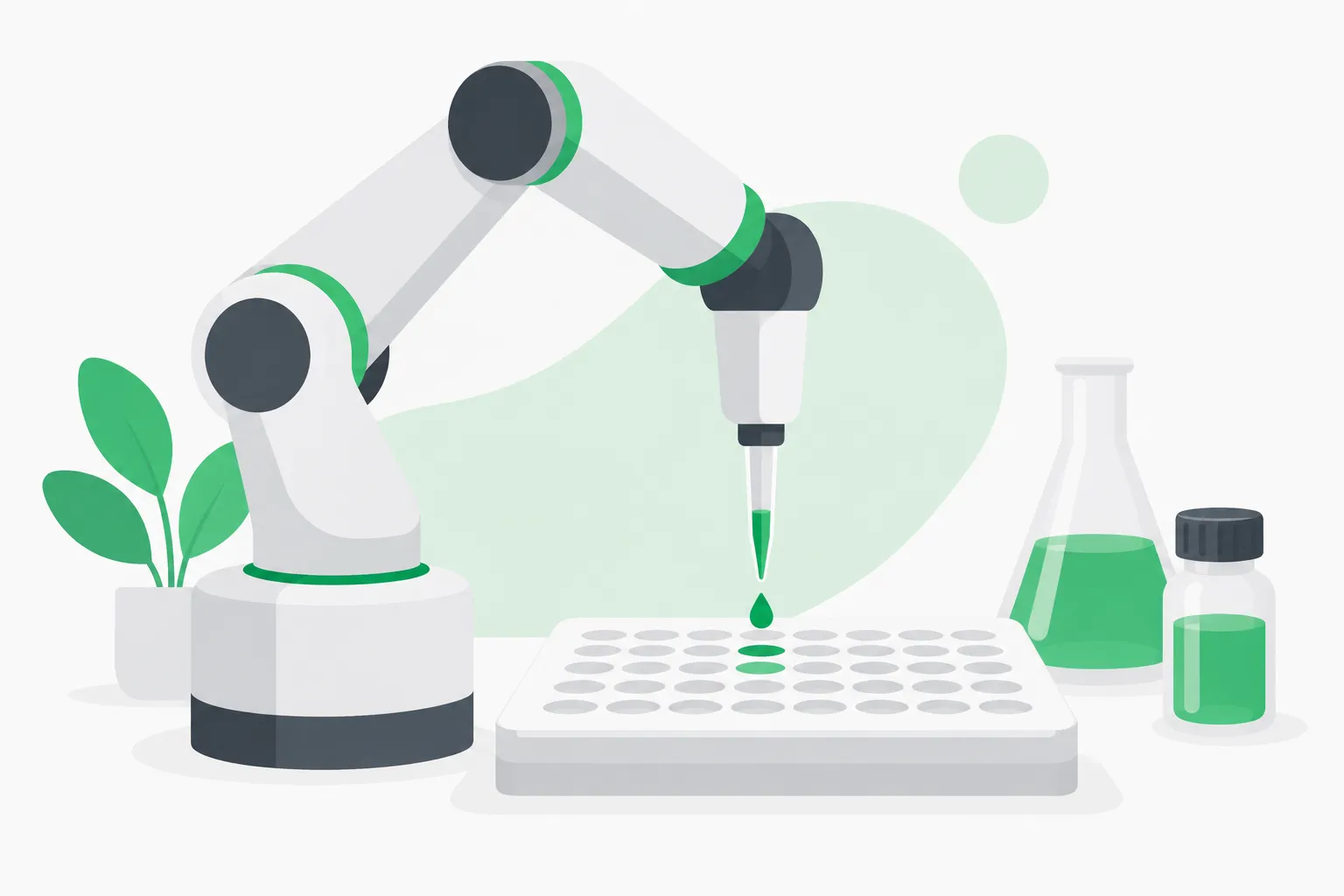 Robot arm pipetting over a lab tray
Coverage ties DP Technology, a Beijing research software firm, integrating Kimi K3.1 Pro into BioMaster. The reported mouse pancreatic cell study processed 3,696 cells, returning 100 candidate genes in about 90 minutes against an estimated four hours of expert labor.
Treat timing and accuracy as vendor-reported case study, not peer-reviewed validation. Still, it shows how Moonshot wants Kimi sold: measurable lab hours saved, not only HumanEval points.
Readers comparing to Western stacks should see OpenAI Rosalind and GeneBench programs and November 16 ChatGPT for Academic Researchers expansion as the US mirror image.
Why coding benchmarks may feel saturated
The Decoder piece cites TCSExam, a 100-problem theoretical CS benchmark where leading models produce verifiable proofs but do not crack open conjectures solo. US labs hit similar walls when marketing math breakthrough claims that mathematicians scrutinize.
When leaderboard deltas shrink, labs reallocate compute to domains with higher willingness to pay and regulatory moats. Pharma fits that profile even when Citi survey skeptics doubt near-term success rates.
 Molecule cluster in a mortar illustrating drug discovery research
China science AI in context
Moonshot join Tencent Hy4 flash office narrative and Alibaba Qwen science guardrails in pushing vertical scientific tools, not only general chatbots.
Sakana JFinBench shows another pattern: high-stakes qualification simulators as moats. Moonshot BioMaster path is the life-sciences version.
What builders should do this month
- If you run coding agents on Kimi, no change required today; monitor Moonshot model cards for science-tuned releases.
- If you sell biotech software, test BioMaster plus Kimi claims on your assays before marketing joint speedups.
- Track compute access stories separately; science pivot does not resolve B300 lease scrutiny.
- Compare pricing on Fireworks Kimi hosting when benchmarking against OpenAI researcher grants.
Coding was Moonshot's front door
Kimi became globally visible through coding and reasoning leaderboards, which triggered US export-control politics and distillation accusations all summer. Together Compiler research still names Moonshot among labs it post-trains, showing software demand follows compute wherever it lands.
A science pivot does not unwind that history. It reframes the next dollar of training spend: instead of squeezing another Terminal-Bench point, Moonshot can sell pharma hours saved stories that resonate with R&D budgets larger than individual developer subscriptions.
Competitive landscape in scientific AI
| Player | November 2026 angle |
|---|---|
| OpenAI | Expanded ChatGPT for Academic Researchers grants and Science at the Frontier economic research |
| Anthropic | Claude Science partnerships such as Novo Nordisk adoption |
| Google DeepMind | Isomorphic, AlphaFold lineage, and enterprise science clouds |
| Moonshot | Kimi inside BioMaster gene screens, public anti-coding-benchmark messaging |
| Tencent / Alibaba | Productivity and office models with science guardrails |
Moonshot differentiation is speed-to-demo in Chinese biotech software stacks, not necessarily unique wet-lab validation.
Export controls still dominate the background
Science narratives do not remove GPU politics. Congressional scrutiny of Moonshot leases, Speaker Johnson chip consensus quotes, and Pax Silica supply-chain diplomacy still shape which Kimi revision ships on which host.
Builders outside China should separate model capability marketing from hosting compliance. A science-tuned Kimi served through US inference providers may still be the practical path for Western pilots even as Moonshot pitches domestic BioMaster integrations at home.
What a flattening benchmark era means for eval culture
When labs admit coding leaderboard saturation, expect:
- More domain simulators (finance exams, wet-lab planners, manufacturing docs) as moats.
- Fewer single-number launch tweets unless the number ties to revenue or regulatory relief.
- Greater skepticism toward self-reported speedups without third-party replication, as seen in AI homework versus exam learning penalties.
Moonshot pivot is a data point in that macro shift, not proof that coding models stopped improving technically.
Practical takeaways for indie developers
- Do not panic-sell Kimi coding routes based on one strategic interview; APIs remain available.
- Do experiment with science bundles if your product touches omics or compound screening sales cycles.
- Document your own eval suite rather than trusting any lab headline benchmark.
- Watch DP Technology and Moonshot sites for BioMaster API docs if you want early integration access.
Kimi K3.1 Pro in the BioMaster workflow
Decoder describes Kimi K3.1 Pro, a post-trained version of Kimi K3 rather than the base K3 chat SKU, inside BioMaster. That tiering matters for procurement: science teams may pay for reasoning-class models while developers stay on cheaper coding endpoints. When you replicate the mouse pancreatic screen, ask which Kimi revision DP Technology exposes and whether tool use (databases, plot libraries, statistical tests) is enabled or the model only ranks genes from a flat expression matrix.
If you already run Vals AI comparisons on Kimi via Fireworks, expect different refusal and biology risk postures on China-first science hosts versus US resellers. Budget time for compliance review before patient-linked data touches any hosted Kimi route.
Web Summit context and global messaging
Web Summit positioning lets Moonshot speak to European pharma partners and investors without leading with export-control headlines. Ficari's science is harder than code line is crafted for executives who fund R&D platforms, not GitHub contributors.
That does not replace technical communication. Watch for a Moonshot research blog or Kimi model card update that turns interview rhetoric into reproducible benchmarks on public biology tasks. Until then, treat the pivot as go-to-market direction backed by one BioMaster vignette.
How independent teams should benchmark the claim
- Pick a public single-cell dataset with a published baseline analysis.
- Run Kimi K3.1 Pro through the same BioMaster or API path DP Technology cites, with fixed prompts.
- Compare candidate gene overlap with the paper's hits, not only wall-clock time.
- Log cost per million tokens on your host; science prompts balloon context quickly.
- Document human review time for false positives; gene lists are cheap, validation is not.
This mirrors how explainx.ai covered Claude scorpion toxin binders: headline hit rates without lab replication are hypotheses, not products.
Reading the Citi pharma skepticism stat
The Decoder piece cites a June Citi survey where 72% of leaders already use AI broadly but only 24% expect material improvement in drug development success rates. That gap explains why Moonshot must sell workflow hours (ninety minutes versus four hours) instead of FDA approval odds.
For builders, the lesson is positioning: science AI buyers reward credible time savings on well-defined subtasks more than AGI countdown clocks. If your product page only shows leaderboard ranks, consider adding one wet-lab-adjacent case study with datasets readers can rerun.
Will coding investment stop?
Unlikely. Moonshot still competes for Chinese developer mindshare against DeepSeek, Qwen, and MiniMax. The pivot statement targets marginal training dollars, not abandonment of Kimi on coding hosts. Expect parallel SKUs: coding-optimized checkpoints plus science bundles with longer context and tool hooks into lab software.
Limits of the November 16 reporting
- Primary Moonshot blog post for the pivot was not linked in Decoder text; rely on Ficari remarks and SCMP sourcing noted there.
- BioMaster metrics are single case study numbers.
- Pharma skepticism stats come from Citi survey secondary summary.
Related reading
- Fireworks Kimi K3 reasoning tokens
- Moonshot B300 filing claimed vs verified
- White House Moonshot distillation fight
- AI flattens scientific discovery — Evans Nature study
- Claude protein binder lab results
- OpenAI science blog Astra lattice post
Moonshot has not published a dated roadmap tying Kimi science releases to specific calendar quarters in the sources we read November 16. Track Moonshot news pages and BioMaster release notes for the first hard deadline.
Strategic claims are accurate as of The Decoder coverage dated November 16, 2026.