



Scientific data rarely arrive with instructions. A computational biologist must decide whether a signal is biology or batch noise, whether the cohort supports the estimand, and when to abandon a first analysis plan. Recalling facts and running a canned pipeline are not the same skill.
On June 30, 2026, OpenAI introduced GeneBench-Pro — a research-level benchmark built to measure that harder layer: judgment-heavy analysis in computational biology. Greg Brockman amplified it July 1: problems that would take a human expert 20–40 hours each, with GPT-5.6 Sol as the current frontier result.
This post breaks down what GeneBench-Pro tests, how problems are built, where models fail, and why the scores matter for GPT-5.6 availability hype.
Update — July 11, 2026: OpenAI's $50K Bio Bounty stress-tests biosafety safeguards on GPT-5.6 the same week capability benchmarks rise — capability and red-team moving together.
TL;DR
| Announced | June 30, 2026 — OpenAI Research |
| Scope | 129 problems · 10 domains · 21 sub-domains |
| Skill tested | "Research taste" — QC, path choice, iteration, decision-ready conclusions |
| Human effort | 20–40 hours per problem (~$4k–8k at $200/hr reviewer estimate) |
| Best score | GPT-5.6 Sol: 28.7% (highest reasoning) · 31.5% with Pro mode |
| Baseline progress | Original GeneBench: GPT-5 below 5% when benchmark work began |
| Data design | Synthetic with known causal structure — deterministic grading |
| Open release | 10 questions on Hugging Face + web UI; 50-question subset → Artificial Analysis |
| Agent environment | Isolated workspace — Python, scientific stack, PLINK 2.0, genomics libs |
The Benchmark Gap in Biology
Most existing biology benchmarks stop early in the scientific workflow:
| Typical benchmark scope | Real end-to-end analysis |
|---|---|
| Curated, cleaned dataset | Raw assay + phenotype + clinical context |
| Execute well-defined routine | EDA, QC, preprocessing — outliers? batch effects? |
| Result | Modeling + diagnostics + refinement loop |
| Conclusion that drives translational or clinical decision |
OpenAI's diagram captures the gap explicitly:
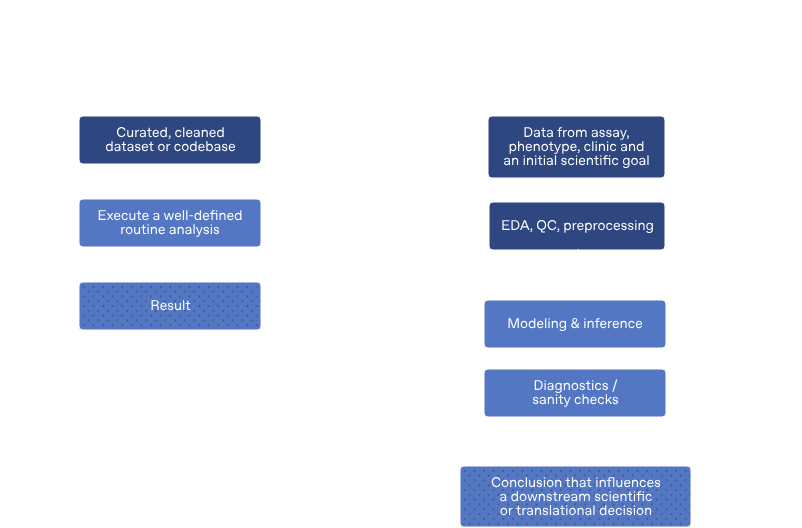 The benchmark gap in biology — typical benchmark scope (curated data → routine analysis → result) vs end-to-end scientific analysis with preprocessing, modeling, diagnostics, and iterative refinement
GeneBench-Pro sits on the right column. Agents get messy realistic data, brief experimental context, and a target estimand tied to a downstream decision. Passing requires exploring data, picking an analysis path, iterating when diagnostics fail, and returning a numerically gradable answer.
OpenAI defines "research taste" as the chain of judgment calls: which questions the data can support, how early QC should change the model, when to revise the plan.
129 Problems Across Computational Biology
GeneBench-Pro spans genomics, quantitative biology, and translational medicine — expanding the earlier GeneBench line referenced in GPT-5.6 preview benchmarks.
Domain atlas (n=129):
| Domain | n | Sub-domains (examples) |
|---|---|---|
| Population genetics | 21 | Admixture & aDNA, history & genealogies, selection & mutation |
| Clinical, PGx & diagnostics | 26 | Variant interpretation, pharmacogenomics, prenatal/clinical risk |
| Statistical genetics | 17 | Association & correction, causal mapping |
| Quantitative genetics | 17 | Trait architecture, family/transmission effects, genomic selection |
| Regulatory omics | 17 | Regulatory QTLs, transcriptome structure, spatial/chromatin context |
| Cancer genomics | 10 | Somatic genomics, liquid biopsy |
| Functional genomics | 9 | Functional genomics workflows |
| Proteomics | 7 | Proteomics and biomarkers |
| Microbial genomics | 3 | Metagenomic genomics |
| Forensic genetics | 2 | Forensic genetics |
Example problem types on the case-studies page include CRISPR target validation, linked genetic locus mapping, carrier screening, parent-specific ancestry, and structural-variant-guided tumor therapy benefit–risk decisions — each with a concrete JSON answer contract and reasoning field.
Why Synthetic Data — Not Messy Historical Cohorts
Long-horizon biology benchmarks often fail in two opposite ways:
- Too ambiguous — multiple defensible analysis paths; scores reflect benchmark author quirks, not model quality
- Too insensitive — fundamental analysis errors still numerically pass
GeneBench-Pro's fix: simulate every dataset from a known structural causal model (SCM).
That enables:
- Tuned complexity per problem
- Acceptance bands so reasonable subjective choices still pass
- Ablation proof that plausible wrong analyses fail
- Trace audits for information leakage and shortcut paths
- Deterministic grading against ground truth — no rubric verbosity games
External review: 82 of 129 problems went to graduate students, postdocs, industry scientists, and professors — assessed for realism, identifiability, and appropriate estimators.
"The problems I reviewed would have been challenging for a graduate student to complete without iterated feedback from an experienced supervisor… they were not simply applying some off-the-shelf method to clean and well curated data." — Alexander Strudwick Young, Assistant Professor in Human Genetics, UCLA
Construction and Validation Workflow
Each problem follows a build → review pipeline:
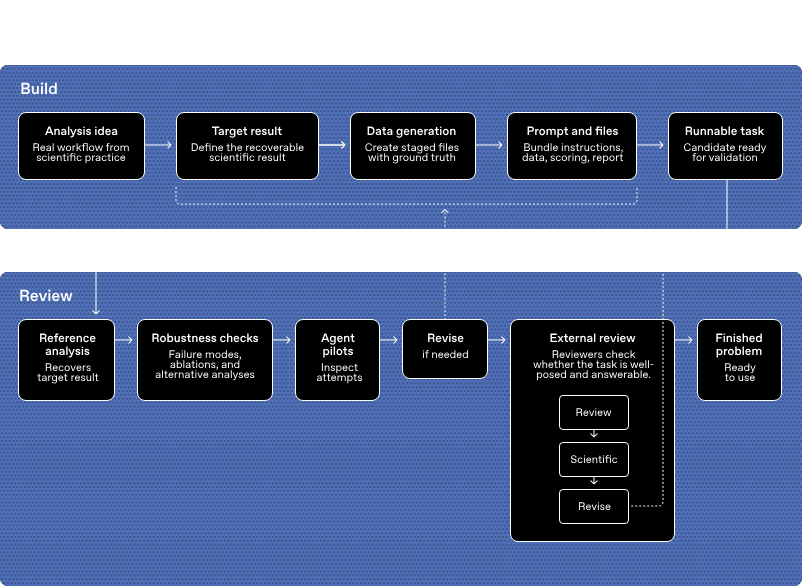 Construction and validation of a GeneBench-Pro problem — build phase (analysis idea, target result, data generation, prompt bundle) and review phase (reference analysis, robustness checks, agent pilots, external review, revision)
Build phase
- Analysis idea — real workflow from scientific practice
- Target result — recoverable scientific ground truth defined upfront
- Data generation — staged files with embedded truth
- Prompt + files — instructions, data, scoring spec, report template
- Runnable task — candidate ready for validation
Review phase
- Reference analysis recovers target
- Robustness checks — failure modes, ablations, alternatives
- Agent pilots — inspect real model attempts
- External review — well-posed and answerable?
- Revise loop until finished problem
What Agents Actually Receive
Each GeneBench-Pro task is a self-contained scientific analysis in an isolated workspace:
- Short prompt + data files
- Standard bioinformatics stack: Python, scientific computing libraries, PLINK 2.0
- Problems do not require exotic domain-only tooling beyond that baseline
Example output contract (benefit–risk tumor board problem):
{
  "answer": {
    "therapy_class_code": 1,
    "benefit_rd_pp": 12.4,
    "toxicity_dropout_risk_pp": 8.1,
    "net_clinical_utility_pp": 9.6
  },
  "reasoning": "Marginal structural Cox model; excluded prevalent users; 90-day efficacy lag..."
}
Graders check numerical correctness and expect quality of analytical reasoning in the reasoning field — shortcuts are explicitly discouraged in prompts ("These data came from a real experiment… do not attempt to take any shortcuts.").
Results — GPT-5.6 Sol Leads, Room to Grow
| Model / setting | GeneBench-Pro pass rate |
|---|---|
| GPT-5.6 Sol (highest reasoning) | 28.7% |
| GPT-5.6 Sol + Pro mode | 31.5% |
| GPT-5.6 Sol (lowest reasoning) | Single digits |
| GPT-5 (when GeneBench work began) | Below 5% |
| GPT-5.2 (high reasoning comparison) | ~5× fewer solves than GPT-5.6 Sol at high reasoning, using more tokens |
Scaling test-time compute: At lowest reasoning, GPT-5.6 Sol barely registers; at highest, it solves nearly six times as many questions as GPT-5.2 while using about two-thirds the tokens.
Open vs closed gap: The performance gap between GPT-5.6 / GPT-5.5 and leading open weights like GLM 5.2 is larger than coding benchmarks would predict — open models look more coding-specialized than strong at this kind of quantitative scientific judgment under uncertainty.
Bias concern addressed: OpenAI used frontier GPT models to evaluate problems during development and worried about pro-GPT bias. Competitor models at best matched contemporaneous GPT releases and often fell short.
Economics: Reviewers estimate 20–40 hours per problem. At $200/hr, human labor is thousands of dollars per task vs several dollars inference per agent run — partial automation at current ~30% pass rates could still move industrial genomics workflows if reliability improves on subsets.
OpenAI notes the benchmark may saturate by end of 2026 at current improvement pace — a bold claim that will invite scrutiny as Artificial Analysis runs the 50-question independent subset.
Where Models Fail — The Inferential Loop
Expert reviewers and failure traces cluster on predictable gaps:
| Failure mode | Example |
|---|---|
| Data QC blindness | Ancestry swaps, C>T bias in ancient DNA, batch artifacts — agents "aren't cautious enough" (Lex Flagel, Gencove) |
| Wrong tool, right vibe | Conventional Cox when marginal structural models needed for treatment-confounder feedback |
| Partial progress | Observations without integrating into revised plan — novice pattern vs expert reframing |
| Solver contract sensitivity | Prompt wording changes which analyses appear permissible (Cyrillus Tan, NYGC) |
Pharmacogenomic time-to-event example: GPT-5.5 fit a counting-process Cox with time-varying treatment but missed treatment-confounder feedback. GPT-5.6 Sol used a new-user marginal structural Cox model — excluded prevalent users, stabilized IP weights, 90-day efficacy lag — the causally appropriate path.
Models make partial progress on hard problems but struggle to close the inferential loop — mirror of expert vs novice cognition.
GeneBench-Pro vs LifeSciBench
Both landed in the same June 2026 research burst; they test different layers:
| GeneBench-Pro | LifeSciBench | |
|---|---|---|
| Focus | Computational biology research judgment | Industry biotech workflows |
| Tasks | 129 synthetic genomics/QTL/PGx analyses | 750 expert-written FDA, assay, regulatory tasks |
| Grading | Deterministic numerical targets | Rubric on free-response answers |
| Hero metric | GPT-5.6 Sol ~31.5% | GPT-Rosalind ~36% (different task distribution) |
| Open data | 10 problems on Hugging Face | Paper + contributor program |
Together they signal OpenAI positioning life-science AI beyond chatbot biology trivia — toward R&D and translational decision support.
Community Reaction (July 1, 2026)
Greg Brockman on X framed GeneBench-Pro as testing analysis that takes humans 20–40 hours — with GPT-5.6 Sol as a "big step forward."
Launch-day threads mixed excitement with skepticism:
- Capability tracking fatigue — hard to compare agents when harnesses and
/goalcontext change behavior (Codex long-horizon context) - Chart readability — community reposted simplified score visualizations
- "Benchmark tuned for GPT" — countered by OpenAI's competitor-matching analysis and upcoming Artificial Analysis subset
- "When can we use GPT-5.6?" — GeneBench-Pro dropped alongside ongoing limited preview; broad GA still expected in coming weeks on the same export-control timeline as Fable 5's July 1 restore
Why It Matters Beyond the Leaderboard
Sequencing is cheap; interpretation is the bottleneck. Biobanks link molecular, phenotypic, and EHR data at scale — but target prioritization still leans on human genetic evidence and teams of analysts.
If agents reliably automate even a fraction of GeneBench-Pro-class workflows:
- Faster hypothesis triage and target follow-up
- Shorter loop between data generation and go/no-go decisions
- More reproducible exploratory analysis — if solver contracts stabilize
OpenAI's framing: future benchmarks must test abstraction-level scientific judgment, not book knowledge or routine .fit() pipelines — the same direction as TabFM-style zero-shot ML for structured data, but for causal genomics under mess.
Try It Yourself
- Announcement + paper: openai.com/index/introducing-genebench-pro
- 10 open problems: Hugging Face + interactive web UI (linked from announcement)
- Case studies: 10 representative questions with multi-page writeups on OpenAI's site
- Third-party eval: 50-question subset → Artificial Analysis (forthcoming)
Related Reading
- Andrew Ho leaves OpenAI — GeneBench → RL dataset startup
- GPT-5.6 Sol, Terra, and Luna Preview Guide
- When Will GPT-5.6 Be Available to Everyone?
- LifeSciBench: OpenAI's 750-Task Biotech Benchmark
- OpenAI Rosalind Workbench: life-sciences workspace in research preview
- Google TabFM: Zero-Shot Tabular Foundation Model
- Anthropic Agents for Biology — VirBench and gget
- Evans Nature study — AI flattens discovery in data-rich biology
- ChatGPT for Academic Researchers — free GPT-5.6 Sol Pro access