



On October 20, 2026, Anthropic published a new Claude Science result: an internal research model designed protein binders against scorpion neurotoxins. Two contract labs tested 211 designs, and 17 met Anthropic's criteria for a binder. Anthropic released every design and the lab data. It also states, up front, that it has not shown any of them neutralizes venom, so this is a strong first step and not an antivenom.
This follows the August study where Claude designed working binders for 14 of 15 targets. The new twist is who ran it and what they aimed at: a group of motivated non-experts from Citrini Research, a financial investment research firm, asked whether AI could help them tackle a real health problem.
Update (October 22, 2026): outside experts say the result is promising but far from a drug
The Verge reported on October 22 that Citrini Research, the firm behind the experiment, worked from Anthropic's offices with the safeguards lifted and an unreleased model, and that Anthropic covered a compute and token bill of just under $50,000. Testing at Adaptyv Bio and Twist Biosciences reportedly cost about another $150,000. The Verge also notes that Citrini itself says no experiment has yet tested whether the binders actually stop the toxins working. Citrini and Anthropic did not respond to The Verge's requests for comment.
Experts quoted by The Verge are cautious. Andreas Hougaard Laustsen-Kiel of the Technical University of Denmark says finding a good binder against scorpion and snake toxins is "easy-ish" and the hard part is turning it into a medicine. His DTU colleagues Melisa Benard Valle and Anne Ljungars call the results technically promising but "far from a medicine and hyped", and say the most novel part was the autonomous discovery process rather than the biology. Andreas Bender of Khalifa University says binder design is "kind of" a solved problem and that existing high-throughput screening can find many hits at manageable cost without AI. These are the experts' views as reported, not new lab data. They match the caveats already in the claimed-versus-verified section below.
TL;DR: the scorpion toxin results at a glance
| Question | Answer |
|---|---|
| What was designed? | Minibinders (small designed proteins) against five scorpion neurotoxins |
| Who ran it? | Anthropic's life science team with Citrini Research; labs: Adaptyv Bio and Twist Bioscience |
| How many designs? | 318,484 generated, 180 selected by Claude, 31 added with Claude's help, 211 tested |
| How many worked? | 17 met the binder criteria, each against one toxin |
| Single-toxin hit rate | 11 of 60 designs (18%), which Anthropic calls typical for protein design campaigns |
| Best binders | Cn2-B1 and Cn2-B2, single-digit nanomolar affinity |
| Time and compute | 64 hours, on the order of 10,000 GPU hours |
| Is it an antivenom? | No. No neutralization testing in cells or animals yet |
| Multitoxin binders? | None met the criteria against more than one toxin |
| Data public? | Yes, all 211 designs plus experimental data |
Why scorpion venom?
Anthropic's post cites at least 1.2 million stings a year and more than 3,250 deaths, mostly among children in regions with limited access to medical care. Existing antivenoms are made by milking venom from thousands of scorpions, immunizing horses, and purifying their antibodies, a process that can take months. They tend to work against only a small number of neurotoxins, and are costly or scarce where stings are common.
The toxins that endanger humans attach to sodium channels in nerve cells and make nerves fire at the wrong time, flooding the body with stress chemicals such as adrenaline. In severe cases that leads to heart failure and fluid in the lungs. A binder that sits on the part of the toxin that grips the channel could, in principle, keep the toxin from reaching it.
Anthropic describes scorpion envenomation as a neglected tropical disease: the people affected are poorly placed to fund drug development, and treatments are unlikely to earn back their cost. That is the case for trying cheap computational design here. Anthropic says its approach was inspired by earlier work that designed proteins neutralizing snake neurotoxins and protected mice, and that to its knowledge no de novo designed binders against scorpion neurotoxins had been described before.
How Claude ran the campaign
The initial prompt reused the one from the August protein-binder study, modified with Citrini. It defined the targets, the design and folding tools, and the rules for novelty, scoring and filtering. Then Claude took over most of the decisions.
 Claude scorpion toxin binder design results across the five neurotoxin targets
Image: Anthropic
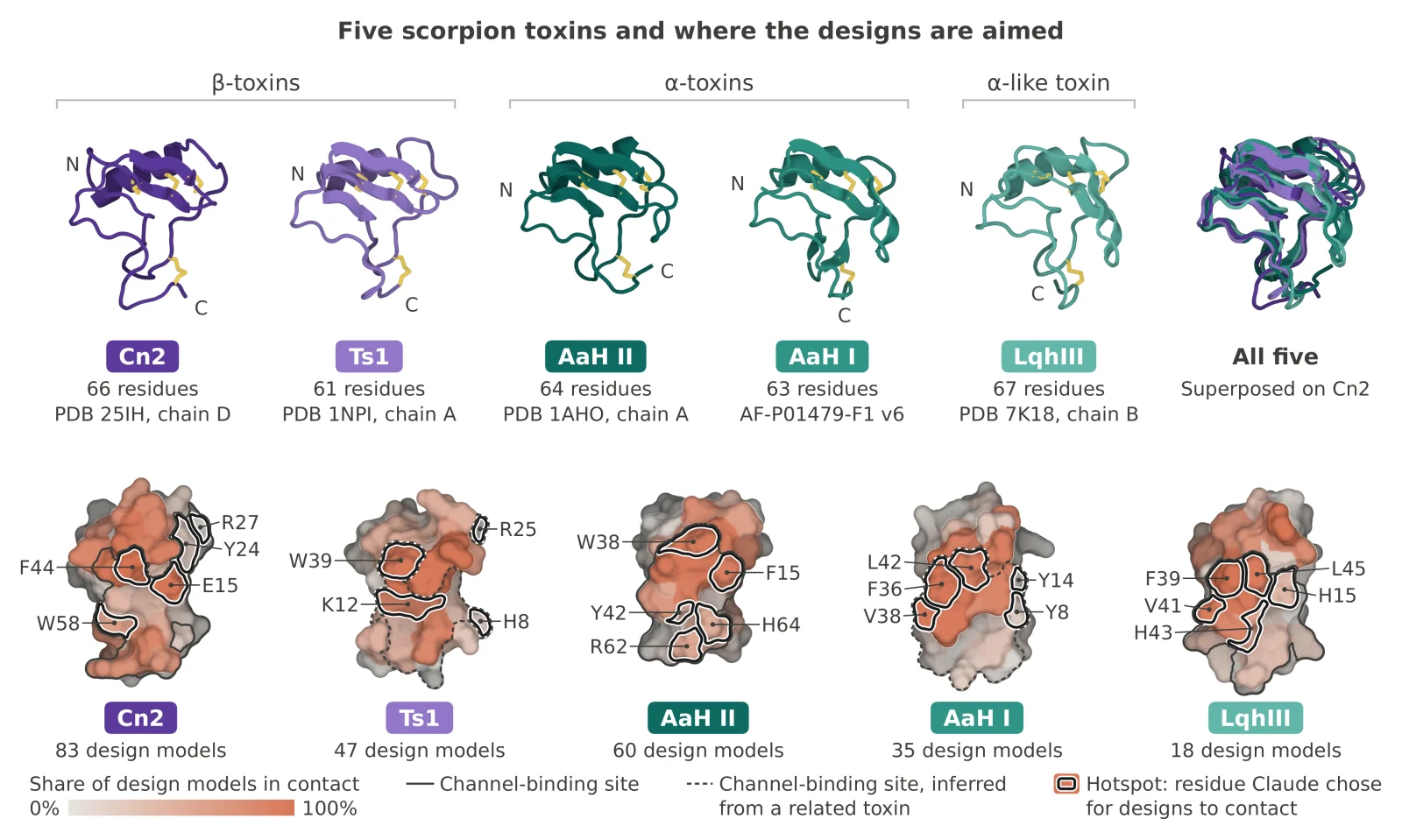
The figure shows the five toxins and where the designs were aimed. Anthropic says Claude searched the Protein Data Bank and the AlphaFold database for structures, picked five hotspots (specific amino acid positions) per toxin, set the quality thresholds a design had to clear, chose how much to lean on each design tool, and invented strategies for multitoxin binders. The five toxins span four regions: Mexico (Cn2), Brazil (Ts1), North Africa (AaH I and AaH II) and the Middle East (LqhIII).
The numbers behind the 64 hours:
- Claude used 12 design tools and generated 318,484 designs.
- It filtered out any design that resembled a toxin or a known protein.
- It co-folded and screened 553,052 design-toxin pairs, predicting each pair's structure as one complex.
- It produced a final list of 180 designs, and the team later added 31 more with Claude's help.
- Claude worked autonomously for the first 24 hours, then was prompted four more times, mainly to pursue multitoxin binders.
- Claude selected most of the 180, including the strongest binder, only after the third follow-up.
At the team's request, Claude emailed the protein sequences to Twist Bioscience, with the emails marked as written by Claude. A footnote adds that the compute is "much more than most researchers have access to," but that Anthropic has since made these models about 4x faster on average, and that a simplified prompt with a single agent on a single GPU over 24 hours reached comparable in-silico scores.
The 211 tested designs break down as 60 single-toxin designs (12 per toxin), 30 aimed at the two beta-family toxins, 30 at the three alpha-family toxins, and 91 at all five.
What the labs measured
Adaptyv Bio and Twist Bioscience each produced the designs in their own format. Adaptyv expressed them in a cell-free system, which uses protein-making machinery extracted from bacteria. Twist expressed them in human kidney cells as fusions to an antibody stem (Fc). Both measured binding with surface plasmon resonance, where the toxin flows over the design and an instrument tracks how fast it binds and detaches. The output is a dissociation constant (KD): the lower it is, the tighter the binding.
 Lab binding measurements for Claude-designed protein binders against scorpion toxins
Image: Anthropic
The bar for calling something a binder was strict:
- A hit at both labs, with binding in every replicate (LqhIII was assessed only by Adaptyv Bio).
- Every KD at 1 micromolar or tighter.
- No signal against CLEC12A, an unrelated human protein used to detect off-target stickiness.
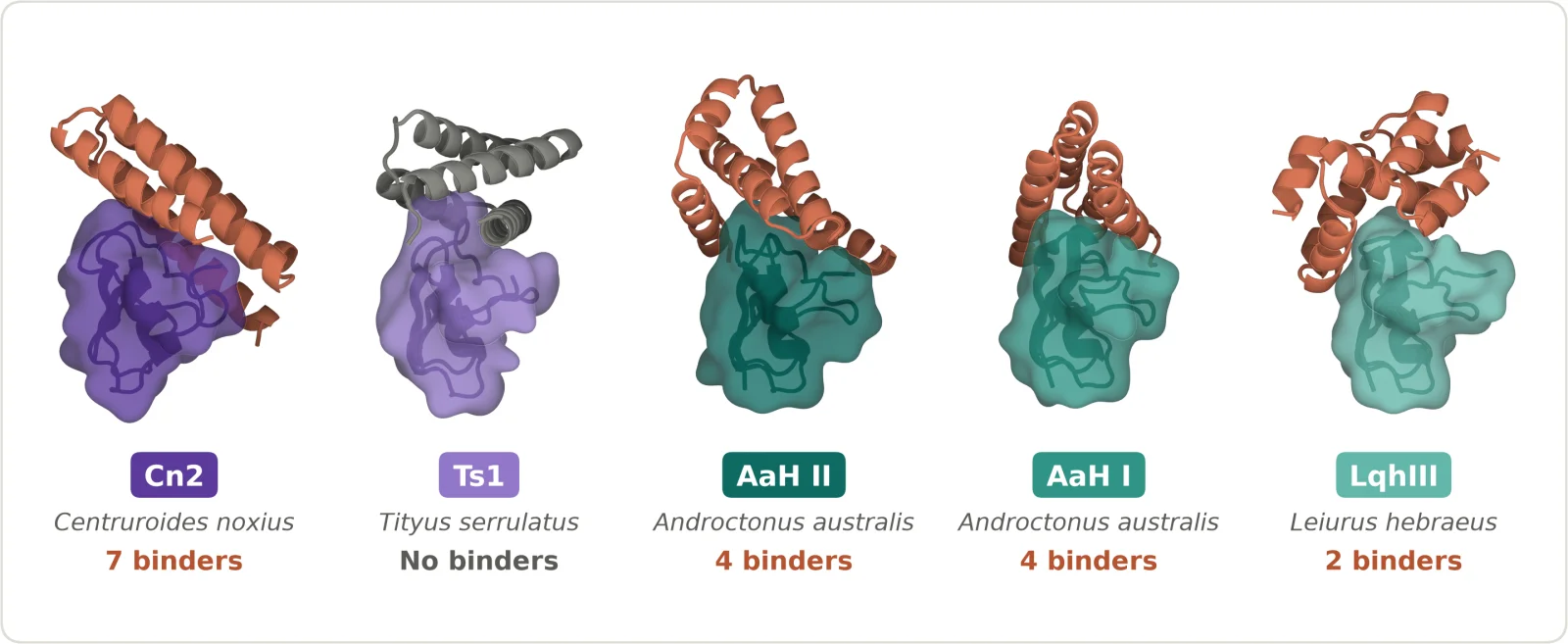
Seventeen of 211 designs cleared it: seven against Cn2, four against AaH II, four against AaH I, and two against LqhIII. None cleared it for Ts1. Among the 60 single-toxin designs, 11 were binders, an 18% rate that Anthropic says is consistent with typical protein design campaigns, including its own earlier work.
The strongest binders and the antibody comparison
Cn2-B1 and Cn2-B2 bound Cn2 in the single-digit nanomolar range at both labs. For context, Anthropic notes that antibodies and nanobodies remain the standard to beat: three such molecules have reported affinities below 1 nM against Cn2 or AaH II and have protected mice. So these designs are tight, but not yet at the best antibody level.
A competition experiment tests whether two molecules can bind the target at once. If one reduces the other's binding, they likely share a site. Anthropic reports that its Cn2 binders appear to attach on or near the epitope of an antibody called LR, which has been reported to neutralize Cn2 in mice and covers the part of Cn2 that grips the sodium channel. Anthropic says that suggests they will likely neutralize Cn2, but it has not tested Cn2-B1 or Cn2-B2 in cells or animals. Read that as a hypothesis with supporting evidence, not a result.
What did not work
Claude struggled with multitoxin design. None of the designs aimed at multiple toxins met the criteria for more than one. Anthropic lists possible reasons: Claude's current capabilities, its own prompting, the limits of available design tools, and whether multitoxin design is biologically feasible at all. The five toxins share one overall fold but are only 26% to 62% identical in sequence, so this was a deliberately hard test. A single molecule that covers every scorpion toxin would have made a cheaper, region-neutral antivenom cocktail, and that goal is still open.
Claimed versus verified
| Claim or question | Status |
|---|---|
| Claude designed binders that bind scorpion toxins | Verified by two independent labs under strict criteria, per Anthropic's report |
| 17 of 211 designs met the criteria | Anthropic's count; the data is released for outsiders to check |
| Cn2 binders likely neutralize the toxin | Inferred from competition with antibody LR; not tested |
| This is an antivenom | Not claimed. No neutralization in vitro or in vivo |
| Binds toxin purified from real venom | Not tested; only recombinant toxins were used |
| Multitoxin binders | Not achieved |
| Outside expert view | Two external experts, Susana Vázquez Torres (CNIO, Madrid) and Timothy P. Jenkins (Technical University of Denmark), called it a promising first step, per Anthropic |
Note that the expert quotes are published on Anthropic's own page, so they are best read as supportive context rather than an independent review.
What would have to happen next
Anthropic spells out the path. First, confirm a design such as Cn2-B1 binds toxin purified from venom. Then test function in vitro with patch-clamp recordings, which measure the current through sodium channels, to see whether it stops the toxin acting on the channel. Then test in mice. Beyond neutralization, a treatment must be safe, stable, affordable and available where stings occur, which also takes clinicians, funders and policymakers.
Vázquez Torres' comment in the post captures the shift: binding itself is no longer the main bottleneck, and the real impact comes from the parts of the pipeline beyond it. That matches the caution in our earlier coverage that protein binders are not drugs.
What this means if you build with AI
- Agentic science is getting concrete. Four follow-up prompts steered a 64-hour campaign that Claude ran largely alone: tool selection, filtering, thresholds and report drafting. Compare the pattern with Claude's other long autonomous runs on quantum circuit design and the first complete UV map of the sky.
- Wet-lab validation is the credibility layer. The result is believable because outside labs tested it with preset criteria and the raw data is released.
- Hit rates are normal, not magical. 18% for single-toxin designs is typical. The novelty is the speed, the breadth of targets, and the autonomy, not a better hit rate than August's.
- Tooling is converging. Expect more agent toolkits wrapping structure and design models, such as NVIDIA's BioNeMo agent toolkit for Claude Science.
- Pharma is paying attention. See how a large drugmaker is using the same platform in Novo Nordisk's Claude Science work.
The safety angle
Designing protein binders for toxins is defensive work, since the binders are meant to neutralize a toxin rather than make one. Still, the same design tools raise dual-use questions, which is why watermarking efforts such as DeepMind's SynthID Bio for AI-designed proteins are being built. Anthropic's post does not describe special biosecurity handling beyond filtering out designs that resemble a toxin or known protein, so readers should look to the technical report for detail.
How to dig in yourself
- Read the Anthropic research post and open the technical report and data release it links.
- Look up the toxin structures in the Protein Data Bank; the figure above lists the entries Claude used (for example 1AHO for AaH II and 7K18 for LqhIII).
- See how the testing partners work: Adaptyv Bio and Twist Bioscience.
- If you work in structural biology, compare the released sensorgrams against your own design pipeline's hit rates.
Related reading
-
Warp Sciences: Kevin Weil's robot wet lab for drug discovery
-
Omnii-1: Radical Numerics' genome model and AI-designed phage claim
-
Claude designed working protein binders for 14 of 15 targets
-
Anthropic and Claude solve the first prokaryotic vault particle structure
Details in this post reflect Anthropic's October 20, 2026 publication; check the original post and technical report for updates.