




The House Foreign Affairs Committee has published export-license data that puts numbers on Nvidia and AMD sales to China. In a statement on November 19, 2026, the committee said Chairman Brian Mast "exercised his authorities under the Export Control Reform Act to publicly reveal export control license application information regarding NVIDIA and AMD's AI chip licenses for the People's Republic of China." The headline figures: 3.4 million AI chips requested for China, and more than 879,000 approved by the Commerce Department's Bureau of Industry and Security (BIS), as of May 2026.
This post sets out what the committee said, what the numbers do and do not mean, and where the story connects to the Nvidia threads we have been tracking.
TL;DR: the committee disclosure
| Question | Answer |
|---|---|
| Who released it? | House Foreign Affairs Committee, Chairman Brian Mast, on November 19, 2026 |
| What was requested? | 3.4 million AI chips for Chinese buyers, as of May 2026 |
| What was approved? | More than 879,000, by BIS |
| Which chips? | "AI chips" from Nvidia and AMD; the statement as quoted names no models |
| Who got approvals? | Companies including Alibaba and Tencent, which the Pentagon lists as Chinese Military Companies |
| Does approval equal shipment? | No. The coverage gives no delivery numbers |
| Other claim? | Findings include Nvidia requests relying on possible chip-smuggling fronts |
What did the committee actually say?
CNBC reported that BIS approved sales of more than 879,000 AI chips to Chinese companies including Alibaba and Tencent as of May 2026, according to documents released Thursday. Some approvals, the documents show, included companies the Defense Department designates as "Chinese Military Companies." As of May there had been 3.4 million requested sales of US AI chips to China, Mast said, citing Nvidia and AMD.
A Reuters report carried by Devdiscourse quotes the committee's wording more fully: findings include "requested sales of 3.4 million AI chips to China, and the approval of more than 879,000 by BIS-including approvals for AI chip exports to Department of War-designated Chinese Military Companies like Alibaba and Tencent. It also includes requests by NVIDIA to depend on possible chip-smuggling fronts to facilitate their sales of advanced AI chips to Chinese companies." The Reuters text as syndicated by Devdiscourse is short, and neither report lists a company-by-company table.
What the numbers do not tell you
Four caveats matter before anyone repeats the figures.
- Requests are not approvals. About a quarter of requested volume, 879,000 of 3.4 million, was approved by the cutoff, on those figures. The rest were pending, denied or withdrawn; the coverage does not break that down.
- Approvals are not shipments. A license lets an exporter ship. It does not show units delivered, and the committee numbers we saw do not claim they were.
- The date is May 2026. The data is a snapshot from six months ago. Rules, license conditions and company behavior have changed since then, including the Commerce rule on Chinese AI firms using Nvidia chips remotely.
- Per-company counts need the source. Social posts relaying the story give exact figures for individual Chinese firms. Those were not in the CNBC or Reuters text we reviewed, so treat them as unverified until the committee's own release or documents are read.
The wording about "possible chip-smuggling fronts" is a committee characterization of Nvidia's requests. It is not a court finding, and the committee statement as quoted does not name a defendant.
How does a chip license request work?
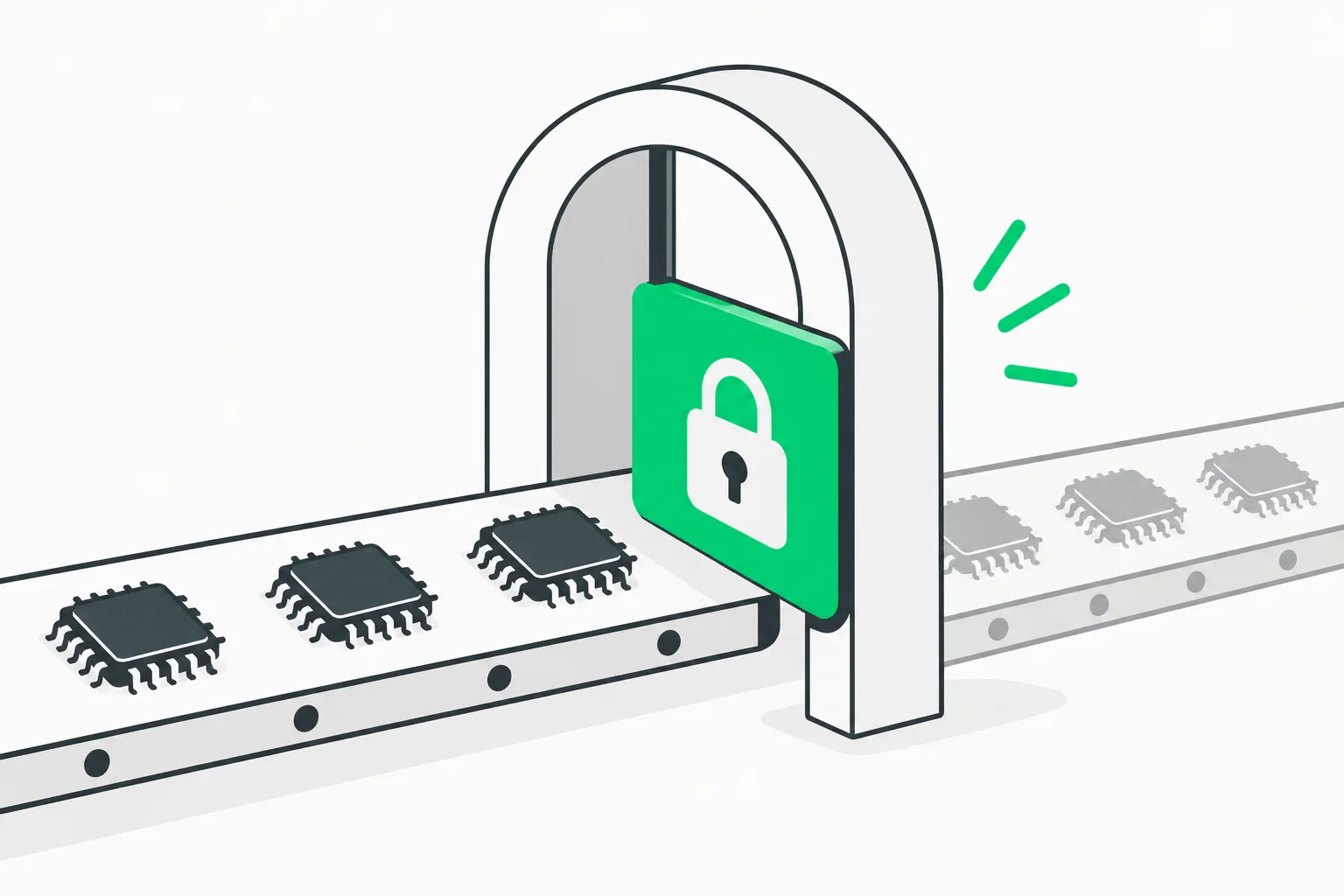 A cream chip resting behind a closed green shipping gate, illustrating how BIS licensing gates AI chip exports to China
A chipmaker that wants to sell controlled hardware to a buyer in China files a license application with BIS, the Commerce Department unit that runs US export controls. The application names the product, the quantity and the end user. BIS can approve it, attach conditions, deny it or leave it pending. Because a single application can cover many thousands of chips, the committee's totals are counts of chips across applications, not counts of buyers or orders.
That explains why the 3.4 million and 879,000 figures can both be true while telling different stories. A large request volume shows demand and the effort that vendors put into the licensing channel. A smaller approved volume shows how much BIS actually let through. Neither number shows the end use, and neither shows whether the chips went to a data center, a research lab or a reseller. That gap is exactly what the smuggling-front language in the committee statement points at: a licensed shipment to a legitimate-looking buyer can still be diverted.
For readers following the policy fight, the useful questions are simple. Which approvals went to firms on the Pentagon list? What conditions did BIS attach, such as end-use checks? And did Nvidia or AMD tell BIS about intermediaries that the committee now calls possible fronts?
Timeline: how the week unfolded
| Date | Event | Source |
|---|---|---|
| Nov 10 to 11 | Bloomberg reporting that BIS progress on the Megaspeed smuggling probe paused and that chip counts sent to Washington missed about 50,000 units | explainx.ai coverage |
| Nov 17 | Nvidia's board forms an export control oversight committee | explainx.ai coverage |
| Nov 19 | House Foreign Affairs Committee publishes Nvidia and AMD license data | CNBC, Reuters |
Why this came out now
CNBC ties the release to the fallout from Jensen Huang's departure from Nvidia after reports about a relationship with a suspected Chinese spy, which raised concerns about chip diversion. It says Republicans and Democrats have since called for stricter export legislation. We covered the sequence in our posts on the Megaspeed probe pause and chip counts, the claimed-versus-verified Megaspeed hub and the Wyden and Neal preservation demand.
License data is normally confidential. Using Export Control Reform Act authority to publish it is a deliberate step, and it hands Congress and outside analysts a baseline to test claims such as how many advanced chips legally reached China.
How this fits the larger export fight
Three threads now run together.
Oversight inside Nvidia. The board created a National Security and Export Control Oversight Committee on November 17, with quarterly meetings and outside experts. The committee release adds outside pressure on what that group will review.
Legislation. Members from both parties have pushed export-control bills since the Huang exit. Our earlier note on the Gang-of-Eight briefing and NDAA push and on Speaker Johnson backing chip limits show the direction.
Administration policy. President Trump told Fox News from APEC that Blackwell sales to China might be allowed in two or three years, with no rule change yet, as covered in Trump on Nvidia Blackwell and China. The committee figures show BIS had already approved large volumes of chips for Chinese buyers by May.
What this means for what you build or pay
For builders, the practical effect is indirect. Tighter licensing and congressional scrutiny can change GPU supply, cloud region access and the contract language that cloud and hardware vendors use about end users. If you resell compute or run workloads for overseas customers, expect more questions about who the end user is.
For founders, any plan that depends on selling AI hardware or hosted inference into China should assume the rules can move quickly and that past approvals do not predict future ones. For marketers and analysts, the safe approach is to cite the committee's wording and date, and avoid turning "approved" into "sold."
What people are asking
Is this the same as the Megaspeed smuggling story? No. Megaspeed concerns alleged diversion of chips through a corporate network. The license data concerns legal applications and approvals. The committee links them only through its wording about possible smuggling fronts, so keep the two threads separate until documents show a connection.
Did the administration break a rule by approving these licenses? The coverage we reviewed does not say so. Approving licenses is within BIS authority. The dispute is over policy: whether approvals to firms on the Pentagon list were wise, and whether safeguards were enough.
Are these H100 or Blackwell chips? The committee statement as quoted says only "AI chips" for Nvidia and AMD. The product list is unconfirmed until the documents are read.
What to watch next
- The committee's own documents. The full release should show which licenses, which chips and which buyers. Read it before relying on per-company numbers.
- Responses from Nvidia, AMD and BIS. The coverage we reviewed did not include company or agency comment. The official answer will appear in their statements and in the committee's press page.
- Congressional follow-up. Hearings, subpoenas and export bills are likely to cite these figures.
- Delivery data. Customs, company filings and earnings disclosures are the way to test how many approved chips shipped.
How to read similar claims
When a headline gives a big chip number, check four things: whether it counts requests, approvals or deliveries; which chip generation it covers; the cutoff date; and who produced it. The same pattern showed up in our look at reported links between Chinese universities and blacklisted procurement and in the US-China commission's report on PLA use of Nvidia chips: documents give solid anchors, and headlines tend to blur categories.
Related reading
- Nvidia export control oversight committee
- Megaspeed probe paused, 50,000 chips
- Wyden and Neal Nvidia China investigation
- Congress pushes tighter chip curbs
- Speaker Johnson and chip export limits
- Commerce rule on remote Nvidia chip use
- Trump on Blackwell and China
Figures are as stated by the House Foreign Affairs Committee, CNBC and Reuters on November 19, 2026, and may be revised when the full documents are read.