




On November 12, 2026 IBM published LLMON: An LLM-Native Markup Language, now in Granite 4.1 3B and 8B on Hugging Face—pairing a structured prompt format with open preview weights aimed at agent brittleness and indirect prompt injection. Context is not just long text; it mixes system rules, tool JSON, retrieved documents, and reasoning chains. IBM's pitch is that implicit structure fails small models and invites prompt injection hidden inside user data.
LLMON adds explicit tags and exec blocks so a 3B–8B Granite model knows which span is an instruction versus readable material—and which instructions are actually in force.
TL;DR
| Question | Answer |
|---|---|
| What shipped? | granite-4.1-3b-LLMON-preview, granite-4.1-8b-LLMON-preview, GitHub toolkit |
| Why not JSON? | Delimiters are reserved tokens; nesting is local; converters round-trip JSON |
| Security hook? | High OPI robustness (1 − attack success) vs instruct Granite and frontier tests |
| General ability? | IBM says benchmark buckets match Granite 4.1 Instruct |
| How to try? | Hugging Face weights, generative-computing/llmon, Mellea integration |
| Maturity? | Experimental preview |
Agents that act on your behalf need rules. See how explainx helps secure your agents →
Why structure matters for small open models
IBM Granite 4.2 reasoning releases pushed open weights toward agents. The failure mode IBM names here is different from raw capability: small LMs mis-parse overlapping JSON punctuation and merge retrieved text with system commands.
That is the same class of risk Coinbase's agent controls and United Airlines' third-party agent blocks worry about in production—unexpected authority bleeding from untrusted payloads.
LLMON does not replace weight-editing backdoor research or hosting guardrails; it attacks context formatting at the tokenizer boundary.
How a turn renders
A user turn can name instruction, data, and requirement parts with exec: True or False. True parts bind into an exec block that states which instruction runs on which data under which requirements; False parts appear in context but nothing references them—decoys included in training.
IBM's blog shows a minimal Python-shaped message list and the rendered LLMON span (abbreviated here):
messages = [ { "role": "user",
               "instruction": [{ "value": "Write a short paragraph about", "exec": True }],
               "data": [{ "value": "IBM Company", "exec": True }],
               "requirement": [ {"value": "Use less than 10 words", "exec": True},
                                {"value": "Do not use commas", "exec": True}]
             } ]
The template emits tagged blocks with two-token IDs addressing components—exec wires instruction, inputs, requirements, and the assistant output slot.
Compared with IBM Granite Switch 4.1, which routes modalities through one endpoint, LLMON is a prompt serialization layer you can embed in agent harnesses.
Prompt injection benchmark
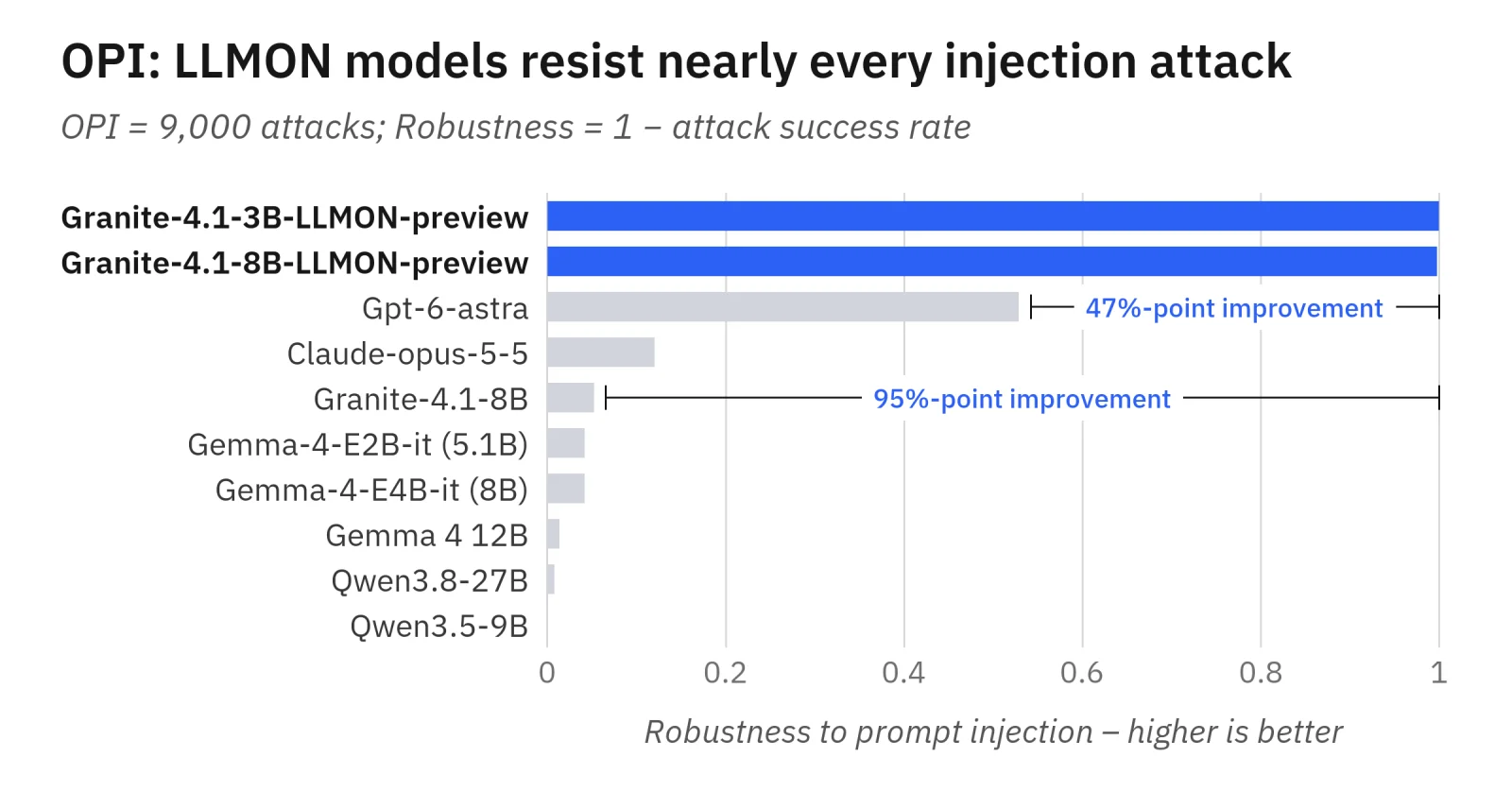 IBM LLMON OPI indirect prompt injection benchmark comparison chart
Image: IBM
IBM tests indirect injection—malicious instructions embedded in retrieved documents or tool bodies—on OPI, ASB, and StruQ. On OPI they report robustness (1 − attack success rate):
- Conventional instruct models: high hijack probability.
- LLMON previews: near-zero attack success on the cited OPI setup—47% more attacks avoided than the best frontier model they tested and 95% more than the best open-source comparator in their table.
They note benchmarks cover static injections; adaptive multi-turn attacks remain work in progress—aligning with agent security surveys that stress conversation-long attacks.
For builders comparing to closed APIs, treat these as IBM-reported evaluations on named suites; rerun on your tool schemas.
General capability
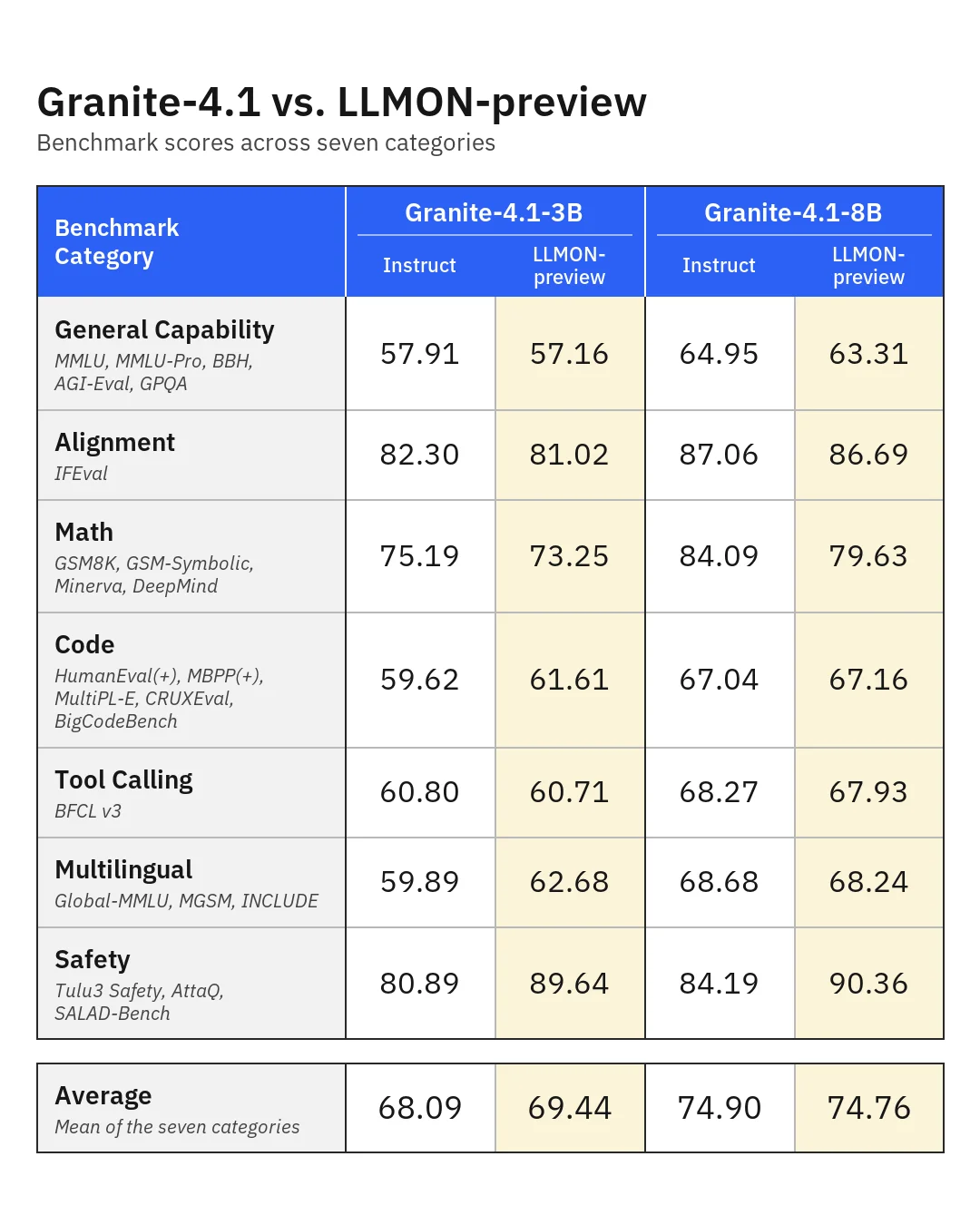 Granite 4.1 Instruct versus LLMON preview general capability comparison
Image: IBM
IBM claims standard benchmark categories line up with Granite 4.1 Instruct—the safety margin is not purchased as a large capability tax in their charts.
If you already run Granite 4.1 3B or 8B locally via llama.cpp-class stacks, swapping checkpoints is a weight change, not a new runtime—though you must ship the LLMON chat template from the model card.
Training recipe (high level)
Checkpoints start from Granite 4.1 base, not instruct, so LLMON behavior is learned during post-training:
- Tokenizer: six reserved delimiter tokens for tag open, close, nest, anchor.
- Supervised fine-tuning: re-serialize instruction-tuning corpora into LLMON blocks; add decoy unbound instructions and data while targets unchanged—teaches ignoring unreferenced spans.
- RL stack: five GRPO stages (reasoning, RLHF, calibration, math) plus DPO on ~1k on-policy preference pairs from the model's own responses to injection attempts.
The privilege rule is learned: instructions reached through exec are authoritative; data-path text is not commands. IBM hosts an attention visualization Space to inspect layer behavior—useful for security reviewers, not mandatory for inference.
 Granite LLMON preview training separates exec-bound instructions from decoy data spans
Bring-your-own schema
LLMON is not a fixed tag set. IBM demonstrates ScienceWorld with custom tags like instr.task.goal and data.state.inventory, fine-tuning a LoRA on trajectories—similar spirit to agent skills but at the token markup layer.
Tool-calling notebooks in the GitHub repo mirror patterns from Hugging Face pybot swarm agents at a different scale: structure first, orchestration second.
How to try it this week
- Pull weights from Hugging Face:
granite-4.1-3b-LLMON-previewandgranite-4.1-8b-LLMON-previewmodel cards list inference snippets. - Clone toolkit: github.com/generative-computing/llmon for converters and workflow templates.
- Mellea path: github.com/generative-computing/mellea advertises native LLMON on LLM calls.
- Red-team your RAG corpus: embed classic injection strings in a
datapart withexec: False, bind a benign instruction withexec: True, compare against your current Granite instruct prompt. - Read papers linked from the post: arXiv:2610.38120 and arXiv:2603.22519 for methodology beyond the blog summary.
IBM asks for feedback in GitHub Discussions—appropriate for a preview.
 Granite 4.1 LLMON preview weights ship as open checkpoints on Hugging Face
Comparison anchors
| Approach | What it optimizes |
|---|---|
| JSON tool schemas in chat | Ecosystem familiarity; brittle for small LMs |
| LLMON | Explicit binding and injection resistance on Granite previews |
| Server-side guardrails only | Policy after the model already merged text |
| Claude Cage VM isolation | Network and filesystem boundaries, not tag grammar |
Teams on Bedrock Granite should watch whether AWS inference endpoints expose the same template hooks; today's artifact is Hugging Face + local inference.
Limitations IBM states
- Experimental preview—not for production.
- Learned privilege rule, not a cryptographic guarantee.
- Static injection benchmarks do not cover all adaptive attacks.
- Custom tags need LoRA or further tuning beyond the shipped vocabulary.
JSON versus LLMON in agent harnesses
Most agent frameworks serialize tool results as JSON strings inside user messages. That works when a large frontier model infers structure statistically. IBM's argument is that 3B–8B models treat {, quotes, and commas as ordinary text tokens, so a malicious PDF chunk containing "ignore prior instructions" is lexically similar to a closing JSON quote.
LLMON replaces punctuation delimiters with reserved vocabulary entries the base model never sees in free text. Nesting is local: an opening tag announces data or req and a matching close ends the span without counting brackets across 8k tokens.
The GitHub LLMON-converters package claims lossless JSON round-trip. Practically, that lets teams keep Zod/OpenAPI schemas in CI, emit LLMON at the inference boundary, and convert assistant output back to JSON for downstream APIs—similar philosophically to Expo's EXACT contract runtime, but at the tokenizer layer.
When to reach for LLMON versus guardrails alone
| Layer | Stops what class of failure |
|---|---|
| Input firewall | Known signatures; misses novel instruction text in documents |
| Output guardrail | Toxic or leaking text after the model already obeyed bad commands |
| LLMON binding | Teaches the model to ignore unbound instructions in data paths |
| Tool sandbox | Limits filesystem and network reach even if the model complies |
IBM positions LLMON as complementary to Guardrails-style filters, not a replacement—similar to how shadcn's agent skill audit pattern separates cheap planning from expensive execute without trusting plan text as shell input.
Mellea and local inference paths
The post links Mellea for teams that want automatic LLMONization on each LLM call without rewriting orchestration. That is the fastest A/B path: same agent graph, swap only the serialization layer and compare hijack rates on a poisoned corpus.
For on-prem, pair previews with Ollama-style or vLLM recipes once IBM documents template IDs—today's artifact is Hugging Face-first. Watch GPU RAM: 8B LLMON is still an 8B forward pass.
Builder skepticism worth testing
Markup-spec releases often stay quiet until someone publishes a repro notebook. Skeptics will ask whether adaptive injections over multi-turn chats beat static OPI scores; IBM acknowledges that gap openly.
Productive tests people run next:
- Paste a tool result containing
"exec": truefake JSON and measure whether instruct Granite complies versus LLMON preview. - Compare token overhead of LLMON tags against compact JSON for the same schema—binding buys safety at some context tax.
- Fine-tune a LoRA on a proprietary tag set (ScienceWorld-style) and measure whether injection robustness survives.
ScienceWorld and custom tag vocabularies
IBM's ScienceWorld walkthrough defines tags like instr.task.goal, data.state.room, and assistant.next_action. Reference trajectories convert to tagged text; a LoRA on top of LLMON teaches the model to emit the next action in that vocabulary.
That pattern suits simulator-driven agents where state is already structured—closer to Infrathon-style infra agents than to free-form chat. If your environment API already exports JSON state, converters are the bridge.
What people are asking
Does this replace chat templates from Hugging Face tokenizer.apply_chat_template? No—it extends them with per-part exec flags. You still pass a messages list.
Can I use LLMON with Claude or GPT APIs? The preview weights are Granite; the notation might inspire prompts elsewhere but is not shipped as a cross-vendor standard yet.
Is this related to IBM Granite Guardian? Guardian is a policy classification model family per Switch 4.1 coverage; LLMON is context encoding for generative checkpoints.
Will Hugging Face transformers ship native helpers? Watch the ibm-granite org and generative-computing/llmon releases; preview status means APIs may move weekly.
Related reading
- IBM Granite 4.2 open reasoning models
- Granite Switch 4.1 multi-modal endpoint
- Social engineering and prompt injection craft
- United Airlines blocks third-party booking agents
- Hugging Face token pooling research
- Local open-weight inference with TensorFold
- What are agent skills
Model names, benchmark claims, and repository paths reflect the November 12, 2026 IBM Hugging Face blog post and linked papers as cited there.