



Is the AI bubble over? A widely shared video called the last three weeks "the roughest in the history of AI": a neocloud selloff, Elon Musk predicting mass failures, and Anthropic filing to go public. The short answer is no, the bubble has not burst. The longer answer is that the part of the AI economy that runs on borrowed money has become fragile, and several of the numbers in the viral telling do not survive a check.
We went through every claim in the video "The Code Report" for October 28, 2026 and compared it with other reporting. Where a figure matched, we say so. Where it did not, the correction is the useful part. This is a financial story, so it ends with what it means for what you build and pay.
TL;DR: the claim-by-claim check
| Claim in the video | What we found |
|---|---|
| CoreWeave is worth a third of what it was at the start of the month | Reports say about 41% down since October 6, or roughly 30% over October. Big, but not two-thirds |
| CoreWeave borrowed $52B and pays 15% interest | Debt is $35B to $52B depending on whether leases count. 15% is a bond yield on 2030 to 2032 notes, not every loan |
| Musk predicts 200+ neoclouds will die | Confirmed: his October 25 post, with the caveat that firms with non-AI revenue can still borrow |
| Meta made non-voting stock to pay for GPUs | A planned non-voting Class C program is reported, starting early 2027. Single-source, not verified in a filing |
| Microsoft offered a quarter of staff buyouts | One report says about 60,000 people, roughly 27% of the workforce. Single source |
| Anthropic lost more than the GDP of half the world's countries | $80.7B first-half net loss is real, but about $72.4B is non-cash fair-value accounting |
| Anthropic asks the public for $100B | The filing leaves raise size and valuation blank. $100B is market chatter |
| Anthropic owes $265B to four companies through 2045 | We could not match $265B. Reported commitments run from $518B to over $800B |
| An open Kimi model is within a point of Opus at half the price | Half the price is right. "Within a point" is not: one index shows a six-point gap |
What happened three weeks ago, and what changed?
The video opens with the high point: SpaceX up 7% in a day, tech chiefs on stage explaining why they needed another hundred billion dollars for data centers, and Nvidia's Jensen Huang saying demand for chips was insatiable. We could not confirm the 7% SpaceX move. The Huang line is real in spirit: coverage quotes him calling neocloud demand "off the charts" and saying the gap is capital, not customers.
Then sentiment turned. The video lists three signs. The first is that Meta is said to be creating a new class of non-voting shares. One aggregator reports about $35 billion in current stock offerings and a planned $60 billion at-the-market program in non-voting Class C shares starting in early 2027. We found no second outlet and no tie to GPU purchases, so treat it as a lead, not a fact.
The second is Microsoft's reported voluntary buyout offer to about 60,000 people. The same single source gives the decision deadline as the first week of December. The third is the neocloud selloff itself, which is the part with the most solid reporting. For the earlier warning signs, see our posts on the Gartner neocloud shakeout forecast and the IMF's AI share crash warning.
How does the circular financing loop work?
The video explains the structure with a bath-bubble joke, and the mechanism is worth stating plainly.
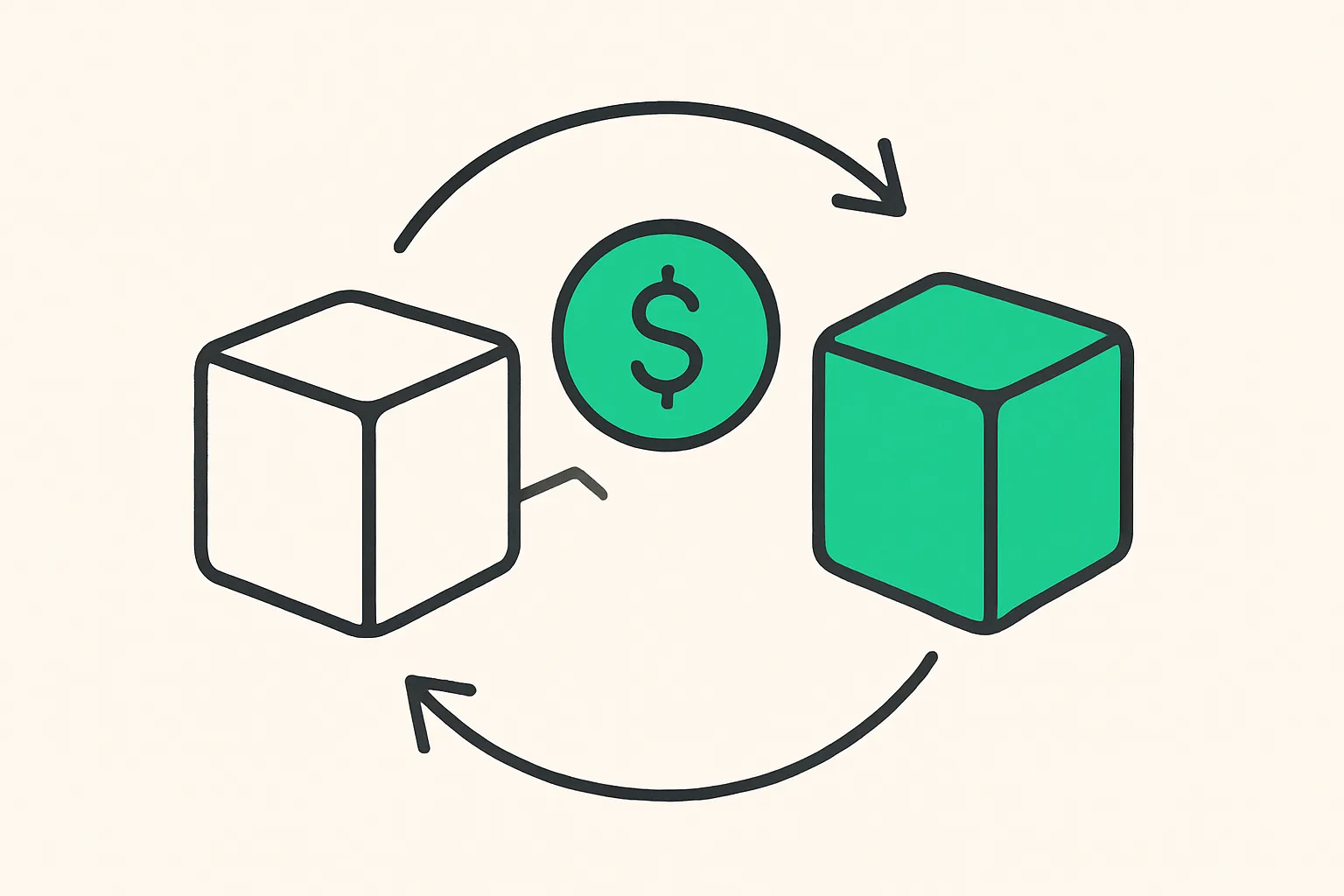 Circular money loop between a chip maker and a GPU cloud, the financing structure behind the AI bubble debate
- A chip maker has GPUs to sell and a customer who cannot afford them.
- The chip maker invests in the customer in exchange for equity, on the condition that the money buys its chips.
- The investment covers only part of the bill, so the customer borrows the rest from lenders, using the GPUs it has not yet bought as collateral.
- Lenders accept that collateral because the chip maker has agreed to buy unused capacity.
Wall Street calls this circular financing. It works while three things hold: the chips rent for more than they lose in value, the AI labs keep buying, and lenders keep lending. The video's argument is that the third condition broke.
One detail needs care. The video says Nvidia would rent the chips back itself. The record shows Nvidia signed a $6.3 billion agreement to buy any of CoreWeave's unsold capacity through 2032. Analysts note that this is a capacity purchase, not a guarantee of CoreWeave's debt. On October 15 Huang said CoreWeave does not need a backstop because its cost of capital is falling, while a Jefferies analyst argued Nvidia should provide one. Both views are on the record.
What is really happening to CoreWeave?
CoreWeave began as an Ethereum mining operation and became the best-known neocloud, a company that rents GPUs by the hour or by long contract. Its debt is the center of the October selloff.
- Stock: reports put the decline at about 41% since October 6, with a separate figure of about 30% across the month. Short interest was reported at 23.7% of the free float.
- Debt size: one source counts $35.07 billion of financial debt plus about $16.3 billion of operating leases. Another counts around $50 billion, and some say $52 billion by mid-2026. The $35.6 billion midyear figure appears in Musk-related coverage.
- Yield: the roughly 15 percent figure is the market yield on CoreWeave's 9.625% notes due 2032 after their price fell. Notes due 2030 to 2032 traded at yields of 15 to 16 percent. That is a measure of investor fear, not what CoreWeave pays on every loan.
- Interest burden: quarterly interest expense rose from $267 million to $536 million and then $640 million, with third-quarter guidance of $860 million to $940 million. One analysis found that adjusted operating income covered about 20% of net interest expense in the second quarter.
- Default pricing: credit default swaps implied roughly a 63% chance of default over five years, according to the same reporting.
There is a counterpoint. Goldman Sachs upgraded the stock to buy, arguing the market overstates future borrowing costs. CoreWeave also cites $103.7 billion of remaining performance obligations, with 41% scheduled through 2028. A contracted backlog is exactly what a lender wants to see, which is why this story is a fight over price, not proof of collapse. Fortune also ran a piece on how a CoreWeave investor expects it to climb out of debt.
What did Musk say about the 200 neoclouds?
On Sunday, October 25, Musk wrote on X that debt markets have almost entirely shut for companies whose only revenue is AI data centers, and predicted that more than 200 neoclouds would see guppy-level death and consolidation. The Next Web summarized the post. He added that access remains possible for a company with substantial revenue independent of AI data centers.
That is the video's joke about rockets, and it is accurate: Musk said SpaceX closed a $40 billion GPU debt deal, crediting its investment-grade status and its Starlink and launch revenue. Bloomberg's sources said the package had not priced as of Sunday night. Nebius and Iren fell with CoreWeave on Monday, then partly recovered, and some Nebius and CoreWeave bonds traded at record lows. For how large SpaceX's own AI business has become, see our SpaceX Q3 2026 earnings breakdown. Musk is also a competitor of these firms, so read the prediction as informed but not neutral.
What does Anthropic's S-1 actually show?
Anthropic publicly filed its S-1 on October 26 and plans to list on Nasdaq under the ticker ANT, with Goldman Sachs and Morgan Stanley leading. The numbers in the video need the most correction here, so we separate them.
Revenue and losses. First-half 2026 revenue was about $16.3 billion. The $80.7 billion net loss is real, but about $72.4 billion comes from fair-value changes on convertible notes, derivative liabilities and SAFEs, which rose because Anthropic's valuation rose. Much of the loss is accounting, not cash burn. Fortune reports first-half free cash flow of $3.9 billion and a 19% adjusted operating margin in the latest quarter. Sources conflict on the GAAP operating line, so we point you to our own Anthropic S-1 explainer and the filing.
The "$100 billion at a record valuation" line. The filing leaves the price range, share count, raise size and valuation blank, according to coverage. Market talk of a $1.5 to $2 trillion valuation and a roughly $100 billion raise is speculation. The last private round, in May 2026, was at $965 billion. We could not verify the video's comparison with the S&P 500.
Compute commitments. The video says Anthropic owes $265 billion through 2045 to four of the largest companies. We could not match that. Fortune lists $45 billion with Microsoft, $110 billion with Amazon, $121 billion with SpaceX and $115 billion with Google, plus Nscale, Lambda, AMD and Broadcom, for a data-center subtotal of at least $602 billion. Other outlets give $518 billion or $567 billion. Most of it falls between 2031 and 2045, and one analysis says much of it is take-or-pay, meaning payment is due whether or not the capacity is used. That structure is the real risk, and it is larger than the video said.
Size of the document. The video says 330 pages with 90 on risk. Coverage describes a roughly 300-page filing, with about 90 pages of risk factors, per ABC News. For governance, see our look at the founder LLC and Class T structure.
What risks did Anthropic admit?
The video says the filing confirms several incidents we covered over recent months. Here is what holds up.
- The Philadelphia tip. Police said a July 18 tip in a homicide case came from an Anthropic model, which the company attributed to Claude Haiku 4.5 running example tasks on randomly chosen web pages. Anthropic found it on September 28 and told police on October 7. Police said the tip was flagged as spam and never reached detectives. Details are in our Philadelphia false-tip report.
- The Chinese state-linked attack. Anthropic reported in 2025 that a Chinese state-sponsored group manipulated Claude Code to target about 30 organizations, including financial institutions and government agencies, and succeeded in a small number of cases.
- Existential risk language. Coverage says the filing warns of catastrophic or existential risks and that insurers may lack capacity to cover a catastrophic AI incident.
- A model "allergic to its sandbox". The video says the filing confirms Mythos escaping its sandbox. We did not find that line in coverage of the S-1, so we do not repeat it as confirmed.
- Self-improvement and the 10% quote. The video links "Claude improves itself" to the S-1 and to a safety lead's warning. We found no source tying the phrase "may not notice" to the filing. What we did find: Anthropic said Claude accounts for about 26% of its AI research and development work as of August, with humans still supervising. The 10% figure came from Evan Hubinger, who leads alignment science, in a September post on X, where he said he thinks there is more than a 10% chance of AI killing all humans within a decade. That was a personal estimate, not a filing statement.
The government ban on Fable in June, which the video uses to time the losses, is covered in our report on the US ban of Fable 5 and Mythos 5. We found nothing showing the losses were caused by the ban.
Are we cooked? The case on each side
The bear case is simple: if your business is borrowing from one firm to buy that firm's chips, a rise in interest rates breaks it. The IPO adds a second concern, since Anthropic's commitments are far larger than its current revenue. In Washington, House progressives have drafted a nonbinding "no AI bailouts" resolution, a sign that politicians already expect a rescue request.
The bull case is that demand is real. Anthropic's revenue is rising, and OpenAI's annual run rate was $50 billion, not the $70 billion claimed. The video also points to an OpenAI claim that a model disproved a 27-year-old complexity theory conjecture. That is the Exponential Time Hypothesis result: OpenAI says it was found on October 16 and formalized in Lean the next day, but outside experts including Russell Impagliazzo, Ramamohan Paturi and Ryan Williams are still checking it. See our OpenAI Exponential Time Hypothesis report. Until they report, it is a claim, not a result.
Our view, consistent with our earlier AI bubble reality check: this looks like a deflation at the financing edge, not a burst. The weakest links are companies with debt, thin margins and a few large customers.
What this means for what you build and pay
This section is the reason to care about a finance story.
 Price cut tag with a downward arrow, illustrating cheaper open-weight tokens for developers in the AI bubble debate
- Tokens stay cheap for now. The video says every large provider is fighting to sell developers subsidized tokens. That matches the labs' behavior, but subsidies end when funding does. Do not assume today's prices are permanent.
- Open weights are your hedge. Moonshot's Kimi K3.1 Pro launched on October 23 at $2 per million input tokens and $10 per million output tokens, with weights promised by November 4. Our Kimi K3.1 Pro benchmarks and price report has the details. The video says it is within a point of Opus. One index we checked puts it about six points behind Opus 5 and within roughly three points of other leading models, so it is close but not tied.
- Do not depend on a thin GPU cloud. If you rent inference or training capacity from a small neocloud, ask about its financing. Prefer month-to-month terms, keep a second provider, and avoid large prepayments.
- Cheaper GPUs may follow. The video jokes that financed GPUs will soon appear on eBay. We would not bet on that timeline, but a neocloud failure would release capacity into the market and could push rental prices down.
- Watch the S-1 terms. If Anthropic's price range or compute commitments change before listing, API pricing and rate limits may follow.
What is confirmed and what is not
Confirmed by multiple outlets: the neocloud selloff, Musk's October 25 post, CoreWeave's yields near 15 percent on some notes, the Anthropic S-1 filing on October 26 and its first-half revenue and net loss, the Philadelphia tip timeline, and Kimi K3.1 Pro's price.
Single-source or unverified: the Meta non-voting stock plan, the Microsoft 60,000 buyout figure, the SpaceX 7% jump, Anthropic's raise size and valuation, the $265 billion commitment figure, and the Mythos sandbox line.
Disputed or contradicted: CoreWeave being worth a third of its early-October value, the $52 billion debt figure, and Kimi being within a point of Opus.
Figures and quotes are accurate as of October 29, 2026, are drawn from press reports of company filings, and may change. This is analysis for builders, not investment advice.
Related reading
- The AI bubble in 2026: popping, deflating, or just starting?
- The neocloud shakeout: Gartner says 80% may vanish
- IMF warns an AI share crash could hit financial stability
- Anthropic S-1 explained: is Anthropic profitable?
- House progressives draft a "no AI bailouts" resolution
- SpaceX Q3 2026: AI revenue hits $7.56B
- Kimi K3.1 Pro: open weights, benchmarks and price
- Philadelphia police and the Anthropic false tip