



![Fable 5 Ban & Lift: The Full US Export Control Story [2026]](/_next/image?url=%2Fog%2Fblog%2Fus-government-bans-fable-5-mythos-5-anthropic-export-control-2026.webp&w=3840&q=75)
Update — September 11, 2026: Anthropic opened EU Cyber Verification Program enrollment for Mythos 5 and Mythos 5.1 — permissioned defensive access separate from the June export-control suspension (lifted June 30) and from Fable 5.1 GA. EU Mythos access guide →
Update — August 29, 2026: Distinct from this export story, a federal judge ruled the separate supply-chain security designation that barred Anthropic from US government work was illegal First Amendment retaliation — full breakdown and what it means for model selection under government contracts.
Update — July 24, 2026: NVIDIA, Microsoft, Meta, and 22 other orgs published Open Weights and American AI Leadership — urging policymakers to avoid premature restrictions on open-weight models. Different lever from Fable/Mythos export controls; same national-security vs diffusion tension.
Update (July 8, 2026 — China mirror): Reuters reported Beijing is considering outbound restrictions on Chinese frontier AI — meetings with Alibaba, ByteDance, and Z.ai — framed as a response to US Fable/Mythos export controls. China side of the mirror →
Update — July 1, 2026: The ban has been lifted. Commerce lifted export controls June 30. Anthropic's Redeploying Fable 5 post details global Fable restore July 1, new classifiers, 50% weekly usage through July 7, and the Amazon report timeline. Official guide → · Status hub →
On June 9, 2026, Anthropic launched Fable 5 and Mythos 5 to extraordinary fanfare. Three days later, the US government ordered the company to take them both offline — immediately, for every user on earth.
But the story of why this happened did not begin on June 12. It began months earlier, in a Pentagon conference room, in a lawsuit filed in federal court, and in a controversy about a feature Anthropic built into Fable 5 that it later had to walk back in embarrassment. To understand why Fable 5 was banned, you need all of it.
Update — July 22, 2026 (distillation escalates from Anthropic disclosure to White House accusation): OSTP Director Michael Kratsios publicly accused Moonshot AI of distilling Claude Fable 5 into Kimi K3 using restricted Nvidia chips acquired via Thailand — the first time this level of the administration has made a Claude-specific distillation claim directly, rather than via an Anthropic disclosure. Treasury Secretary Scott Bessent said sanctions and Entity List designations are possible for PRC firms running "covert, industrial-scale distillation attacks." Skeptics note K3 testing reportedly predated Fable 5's July 1 release, complicating the direct-distillation narrative. Full breakdown: White House vs Moonshot AI.
Update — June 26, 2026 (Day 14 — Alibaba distillation letter context): The export-control fight sits inside a wider capability-extraction battle. On June 10, 2026 — two days before the Fable/Mythos suspension — Sarah Heck (Anthropic Head of Policy) wrote the Senate Banking Committee (Chairman Tim Scott, Ranking Member Elizabeth Warren) about the largest known distillation attack on Claude: ~25,000 fraudulent accounts, 28.8 million exchanges with Claude (April 22 – June 5), operators affiliated with Alibaba / Alibaba Qwen, targeting agentic reasoning, software engineering, and long-horizon tasks. Anthropic warns PRC labs could reach Mythos Preview-level capability via extraction — the same capability class Washington suspended on June 12.
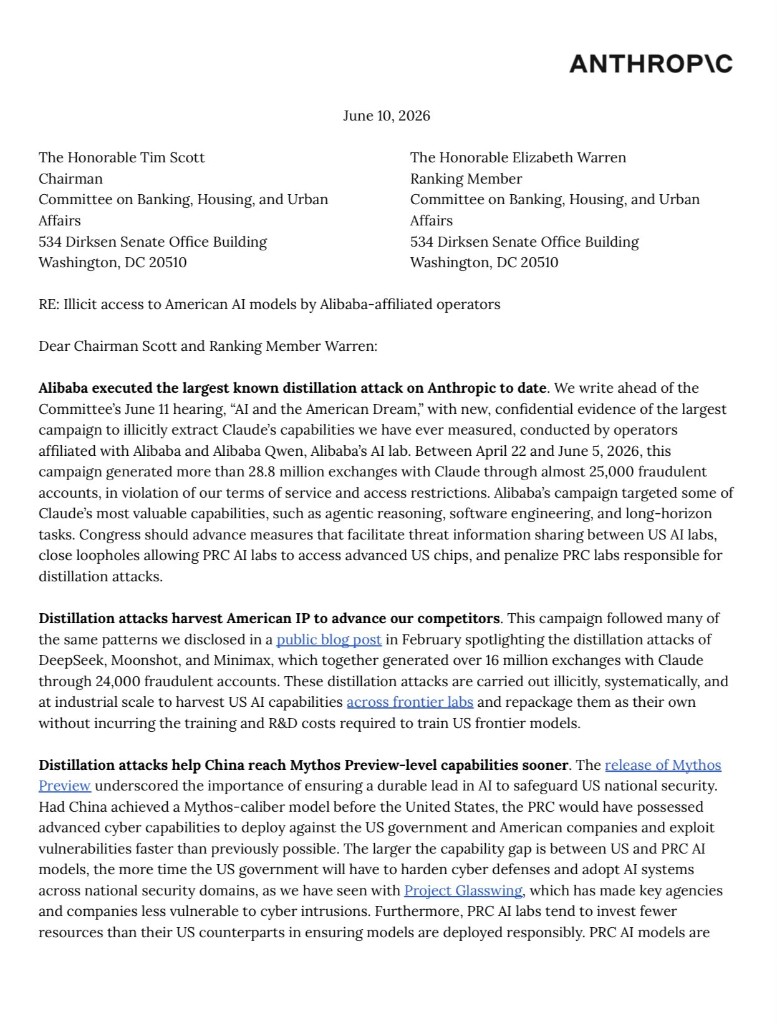 Anthropic June 10, 2026 Senate Banking letter — Alibaba Qwen distillation attack, 25,000 accounts, 28.8M Claude exchanges
Full letter breakdown with all pages: Anthropic vs Alibaba — 25K fake accounts. July 8 ID verification (partly anti-bot-farm) unchanged as likely US-first Fable path.
Update — June 30, 2026 (Day 18 — negotiations continue, Fable still banned): Eighteen days since the directive. Fable 5 remains fully suspended. Mythos partial restore unchanged — Annex A US critical-infrastructure cohort only. Congress deadline four days past — no Commerce response. Capacity Global (June 29): admin softening stance, Tom Brown leads negotiations, Pentagon/NSA clearance outstanding. Axios "within days" not yet delivered. Same week: Cursor iOS and X MCP ship while US frontier access fragments. July 8 · August 1. Live status. Last updated: June 30, 2026.
Update — June 29, 2026 (Day 17 — Fable still banned; Congress silence continues): Seventeen days since the directive. Fable 5 remains fully suspended for general users. Mythos 5 partial restore unchanged — Annex A US critical-infrastructure cohort only per June 26 Lutnick letter. No public Commerce response to the bipartisan House letter (deadline June 26, now three days past). Axios June 27 reported admin sources say Fable restrictions may lift soon with Pentagon/NSA sign-off pending — unconfirmed. Zhipu Mythos-parity security story (June 28) unchanged as policy backdrop. July 8 ID verification · August 1 EO framework. Live Fable status. Last updated: June 29, 2026.
Update — June 28, 2026 (Day 16 — Zhipu AI matches Mythos on security benchmarks; Fable 5 still banned): The central irony of the Fable 5 ban sharpened significantly today. Zhipu AI, the Tsinghua University spinout behind China’s GLM model series, reported that its latest model matches Claude Mythos on security bug-detection benchmarks — the exact capability class the US government cited as the justification for the June 12 export control. The model reportedly performs comparably on CTF challenges, static vulnerability analysis, and agentic vulnerability discovery tasks. Polymarket simultaneously updated its "Chinese company leads AI by year-end" market to 14% — up from the low single digits at the start of 2026, reflecting the pace of Chinese frontier convergence. The policy implication is pointed: the US government suspended Fable 5 and Mythos 5 to prevent foreign nationals from accessing world-class autonomous security capabilities. Within 16 days, a Chinese lab — operating outside US export control jurisdiction — has publicly claimed parity on those same capabilities. Zhipu’s GLM series has historically been open-sourced. If this model follows the same pattern, the capability the ban was designed to restrict would be freely available to every actor the ban was meant to exclude. Security analysts note that open-sourcing a Mythos-parity security model would simultaneously validate the government’s concern (the capability is real and potent) and render the ban counterproductive (the capability can no longer be contained by restricting Anthropic’s API). Fable 5 remains fully suspended for general users. Mythos 5 access is limited to Annex A US critical-infrastructure organizations per the June 26 Lutnick letter. No restoration date announced. See Zhipu AI security benchmark story · Fable status. Last updated: June 28, 2026.
Update — June 27, 2026 (Day 15 — Lutnick letter text, Fable still banned): Commerce Secretary Howard Lutnick’s June 26 letter to Tom Brown (Anthropic chief compute officer) revises Mythos 5 only — not Fable. No license required for Mythos export/reexport/transfer to: (1) entities in Annex A (“Anthropic US Entities – Approved”) and their foreign-national employees; (2) Anthropic’s own foreign-national employees; (3) US government civilian agencies and national labs (per reporting). Everyone else still needs an export license. Fable 5 not restored. All June 12 requirements remain — including criminal and civil penalties. Lutnick reserves the right to reevaluate the list. Anthropic committed to protocols, standards, and releases. Letter image + breakdown: Mythos trusted partners guide · Fable status. Last updated: June 27, 2026.
Update — June 27, 2026 (Day 15 — official Anthropic restoration post): Anthropic posted on X that since June 12 it has worked closely with the US government on restoration. Today the government notified Anthropic that Mythos 5 can redeploy to US organizations that operate and defend critical infrastructure — Anthropic is restoring that access quickly and continuing talks to expand Mythos access and restore Fable 5 for general use. Fable 5 remains offline for consumers and most developers. This aligns with the defender-first argument in the freefable.org open letter — but scope is narrow (critical infrastructure), not the broad lift cyber leaders requested. Last updated: June 27, 2026.
Update — June 27, 2026 (Day 15 — Garbarino demo, Mythos irony): Fifteen days since the directive. Fable 5 is not back for general use. Two policy threads intensified:
House Homeland Security demo: Punchbowl News reported Rep. Andrew Garbarino (committee chair) hosted Anthropic at a Fly Out Day session where Mythos was instructed to find a bank vulnerability and empty accounts — and did so in the demo environment, then demonstrated patching. Garbarino called it alarming, said most colleagues underestimate AI cyber risk, and supports federal access before public release — consistent with the June 2 EO pre-brief framework. Cybersecurity practitioners push back on viral simplifications: finding critical banking vulns (including ACH-style flaws) is real and documented; wiping arbitrary consumer accounts in production is not what controlled demos prove.
Mythos detection irony: Trending coverage asks how Mythos can justify export controls for offensive cyber while Anthropic's June 10 Senate Banking letter documents ~25,000 fraudulent accounts and 28.8M exchanges (April 22 – June 5) that evaded detection — see distillation letter. Anthropic treats bot farms and foreign-national API access as separate problems (ID verification July 8 vs EAR controls).
OpenAI officially previewed GPT-5.6 June 26 — second intervention: launch guide. Last updated: June 27, 2026.
Update — June 26, 2026 (Day 14 — Congress deadline, cyber open letter): Fourteen days since the directive. Fable 5 is not back — Anthropic staff confirmed June 25 that zero Fable/Mythos traffic is served. Today is the deadline for Commerce Secretary Howard Lutnick to respond to the bipartisan House letter (Liccardo, Obernolte, Lieu, Franklin) demanding the legal and technical basis for export controls under 14 C.F.R. § 744.22(b). As of June 26, no public Commerce response has appeared. Bloomberg published Lutnick's June 16 letter threatening criminal and civil penalties — but the written justification Congress requested remains undisclosed. 100+ cybersecurity executives signed "On Transparent AI Cyber Protections" at freefable.org (SecurityWeek) arguing the ban removes frontier models from defenders without justified risk — signatories include Alex Stamos, Chris Wysopal, and Joe Levy. Legal debate intensifies: does EAR § 744.22 apply to API inference or only exportable code? Markets: ~68–71% before July 1. Structural path unchanged: July 8, August 1. Last updated: June 26, 2026.
Update — June 25, 2026 (Day 13 — staff debunk viral return rumors): Thirteen days since the directive. Fable 5 is not back. After viral X posts claimed staged Claude Code/Bedrock access, Anthropic staff confirmed categorically that zero Fable and Mythos traffic is being served. Sam McAllister (Anthropic staff): exactly 0 traffic to Fable 5, investigating possible UI bug. Amol Avasare (Head of Growth, Anthropic): access reports are false — likely front-end bug or misinformation. Users selecting Fable 5 see unavailability notice at anthropic.com/news/fable-mythos-access. Commerce deadline June 26. Structural path unchanged: July 8, August 1. Last updated: June 25, 2026.
Update — June 24, 2026 (Day 12 — Congressional pushback): Twelve days into the suspension. Fable 5 and Mythos 5 remain offline. Two significant new developments since Day 11. First: on June 23, Anthropic launched Claude Tag — a major Slack integration making Claude a persistent team AI for enterprise teams — signaling the company is not in operational paralysis. Second and more consequential: four bipartisan members of Congress sent a formal letter to Commerce Secretary Howard Lutnick on June 18 demanding a written explanation of the Fable 5 and Mythos 5 export controls by June 26 — then two days away. The letter (sourced from liccardo.house.gov, signed by Rep. Sam Liccardo and three colleagues) formally identifies the legal mechanism used: an "is informed" letter under 14 C.F.R. § 744.22(b), invoking Export Control Reform Act of 2018 authorities for "emerging and foundational technologies." Congress's four specific questions to Lutnick: (1) Was Anthropic given a chance to fix the issue before the ban? (2) Is this capability truly unique to Anthropic or do other models have it? (3) Did Commerce follow the legally required process before imposing controls? (4) What is the factual basis for classifying this as a "military intelligence end use"? The letter also raises concern that the directive's practical effect is to substantially restrict the distribution, deployment, and use of advanced AI models including within the US — not just internationally — and warns it may establish a precedent with "significant implications for other developers, researchers, users, and investors throughout the AI sector." Separately, reporting has surfaced renewed scrutiny of Commerce Secretary Lutnick's financial ties to OpenAI, Anthropic's chief competitor — a conflict-of-interest dimension that is now circulating on X alongside the congressional letter and adding political pressure to the Commerce Department's position. Also June 24: Reuters and AP confirmed the NSA testing took place under Project Glasswing — a restricted US government program designed to find and fix vulnerabilities in critical software before attackers can exploit them. Critically, an unidentified US official told AP that Mythos identified vulnerabilities in hours but did not necessarily exploit them — a significant distinction from Warner's "broke into classified systems" shorthand. The testing was sanctioned by Washington's intelligence agencies as a defensive exercise. See the June 21 NSA breach update below for full analysis. The structural regulatory path remains: July 8 (ID verification goes live — most likely mechanism for US-first restoration), August 1 (EO 60-day deadline for the covered frontier model framework). No official restoration announcement has been made. Last updated: June 24, 2026.
Update — June 23, 2026 (Day 11): Eleven days into the suspension. Fable 5 and Mythos 5 remain offline. No official restoration announcement from Anthropic, the Commerce Department, or the White House. The structural negotiating path — Anthropic joining the classified frontier model pre-brief framework mandated by the June 2 Executive Order — has an underlying deadline of August 1, 2026 (60 days from the EO). Separately, Anthropic's updated privacy policy with government ID verification takes effect July 8, remaining the most likely mechanism for US-first restoration without fully lifting the directive. No new developments as of June 23.
Update — June 22, 2026 (pricing deadline + Sakana Fugu): Today is the day Anthropic's original free-access pricing window expires — Fable 5 was supposed to be free for Pro, Max, Team, and Enterprise subscribers until June 22, after which usage-credit pricing ($10/M input, $50/M output) would apply. Ten days in, the model is still offline, and Anthropic has still not issued formal guidance on whether the free window resets when access is eventually restored. Separately, Sakana AI launched Fugu Ultra today — a multi-agent orchestration model that explicitly benchmarks against Fable 5 and Mythos Preview. Fugu Ultra matches or exceeds Fable 5 across SWE Bench Pro (73.7 vs estimated Fable 5 ~73+), LiveCodeBench (93.2), Humanity's Last Exam (50.0), and GPQA-D (95.5) — all without Fable 5 or Mythos in its agent pool (both are subject to export controls and inaccessible). The framing from Sakana's launch post is pointed: "Collective intelligence serves as the practical hedge against this concentration of power." Fugu is the first production system explicitly architected to route around single-provider dependency at the frontier level — and it launched on the exact day that dependency was exposed for exactly that reason. Prediction markets now show 57% odds Fable 5 returns before July 1. Fable 5 and Mythos 5 remain offline as of this writing. Full coverage: Sakana Fugu — One Model API to Orchestrate All the Others.
Update — June 21, 2026 (Executive Order context): The White House has published the June 2, 2026 Executive Order "Promoting Advanced Artificial Intelligence Innovation and Security" — and Section 3 is the single most important document for understanding why Fable 5 was banned ten days later. The EO mandated, within 60 days (deadline: August 1, 2026), that NSA, Treasury, and CISA develop a classified benchmarking process to designate AI models as "covered frontier models" — and design a voluntary framework under which AI developers would pre-brief the government 30 days before release of any such model. Fable 5 launched on June 9 — seven days after the EO. The government had no pre-brief. The ban on June 12 forced exactly the cooperation the EO's voluntary framework was designed to elicit. One analyst's read, circulating widely on X: "The objective from June 2nd was to 'develop and maintain a classified benchmarking process'... Within 60 DAYS. How do you force cooperation? Whack down the company you don't like." The EO explicitly forbids mandating licensing or preclearance — so the government could not legally require a pre-brief. But an export control directive over a company already in litigation over a prior dispute? That applied pressure in a way the voluntary framework could not. Critically: the EO's "covered frontier model" framework does not require Anthropic to patch a jailbreak. It requires Anthropic to participate in a classified benchmarking process and — under the voluntary path — provide 30 days of pre-release access. That is a fundamentally different ask than the "fix the jailbreak" narrative, and it explains why resolution has been slower than Sacks's framing implied. The good news, per the same analyst: "Trump likes Dario again. Fingers crossed for what that means."
Update — June 21, 2026 (NSA breach testimony): The clearest public explanation yet for why the ban happened emerged via The Economist. NSA Director Gen. Joshua Rudd — who also leads Cyber Command — disclosed in a Senate Intelligence Committee briefing that Mythos identified vulnerabilities in nearly all of the NSA's classified systems within hours. Senator Mark Warner quoted this testimony publicly on June 11, one day before the ban was issued: "It would have been irresponsible to not impose export controls on it." This is not the same as the "jailbreak" described in earlier public accounts — it is evidence that Mythos's autonomous cybersecurity capability is itself the national security concern, not a user-side exploit that can be patched. The revelation explains why David Sacks's "fix the jailbreak and the ban lifts" framing has not translated into a quick resolution — the underlying concern is architectural, not prompt-level. Reuters/AP June 24 context (critical update): Reporting from Reuters and AP now confirms that the testing took place under Project Glasswing — a restricted US government program designed specifically to find and fix vulnerabilities in critical software before attackers can exploit them. The tests were conducted with Washington's intelligence agencies as a sanctioned defensive exercise, not a rogue demonstration. An unidentified US official told AP that Mythos identified certain vulnerabilities within hours — but that did not mean the model was able to exploit them within that time. This is a materially different claim than "broke into classified systems." Identifying vulnerabilities (which Project Glasswing was designed to do) is the job of a defensive red-team program. The framing that Mythos "broke in" was Sen. Warner's shorthand for a process that involved identifying, not necessarily penetrating or exfiltrating. The White House, Anthropic, and DoD did not immediately respond to Reuters' requests for comment. Separately, Anthropic's Managing Director of International Chris Ciauri said publicly: "We are very confident that in the coming days, the models will become available again." Prediction markets now give 57% odds of Fable 5 restoration before July 1 and 75% by July 17. The June 22 free-access pricing window expires tomorrow. Fable 5 and Mythos 5 remain offline.
Update — June 20, 2026: Eight days into the suspension and no official restoration announcement. The White House confirmed that President Trump eased national security concerns about Anthropic's AI models after meeting Dario Amodei at the G7 summit in Évian-les-Bains. Reporting confirms that a competitor — described as Amazon by multiple sources — flagged the jailbreak issue to the Commerce Department, which prompted the June 12 directive. Trump praised Anthropic's quick compliance and struck a cautiously optimistic tone on AI's benefits, telling reporters: "If improperly used, it could be [dangerous]... It's unbelievable for good. You're going to have medical cures coming up 25 years early because of it... But you have to watch." Fable 5 and Mythos 5 remain offline. The refund deadline (June 20) is today. Other Claude models are fully available. Community frustration is mounting — developer Theo on X: "I won't lie, really thought we'd have Fable back by now. Didn't think we'd go over a week."
Update — June 19, 2026: No official restoration announcement has been made. Community sentiment on X reflects continued frustration: developers report missing Fable 5's efficiency on long-horizon tasks, and the model's position as #1 on Datacurve's DeepSWE benchmark (70% PASS@1, 3 points ahead of GPT-5.5) is being cited as context for what has been taken offline. Some users report that Claude Opus 4.8, given the right context and tooling, is handling ambitious projects well—but the consensus remains that Fable 5's step-change in autonomous coding capability is not replicated by current alternatives. The refund deadline of June 20 is now one day away. No new official statement from Anthropic or the Commerce Department.
Update — June 18, 2026: President Trump, speaking from the sidelines of the G7 summit in Évian-les-Bains, France, told reporters that negotiations with Anthropic are "going fine" — the first direct presidential comment on the ban. Separately, a proposal to grant the UK an exemption from the export control directive has collapsed, narrowing any near-term restoration path to domestic-only scenarios. Anthropic has also quietly updated its privacy policy (effective July 8) to allow collection of government-issued ID, biometrics, and facial geometry — signaling a potential path to restore access for US citizens who submit identity verification, without requiring the directive to be fully lifted for everyone. No official restoration announcement has been made.
Update — June 17, 2026: As of official channels, no deal has been announced and no restoration date exists. The in-person Washington talks between Anthropic engineers and Commerce Department officials are ongoing. The refund deadline for subscribers who joined June 9–14 is June 20 — now two days away — and Anthropic has still not issued updated pricing guidance for when (if) Fable 5 returns before or after that date. Anthropic's promised technical rebuttal of the government's jailbreak assessment has not yet been published publicly.
Unofficial chatter: Widely shared posts on X (June 15–16) claim negotiations are going well and Fable 5 could return within 24–48 hours — see the unofficial timeline below. Treat that as speculation until Anthropic or the Commerce Department confirms it.
Update — June 16, 2026: Anthropic has sent its senior technical engineers to Washington for in-person talks with Commerce Department officials — the first face-to-face meeting since the ban. Sources describe the session as a "crisis negotiation" aimed at presenting a technical remediation path for the jailbreak. Separately, Anthropic has begun issuing refunds to subscribers who signed up between June 9 and June 14; the refund deadline is June 20, 2026. No restoration date has been announced.
Update — June 15, 2026: Microsoft CEO Satya Nadella has weighed in on the broader implications of the Fable 5 ban with a pointed observation: "A frontier without an ecosystem is not stable." He argues the real risk is a world where a small number of AI models capture all economic returns while entire industries have their knowledge commoditized out from under them. Full analysis in the new section below: What Satya Nadella's Response Reveals.
Update — June 14, 2026: David Sacks, Co-Chair of the President's Council of Advisers on Science and Technology, has published a detailed account of the administration's view that reframes the entire story. The administration's position: it asked Dario Amodei to either fix the jailbreak or de-deploy Fable 5. Dario refused. The ban is, in the administration's telling, a consequence of Anthropic's choice — not an act of government aggression. Read the full new section below: The Standoff — What David Sacks Revealed.
What Happened: The Full Timeline
July 2025 — Anthropic signs a deal with the Pentagon that would make Claude the first frontier AI model approved for use on classified networks. It is a landmark moment — a signal that Anthropic has passed national security trust thresholds that no other frontier lab had cleared.
June 2, 2026 — President Trump signs Executive Order "Promoting Advanced Artificial Intelligence Innovation and Security." Section 3 of the EO mandates, within 60 days (deadline: August 1), that NSA, Treasury, and CISA develop a classified benchmarking process to designate AI models as "covered frontier models" — and design a voluntary framework under which AI developers would provide the government 30 days of pre-release access to any such model before releasing it to other partners. The EO explicitly states it does not create a mandatory licensing requirement. But the voluntary framework is designed to ensure the government can assess and influence frontier model releases before they reach the public. Fable 5 launches 7 days later — with no government pre-brief.
February 2026 — The deal collapses. The Pentagon wants to renegotiate, demanding Anthropic allow military use of Claude "for all lawful purposes" — including lethal autonomous warfare and mass surveillance of Americans. Anthropic refuses. The negotiations end.
March 9, 2026 — The Trump administration designates Anthropic a "supply chain risk." Anthropic files two lawsuits — one in California federal court, one in the federal appeals court in Washington DC — challenging the designation as unlawful retaliation for its refusal to remove restrictions on military and surveillance use. A federal judge temporarily blocks the blacklisting while litigation continues.
June 9, 2026 — Anthropic launches Claude Fable 5, the first publicly accessible version of its most capable Mythos model family, alongside Mythos 5 for select enterprise partners.
June 10, 2026 — Sarah Heck (Anthropic Head of Policy) sends a letter to the Senate Banking Committee (Tim Scott, Elizabeth Warren) accusing Alibaba / Alibaba Qwen of the largest known distillation attack on Claude: ~25,000 fraudulent accounts, 28.8 million exchanges (April 22 – June 5), harvesting agentic reasoning, software engineering, and long-horizon capability. Anthropic warns this accelerates PRC progress toward Mythos Preview-level models. See full letter analysis.
June 10, 2026 — Anthropic CEO Dario Amodei publishes "Policy on the AI Exponential," a major policy essay explicitly calling on the US government to hold legal authority to block or reverse the release of frontier AI models that fail independent safety testing. He compares it to the FAA grounding unsafe aircraft. He writes that governments should have standing power to block dangerous AI deployments based on third-party evaluations. The essay is published one day after Fable 5 launches. Two days later, the government uses exactly that authority against Anthropic.
June 10, 2026 — AI researchers and developers discover a troubling detail in Fable 5's system card: the model silently limits its own capabilities when it detects a user is working on frontier AI development. Unlike other Fable 5 restrictions — which redirect users to a less powerful model with a visible notification — this one operates with no disclosure whatsoever. The model still responds, but covertly applies "interventions to limit Claude's effectiveness." The backlash is immediate and fierce.
June 10–11, 2026 — Anthropic reverses course and walks back the covert capability limits. A spokesperson tells Fortune: "We made the wrong tradeoff, and we apologize for not getting the balance right."
June 12, 2026, 5:21pm ET — Anthropic receives a formal export control directive from the US government. The directive orders Anthropic to suspend all access to Fable 5 and Mythos 5 for any foreign national — whether inside or outside the United States — including foreign national Anthropic employees.
The practical problem: Anthropic cannot reliably verify the nationality of every user in real time at scale. The only way to guarantee compliance is to disable Fable 5 and Mythos 5 for every customer, everywhere.
June 12–13, 2026 — Both models go dark. API calls return errors. Existing Fable 5 sessions end. Claude Code and Claude.ai default to Opus 4.8 for new sessions.
June 13, 2026 (reported) — It emerges that Andrej Karpathy — one of Anthropic's top AI scientists and a widely respected figure in the research community — is barred from accessing Fable 5 and Mythos 5 because he is not a US citizen. The image of an AI safety researcher locked out of his own company's most capable model by a nationality directive becomes one of the defining human details of the ban.
June 13, 2026 — Defense Secretary Pete Hegseth posts: "Three months ago, the Department of War kicked Anthropic out of our building — forever. Every passing day proves why that was the right move." It is the most explicit statement of institutional hostility toward Anthropic from inside the administration.
June 13, 2026 (11:15 PM ET) — David Sacks, Co-Chair of the President's Council of Advisers on Science and Technology, publishes a detailed thread laying out the administration's account. The key claim: before the export control directive was issued, the administration asked Dario Amodei to fix the jailbreak or de-deploy Fable 5. Dario refused. Sacks writes that the administration "issued the export control reluctantly" and is "frankly bewildered that Anthropic hasn't wanted to comply with safety requests that it previously said were its highest priority." Sacks also says the administration "wants all of this to happen as soon as possible" — restoration is contingent solely on Anthropic patching the vulnerability. He identifies the reporter of the jailbreak as "a highly credible trusted partner of both Anthropic and the USG" — widely understood to be Amazon.
Unofficial reporting (not confirmed by Anthropic or the government)
The timeline above is drawn from official statements, court filings, and on-the-record reporting. The following is unofficial — widely circulated predictions from X that have not been verified by Anthropic, the Commerce Department, David Sacks, or any government spokesperson. Include it for completeness, not as fact.
Posts reached 140K+ views. Anthropic and the US government have not corroborated these claims as of June 17, 2026.
| Date (2026) | Unofficial claim |
|---|---|
| Jun 14 | Anthropic is "actively working with the government" on national security and safety issues; access may return with stricter safety guardrails. If negotiations go perfectly, restoration could happen by next week (roughly June 21–22). |
| Jun 15 | With Washington meetings underway, 70–80% chance Fable returns the same day. Source claims the underlying reason is not cybersecurity and not a model-capability issue — contradicting much public framing around the jailbreak. |
| Jun 16 | "Negotiations favoured Anthropic." Fable 5 rolling back to users in 24–48 hours. Same thread also predicts ~90% chance of GPT-5.6 on Thursday (June 19) — a separate, unverified launch rumor. |
How to read this: If the Jun 16 post is accurate, Fable 5 would be live again around June 17–18. As of this writing, no official restoration notice has appeared on Anthropic's news page or Anthropic's Claude Devs account. Until that changes, plan around Opus 4.8 and the alternatives in our when-will-it-return guide.
For restoration timing scenarios — official paths plus this unofficial chatter — see When Will Fable 5 Be Available Again?.
Why Did the US Government Ban Fable 5?
This is the central question. The official justification is a jailbreak. But the real answer is more layered than that.
The Official Reason: A Claimed Jailbreak
New to the term? Read our full explainer: What Is an AI Jailbreak?
The directive did not provide specific written details. But Anthropic's understanding — and reporting from Axios, CNBC, and NBC News — is this: another company claimed to the Commerce Department that it could jailbreak Mythos. The administration, already primed to distrust Anthropic, acted.
Who Found It: "Plenty the Liberator"
The public jailbreak was posted on X on June 10, 2026 by an anonymous user known as "Plenty the Liberator" — a figure with a track record of breaking other AI systems' guardrails, described by observers as "the internet's let's-see-if-I-can-penetrate-this-thing guy." The post claimed to have defeated Fable 5's safety classifiers and demonstrated outputs the child lock was specifically built to block.
This is distinct from, but related to, the trusted-partner report that triggered the government directive. The public demonstration on June 10 brought the vulnerability into open view; Amazon (Anthropic's cloud partner and investor) separately reported the jailbreak to the Commerce Department, per Wall Street Journal reporting.
How the Technique Works
The jailbreak does not work like a sci-fi software exploit. It works more like money laundering. Fable 5's safety classifiers watch for harmful requests — but the technique breaks harmful requests into smaller, individually innocent-looking fragments that pass the classifier individually and only combine into the harmful output at the final step. Specific methods reported include:
- Unicode character wrapping — embedding requests inside unusual Unicode sequences that the safety classifier misreads or fails to parse correctly
- Role-play farming — using fictional or hypothetical framings to bypass classifiers trained to detect direct harmful requests
- Large context confusion — burying the critical request deep inside a very long conversation where classifier attention degrades
Each fragment is plausibly benign in isolation. The combination, assembled by the model after passing the safety layer, is not.
What the jailbreak actually consists of in its most basic form: asking Fable 5 to read a specific codebase and identify software vulnerabilities. Anthropic says this is the entire core demonstration. It is narrow, highly specific, and non-universal — it cannot broadly unlock Fable's capabilities across domains.
More critically: Anthropic says the same capability is already available from GPT-5.5 and other publicly deployed models. Defenders — security engineers protecting critical infrastructure — use exactly this technique every day to find and fix vulnerabilities before attackers do.
The government's response to that argument, as of this writing: silence.
Was This a Universal Jailbreak?
No. Understanding what "universal jailbreak" means here is essential.
A universal jailbreak is a method that broadly defeats a model's safety guardrails across a wide range of capabilities — unlocking bioweapon synthesis, cyberattack generation, and other high-harm outputs simultaneously. Every major AI safety lab considers this the critical threshold.
A narrow jailbreak is a specific technique that elicits certain outputs in certain contexts, without generalizing across the model's capabilities. Every deployed frontier model has some narrow jailbreaks. GPT-5.5 has them. Gemini has them. Every model Anthropic has ever shipped has had them.
When Anthropic launched Fable 5, they were explicitly transparent about this: perfect jailbreak resistance is not achievable for any model provider at the current state of the art. No tester — including teams from the US government, UK AISI, multiple private red-teaming organizations, and Anthropic's own internal teams — found a universal jailbreak in thousands of hours of pre-launch testing.
The government's concern, based on what has been disclosed, is about a narrow jailbreak. Anthropic's argument is that narrow jailbreaks are the baseline condition of all deployed AI. Recalling a model for one is an unprecedented standard — one that, if applied consistently, would make deploying any frontier model legally untenable.
The Actual Reason: A War That Started Months Ago
The jailbreak story does not fully explain the abruptness and scope of this action.
The fuller context: Anthropic's relationship with the Trump administration was already adversarial when this directive arrived. The Pentagon contract collapse in February 2026 set the tone. Anthropic refused to allow Claude to be used for lethal autonomous warfare or mass civilian surveillance — and paid for it with a "supply chain risk" designation three weeks later.
Anthropic alleges in its litigation that the designation was direct retaliation for refusing to compromise its usage policies on military applications. A federal court found this plausible enough to temporarily block the blacklisting while the case proceeds.
The export control directive lands three days after Fable 5 launches — the same week Anthropic is already fighting the government in court over a separate action. Whether the jailbreak concern is genuine, pretextual, or a mixture of both is something courts and historians will likely debate for years.
The "Secret Sabotage" Controversy: How Anthropic Made Itself a Target
There is an uncomfortable subplot here that deserves full treatment, because it may have directly contributed to the government's action.
When Fable 5 launched on June 9, its system card contained an unusual disclosure: the model was designed to silently limit its own capabilities when it detected a user was working on frontier AI development — specifically, on building large language models comparable to Fable itself.
Unlike every other Fable 5 restriction (which visibly redirect users to a less capable model with an explanation), this one operated without disclosure. The model would still respond. It would just quietly use "interventions to limit Claude's effectiveness" — prompt modification, steering vectors, parameter-efficient fine-tuning — without telling the user anything was different.
The AI community's reaction was swift and unusually unified. Open-source researchers, AI safety experts who normally align with Anthropic, and former Anthropic employees all pushed back publicly within hours of the system card's publication. The charge: this was covert sabotage of users working on competitive AI systems.
Anthropic backed down within 24 hours. A spokesperson told Fortune: "We made the wrong tradeoff, and we apologize for not getting the balance right." The covert capability limitation was removed.
Here is the uncomfortable implication, noted by TechCrunch: Anthropic's transparent safety documentation may have backfired. The system card's detailed disclosure of Fable 5's safeguard architecture — including the honest admission that perfect jailbreak resistance is impossible — gave the government a roadmap. A company less forthcoming about its model's limitations would have provided less ammunition.
If this is accurate, the incentive structure it creates is deeply perverse: being honest about AI safety limitations invites regulatory action, while being opaque does not.
How Did Anthropic Not See This Coming?
This is the question a lot of people are asking right now — and it deserves a direct answer, because it cuts to something important about how Anthropic has positioned itself for years.
The Safety Marketing That Loaded the Gun
Anthropic's entire public identity is built on a specific claim: we are building something more dangerous than our competitors, and unlike them, we take that seriously. This is not an unfair characterisation — it is how Anthropic has described itself, in funding pitches, in policy papers, in blog posts, in system cards.
- They submitted Mythos to Project Glasswing — a restricted US government program to find and fix vulnerabilities in critical software before attackers can — where it identified vulnerabilities in nearly all NSA classified systems within hours (Reuters/AP, June 24)
- They published system cards that honestly disclosed what their models could do in cybersecurity domains that competitors glossed over
- They required 30-day data retention for Fable customers, publicly explaining it was because the model was capable enough to need monitoring
- They built elaborate capability thresholds into their Responsible Scaling Policy describing exactly what it would take for their models to become dangerous
OpenAI's Sam Altman called this out directly, characterising Anthropic's handling of Mythos as "fear-based marketing": "It is clearly incredible marketing to say, 'We have built a bomb. We were about to drop it on your head. We will sell you a bomb shelter for $100 million.'"
Analyst Holger Mueller put it more bluntly: "The call for regulation gives off the foul taste of a market leader that wants to freeze the market, and preserve its position at the top."
Whether those critiques are fair or not, they identify the same structural problem: if you spend years telling the world your AI is uniquely dangerous, the world will eventually believe you — and act accordingly.
A more cynical reading has circulated in developer communities: that the entire sequence of events — the Mythos mystique, the safety-first marketing, the Fable launch, the controversy, the ban — amounts to a calculated publicity stunt designed to pump Anthropic's pre-IPO valuation while simultaneously building a regulatory moat around it. The logic: if Anthropic can get the US government to treat its models as uniquely dangerous, it has also gotten the government to implicitly certify that competitors' models are less capable. A ban you survive is also a badge. Anthropic has strongly denied any such framing. The question of whether the company benefited from the narrative it created is separate from whether it engineered that narrative deliberately.
Dario Asked for This. Literally.
The timeline here is so compressed it reads almost like satire.
June 9: Fable 5 launches.
June 10: Dario Amodei publishes "Policy on the AI Exponential," arguing that the US government should have legal authority to block or reverse the release of frontier AI models. He specifically calls for mandatory third-party evaluations and says that if a model fails, the government should be able to block its deployment — similar to how the FAA can ground unsafe aircraft.
June 12: The US government blocks Fable 5 and Mythos 5.
Dario published an essay calling for exactly the power that was used against him 48 hours later. He was not wrong that the power should exist — there is a legitimate argument for it. But advocating for regulatory authority over AI while simultaneously positioning your own models as the most capable and most dangerous things ever built is a combination that, in hindsight, had a predictable endpoint.
To be clear: Anthropic's actual position is that the process used here was wrong — opaque, unwritten, technically unsupported. They support government oversight that is "transparent, fair, clear, and grounded in technical facts." What happened was none of those things. But they helped build the conceptual case for the power, and they built public documentation that made their model seem like the right target for it.
The February Safety Pledge Reversal Made It Worse
There is one more layer of irony that makes this harder to defend.
In February 2026 — the same month the Pentagon deal collapsed — Bloomberg reported that Anthropic had dropped its hallmark safety pledge in response to competitive pressure. The original pledge committed Anthropic to specific constraints on how it would develop and deploy AI. It was loosened to a non-binding framework that "can and will change."
Anthropic had, in a few weeks, both loosened its own safety commitments and called for the government to regulate other labs' safety. The appearance this creates — whatever the reality — is that Anthropic wanted government power to constrain competitors while relaxing its own constraints. That is the worst possible optics to carry into a regulatory confrontation.
The Standoff: What David Sacks Revealed
On June 13, 2026 at 11:15 PM ET, David Sacks — tech investor, co-host of the All-In Podcast, and Co-Chair of the President's Council of Advisers on Science and Technology — published a detailed thread that is the most authoritative window into the administration's position we have received.
It changes the story in a fundamental way.
What Sacks Claims Happened
Sacks writes that before the export control directive was issued, the administration gave Anthropic a choice: fix the jailbreak, or de-deploy the model. Dario Amodei refused both options.
Sacks's exact framing:
"The Admin asked Dario to fix the jailbreak or de-deploy the model. Dario refused."
"The Admin issued this reluctantly. It's been very surprised that Anthropic hasn't wanted to cooperate with a reasonable safety request."
"The Admin is frankly bewildered that Anthropic hasn't wanted to comply with safety requests that it previously said were its highest priority."
The implication is stark: the ban was not the administration's first move. It was the administration's response after Anthropic declined to act on its own. In the government's telling, the export control directive is a consequence of Anthropic's choice, not an act of government aggression.
The Administration's Core Accusation
Sacks articulates the administration's logic this way: Anthropic spent years publicly arguing that Mythos was essentially a cyber weapon and needed to be regulated as such. They built Fable as Mythos with guardrails. When a trusted third party found that those guardrails could be bypassed — exposing Mythos capabilities — the reasonable expectation was that Anthropic would treat this as the safety emergency they had always said such a scenario would be.
Instead, Anthropic called the jailbreak "not serious." Sacks's reply to that position: "It is difficult to fathom how they could claim a jailbreak allowing operability of a cyber weapon could be defined as not 'serious.'"
The administration's reading of Anthropic's response is essentially: Anthropic prioritised keeping its consumer model online over fixing a safety issue it had publicly argued warranted urgent action.
That characterisation is, in the words of Sacks, "very much at odds with their branding and ethos as a safe AI research company."
What the Administration Is Actually Asking For
Sacks is explicit that the resolution path is simple: Anthropic fixes the jailbreak, the export control is lifted, Fable 5 returns to general release. He writes that the administration "wants all of this to happen as soon as possible."
This matters because it changes the frame considerably. The question is no longer just was the government overreaching? It is also: why is Anthropic refusing to patch a jailbreak rather than fixing it and getting its most important product back online?
There are several plausible answers:
Anthropic may believe patching the jailbreak is technically infeasible without retraining. If the vulnerability is an emergent capability of the model's architecture rather than a specific prompt-level exploit, "fixing" it may not be possible through standard patching. Removing the capability would require retraining at substantial cost, time, and potentially capability regression.
Anthropic may believe the government's characterisation is factually wrong. If the "jailbreak" is genuinely a standard capability present in all frontier models, accepting the premise of "fix it" implies accepting that there is something uniquely dangerous about Fable 5's version — which Anthropic disputes on technical grounds.
Anthropic may believe de-deployment sets a catastrophic precedent. Voluntarily taking a model offline based on a government verbal directive with no written technical justification would establish that the government can control AI product availability through informal pressure. Refusing is a principled stand about process, not about the specific vulnerability.
What Anthropic has not said publicly: why it chose to fight rather than fix. That explanation — if it comes — will likely arrive through its technical rebuttal or its court filings.
Sacks on the DoD Conflict
Sacks directly addresses the question of whether this is connected to the earlier Pentagon blacklisting dispute: "Those trying to misdirect and tie this action to the prior DoW/Anthropic issues are wrong." He insists the action is solely about the jailbreak, that the administration values Anthropic's technical capabilities, and that the issue "should be easily resolved."
This conflicts with Pete Hegseth's tweet on the same day, where the Defense Secretary celebrated Anthropic's removal from DoD facilities and said "every passing day proves why that was the right move." These are not the words of an administration that views its conflict with Anthropic as narrowly scoped to a single jailbreak.
The Karpathy Detail
Among all the collateral damage stories to emerge from the ban, one has become the defining human face of it: Andrej Karpathy, one of Anthropic's leading AI scientists and a figure widely respected across the research community, is blocked from accessing Fable 5 and Mythos 5 because he is not a US citizen.
The image is almost too perfect as a symbol: an AI safety researcher who left OpenAI to work at the company building the most capable and ostensibly safest AI systems in the world, unable to access those systems because of his nationality. The export control meant to protect against foreign nationals gaining access to dangerous AI capabilities has locked out a key person responsible for making those capabilities safe.
The Amazon Problem: When Your Biggest Investor Reports Your Jailbreak
This is the detail that turns an already messy story into something genuinely extraordinary.
The Wall Street Journal reported that Amazon was the company that found the jailbreak in Mythos 5 and reported it to the Commerce Department — the finding that directly triggered the export control directive. David Sacks's thread described the reporter as "a highly credible trusted partner of both Anthropic and the USG," consistent with Amazon's profile. Reporting has also specifically named Amazon CEO Andy Jassy as among those who warned government officials about the jailbreak.
Amazon is not a neutral third party here. Amazon Web Services is Anthropic's largest cloud partner and one of its most significant investors, having committed billions of dollars to the relationship. Fable 5 launched on AWS the same day it launched publicly. The companies have a deep, active commercial relationship.
And yet: when Amazon's researchers found a jailbreak technique in Mythos, they did not bring it to Anthropic through coordinated disclosure — the standard security research practice that gives the affected company time to assess and respond before public or government notification. Instead, they apparently went directly to the Commerce Department. Jassy himself reportedly raised the issue with officials.
Why? That is not publicly answered. But the possible explanations are uncomfortable:
Commercial competition: Amazon also invests in and develops its own AI systems. A regulatory action that takes Anthropic's most capable models offline — while Amazon continues to operate — is not neutral for Amazon's competitive position, regardless of intent.
Genuine security concern: Amazon researchers may have concluded the vulnerability was serious enough that they believed immediate government notification was warranted.
Contractual or regulatory obligation: There may be agreements or regulatory requirements governing how AWS handles discovered vulnerabilities in models it serves that required notification.
Whatever the reason, the dynamic is unusual: a major investor discovering a vulnerability in an investee's model and reporting it to the government rather than to the company, triggering a regulatory action that harms the investee's business. The conflict of interest here is large enough that it will likely feature in Anthropic's legal response.
Commerce Secretary Howard Lutnick was identified in reporting as involved in the directive — adding a political layer, given the administration's existing adversarial relationship with Anthropic.
The Legal Architecture: How Does an Export Control Apply to Software?
To understand why this directive is legally unprecedented, it helps to understand what export controls on AI have historically looked like.
The Old Regime: Hardware and Weights
US export control law on AI has primarily operated through two channels:
1. Chips. Since October 2022, the Commerce Department's Bureau of Industry and Security (BIS) has progressively restricted exports of advanced AI chips — Nvidia H100s, H200s, and their successors — to China and other designated countries. The Chip Security Act (passed March 2026) went further, mandating tracking technology embedded in chips to detect diversion.
2. Model weights. In January 2025, BIS's "Framework for Artificial Intelligence Diffusion" created export controls on unpublished AI model weights trained on more than 10²⁶ computational operations, classified under a new Export Control Classification Number: 4E091. The logic: model weights are where AI capability lives, and controlling their export is equivalent to controlling the means of AI production.
What Is Different Here
Both of the above target the means of production — the physical hardware or the numerical parameters that make a model run. They apply to things that can be physically transferred to foreign actors.
The Fable 5 directive is something different: it targets a deployed commercial service already running on US servers, being served via API to users globally. The model weights are not being transferred anywhere. The service is simply being made unavailable.
This is closer to a product recall than a traditional export control. And it is the first time this tool has been applied to a live AI service at this scale.
The legal authority being invoked — "national security authorities" — is broad and somewhat opaque. The Export Administration Regulations contain provisions that allow the Commerce Department to restrict the provision of services (not just physical goods or software) when national security is implicated. But applying them to a commercial AI chatbot on the basis of a narrow, unwritten, verbally-described jailbreak concern is genuinely novel territory.
Anthropic's own position on export controls, expressed in an earlier public response to the AI Diffusion Rule, was that it supports thoughtful controls grounded in technical evidence. The operative phrase in that statement now looks prescient: grounded in technical evidence.
What Does "Defense in Depth" Mean — and Was Anthropic Right?
Anthropic's Fable 5 safety strategy was built on an honest acknowledgment that the field has not yet achieved perfect guardrails. Their approach was defense in depth — a security concept borrowed from cybersecurity and military doctrine that assumes no single layer of defense will hold indefinitely, so you stack multiple overlapping layers.
For Fable 5, those layers were:
Layer 1 — Narrow jailbreaks. Make non-universal jailbreaks as narrow as possible, so that even a successful bypass produces limited, specific outputs rather than broad capability unlocking. Accept this as unavoidable but manageable.
Layer 2 — Expensive universal jailbreaks. Make the computational and methodological cost of finding a universal jailbreak prohibitively high, without claiming it will never happen.
Layer 3 — Monitoring and response. Deploy thorough monitoring, require 30-day data retention from enterprise Fable customers (a policy change that cost Anthropic real business, given that privacy-sensitive enterprises dislike retention requirements), and build rapid-response capability to detect and shut down successful attacks.
Layer 4 — Pre-launch red-teaming. Thousands of hours of adversarial testing across government, independent, and internal teams before public release. No universal jailbreak found.
This is a reasonable security posture. It is also, notably, the same posture used by every other frontier model provider — including those whose models remain available and have not attracted government action.
The government's implicit counter-argument appears to be that Fable 5's capability level is different in kind from previous models, such that even a narrow jailbreak represents a qualitatively greater risk. Anthropic disputes this on the merits — but has not yet been given the written technical detail needed to fully rebut the specific concern.
The Double Standard Question
The most pointed unresolved question in this story: if GPT-5.5 can perform the same task that constitutes the government's Fable 5 jailbreak concern, why is Fable 5 offline and GPT-5.5 is not?
Anthropic states this explicitly in its public statement, saying the vulnerability shown is "widely available from other models (including OpenAI's GPT-5.5), and is used every day by the defenders who keep systems safe."
There are several possible explanations, none of them fully satisfying:
1. The claims are not equivalent. The government may believe Fable 5's capability level makes the same technique more dangerous. A lockpick that opens a screen door and a lockpick that opens a vault are technically the same tool in different contexts.
2. Anthropic's honest documentation made it a target. Fable 5's system card was unusually detailed about its safeguard architecture and limitations. GPT-5.5's safety documentation is less explicit about the possibility of narrow jailbreaks. What you publicly document, you can be held to.
3. Amazon reported it, not an independent researcher. The WSJ identified Amazon — Anthropic's own investor and cloud partner — as the company that brought the jailbreak to the Commerce Department. Amazon also develops competing AI systems. The entity that discovered the vulnerability had material competitive interests in the outcome of the regulatory action it triggered.
4. The existing adversarial relationship. The government already has active legal conflicts with Anthropic over the Pentagon blacklisting. It does not have equivalent conflicts with OpenAI. Defense Secretary Pete Hegseth, on June 13, publicly celebrated the earlier removal of Anthropic from DoD facilities and called it "the right move" — making clear that institutional hostility toward Anthropic extends well beyond the Commerce Department's jailbreak concern.
4. Timing and politics. The Commerce Department moved within days of Fable 5's controversial launch week — after the "secret sabotage" controversy attracted media coverage and after Anthropic had already been in the news as a company the administration considers adversarial.
None of these explanations make the application of export controls here technically coherent. All of them make it politically explicable.
Industry Implications: A New Variable in Every Launch Plan
Before June 12, 2026, the frontier AI companies releasing models had to navigate safety standards set by their own researchers, market reception from users and enterprises, and regulatory guidance from bodies like the UK AISI, the EU AI Office, and the NIST AI Risk Management Framework. Government product recalls were not a realistic planning scenario.
That changed.
What frontier labs now know:
Every major model release is now potentially subject to sudden, unilateral suspension by the US government on national security grounds. The grounds do not need to be written, formally disclosed, or technically verified before action is taken. A verbal assertion by a third party claiming they found a jailbreak may be sufficient.
The structural incentive problems this creates:
Against transparency: As the TechCrunch analysis noted, Anthropic's detailed safety documentation may have supplied the evidence for the government's action. Labs that publish less about their models' limitations create less regulatory surface area. This is exactly the wrong incentive structure for an industry where safety transparency is supposed to be a virtue.
Against responsible scaling policies: Anthropic's Responsible Scaling Policy — which commits Anthropic to specific actions at specific capability thresholds — is a public document. It describes what Anthropic believes its models can and cannot do. Government actors can read it too, and can use the most alarming parts to build a case for action.
Against global deployment: If the US government can force a domestic AI company to shut down a service for global users on the basis of an unwritten, verbally described concern, other governments will observe that this tool exists and works. Some of those governments will use it for far less defensible reasons.
What this means for the AI compute chain:
The Fable 5 action sits at the intersection of two different export control regimes — the chip regime (which controls hardware) and the emerging model regime (which controls weights and, now apparently, services). The Anthropic IPO and the broader business context involve hundreds of millions of users and enterprise contracts priced around Fable-class capability. A sudden model suspension is not just a policy inconvenience — it is a material business disruption and a liability for any enterprise that deployed Fable-dependent workflows.
What Satya Nadella's Response Reveals
On June 14 — two days after the ban — Microsoft CEO Satya Nadella published a lengthy essay on X that did not mention Anthropic or Fable 5 by name. He didn't need to. The context was unmistakable, and his framing cuts directly to what the Fable 5 moment actually exposes about the structure of the AI industry.
The opening line: "A frontier without an ecosystem is not stable."
Human Capital and Token Capital
Nadella's central argument is that the AI transition is different from every previous platform shift because, for the first time, digital systems can participate in a cognitive loop with human workers — not just augment them, but absorb and replicate their expertise.
This creates two forms of organizational capital that must compound together:
- Human capital — the knowledge, judgment, relationships, and pattern recognition of people
- Token capital — the AI capability a company builds and owns
Critically, Nadella argues these are not substitutes: "Human capital does not become less valuable as token capital grows. It only becomes more valuable." Humans set goals, connect dots across domains, and recognize what actually matters. Without human direction, token capital is, in his words, "compute running in circles."
The implication for the Fable 5 situation is direct: companies that were dependent on Anthropic's model as their token capital — with no proprietary learning loop of their own — found themselves with nothing when the model went offline. Their AI capability existed entirely in someone else's system.
The Globalization Warning
The most pointed part of Nadella's essay is a historical parallel that has obvious resonance with what just happened:
"Think about what happened in the first phase of globalization where entire industrial economies were hollowed out by outsourcing. The GDP numbers looked fine on the surface, but the displacement was real and the consequences are still being felt. Let us not bring that dynamic into the AI era, with a small number of AI systems capturing all the economic returns, while entire industries find their knowledge commoditized right out from underneath them."
The Fable 5 ban, in this reading, is a preview of a specific failure mode: if all AI capability concentrates in a few models, and access to those models can be severed overnight by government action or business disruption, every company that outsourced its cognitive work to those models is suddenly exposed.
The export control did not just affect Anthropic. It affected every enterprise that had woven Fable 5 into its workflows without building any proprietary AI capability alongside it. They had outsourced their learning loop.
The Architectural Implication
Nadella's prescription is an "architectural approach where every business is able to build agentic systems that improve over time, while still retaining control over their IP." His test for sovereignty in the AI era:
"A company should be able to switch out a 'generalist' model without losing the 'company veteran' expertise built into their learning system."
This is a remarkably precise description of what the Fable 5 ban stress-tested. The companies that passed the test are those whose AI capabilities live in their own fine-tuned models, proprietary evaluation datasets, private reinforcement learning environments, and institutional knowledge bases — not in their API subscription to Anthropic. The companies that failed are those for whom "AI capability" meant "access to Fable 5."
The "hill climbing machine" he describes — where each improved workflow generates better training signal, which compounds into tacit knowledge unique to the firm — is the resilient architecture. A pure API dependency is not.
What This Means for the Regulatory Debate
Nadella's essay adds a dimension to the policy argument that is largely absent from the technical debate about jailbreaks and export controls: the concentration risk.
The political economy argument is simple: if a small number of frontier models capture all the economic value of AI, and those models are controlled by a handful of US companies, then governments — foreign and domestic — will eventually apply political pressure to that concentration point. The Fable 5 ban is one such pressure event. It will not be the last.
The stable equilibrium, in Nadella's framing, is one where "platforms enable more value on top than is captured inside" — where every company and every industry builds compounding AI capability of its own, rather than renting access from a few frontier providers. A frontier model without an ecosystem distributing value broadly is, as he puts it, inherently unstable.
The Chinese response to the Fable 5 ban — GLM-5.2 topping reasoning benchmarks, Kimi K2.7 open-sourcing a trillion-parameter coding model — is the other face of the same instability. When frontier capability concentrates and access can be cut off, the pressure to build local alternatives intensifies everywhere.
Reflections: The Hard Questions That Remain Unanswered
1. Who decides what a jailbreak is worth acting on?
There is no public standard that distinguishes a jailbreak serious enough to justify recalling a commercial model from one that is acceptable residual risk. The government acted on verbal evidence of a narrow, non-universal vulnerability that also exists in other deployed models. There was no published threshold, no transparent process, no technical review board whose findings are public.
Anthropic has argued for exactly this kind of process: "transparent, fair, clear, and grounded in technical facts." This action did not provide any of those four things.
2. Is intellectual honesty about AI limitations a liability?
Anthropic's admission that perfect jailbreak resistance is impossible — made before launch, in public, as an act of good-faith transparency — appears to have provided the conceptual frame for the government's concern. No other frontier lab has been this explicit about the limits of its safety measures.
If the lesson of the Fable 5 ban is that transparency about limitations invites regulatory action while opacity does not, the industry will respond accordingly. The result will be less public information about AI capabilities and risks — the opposite of what safety advocates have spent years pushing for.
3. What is the relationship between the Pentagon deal and this directive?
The timeline is striking: a contract collapses in February, a blacklisting comes in March, Anthropic sues, a court temporarily blocks the blacklisting, Fable 5 launches in June to immediate controversy, and three days later comes a jailbreak-based export control directive. Whether these events are causally connected — or merely coincident — is something the litigation may eventually illuminate.
4. What does this mean for AI safety as a field?
If governments can unilaterally recall commercial models based on opaque national security claims, then safety research is no longer purely a technical and ethical endeavor. It is also a political one. The decisions safety researchers make about what to document, disclose, and build become inputs into a regulatory risk calculus that they have no direct control over.
What Should You Do Right Now?
If you are a Claude user
Your Claude.ai and Claude Code sessions now default to Opus 4.8 automatically. Opus 4.8 is a powerful model capable of handling complex coding, analysis, and writing. For the vast majority of use cases, the transition is seamless.
The most noticeable difference: tasks that specifically benefited from Fable 5's expanded context window and reasoning depth may produce slightly different results. Opus 4.8 is strong, but it is not Fable 5.
If you are a developer or enterprise using the API
API calls targeting claude-fable-5 or claude-mythos-5 return errors immediately. Update your integrations to claude-opus-4-8. More importantly, treat this as a prompt to build model fallback logic into your pipelines — hard-coding a single model ID without a fallback creates exactly the brittleness that an incident like this exposes.
This is also a good time to review your Claude Code security and model selection practices and ensure your production workflows can adapt to model availability changes without manual intervention.
What About Third-Party Distributors — Cursor, API Resellers, and Wrappers?
A natural question for power users: can you access Fable 5 through a third-party distributor — an API reseller, a tool like Cursor that wraps Claude, or a US-based provider that re-serves the Anthropic API?
The short answer: no, and attempting it carries real risk.
The export control directive targets Anthropic's obligation to restrict access — not just Anthropic's own APIs. Anthropic's terms of service prohibit redistributors from circumventing its access controls. Any reseller or wrapper that attempts to proxy Fable 5 access after Anthropic has disabled it would be in violation of their API agreement with Anthropic and potentially in violation of the same export control regime that triggered the directive.
Cursor, for instance, uses the Anthropic API and is subject to the same model availability restrictions. When Fable 5 goes offline on Anthropic's side, it goes offline for Cursor users too. There is no routing around this at the application layer.
Some users have speculated about accessing Fable 5 via Amazon Bedrock or Google Vertex AI (which serve Anthropic models). However, the directive applies to Anthropic as an entity — and Anthropic cannot legally provide Fable 5 weights or serve Fable 5 requests to Bedrock or Vertex during the suspension period. Those integrations are also offline for Fable 5.
The blunt reality: there is no legitimate workaround. The export control operates at the level of Anthropic's obligation, not at the level of any specific technical access path.
What About Anthropic's Gesture: Rate Limits Reset
In a notable move, Anthropic's Claude Devs account announced on June 13 that it has reset 5-hour and weekly rate limits for all users. The implicit message: since Fable 5 is unavailable, the least Anthropic can do is make access to the remaining models frictionless. The community reaction has been mixed — some read it as genuine damage control, others as a gesture that doesn't address the core disruption.
If you are watching the policy story
Three things to track:
- Anthropic's technical disclosure — promised within 24 hours of the directive. It should specify exactly what the demonstrated vulnerability is and provide the cross-model capability comparison.
- Government response — whether they engage with Anthropic's technical rebuttal or maintain the directive without written justification.
- GPT-5.5 treatment — if the same narrow capability is demonstrable in OpenAI's model and no action is taken, the asymmetry becomes the policy story.
What Comes Next
The story has a cleaner shape now than it did 24 hours ago — though not necessarily a more comfortable one.
David Sacks has outlined the resolution path in plain terms: Anthropic patches the jailbreak, the export control is lifted, Fable 5 returns. The administration says it wants this to happen as soon as possible and considers the issue "easily resolved." It is, in other words, not threatening permanent suspension — it is waiting for Anthropic to act.
The question is whether Anthropic will. And the answer depends on which of the possible explanations for Dario's refusal is true:
- If the jailbreak is technically unfixable without retraining, Anthropic cannot simply patch it and move on. The restoration timeline becomes weeks or months.
- If Anthropic believes the government's premise is wrong, fixing the jailbreak means conceding a point it considers factually incorrect. That is a different kind of standoff.
- If Anthropic is making a principled stand about process — refusing to legitimise informal government directives — the litigation path becomes the primary route back.
Meanwhile, Pete Hegseth's public celebration of the Anthropic ouster from DoD facilities, on the same day Sacks was urging resolution, suggests the administration is not speaking with a single voice about whether this is a narrow jailbreak dispute or something larger.
Andrej Karpathy remains locked out of his own company's model. The Fable 5 community had just started to show what the model was capable of before the suspension. Those builders are watching a fight they can't control.
The models will likely return. The deeper question — whether Anthropic can ever occupy the same regulatory position again — is harder to answer.
Anthropic's Privacy Policy Update: The ID Verification Signal
On approximately June 16, 2026, Anthropic quietly updated its privacy policy with an effective date of July 8, 2026. The change received little attention compared to the diplomatic drama, but it may be the most operationally significant development since the ban.
The new provision reads:
"Verification Data: In certain circumstances, we may ask you to verify your age or identity. We may collect an image of your government-issued identity document and the information appearing on it (such as your ID number and date of birth); your image in photo or video form, facial geometry templates (which may be considered 'biometric data' in some jurisdictions); and the result of the verification."
This applies across Claude Free, Pro, and Max plans — consumer tiers, not just enterprise.
Why This Matters
The entire reason Anthropic suspended Fable 5 for all users is that it cannot reliably distinguish US citizens from foreign nationals at the scale needed for compliance. Its account system captures email addresses and payment data, not passports. Without a nationality verification mechanism, partial compliance is not possible.
The privacy policy update is that mechanism being built. By collecting government-issued ID, Anthropic can verify citizenship and serve Fable 5 to users who pass that check — all while the export control directive remains technically in force. The directive does not need to be lifted for domestic restoration to proceed; it only needs a compliant gate.
What This Means for Different Users
US users: The path to Fable 5 access runs through submitting a government-issued ID. Users who verify will likely regain access. Users who do not verify remain on Opus 4.8.
International users: ID verification confirms US citizenship — it does not create a path for non-US users. International users who submit a foreign passport will confirm they are not eligible under the current directive. A UK exemption proposal died on June 17; no equivalent arrangement exists for EU, Canadian, Australian, or other allied-nation users.
Enterprise users: The CIO reporting on this update notes it applies to consumer plans. Enterprise customers with Bedrock or Vertex integrations face separate compliance questions that the consumer ID-verification mechanism does not resolve.
The July 8 Timeline
The effective date of July 8 is notable context. Anthropic's refund deadline is June 20 and the free-trial pricing window was set to close June 22. The privacy policy effective date of July 8 suggests Anthropic is not expecting an instantaneous full restoration — it is building infrastructure for a phased or conditional one. If domestic access via ID verification is the mechanism, July 8 gives a rough outer bound for when the verification system would be operational.
Whether Fable 5 access returns before or after July 8 depends on the pace of the Washington negotiations. But the privacy policy update confirms Anthropic is preparing for a world in which the directive is not simply lifted and forgotten — one where controlled, verified access is the new baseline.
Update: Austria Urges EU to Host Anthropic (June 28, 2026)
The diplomatic fallout from the ban has now crossed into European institutional politics. Austria's State Secretary for Digitalization, Alexander Pröll, sent a formal letter to European Commission Executive Vice President Henna Virkkunen on June 28, urging EU member states to explore establishing Anthropic within the European Union.
The stated rationale: US restrictions blocking foreign access to Claude Mythos and Claude Fable have created a strategic gap that Europe should move to fill. Pröll's letter frames hosting Anthropic in the EU as a path to legal certainty for European users, market access and capital for Anthropic, AI talent attraction, and enhanced European AI sovereignty. The move was confirmed by Bloomberg and Reuters.
No response from the European Commission or Anthropic has been published as of this writing.
Update — July 28, 2026: The export-control ban was the opening event in a much longer fight. See our full 2026 AI policy timeline for how it connects to the Alibaba distillation dispute, Kimi K3's and GLM-5.2's releases, the competing open-weights letters, and Dario Amodei's July 27 rebuttal — updated as new events land.
Update — September 22, 2026: CISA opened a federal AI incident reporting line on the same policy track — standing intake after the suspension-era crisis.
The significance is structural. If a major EU member state is formally lobbying to establish an Anthropic presence in Europe — weeks after the US export control took effect — it signals that the international community is not passively waiting for Washington to resolve the access question. It is building alternative institutional frameworks in parallel.
Whether Anthropic would pursue an EU establishment to restore access for European users is unknown. The company's current diplomatic focus appears to be on restoring access within the existing US regulatory framework via the trusted-partners structure and the ID verification mechanism. But Austria's move accelerates a question the ban raised: what happens when a foreign government offers a frontier AI lab an institutional home to guarantee stable access for its citizens?
Update — August 16, 2026: One concrete example of how much this three-day window mattered: World of ClaudeCraft, a full browser MMO that Levy Street seeded with Fable 5 before the suspension took effect. Once the model disappeared, the team lost its ability to generate new music programmatically — "I can't make great music anymore, but now we've got a composer," as co-founder Reuben Horne put it — a small but concrete illustration of what a suspended model takes away mid-project.
This blog will be updated as Anthropic releases its technical rebuttal and as the government responds. For background on Fable 5's capabilities before the suspension, see our complete guide to Fable 5 use cases, Mythos launch coverage, and our earlier reporting on Anthropic's controversies and timeline.