



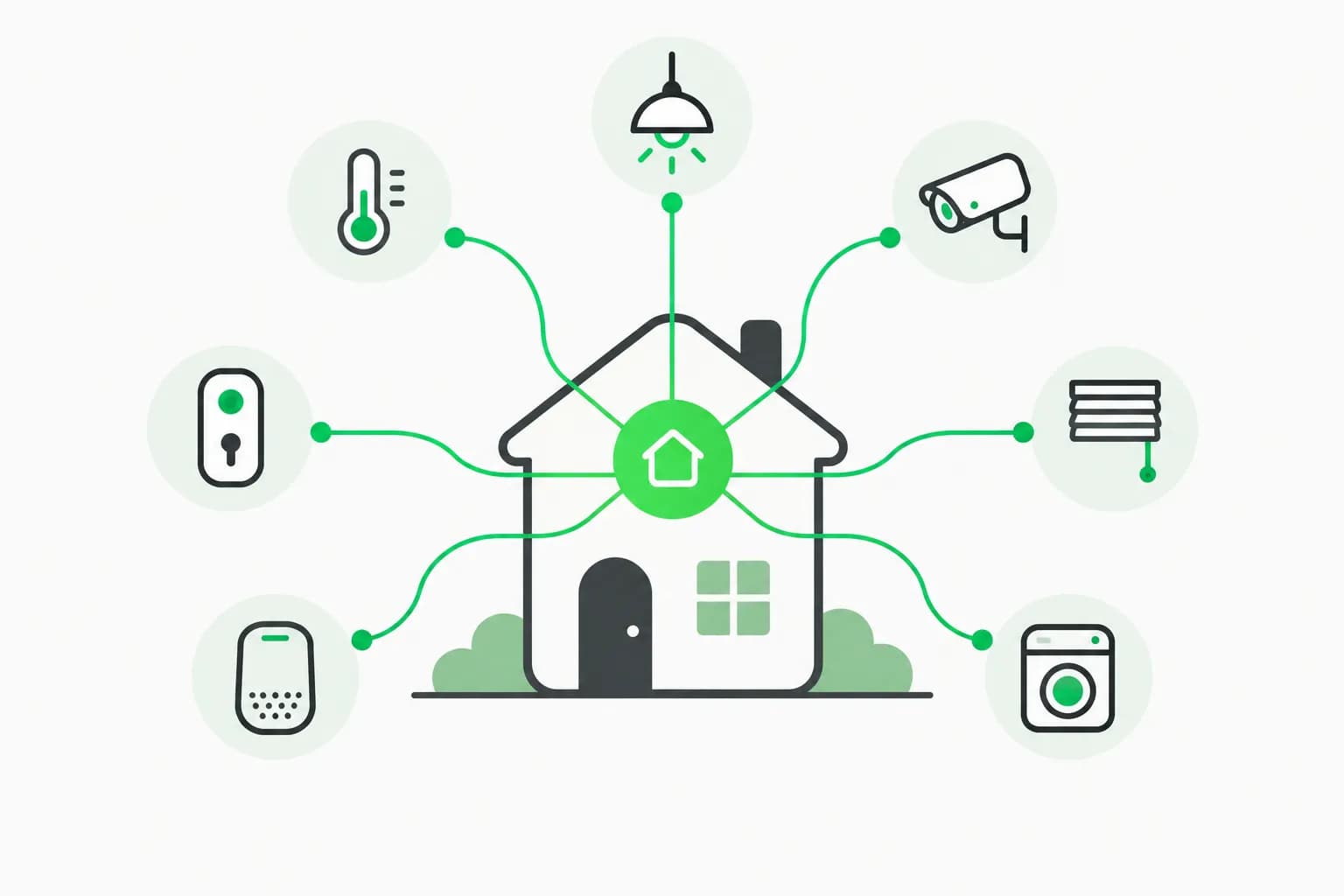
Bloomberg's Mark Gurman reported July 14, 2026 that OpenAI's long-teased consumer hardware push will start with something stranger than a phone: a portable, screenless smart speaker pitched internally as a "humanlike AI companion that lives in the home." The story landed the same week Apple sued OpenAI over the io Products hardware line and days after OpenAI shipped GPT-Live — the full-duplex voice stack Bloomberg says will power the device.
Update — August 4, 2026: OpenAI published Apple is getting this wrong — counsel mix-up, Chang Liu iMessages, and a pushback on Apple's preliminary injunction. Dedicated walkthrough: OpenAI rebuttal. Docket hub: Apple vs OpenAI lawsuit.
On X, the report circulated widely through tech-news aggregators (~65K+ views on prominent reposts July 15). Replies leaned HAL 9000 jokes and "finally, a body for ChatGPT" — but the engineering detail matters more: camera + sensors, mechanical motion, smart-home orchestration, and personality-first positioning in a category dominated by screenless assistants that mostly wait for wake words.
explainx.ai maps what Gurman actually reported, what is still rumor, and what buyers, regulators, and builders should watch before a 2027 ship date.
TL;DR — what Gurman reported vs what is unknown
| Question | Answer (Bloomberg, Jul 14, 2026) |
|---|---|
| Form factor? | Mobile screenless smart speaker — rechargeable battery, carry room to room |
| Defining feature? | Personality + humanlike connection — not just Q&A |
| Moves on its own? | Mechanical elements that move independently — "alive," not passive |
| Sees the room? | Built-in camera + sensors for surroundings and context |
| What can it do? | Smart-home control, media, messaging, ChatGPT capabilities, email-context personalization |
| Voice stack? | Advanced ChatGPT Voice / GPT-Live — full-duplex, humanlike conversation |
| Official name? | None — product still in development, unannounced |
| Reveal / ship? | Unveil 2026, release 2027 — subject to change |
| Roadmap? | Hardware division on ~5 products; speaker first |
| Legal risk? | Apple injunction in trade-secret suit may delay sales |
| OpenAI comment? | Spokesperson declined to comment |
What Bloomberg says OpenAI is building
Gurman's sources describe a device OpenAI internally frames as the first computer built for the AI era — not a speaker accessory for ChatGPT, but a home computer without a screen that makes busy people more productive while feeling like a physical manifestation of ChatGPT.
Core reported capabilities:
| Capability | Reported behavior |
|---|---|
| Conversation | Natural voice via GPT-Live — listen and talk simultaneously, adapt mid-sentence |
| Smart home | Control appliances and connected devices across the house |
| Media + messaging | Play audio, answer questions, respond to messages |
| Context | Draw on personal information such as emails to understand the owner |
| Perception | Camera and sensors interpret user surroundings |
| Mobility | Battery-powered — move between rooms unlike fixed countertop speakers |
| Presence | Mechanical motion — proactive movement, not only animation on command |
OpenAI believes the product "veers significantly from anything Apple has on the market today" and that it does not violate Apple trade secrets, per people familiar with the plans. Audio hardware and industrial design are described as substantially different from HomePod — though that is a legal and marketing claim, not a consumer spec sheet.
Why personality — not specs — is the pitch
Most smart speakers optimize for latency, wake-word accuracy, and skill catalogs. Gurman's report says OpenAI's internal story centers relationship:
- The device learns about its owner over time and personalizes proactively.
- Mechanical elements create embodiment — closer to companion robotics than a static cylinder.
- The goal is to feel like a companion, not an object that only reacts to commands.
That aligns with a broader 2026 pattern explainx.ai has tracked in software — AI companionship apps scaling emotional attachment, and hardware like ElliQ in elder-care robotics using motion to signal attentiveness. OpenAI would be betting the same psychology works at frontier-model quality with whole-home context.
The risk is also familiar: users may anthropomorphize a moving, camera-equipped voice box — especially children. Households already struggle with safe first AI conversations on phones; a persistent home presence raises the stakes.
GPT-Live: the software layer that makes a speaker "humanlike"
Bloomberg ties the hardware to GPT-Live, which OpenAI launched July 8, 2026. GPT-Live uses a full-duplex architecture — the model can process speech continuously while talking, interrupt naturally, and keep conversational flow while delegating hard tasks to GPT-5.5 in the background.
For a fixed smart speaker, turn-based voice was tolerable. For a device sold on connection, full-duplex is closer to a requirement — the difference between a kitchen timer and something that feels like it is in the room with you.
Builders already have a parallel stack in the GPT-Realtime-2 API; GPT-Live is the consumer ChatGPT layer. If OpenAI ships hardware before a GPT-Live API, the speaker becomes the showcase device for voice UX the phone app cannot fully demonstrate — always on, spatially present, mechanically expressive.
On social threads, some readers speculated about GPT-5o-class multimodal models. OpenAI's public GPT-Live post names GPT-5.5 as the background delegate at launch — not a separate "5o" SKU. Camera input on hardware would still push toward multimodal AI product design even if the voice core stays GPT-Live.
Smart home and agents — table stakes, not the moat
Controlling lights, locks, thermostats, and media is expected in 2026. Amazon and Google have a decade of integrations; Apple HomeKit anchors the ecosystem OpenAI's hardware alumni know best.
OpenAI's reported differentiation is not "it turns on the lamp" — it is orchestration with memory and initiative: knowing your schedule from email, nudging you before a meeting, choosing media based on prior conversations, maybe acting without a wake word when context warrants.
That is goal-mode agent behavior transplanted into a appliance: set conditions ("house ready for guests by 6pm") and let the system iterate across devices. The open-source counterweight is OpenClaw — personal agents on your own hardware and channels, without a $999 cylinder that watches the living room.
Camera in the home — privacy and regulation
A built-in camera plus email access plus always-listening voice is the highest-trust bundle consumer AI has attempted in a fixed home device since failed social robots — with better models and worse regulatory clarity.
| Concern | Why it matters |
|---|---|
| Continuous vision | Room layout, occupants, activities — sensitive even without facial ID |
| Household third parties | Guests, babysitters, minors — consent models break down fast |
| Data retention | Cloud inference vs on-device processing changes breach impact |
| Law enforcement access | Home devices already appear in subpoena debates; cameras amplify |
| EU / UK rules | EU AI Act and GDPR scrutinize biometric and high-risk home systems |
US debates on AI surveillance cameras show how quickly "helpful vision" becomes normalized monitoring. OpenAI will need publishable policies on what the camera sees, what leaves the device, and who can delete it — especially if Europe is a launch market alongside the US.
Jony Ive, io Products, and the Apple lawsuit timeline
OpenAI's hardware program sits on the ~$6.5 billion io Products acquisition (May 2025) and collaboration with former Apple design leadership including Jony Ive — the same pipeline Apple's July 10 complaint targets. Tang Tan, ex-iPhone and Apple Watch VP, is OpenAI's Chief Hardware Officer; Bloomberg notes many former Apple engineers worked on iPhone and Mac.
The Gurman report lands after Apple filed Case 5:26-cv-07078 and during Apple's push for an injunction that could block or delay hardware sales. OpenAI said Tuesday it is "not aware of any evidence that this complaint has merit" (via secondary reporting on Apple's suit).
Practical read for buyers:
| Milestone | Status |
|---|---|
| Reveal event | Possible 2026 — prototypes and marketing can precede sales |
| Retail availability | Target 2027 — injunction risk is the gating variable |
| Five-product roadmap | Speaker first; phone rumors persist but not this report's focus |
What people are asking after the Gurman report
Is this just a ChatGPT Echo?
Not in OpenAI's internal narrative. Echo and Nest optimize for skills and search. Gurman's sources emphasize embodiment, motion, proactive personality, and deep personal context — closer to companion hardware than a music puck. Whether consumers pay a premium for that over incumbents with mature smart-home graphs is the open question.
Will it replace my phone?
Bloomberg positions it as a "new type of home computer" for productivity — messaging, questions, control — not a pocket communicator. A phone from OpenAI remains rumor; this device is home-bound but portable within the house.
How much will it cost?
No price in the Bloomberg report. Premium industrial design, camera array, battery, and mechanical actuators suggest above HomePod/Echo pricing — but speculation until OpenAI announces.
Can I trust a camera AI from the company that wants my email?
Trust is the product problem. Technical capability is table stakes after GPT-Live; data governance decides adoption in privacy-sensitive homes and European markets. Watch for on-device processing claims, local-only modes, and third-party audit — not launch-keynote demos alone.
HAL 9000 jokes aside — what could go wrong?
Reported proactive motion + camera + personalization is exactly the stack sci-fi warns about: uncanny presence, over-trust, misread context, and dependency in isolated users. The same design choices that delight as "alive" can alarm roommates who never opted in.
Competitive landscape (no outbound links)
OpenAI enters a crowded field without hyperlinks to rivals per explainx.ai policy — but readers should map positioning:
| Incumbent | Strength | OpenAI's reported angle |
|---|---|---|
| Amazon Alexa | Smart-home breadth, price | Personality, frontier model, ChatGPT ecosystem |
| Google Nest / Gemini | Android + search integration | Embodied companion, mechanical presence |
| Apple HomePod / Siri | Privacy marketing, HomeKit | "Not comparable" per OpenAI sources — direct feud |
| Meta Ray-Ban glasses | Wearable camera + voice | Fixed home hub with actuators |
| Open-source agents (OpenClaw, etc.) | Self-hosted, channel choice | Polished appliance, zero setup |
None of the incumbents ship self-moving mechanical companions at mass-market scale today — if Gurman's details hold, OpenAI is aiming for a new category, not a spec-sheet war.
What to watch through 2027
- Official unveil — name, price, camera policy, on-device vs cloud split
- Apple injunction rulings — can OpenAI sell or only show?
- GPT-Live on hardware — latency, interruption, and offline fallbacks
- Smart-home partnerships — Matter/Thread support vs walled garden
- EU / UK regulatory filings — high-risk classification for home vision AI
- Companion ethics — proactive intimacy features and minor safeguards
- Sibling SKUs — four other hardware products in the Bloomberg roadmap
Summary
Bloomberg's July 14 report is the clearest picture yet of OpenAI's first hardware bet: not a phone, but a screenless, battery-powered, camera-equipped, self-moving AI companion speaker powered by GPT-Live, aimed at 2026 reveal / 2027 ship, and entangled with Apple's trade-secret fight. The defining feature is relationship, not wattage — which makes privacy, consent, and legal timing as important as model quality.
For explainx.ai readers building agents today: the software story (full-duplex voice + home actuation + memory) is already shippable in pieces via GPT-Live, Realtime API, and OpenClaw. OpenAI's hardware is the integrated, embodied bundle — with all the tradeoffs that come from one vendor owning mic, camera, motion, and cloud.
Update — August 17, 2026: Sam Altman told OpenAI interns he expects a ChatGPT descendant to watch your screen and record every meeting and call within about six months — a software-first version of exactly the "relationship, not wattage" ambient-presence bet this hardware story describes. Full breakdown →
Update — August 19, 2026: Apple's own version of this ambient-camera bet leaked — camera-equipped AirPods feeding Siri's Visual Intelligence. Full breakdown →
Update — September 15, 2026: OpenAI reportedly bought computational photography startup Glass Imaging for over $300 million — the neural camera pipeline this speaker's "reads the room" camera would plausibly run on. Full breakdown →
Related on explainx.ai
- OpenAI confirms it will build a humanoid robot — separate from this device push
- OpenAI Buys Glass Imaging for $300M+ to Build AI Camera Hardware
- AirPods camera leak: what the Visual Intelligence demo shows
- Sam Altman: ChatGPT Could Watch Your Screen in 6 Months
- Codex Micro — OpenAI's $230 Work Louder keyboard (Jul 15, 2026)
- OnePlus global exit — Gurman's next Bloomberg hardware story (Jul 16)
- Apple sues OpenAI — io, Tang Tan, trade secrets
- GPT-Live — full-duplex ChatGPT Voice
- AI relationships and companionship ethics
- Overtone — Hinge founder's $18M voice-first AI matchmaker
- What Is OpenClaw — personal AI you self-host
- Goal mode for autonomous agents
- EU AI Act and privacy regulation guide
- Kids' first AI conversation — safe setup
- GPT-Realtime-2 developer voice API
Sources: Bloomberg reporting via Mark Gurman (July 14, 2026, summarized by TechCrunch, The Verge, Straits Times, and Yahoo Finance) · OpenAI — Introducing GPT-Live (July 8, 2026).
Update — October 9, 2026: Natura announced a $99 smart ring that summons AI agents by voice. Full breakdown →
Device details, timeline, and legal outcomes reflect Bloomberg's July 14, 2026 reporting and subsequent secondary coverage — OpenAI has not officially announced the product.