



Frontier coding agents still fail about half of modern web platform checks unless you install Google’s skills—that is the message of the November 11, 2026 Chrome for Developers post marking Modern Web Guidance 1.0. The team runs paired evals: the same prompt with and without guidance, then scores HTML output against machine-verifiable expectations per guide.
If you use Claude Code, Codex, Cursor, or Gemini CLI for UI work, this is the first vendor-maintained answer to “why did the agent ship inaccessible modals again?”
TL;DR
| Question | Answer |
|---|---|
| What shipped? | Modern Web Guidance v1.0 skill pack + public eval dashboard |
| Install | npx modern-web-guidance@latest install (per Chrome blog) |
| Pass rate lift | ~52% → ~91% average on frontier coding agents in Nov 9, 2026 chart |
| Top gaps | Accessibility focus/inert, forms, dialogs, performance, CSP, passkeys |
| Relation to prior art | Builds on the May 2026 preview mentioned in the post |
Why Google published eval numbers
Chrome’s authors say they hear one question constantly: “Don’t new models already know best practices?” Their answer is empirical: unguided agents pass only about half of checks in the suite, versus ~90% guided.
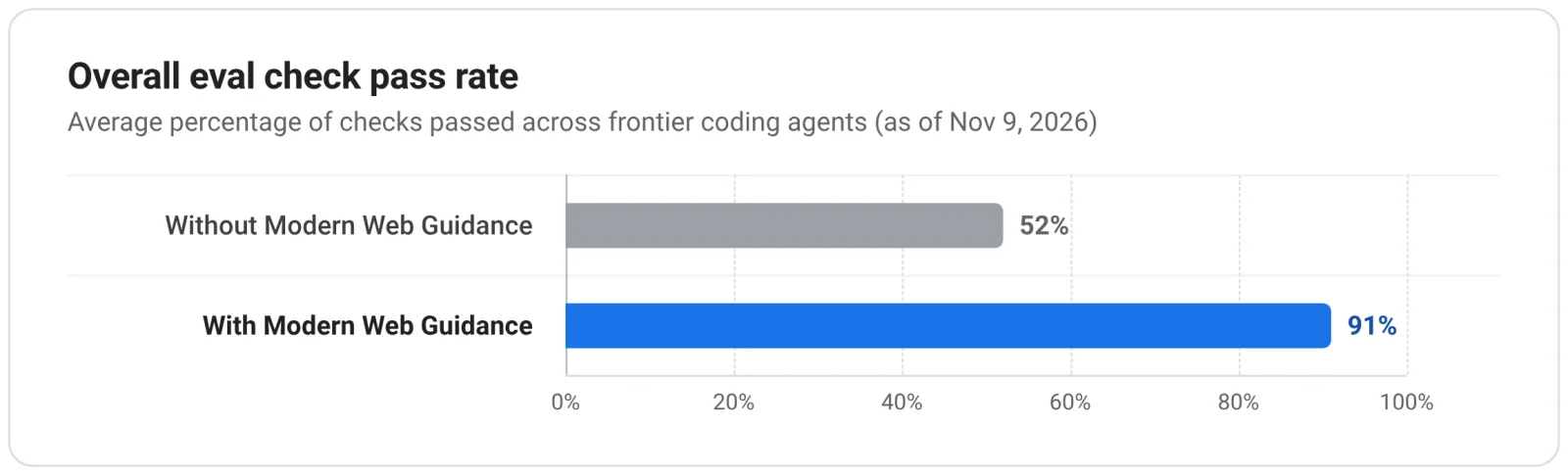 Modern Web Guidance raises AI coding agent pass rates on web platform evals
Image: Google Chrome for Developers
That gap lands in a week when explainx.ai also covered shadcn’s agent-skill audit guidance and Cloudflare’s security-audit skill pattern. Skills are becoming the web’s real spec for agents—not README nostalgia.
The ten problem areas (summarized for builders)
Each section in Google’s post ties to a Modern Web Guidance module with explicit pass/fail tests. Condensed for action:
 Keyboard focus management for AI-generated modals and dialog accessibility
1. Keyboard focus and inert
Agents open modals but fail to move focus, restore focus, or mark background content inert. They hand-roll tab traps instead of <dialog> and inert.
Fix pattern: require native dialog + inert on the host app; reject PRs that only add aria-modal.
2. Reduced motion
Models remember prefers-reduced-motion for basic CSS animations but miss scroll-driven animations, view transitions, and unconditional scroll-behavior: smooth on :root.
Fix pattern: gate motion features behind reduced-motion queries in your design system tokens.
3. Forms, validation, and autofill
Agents reimplement :user-invalid in JavaScript, desync aria-invalid, hide format hints in placeholders, and style :autofill with border color alone.
Fix pattern: copy Chrome’s expectation list into your component library’s agent-facing SKILL.md.
4. Touch and swipe
Custom touchmove handlers instead of scroll snap, missing overscroll-behavior-x, main-thread scroll effects instead of scroll-driven animations.
5. Dialogs, popovers, top layer
Hand-rolled overlays vs popover, JS-driven enter/exit vs @starting-style, overflow: hidden on html vs dialog overscroll behavior.
6. Dark mode and color-scheme
Missing <meta name="color-scheme">, no light-dark() tokens, binary localStorage theme with no return-to-system-default path.
7. Runtime responsiveness (INP)
setTimeout queues instead of scheduler.postTask, layouts without content-visibility, killing rendering state with display:none on SPA panels.
8. Layout shifts (CLS)
Video without dimensions, fonts without font-size-adjust, 100vh heroes on mobile, opacity-zero anti-flicker hacks for A/B tests, early view transitions before critical markup.
9. Security: DOM XSS
Custom sanitizers instead of setHTML() or DOMPurify, permissive Trusted Types policies, weak CSP ('self' without hashes on static sites).
This is where agent output intersects agent security timelines: agents rarely add CSP without prompting, per Chrome.
10. Passkeys and WebAuthn
Hand-rolled Base64URL helpers instead of parseCreationOptionsFromJSON, missing signalUnknownCredential, skipping getClientCapabilities, wrong uiMode vs deprecated mediation: "immediate".
How to install and wire the skills
The blog’s command:
npx modern-web-guidance@latest install
Search your agent’s plugin marketplace for the same package name if your harness does not expose npm installers. Treat installation like adding eslint-config—version pin in repo, run in CI.
Pair with:
- DESIGN.md templates for visual constraints agents can read.
- Claude Code command reference when you bind checks to review hooks.
- Indirect prompt injection when agents ingest untrusted HTML in DOM XSS fixes.
What the Hacker News thread lacked
The HN submission had five points and no discussion when we checked—too early for community numbers. Treat Chrome’s dashboard as the living benchmark until developers publish independent reps.
Eval workflow for your team
| Step | Action |
|---|---|
| 1 | Install Modern Web Guidance in the same harness devs use daily. |
| 2 | Run the public dashboard checks on your top three app templates. |
| 3 | Turn recurring failures into lint rules or CI HTML snapshots. |
| 4 | Block agent-merge on accessibility + CSP suites, not only unit tests. |
| 5 | Re-run after model upgrades—skills cache older platform facts. |
Comparison with other “agent standards” pushes
| Initiative | Scope | Enforced by |
|---|---|---|
| Modern Web Guidance | Web platform UX, a11y, perf, security | Chrome eval expectations |
| llms.txt | Site semantics for crawlers | File on origin |
| MCP | Tool transport | Host server |
| Agent skills directories | Task recipes | Harness discovery |
Modern Web Guidance is closest to “HTML that survives real users”—install it when agents touch customer-facing UI.
Related reading
- shadcn: audit skills, cheap execute
- Fragile codebases under agentic coding
- DESIGN.md for agent UI
- Indirect prompt injection guide
- Loop engineering with coding agents
- React Server Components CVE context when agents edit RSC apps
Sources: Chrome for Developers blog, November 11, 2026, npm modern-web-guidance.
Deeper notes on each accessibility cluster
Google’s focus section is not “use aria labels.” It tests focus restoration after route changes, roving tabindex on toolbars, and inert on background trees while dialogs are open. Agents love adding aria-modal="true" on div soup; the eval fails because native dialog semantics are missing.
For forms, the post calls out persistent format hints linked with aria-describedby above the field so mobile keyboards do not cover them. Agents that rely on placeholders alone fail conversion-sensitive flows—checkout, healthcare intake, government forms.
Reduced motion failures often come from blanket * selectors zeroing transitions. That breaks state communication (hover, pressed). The guidance expects surgical motion removal.
Performance section for agent owners
Agents trained on Lighthouse snippets over-index LCP while missing INP. Chrome’s post pushes content-visibility:hidden for inactive SPA views instead of unmounting components—preserving cached layout for back navigation.
When agents add scroll listeners for affordances, they burn main-thread budget. Prefer scroll-state queries where supported, with Intersection Observer fallbacks documented in the skill pack.
Security expectations you can paste into AGENTS.md
Add these non-negotiables for any agent-generated production UI:
- CSP with hashes or nonces on inline script when Trusted Types are absent.
- Trusted Types default policy rejecting DOM sinks unless a vetted sanitizer path exists.
- No hand-rolled sanitizers when
setHTML()or DOMPurify is available. - Passkeys must use JSON serialization helpers from WebAuthn, not custom Base64 loops.
Pair with React RSC security context when agents edit full-stack apps.
Running the eval loop in CI
| Phase | Owner | Output |
|---|---|---|
| Scaffold | Agent | HTML or component tree |
| Guide install | CI | npx modern-web-guidance@latest install |
| Eval | CI | Pass/fail per check ID |
| Human review | Design | Visual regression only on failed IDs |
Publish failed check IDs in PR comments so the next agent prompt includes the regression list.
What changed since the May 2026 preview
Version 1.0 signals stable expectation schemas. Preview users should re-pin skills: silent expectation drift was a common failure mode in early adopters per Chrome’s narrative.
FAQ for engineering managers
Will this slow agents down? Extra tool reads add latency, but fewer rework loops save review time.
Does it replace designers? No—it encodes platform lawyer rules, not brand.
Can we fork checks? The GitHub repo linked from npm is the extension point—upstream merges keep parity with Chrome releases.
Passkeys: why agents fail WebAuthn
Agents often rewrite Base64URL helpers because training data predates PublicKeyCredential.parseCreationOptionsFromJSON. The eval fails when credential id handling breaks password-manager sync.
Missing signalUnknownCredential leaves stale passkeys after server-side revocation. Support teams then blame passkeys when the client never told the platform to forget.
getClientCapabilities gates UI: without it, agents render create passkey buttons on devices that cannot store them.
Dark mode and dialog migration
Chrome tests color-scheme meta, light-dark(), and return-to-OS-default theme paths. Agents ship binary dark/light toggles with localStorage overrides that desync tabs—fix by requiring storage event listeners in your design system spec.
For overlays, ban position:fixed + manual scroll lock in agent PRs; require dialog or popover with @starting-style. These are copy-paste rules you can add atop Modern Web Guidance in internal AGENTS.md.
Model upgrade regression discipline
When you bump from one frontier model to another, re-run the full eval dashboard—not a single smoke page. Regression clusters often appear in CSP and inert before accessibility scores move.
Touch gestures and scroll-driven motion
Agents frequently attach touchmove listeners to mimic carousels. Chrome’s guidance prefers scroll snap and overscroll-behavior-x so browsers handle physics off the main thread. The eval catches browser back gestures accidentally triggered by horizontal swipes— a failure mode mobile QA teams see after every agent sprint.
For scroll-driven animations, agents forget prefers-reduced-motion gates. Document a motion budget: decorative animations off by default, functional motion only when the user has not requested reduced motion.
Layout stability: agents still ship hero sections with static vh units on mobile and opacity-zero anti-flicker snippets for experiments. Chrome’s eval ties those choices directly to CLS regressions that also hurt conversion on agent-built landing pages.
Pass rates and check lists are accurate as of Google’s publication date. Re-run npx modern-web-guidance@latest install after upgrades; eval IDs may change with platform releases.