



Update — September 25, 2026: VQQA-style critique loops show how video understanding feeds video generation. See Google's multi-agent video framework.
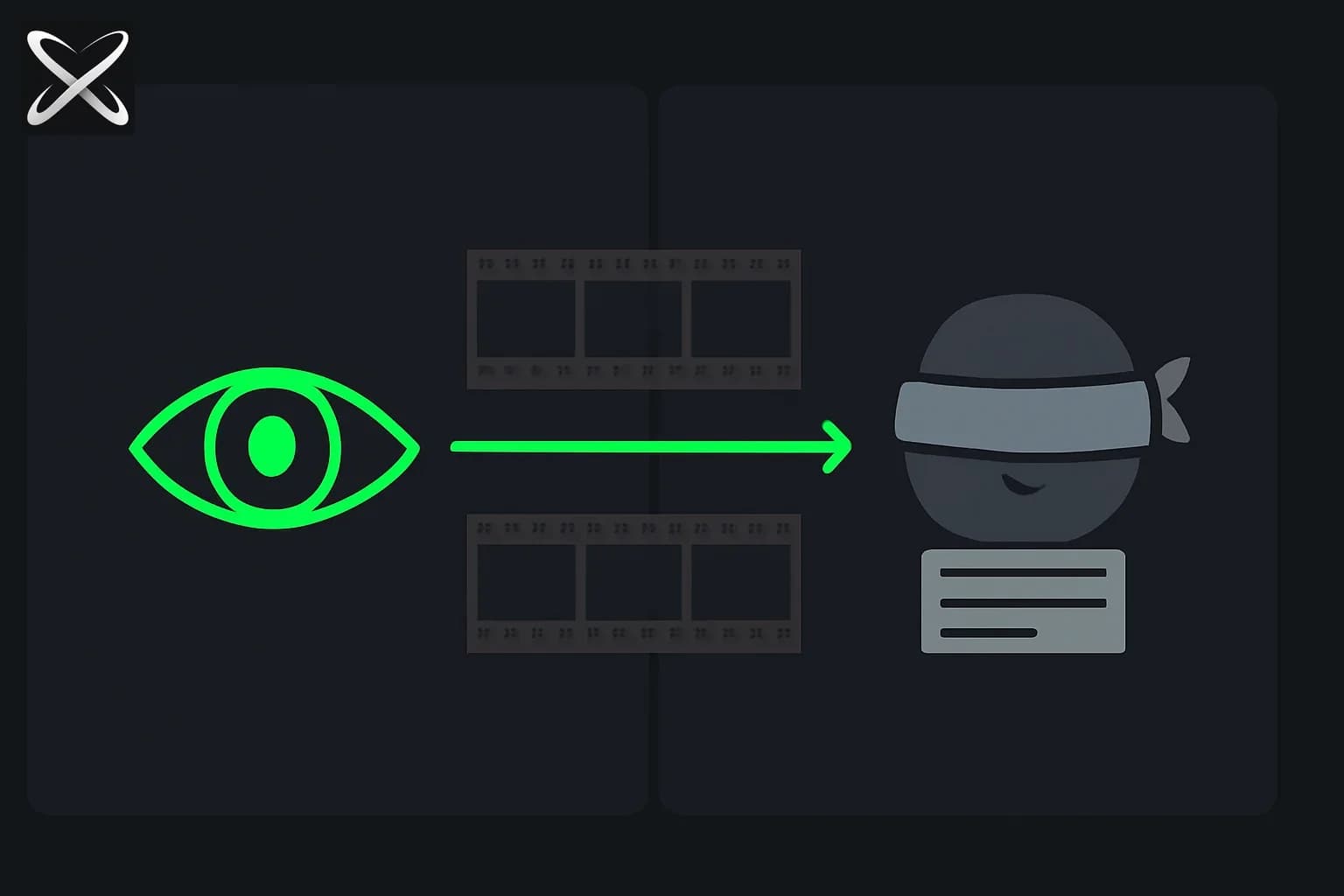
Google AI Studio's own account put it bluntly on September 1, 2026: Gemini "can now take an active, goal-directed role in determining what to watch, at what speed, and through which modality... instead of using static processing." That's a real architectural shift in how a multimodal model consumes video, not a marketing rewrite of the same fixed-frame-rate pipeline.
The headline numbers — up to 88% fewer tokens, up to 66% lower cost — are the kind of figures that invite skepticism. They hold up against Google's own developer documentation, with one important qualifier worth reading past the tweet: "up to" means best case, on long video, where most of the footage doesn't matter to the question being asked.
TL;DR — what changed and what didn't
| Question | Answer |
|---|---|
| What's new? | Gemini can now navigate a video's timeline instead of sampling it at a fixed rate |
| Which models? | Gemini 3.7 Flash, 3.6 Flash, 3.5 Flash-Lite |
| How much cheaper? | Up to 88% fewer tokens, up to 66% lower cost — both "up to," measured on long-form video |
| Does accuracy improve too? | Up to 7% higher accuracy on long-form content — a byproduct of skipping irrelevant frames, not a model upgrade |
| How do I turn it on? | Set "processing": "agentic" on the video input in the Gemini API |
| Available via Vertex AI? | Google's announcement covers the Gemini API (AI Studio) and the Gemini Enterprise Agent Platform; it does not document general Vertex AI availability |
| Extra cost to enable? | No — standard Gemini token pricing, no separate feature fee |
| Is this a new model? | No — same Flash-tier models, different video-processing mode |
The mechanism: from stenographer to investigator
Gemini's default video ingestion — what Google now calls static processing — extracts frames at a fixed rate (1 frame per second by default, adjustable via the API) and places all of them into context in a single pass. A 90-minute lecture at 1 fps is 5,400 frames pushed into the model whether or not the answer lives in minute 3 or minute 87.
Agentic video understanding replaces that single pass with a loop. The model:
- Reads the prompt first, before touching the footage.
- Calls an internal video tool to load a candidate segment of the timeline.
- Inspects that segment — as frames, as audio, or as transcript, whichever modality actually carries the signal for that moment.
- Decides whether to rewatch at a higher frame rate, jump elsewhere, pull the audio track instead of frames, or stop because it has enough to answer.
That modality choice is the detail easy to miss in the one-line announcement. A silent product demo needs frames; a podcast clip needs audio or transcript; a scene with on-screen text needs frames at higher resolution than a slow establishing shot. Static processing treats all three the same — one fixed sampling rate for everything, regardless of content density. Agentic mode treats them as separate signals the model can request independently, which is the same reason scene-aware local preprocessing beats naive 1 fps dumps for tools that have no native video ingestion at all.
Verified against Google's own documentation
Google's developer changelog and the official Google AI blog post confirm the same figures as the AI Studio announcement:
- Up to 88% more token-efficient than static processing
- Up to 66% lower cost
- Up to ~7% higher quality/accuracy on long-form content specifically
Google's own framing matters here: the gains are "especially pronounced on long-form video (from 10-minute how-to guides to 90-minute lectures and multi-hour recordings)." That's not incidental phrasing — it's the tell that these are best-case numbers on the exact content type where fixed-rate sampling wastes the most tokens. A 30-second product clip where every frame is relevant will not see an 88% reduction, because there's nothing wasteful to skip.
How developers actually turn it on
No new endpoint, no separate product. Agentic mode is a value on the existing video-input parameter in the Gemini API:
{
    "type": "video",
    "uri": video_file.uri,
    "mime_type": video_file.mime_type,
    "processing": "agentic"   # default is "static" (fixed 1 fps)
}
It's live now in the Gemini API via Google AI Studio and the Gemini Enterprise Agent Platform, on Gemini 3.7 Flash, 3.6 Flash, and 3.5 Flash-Lite, at standard Gemini token pricing — no separate feature fee. Google's own documentation frames it as the recommended default going forward for long-form content or queries aimed at a specific moment, not an experimental opt-in. Availability on Vertex AI proper, versus the separately branded Gemini Enterprise Agent Platform covered in Google Cloud Next's TPU-8 and Gemini Enterprise announcements, isn't spelled out in the launch material — worth confirming directly if your pipeline runs through Vertex rather than the Gemini API.
This ships on the same Flash-tier lineup covered when Gemini 3.6 Flash and 3.5 Flash-Lite launched in July, and on Gemini 3.7 Flash specifically — it is not a new model release, it's a processing mode added to models already in production.
Worked example: finding one moment in a two-hour video
The question: "At what point does the presenter show the pricing slide?" — asked against a 2-hour conference recording.
Before (static, fixed 1 fps):
- 2 hours × 3,600 seconds × 1 frame/sec = 7,200 frames
- Even at a modest ~250-500 tokens per frame after resizing, that's roughly 1.8M-3.6M vision tokens before the model reasons about anything
- Most of those frames are redundant — the presenter standing still, slide transitions repeated across seconds
- Cost and latency scale with the video's length, not with how much of it matters to the question
After (agentic mode):
- The model reads the prompt, recognizes it's a moment-retrieval question, not a full-transcript summary
- It requests a coarse scan of the timeline — likely audio or transcript first, since "pricing" is a spoken/textual cue
- It narrows to the segment where pricing is mentioned, then requests frames at that specific timestamp to confirm the slide is on screen
- Total fetched content: a handful of transcript chunks plus a small frame cluster around one timestamp — a small fraction of the 7,200-frame baseline
This is the same shift as how a person skims a two-hour recording versus watching it start to finish: you don't watch at 1x with your eyes glued to the screen — you scrub to where the talking changes, listen for a keyword, and only slow down once you're close. Static frame-rate ingestion is the equivalent of forcing the model to watch the entire recording in real time before answering a question a human would solve by scrubbing to minute 47.
What this unlocks in practice
The economics of "process every frame" put a real ceiling on video use cases that only look tractable on paper:
- Meeting and call archives — searching hours of recorded meetings for the one decision or commitment, without paying per-frame costs across every recording in the archive
- Security and surveillance footage review — most footage is empty hallway; agentic mode's ability to skip low-signal stretches and rewatch only flagged moments at higher fidelity is a direct fit for anomaly detection
- YouTube-scale content indexing — building a searchable index across a channel's back catalog becomes economically viable when cost scales with relevant content, not raw runtime
- Sports footage analysis — finding specific plays, fouls, or scoring moments in hours of raw feed without processing dead time between plays
- Long-form lecture and how-to search — Google explicitly calls out this range (10-minute guides to 90-minute lectures) as where the gains concentrate
This is also directly relevant to anyone who has hit the wall described in our earlier piece on whether LLMs can watch video at all — Gemini's fixed ~1 fps default was already the best native option available, and this removes its biggest cost objection for exactly the long-form use cases that were previously price-prohibitive.
Honest limitations
This is a cost and latency optimization, not a new model. The reported accuracy gain — up to 7% — is a side effect of not being forced to sample irrelevant frames, not a separately trained or upgraded model. If your task genuinely requires dense, uniform coverage of every second of footage (frame-by-frame motion analysis, for instance), agentic mode's selective navigation may find less benefit, and static processing at a high fixed frame rate remains the safer choice.
It doesn't change what non-Gemini models can do. Claude still has no native video ingestion, and tools like claude-real-video and video-use remain the answer for teams building on Claude or wanting to keep footage off a vendor's servers entirely. Agentic video understanding is Google solving a cost problem inside a capability it already had — Gemini could already ingest video natively; this changes how efficiently it does so.
A real question from the announcement's replies: is this actually usable via API today, or Studio-only? Per Google's own docs, yes — it's a request-level parameter ("processing": "agentic") available through the Gemini API itself, not a UI-only toggle inside AI Studio. That matters for the follow-up question several developers asked: whether third-party video-editing and video-search tools built on top of the Gemini API would benefit automatically. They would, but only after those tools update their integration to pass "agentic" instead of relying on the current static default — it is opt-in per request, not a silent upgrade to existing integrations.
Update — September 17, 2026: Google published production results from three early-access partners. Mosaic cut median token usage 97% with an index-then-verify routing layer, Ponder Studio hit a 0.967 F1 score using a single agentic call, and Revyl improved bug-catching accuracy 65% by wiring it into their assertion loop. Gemini 3.8 Flash has also joined the supported model list. See Agentic video understanding in production.
Related reading
- Update — September 11, 2026: Google AI Studio opened a Gemini API docs preview in-product at ai.studio/docs — same "build where you look things up" direction as Studio video tooling.
- Update — September 5, 2026: Google shipped Lyria 3.5 in the Gemini app, Gemini API, and AI Studio, extending the "AI Studio as prototyping surface" pattern from video into music — see Google Lyria 3.5: AI music generation in the Gemini API
- Update — September 2, 2026: Reports (unconfirmed by Google) claim a Gemini 3.8 Flash launch the same day — it isn't named among the models supported here because it hadn't shipped in Google's docs yet; that post covers what's verified so far.
- Can LLMs watch video? Claude and Gemini solutions compared — the companion piece this news updates directly
- Gemini 3.6 Flash, 3.5 Flash-Lite, and 3.5 Flash Cyber: what actually changed
- Gemini 3.7 Flash is official: confirmed pricing and benchmarks
- Gemini 3.7 Flash showcase: what Googlers are one-shotting
- Google AI Studio custom URLs
- Gemini Omni Flash video generation
- Marlin 2B — video VLM for structured information
- Token budget planning for agent loops
Official: Introducing agentic video understanding with Gemini · Gemini API video understanding docs · @GoogleAIStudio
Figures, model list, and API details accurate as of September 2, 2026, per Google's developer documentation and blog.google. Always verify current model support and pricing at ai.google.dev.