



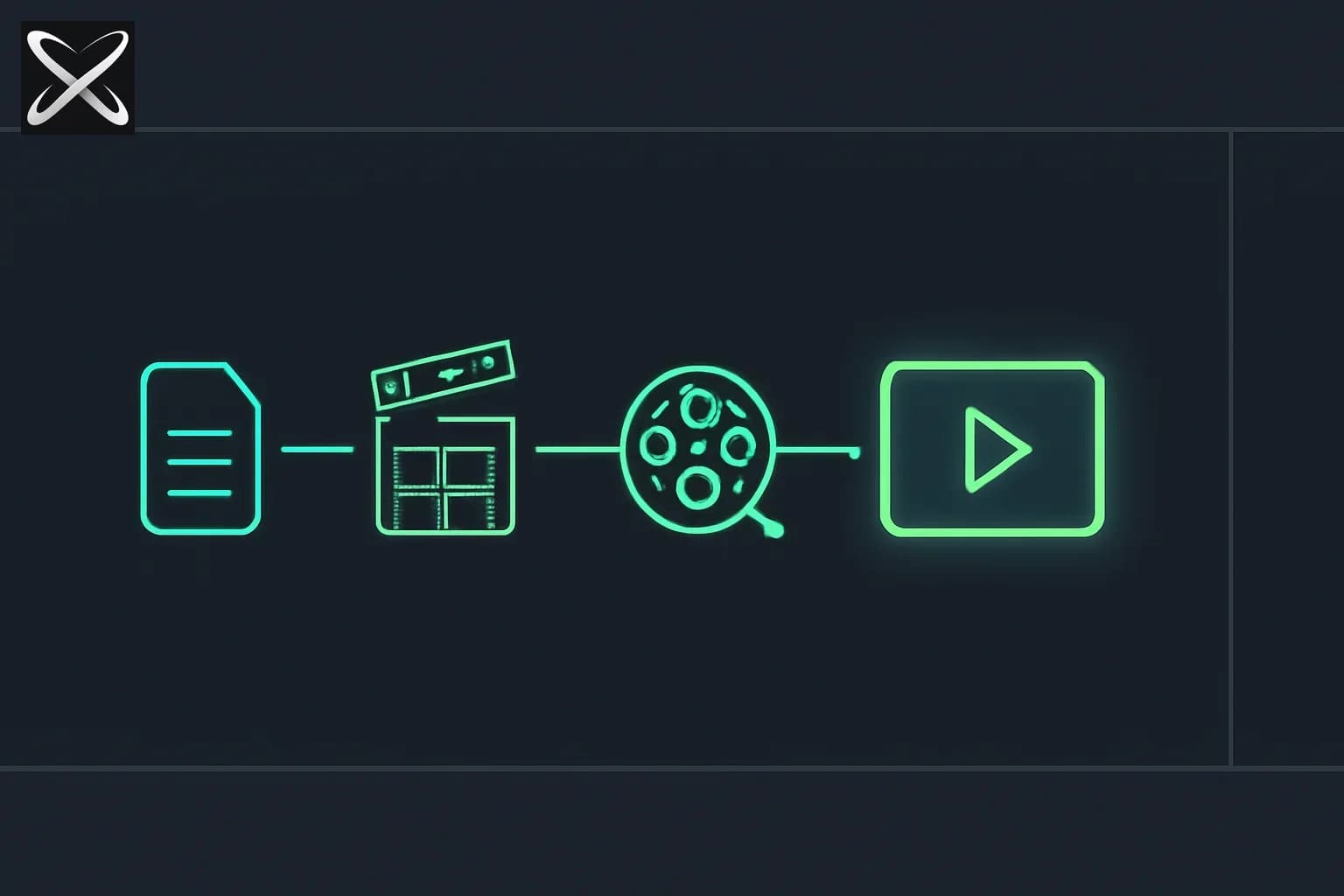
Long AI videos fall apart because each shot is generated a little independently of the last. Faces shift, rooms rearrange, a prop changes color. On September 25, 2026, Google Research announced a unified multi-agent framework meant to fix that by treating long-form generation as a global planning problem rather than a chain of prompts.
It is research, not a product. But the structure is a clean template for anyone building an agentic video pipeline, and the four papers behind it are all public.
TL;DR: the four components
| Component | Job | Benchmark named |
|---|---|---|
| AI Video Co-Director | Hierarchical multi-agent planner that explores narrative strategies with a multi-armed bandit | GenAD-Bench, 81.4 quality score |
| CANVAS | Persistent visual memory of characters, locations and objects | HardContinuityBench |
| A²RD | Generates segment by segment, switching between extrapolation and interpolation | LVBench-C |
| VQQA | Uses a vision-language model's critiques as a "semantic gradient" to refine prompts | T2V-CompBench, VBench2 |
Google frames the pipeline as one that "generates temporally consistent, long-form video narratives while mitigating visual drift and pipeline error propagation." The write-up describes the approach as "treating long-form generation as a global optimization and world-state tracking problem."
Why does long-form AI video drift in the first place?
Most video models generate a few seconds at a time, and long videos are stitched from many clips. Two failure modes compound:
- Visual drift. Each clip conditions on the previous frame or a text prompt, so small identity or layout errors accumulate. By minute two, the protagonist no longer looks like the protagonist.
- Error propagation. In an autoregressive chain, a bad segment contaminates everything after it, and blindly accepting the last iteration of a refinement loop can lock a bad result in.
Earlier approaches either need white-box access to the model, or run expensive test-time optimization. Google notes that test-time methods are "computationally expensive or require white-box access," which is why several of these components are designed to treat the video generator as a black box.
How does each component work?
AI Video Co-Director: global planning
Instead of writing one long prompt and hoping, the Co-Director is a hierarchical multi-agent system that explores creative strategies, narrative modes and aesthetic archetypes, choosing among them with multi-armed bandit optimization. The bandit framing matters: it treats "which style and story structure to use" as an exploration-versus-exploitation problem and spends its generation budget on what scores well, instead of committing to the first idea. The reported quality score on GenAD-Bench is 81.4. The paper is on arXiv 2604.24842 and is listed for COLM 2026.
CANVAS: remembering the world
CANVAS, short for Continuity-Aware Narratives via Visual Agentic Storyboarding, maintains an explicit world state: who is in the scene, what they look like, where locations are, and what objects exist. When a character returns after ten shots, the agent pulls from a multimodal video memory so the character is "anchored to original specifications" rather than regenerated from a loose description. It is arXiv 2604.13452, listed for EMNLP 2026.
A²RD: generate in segments, adapt the mode
A²RD (Agentic Autoregressive Video Generation) generates a long video segment by segment, and an agent chooses per segment whether to extrapolate forward from the previous clip or interpolate toward a planned later anchor. Interpolating toward a known future frame is a strong guard against wandering layouts. Google reports minimized layout drift over minutes on LVBench-C. See arXiv 2605.06924.
VQQA: a critic that talks back
VQQA (Video Quality Question Answering) uses a vision-language model to ask and answer questions about a generated clip, then converts the critique into a "semantic gradient" that edits the next prompt. Because it only sees inputs and outputs, it works on closed video models. A "Global Selection" step evaluates the entire optimization trajectory instead of accepting the final iteration by default. See arXiv 2603.12310.
What can builders actually reuse?
You do not need Google's stack to borrow the architecture. A minimal version fits any agent framework:
1. Plan     Draft a beat sheet and a "bible": characters, locations,
            props, palette, each with a canonical reference image.
2. Track    Keep a world-state store updated after every shot.
3. Generate Produce shot N conditioned on the bible + state, not only
            the previous clip. Interpolate toward shot N+2 anchors
            when the layout matters.
4. Critique Ask a vision-language model targeted questions
            ("Is the jacket still red? Is the kitchen layout unchanged?")
5. Refine   Turn failures into prompt edits; keep the best of ALL
            attempts, not just the last.
Step 5 is the underrated one: keep the whole trajectory and select the best, because refinement loops often regress.
For related building blocks on explainx.ai, see our guide to ViMax and agentic video generation, the Sora, Runway and Kling comparison, and HyperFrames, which turns HTML into video for AI agents. For the critique side, Gemini's agentic video understanding in AI Studio is the kind of vision-language model VQQA-style checks depend on.
What are people asking?
Reactions to the announcement were a mix of skepticism and practical questions.
- "Now when the video still drifts, I've got a whole committee of agents to blame." Funny, and it names a real risk: more agents mean more failure surfaces. The design answer is that each agent owns a specific invariant, such as identity or layout, so a failure is traceable.
- "One agent that works beat five clever ones." Sometimes true. Multi-agent pipelines add latency and cost, and Google's post gives neither. If a single strong video model already holds consistency for your clip length, do not add orchestration.
- "Change one scene halfway through and see if later shots still match." The right test. Editing workflows are where world-state tracking pays off, because state lets you change one entity without regenerating everything.
- "Maybe it's time to release Gemini Omni Pro." Speculation. The announcement is about a research framework and does not mention a model release. For Google's current video models, see Gemini Omni.
What are the limits?
- No cost or latency numbers. Closed-loop refinement with many agents is expensive by construction, and the post does not quantify it.
- Benchmarks are the authors' own choices. GenAD-Bench, HardContinuityBench and LVBench-C are the frameworks' own evaluation settings; independent replications are not in the announcement.
- Research, not a product. There is no API, pricing or availability statement. The papers are public, the system is not.
- Continuity is not quality. A perfectly consistent video can still be dull. Consistency addresses one failure mode, not story or taste.
What this means for what you build or pay
- If you produce long-form AI video: adopt world-state tracking now. A simple character-and-location bible plus a consistency check catches most drift and costs little.
- If you evaluate video models: test on a fixed multi-scene script and check identity and layout across shots, not just single-clip beauty.
- If you budget: expect multi-agent pipelines to multiply generation cost by the number of refinement rounds. Cap the loop and log spend per finished minute.
- If you wait for Google: there is nothing to wait for yet. The ideas are usable today with any video model that accepts reference images.
How would you test a long-form video pipeline?
Drift is easy to miss in single clips, so build a test around it:
- Fix a script with at least six scenes, two recurring characters and one location that returns after several shots.
- Record the bible: reference images, wardrobe, palette and layout notes for each character and place.
- Generate with and without world-state tracking and compare the same shots side by side.
- Score consistency with targeted questions to a vision-language model, such as "Is the jacket the same color as shot 1?" and log pass rates per shot.
- Track cost per finished minute, including every refinement round, so you can see whether consistency gains justify the extra generations.
- Change one scene mid-script and check that unaffected shots still match, which is the editing case commenters asked about.
Anthropic-style "evals for your own task" thinking applies here too: a published benchmark gain matters less than whether your characters survive your script.
What does the cost model look like?
Each added agent adds calls: a planner, a state tracker, a critic and refinement rounds per segment. A rough budget is generation calls times refinement rounds plus critic calls per segment. Capping rounds at two or three and using a cheaper vision model for the critic keeps spend predictable. Google's post gives no cost numbers, so measure your own.
How to read the four papers together
The four components are easiest to understand as answers to four different questions, not as one monolithic system. The Co-Director asks what story and style to attempt. CANVAS asks what the world currently contains. A²RD asks how to move from one segment to the next without wandering. VQQA asks whether the result is actually good, and how to fix the prompt if it is not.
That split is useful when you build your own version, because you can adopt one piece without the others. A team with consistency problems can start with a character-and-location bible and a state store, which is the CANVAS idea. A team with a closed video model can start with VQQA-style critique, since it only needs inputs and outputs. Planning with a bandit is the heaviest piece and the one most dependent on a generation budget the announcement never quantifies.
Bottom line
The durable idea is not any single paper. It is that long-form video needs persistent state, global planning and closed-loop critique around a video model, rather than a longer prompt. That pattern is available to any builder today, and the papers are the reference for how to structure it.
Related reading on explainx.ai
- ViMax: agentic video generation complete guide
- Video generation with Sora, Runway and Kling
- Gemini Omni video model
- Gemini agentic video understanding in AI Studio
- HyperFrames: HTML to video for AI agents
- Seedance 2.5: 30-second 4K AI video
Official source: Google Research, Coherent long-form video generation, with the four arXiv papers linked above.
Benchmarks and paper venues are as reported in Google Research's post on September 25, 2026.