



Major environmental nonprofits are adopting the same large-model stack they publicly criticize. In reporting published November 8, 2026, Reuters (via GMA News Online) says 15 large conservation and development groups told reporter Valerie Volcovici they use artificial intelligence somewhere in their work—and all 15 worry about electricity, water, and greenhouse gases from the data centers behind it.
The practical takeaway: NGOs are not rejecting AI wholesale. They are arguing about where inference runs, what tasks justify cloud GPUs, and whether governments and hyperscalers will disclose footprint data before COP31.
For the infrastructure side of the same debate, see our data-center environmental impact explainer and recent coverage of European moratorium fights and protests at new builds.
TL;DR
| Question | Answer (per Reuters, Nov 8 2026) |
|---|---|
| Who was surveyed? | 15 major environmental, conservation, and development organizations |
| Do they use AI? | All said yes, in some form |
| Do they worry about data centers? | All expressed concern about power, water, and emissions |
| Example wins | Cambodia wildfire alerts; Kenya wildlife surveys; Jane Goodall field-note digitization |
| Footprint projections cited | IEA electricity and UNU water estimates through 2030 |
| Policy hook | COP31 sustainable-AI pledge; Guterres disclosure push |
What changed in the news cycle
This is not the first time explainx.ai has covered data-center sustainability math. Our June explainer walks through global percentages versus local fights. The Reuters piece adds organizational psychology: groups whose mission is protecting nature are now defending specific AI deployments to their own members and donors.
Volcovici anchors the story in three concrete programs:
Conservation International — Ali Swanson, the group's AI lead, told Reuters the nonprofit uses AI to evaluate satellite-detected fire hotspots and push real-time alerts to community forest patrols in remote parts of Cambodia. That is operational inference on a latency-sensitive task: waiting for a human to scroll imagery manually can mean a fire spreads before anyone mobilizes.
Save the Elephants (Kenya) — CEO Frank Pope described a 2025 aerial survey of Kenya's largest protected area that produced roughly 200,000 images. Nine staff spent nine months reviewing them by hand. Pope said models trained on Nvidia GeForce platforms now finish comparable analyses in hours. The surprise was accuracy: human counts missed about one-third of elephants, about half of zebras and giraffes, and about three-quarters of oryx. Better counts, Pope argued, make biodiversity investable because funders can underwrite what they can measure.
Jane Goodall Institute — Vice president of conservation science Lilian Pintea said decades of handwritten chimpanzee observations in Tanzania's Gombe National Park—in local Kiha plus scientific shorthand—were on track to take 13–15 years to digitize. A tool built with Amazon Web Services, according to Reuters, can scan, translate, and structure notes in minutes, cutting the timeline to about two years. Pintea quoted Goodall's view that AI should stay human-centered.
Those examples sit next to warnings that the same industry builds megawatt-scale halls such as the wind-powered campus projects we covered in China and the contested European sites in our Amsterdam moratorium reporting.
 Rounded leaf icons representing biodiversity monitoring datasets NGOs use with computer vision for wildlife counts
The data-center footprint numbers Reuters highlights
Volcovici does not ask readers to guess at scale. She cites institutional projections:
| Metric | Source in Reuters story | Figure |
|---|---|---|
| Data-center land / built footprint | United Nations University Institute for Water, Environment and Health | Could more than double by 2030; footprint compared to roughly twice Jakarta |
| Electricity | International Energy Agency | About 945 TWh/year by 2030; ~300M metric tons CO2 equivalent cited |
| Water | International Energy Agency (via Reuters) | From ~560B liters (2023) to ~1.2T liters/year by 2030 |
Those figures align directionally with what policymakers already fight about in zoning hearings—even when national percentages look small on paper, as we explained in the IEA-adjacent local impact post.
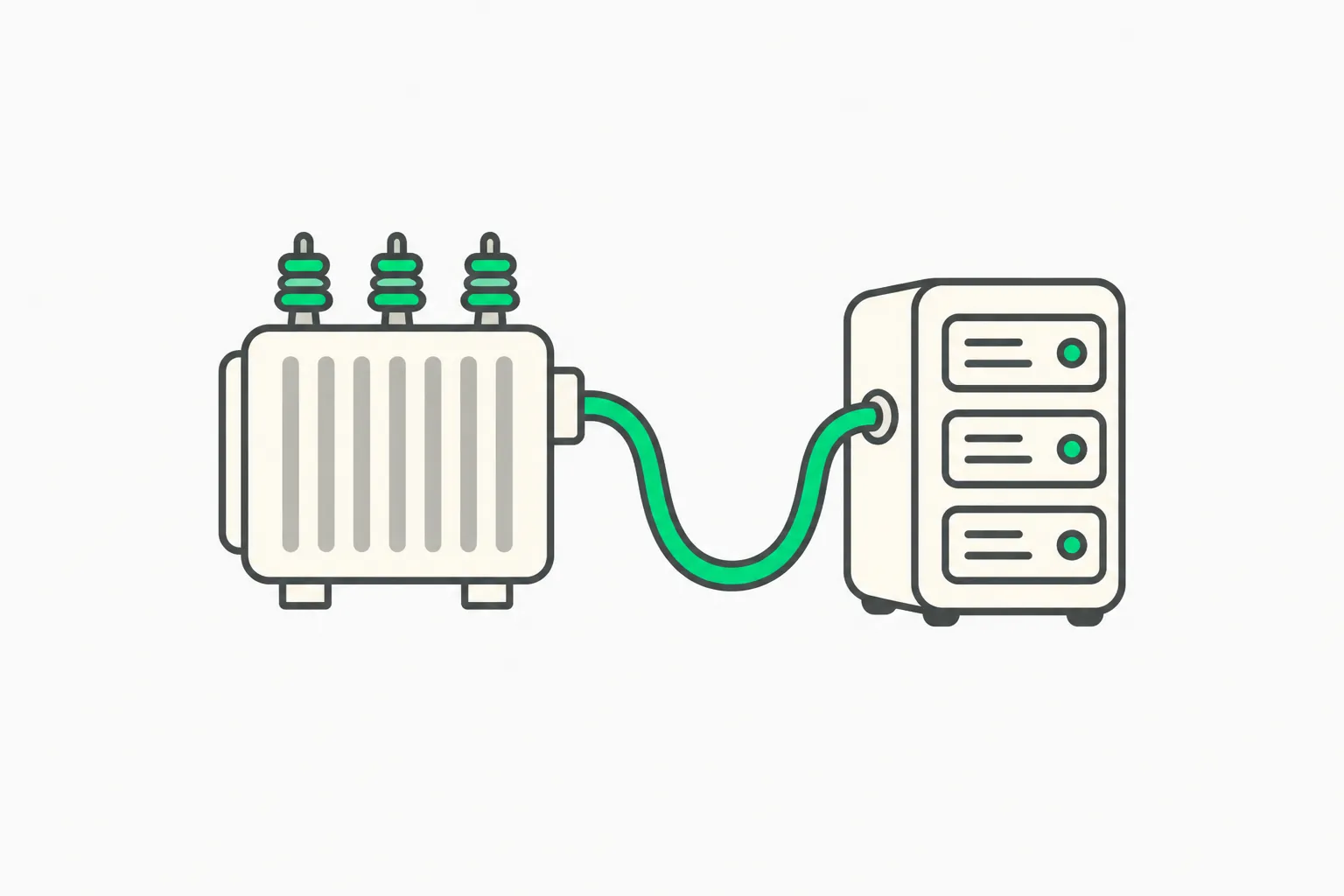 Small server cabinet linked to a transformer, illustrating grid power demand behind large AI data centers
Reuters also notes Microsoft, Amazon, and Google parent Alphabet have reported rising emissions linked partly to AI buildouts, raising questions about long-term corporate climate goals. Amazon told Reuters its AI products are comparatively sustainable because of renewable purchases and efficiency work. Microsoft and Google did not comment for the piece, according to Reuters.
How NGOs are trying to shrink their own AI bill
The organizations Volcovici quotes are experimenting with operational guardrails, not just press releases.
World Resources Institute uses AI to accelerate climate and environmental analysis but told Reuters it limits heavy generative image and video workloads and caches identical queries so the same prompt is not re-run through a remote model farm.
Nature Conservancy analyzes video from commercial fishing vessels to estimate catch composition. Rather than uploading massive video libraries to centralized data centers, senior scientist Vienna Saccomanno said the group installed on-vessel AI cameras that process footage at the edge—trading engineering complexity for lower transfer energy and carbon.
That edge pattern rhymes with themes in our Let's Encrypt confidential-computing GPU roadmap piece, where operators discuss pushing trust and compute closer to devices, even though the conservation use case here is about bytes moved, not TLS certificates.
 Compact edge sensor housing with a green core, matching on-vessel AI cameras that cut cloud uploads for conservation video
Greenpeace International said it uses some AI mainly because software platforms already embed it. Campaigner Katrin Xueying Wu drew a sharper line: while peers ask how to use AI responsibly, Greenpeace asks whether society should build all the massive data centers in the first place—a position that matches the group's visible opposition to hyperscaler expansion covered in our European data-center protest reporting.
BirdLife International chief scientist Stuart Butchart took the opposite emphasis: if AI helps protect the planet with limited budgets, ignoring it is dereliction. That quote captures the internal NGO split better than a simple "pro" or "anti" label.
Weather and wildlife AI are the same toolchain
Conservation groups are not inventing a separate AI stack. They sit on the same satellite, computer-vision, and language pipelines industrial labs sell for other markets.
When Save the Elephants cites Nvidia GeForce training for survey models, it connects to the open weather and nowcasting lineage we tracked in NVIDIA StormScope EU: geospatial tensors, time series, and batch inference on GPUs. The NGO version just optimizes for counting animals instead of cloud motion.
When Conservation International routes fire hotspots to patrols, the workflow resembles public-sector hazard platforms: ingest remote sensing, score risk, push actionable alerts to people in the field. Readers building similar pipelines should study latency, false-positive rates, and human override—the Jane Goodall Institute's insistence on human-centered tooling is an explicit design requirement, not a slogan.
Policy: COP31 and disclosure pressure
Reuters ties the NGO dilemma to COP31, hosted by Turkey in November 2026, where organizers plan to collect signatures on principles for sustainable AI development and deployment. Volcovici also notes UN Secretary-General Antonio Guterres wants large AI companies to disclose environmental impacts of their systems.
That push parallels transparency fights on the infrastructure side—communities asking hyperscalers to publish water and power contracts, not only corporate net-zero pledges. Our Amazon NDA rollback coverage shows how secrecy around siting feeds opposition even when global statistics look modest.
Nothing in the Reuters piece suggests COP31 will settle the tradeoff. It does suggest conservation groups will arrive with case studies (Cambodia fires, Kenya surveys, Gombe notes) and infrastructure warnings (IEA and UNU figures) in the same briefing book.
What builders and donors should ask
If you fund or deploy conservation AI, Volcovici's reporting implies a short checklist:
- Task fit — Is the model doing work that was previously impossible at needed speed (fire alerts, 200k-image surveys), or is it replacing a spreadsheet?
- Inference location — Can edge or cached inference avoid repeated cross-datacenter transfers, as Nature Conservancy and WRI described?
- Vendor emissions claims — Amazon answered Reuters; other hyperscalers declined. Treat absent disclosure as an open item.
- Accuracy audits — Save the Elephants' comparison between human and ML counts is a template: measure error before scaling budgets.
- Political alignment — Greenpeace and BirdLife show two valid strategies: resist buildout versus adopt tools to meet mission faster.
For readers focused on grid impacts rather than field biology, keep the data-center math post handy when translating NGO statements into megawatt terms local officials understand.
What is verified versus what is projection
| Claim | Status |
|---|---|
| 15 NGOs interviewed; all use AI and worry about data centers | Attributed to Reuters reporting, Nov 8 2026 |
| Conservation International Cambodia fire alerts | Quoted program description in Reuters |
| Save the Elephants survey timeline and miss rates | Quoted CEO Frank Pope in Reuters |
| Jane Goodall digitization timeline (13–15 years to ~2 years) | Quoted Lilian Pintea in Reuters |
| IEA / UNU 2030 electricity, water, footprint figures | Cited by Reuters; confirm against IEA primary charts before citing in filings |
| Microsoft / Google comments | Reuters says no response for those companies |
| COP31 Turkey sustainable-AI pledge | Described by Reuters as expected focus; signatories not yet listed in this article |
Update (November 8, 2026): Argentina's opposite pitch
While NGOs warn about data-center power and water, Argentina's government is marketing Patagonia as a lightly regulated AI campus zone with tax breaks for billion-dollar builds. See Milei and Patagonia AI data centers for what AP and Euronews report on stalled Senate incentives and local protests.
Related reading
- Data-center water and power: global stats versus local fights
- Amsterdam moratorium and European data-center politics
- NVIDIA StormScope EU and open weather nowcasting
- Wind-powered AI campus reporting in Inner Mongolia
- Protests and policing at a Microsoft data-center site
Figures and organizational quotes reflect Reuters reporting as of November 8, 2026. Primary energy statistics should be checked against current International Energy Agency publications before use in compliance or procurement documents.