



Update — October 2, 2026: Project Suncatcher's four-TPU prototype launched on Transporter-18; contact confirmed. Still a survival test, not a grid substitute. Launch details · How the cooling actually works. Update — September 25, 2026: Google's space-compute test, Project Suncatcher, launches next. See Project Suncatcher.
TL;DR — the numbers vs the fight
| Question | Global / national reality | Local reality |
|---|---|---|
| Electricity share? | ~1.5% world (2024, IEA); ~4.4% US (2023, LBNL/ELI) | 10–20%+ in clustered markets (e.g. Ireland, several US states) |
| Water share? | ~0.3% US public supply direct (2023, LBNL via AEI/Deseret); ~0.5% cited for industrial water globally (industry comms) | One campus can be 25%+ of a small town’s supply |
| Is opposition “irrational”? | National aggregates are small vs agriculture (~70% freshwater) | Aquifer, noise, bills, jobs are rational local concerns |
| Is AI the whole story? | AI was ~15–20% of DC power in 2024, rising fast (PMC/IEA synthesis) | Protest often proxies AI anxiety + wealth concentration, not cooling math alone |
Social feeds in June 2026 framed data-center fights as PR failures by frontier labs. That may be partly true—but it skips the metering problem: percentages that sound tiny nationally can still break a county.
This post is the sourced middle: what data centers actually consume, where 0.5% water comes from, and why both “we’re not drying the planet” and “not in my aquifer” can be correct.
Electricity: small globally, huge locally
 Data center environmental impact diagram: mostly-empty national electricity and water gauges beside an overflowing local droplet
Global and US totals
The IEA Energy and AI report (2025) puts 2024 global data center electricity at ~415 TWh—about 1.5% of world demand. Growth has run ~12% per year, faster than total grid growth.
Base case 2030: ~945 TWh, just under 3% of global electricity—still not a majority, but four times faster than economy-wide demand growth.
In the United States:
- ~176 TWh in 2023 → ~4.4% of US electricity (Environmental Law Institute fact sheet, citing Lawrence Berkeley National Laboratory)
- Projected 6.7–12% of US electricity by 2028 (LBNL range, same source)
Where “1.5%” misleads
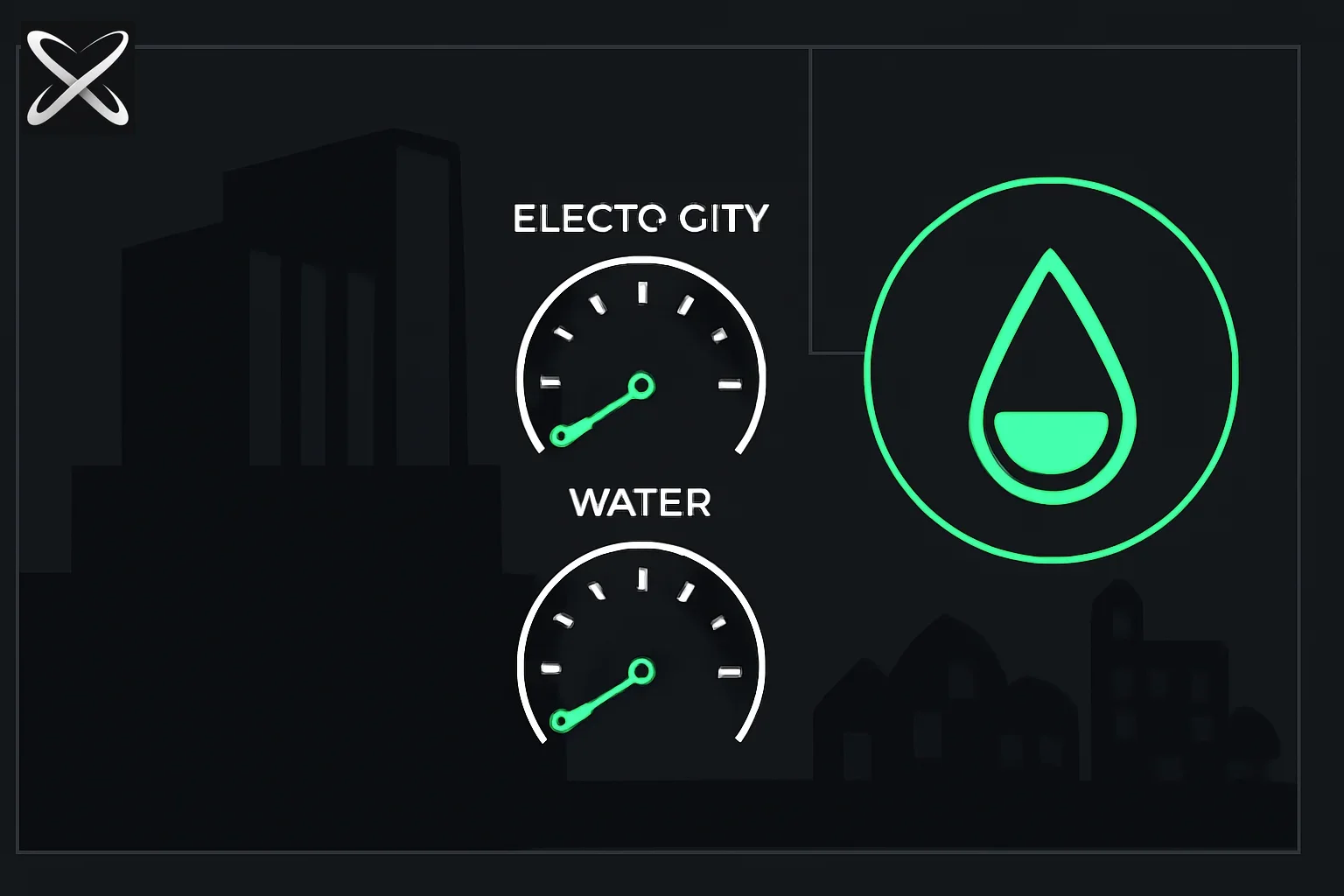
Data centers cluster. The IEA notes nearly half of US capacity sits in five regional clusters. Ireland has reported >20% of national electricity going to data centers. Five US states already exceed 10% sector share per IEA commentary.
So when someone says “it’s only 1.5% globally” to a county facing a 400 MW substation upgrade, they are talking past the room.
AI-specific load: peer-reviewed work synthesizing IEA data estimates AI systems were ~15–20% of data center power in 2024, with potential to approach half of data center demand by 2025 given manufacturing ramp—meaning AI is the growth vector, even if legacy cloud still dominates today (PMC, 2025).
Water: the 0.5% claim, debunked and contextualized
Where “0.5%” appears
Cloud providers have cited ~0.5% of global industrial water use for the data center sector—not 0.5% of all freshwater on Earth, not 0.5% of household use. The denominator matters.
US public supply: ~0.3%, not 5%
Lawrence Berkeley National Laboratory estimates:
| Metric | US 2023 (approx.) |
|---|---|
| Direct onsite water (cooling) | ~66 billion liters (~17.5 billion gallons) |
| Indirect water (from electricity generation) | ~800 billion liters |
| Direct as share of US public supply | ~0.3% (AEI summary of LBNL) |
Even if direct use quadruples by 2030, national share might still land near ~1% of US withdrawals—AEI’s “rounding error” framing for national totals.
Global IEA-style totals (direct + indirect)
For 2023, IEA-linked research totals ~560 billion liters globally:
- ~two-thirds indirect (power plants)
- ~one-quarter direct onsite cooling
- ~8% hardware manufacturing (often excluded from “operational” debates)
UN-affiliated reporting in June 2026 cited ~4.5 trillion liters consumed by data centers in 2025, projecting ~9.3 trillion by 2030—higher than IEA 2023 because definitions, AI load, and inclusion rules differ (Business Times summary of UN-affiliated researchers).
Takeaway: There is no single sacred percentage. Comparing 0.5% industrial to 4.5 trillion liters without labels is how both sides win Twitter and lose policy.
Direct vs indirect: why “one bottle per prompt” was wrong
Most viral per-query water estimates bundled:
- Direct — evaporative cooling at the campus
- Indirect — water consumed generating electricity (coal/gas/nuclear/hydro vary wildly)
Journalism corrections in 2025–2026 (Undark, Deseret News) note updated EcoLogits-class estimates of roughly 0.2–2 mL direct and 1–10 mL total per prompt—orders of magnitude below early “full bottle” headlines.
Grid mix dominates indirect water: the same PMC study notes US hyperscaler regions can range from ~0.68 to ~11.98 liters per kWh water intensity depending on whether power is hydro-heavy or thermal-heavy.
So: not a bottle every chat—but not zero, either, and not evenly distributed across the planet.
Local impacts residents actually measure
Opposition is rarely spreadsheet-driven. Common documented local issues:
| Concern | Mechanism |
|---|---|
| Aquifer stress | Evaporative cooling in drought counties; ~40% of new US builds since 2022 in water-stressed areas (ELI/LBNL) |
| Municipal supply | Examples of one operator >25% of a small city’s water (KETOS industry review) |
| Noise / light | 24/7 industrial hum, glare—quality-of-life (often underweighted in national reports) |
| Grid cost shift | Transmission upgrades; debate over who pays (Brookings on AI energy regulation) |
| Property values | Anecdotal and lawsuit-driven; hard to nationalize |
| Jobs | Construction boom vs long-run automation fear—AI anxiety attaches to the building |
Chile, Arizona, Oregon, Box Elder County Utah—local fights make sense even when US agriculture still dwarfs sector water nationally.
Water is local. Electricity is local. Global percentages are true and insufficient.
Why data centers became a proxy fight
June 2026 discourse often conflated:
- Infrastructure permitting (zoning, water rights, NIMBY)
- AI labor displacement (creative unions, coders, call centers)
- Concentration of AI wealth (hyperscaler margins vs stagnant wages)
- Trust in tech leadership (export controls, gated models—see Mythos trusted partners)
When a 500 MW campus is the most visible capital expenditure in a decade, it absorbs every grievance about AI—even though training runs, inference elsewhere, and your phone’s ChatGPT share the blame.
That does not make protesters “anti-progress.” It means energy literacy and community benefit agreements are now cost of business for anyone scaling frontier inference—not optional PR tours about “benefits of AI.”
What actually reduces impact (per token and per town)
Operator-side
- Closed-loop / liquid / immersion cooling → lower direct water, sometimes higher electricity
- Reclaimed greywater instead of potable
- Siting in wet climates vs Phoenix exurbs
- Efficiency — IEA High Efficiency Case saves >15% electricity by 2035 vs base
User-side (individuals and companies)
- Smaller open models for bulk work (individual open-source guide)
- Regional self-host to avoid shipping every token to Arizona (business guide)
- Hybrid routing — don’t burn frontier GPU for tasks Qwen3 32B handles
Broader climate trade-offs: AI and climate change paradox.
How to read the next headline
When you see a stat, ask:
- Direct or indirect water?
- National, global, or one county?
- 2023 baseline or 2030 AI boom projection?
- Evaporative or air-cooled site?
- Does it include hydro reservoir evaporation? (inflates some viral totals)
Red flag: Any claim that sounds like data centers use most of Earth’s water—they do not. Green flag: Any claim that a specific town will measurably change rates, noise, or aquifer draw—that can be true and worth EIS scrutiny.
Track the projects, contracts, taxes, and cases
For current project-level evidence, use the AI data center backlash map to separate blocks from normal delays, the hyperscaler nuclear-deal table to separate PPAs from options, and Virginia's power-tax analysis to follow facility cost into cloud pricing. The model-selection energy guide covers workload-side efficiency, while the Amazon and Imperial Valley water-litigation tracker distinguishes allegations, settlements, denials, and active cases.
Update — July 30, 2026: CapEx is also a labor story — AI firms hiring electricians and carpenters by the thousands.
Update — August 16, 2026: One startup turning data-center load into a grid asset instead of pure strain — Emerald AI, in our Top 10 AI + Climate Tech Startups list.
Update — September 1, 2026: California lawmakers sent multiple data center bills to Governor Newsom — fair-share utility costs (SB 1168), energy reporting (AB 1577), and a Padilla-Zbur rate compromise amid Big Tech lobbying. Full breakdown: California data center AI infrastructure bills.
Update — September 3, 2026: A viral claim attributed to Sam Altman — one California almond uses more water than 38,000 ChatGPT queries — checks out arithmetically against the per-prompt figures cited above, but dodges the local-concentration question this post is actually about: fact-checking the Altman almond-water comparison.
Update — September 3, 2026: On the supply side, India's first private tokamak went live — worth reading for the control-systems angle, not as an answer to this decade's load curve.
Bottom line
Globally: Data centers are ~1.5% of electricity today, heading toward ~3% by 2030 (IEA)— meaningful growth, not yet the majority of the grid. US water direct use is ~0.3% of public supply, with ~0.5% industrial cited only in narrow denominators—not “half a percent of all water on Earth.”
Locally: Clustered power load, evaporative cooling in deserts, and AI-linked economic fear make fights intense and rational even when national pie charts look small.
Policy that works talks about aquifers and decibel limits, not global averages alone. Tech that works shrinks tokens (efficiency, open models, local inference) instead of assuming infinite permission to build.
Related update — October 6, 2026: Google and Constellation: 890 MW of nuclear uprates.
Figures sourced from IEA, Lawrence Berkeley National Laboratory / ELI (Jan 2026), Brookings, AEI, PMC peer-reviewed synthesis, and UN-affiliated 2026 projections as cited. Percentages shift with methodology—recheck primary sources before citing in filings.
Update — October 9, 2026: New coverage — San Francisco's data center moratorium will study energy, water and air impacts.