



ElevenLabs shipped Scribe v3 for batch transcription and Scribe v3 Live for realtime audio on November 10, 2026, cutting reported word errors versus v2 and adding conversational turn detection so voice agents stop treating mid-sentence pauses as hang-ups.
For builders, the release matters because downstream products inherit upstream transcript mistakes. A wrong digit in a support call breaks authentication. A mislabeled speaker ruins meeting notes. A silence timer that fires too soon makes an agent feel rude. ElevenLabs is attacking all three failure modes in one launch while keeping the model ID swap small for existing ElevenAPI integrators.
TL;DR: models and migration
| Model | Use case | Claimed gain vs v2 |
|---|---|---|
| Scribe v3 | Recorded audio, 102 languages | 27% fewer WER on internal FLEURS variant |
| Scribe v3 Live | Realtime streams and agents | 43% lower semantic WER vs v2 Realtime |
| ElevenAgents | Productized voice agents | v3 Live default; turn prediction built in |
| ElevenAPI | Your app | Change model ID to scribe_v3 or scribe_v3_live |
What ElevenLabs announced
The company blog post frames Scribe as infrastructure for meeting notes, clinical documentation, dubbing pipelines, and voice agents. Real-world audio includes crosstalk, street noise, code-switching, and callers who slow down to read account numbers. Prior models forced teams to choose accuracy or latency; ElevenLabs claims v3 narrows both gaps.
Batch Scribe v3 targets offline files with improved speaker diarization, especially when three or more speakers overlap. The vendor says diarization errors drop 17% versus v2 on those crowded recordings and that v3 beats other batch models ElevenLabs tested on shared languages.
Scribe v3 Live is the streaming sibling. It adds realtime diarization for the first time in the Scribe line, reports 39% fewer diarization errors than the next-best realtime model in ElevenLabs internal tests, and introduces turn detection that reads conversational context, not only silence.
Enterprise packaging repeats familiar ElevenLabs options: default US processing, optional EU, India, Singapore isolated environments, Zero Retention Mode, and SOC 2, ISO 27001, PCI DSS Level 1 coverage with HIPAA eligibility under a BAA.
Turn detection and why agents cared
Classic voice stacks treat end-of-turn as no audio for N milliseconds. Short thresholds barge in on thoughtful callers. Long thresholds feel sluggish. ElevenLabs says Scribe v3 Live already powered ElevenAgents with a predictor that notices a caller pausing mid-number and waits.
The blog exposes that mechanism to API users via commitStrategy: "turn_prediction" in the JavaScript client example. That is the hook for teams building phone tree authentication, medical intake, or banking IVR flows where pauses are informative, not terminal.
If you run agents on other speech APIs, compare your barge-in curves after swapping models. explainx.ai tracked similar trade-offs when Meta Muse Voice Transcribe and Microsoft MAI Transcribe 2 fought for streaming word-error crowns. Scribe v3 Live enters that race with semantic WER emphasis, counting an error only when meaning changes, which matters because streaming formatters disagree on punctuation mid-utterance.
Benchmarks ElevenLabs published
ElevenLabs evaluated on:
- An internal FLEURS variant for 102 languages of short read speech.
- A proprietary 16-language dataset of meetings, agent calls, and voice notes for diarization and messy audio.
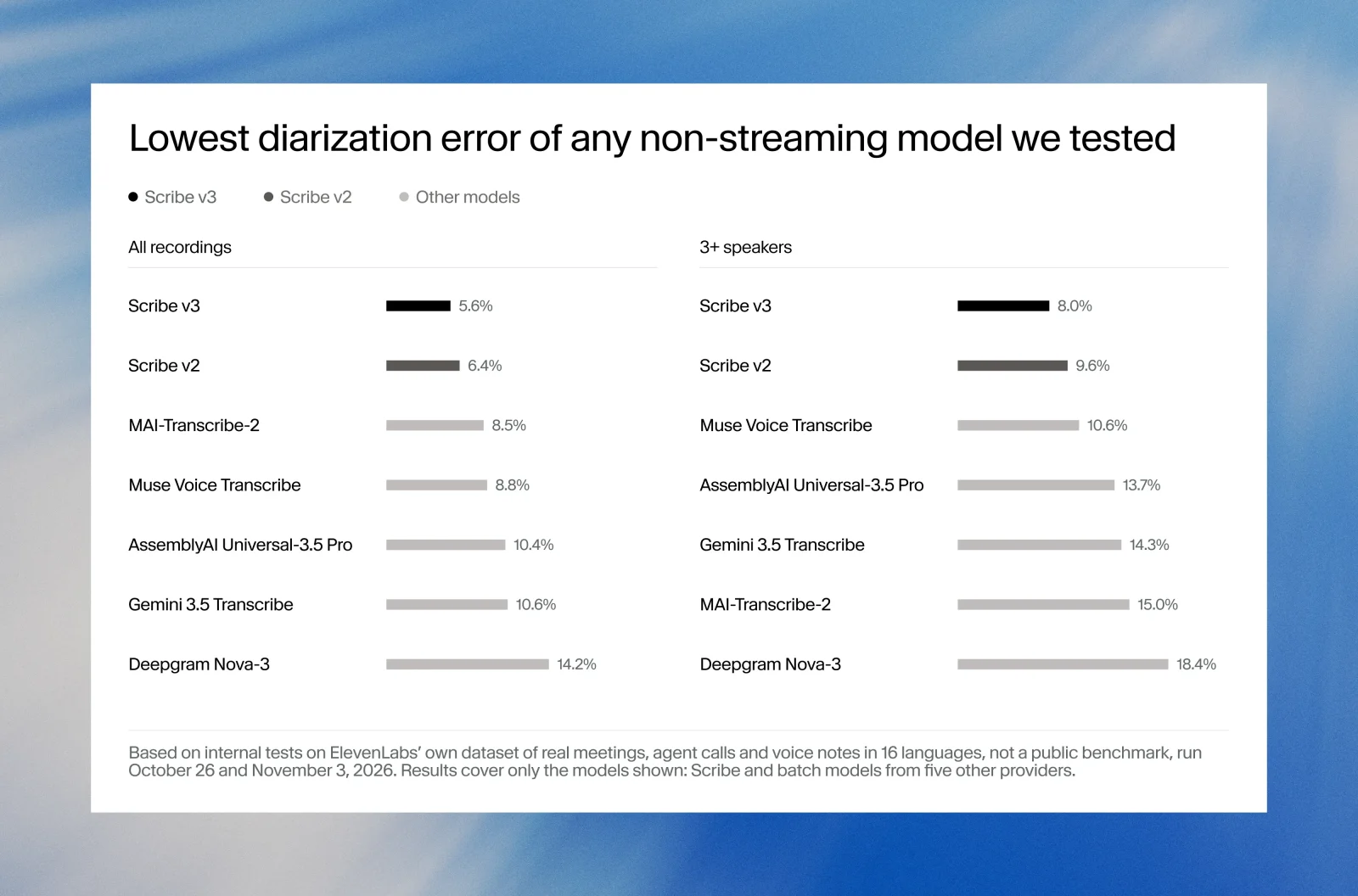 ElevenLabs Scribe v3 diarization error rate chart versus competing speech-to-text models
Image: ElevenLabs
Batch accuracy highlights
Vendor figures, not independent certification:
- German WER down 42%, Spanish 35%, English 23% versus v2 on FLEURS.
- Harder languages also move: Swahili -34%, Tamil -29%, Thai -28% versus v2.
- ElevenLabs says Scribe v3 beats every other batch model tested on overlapping languages.
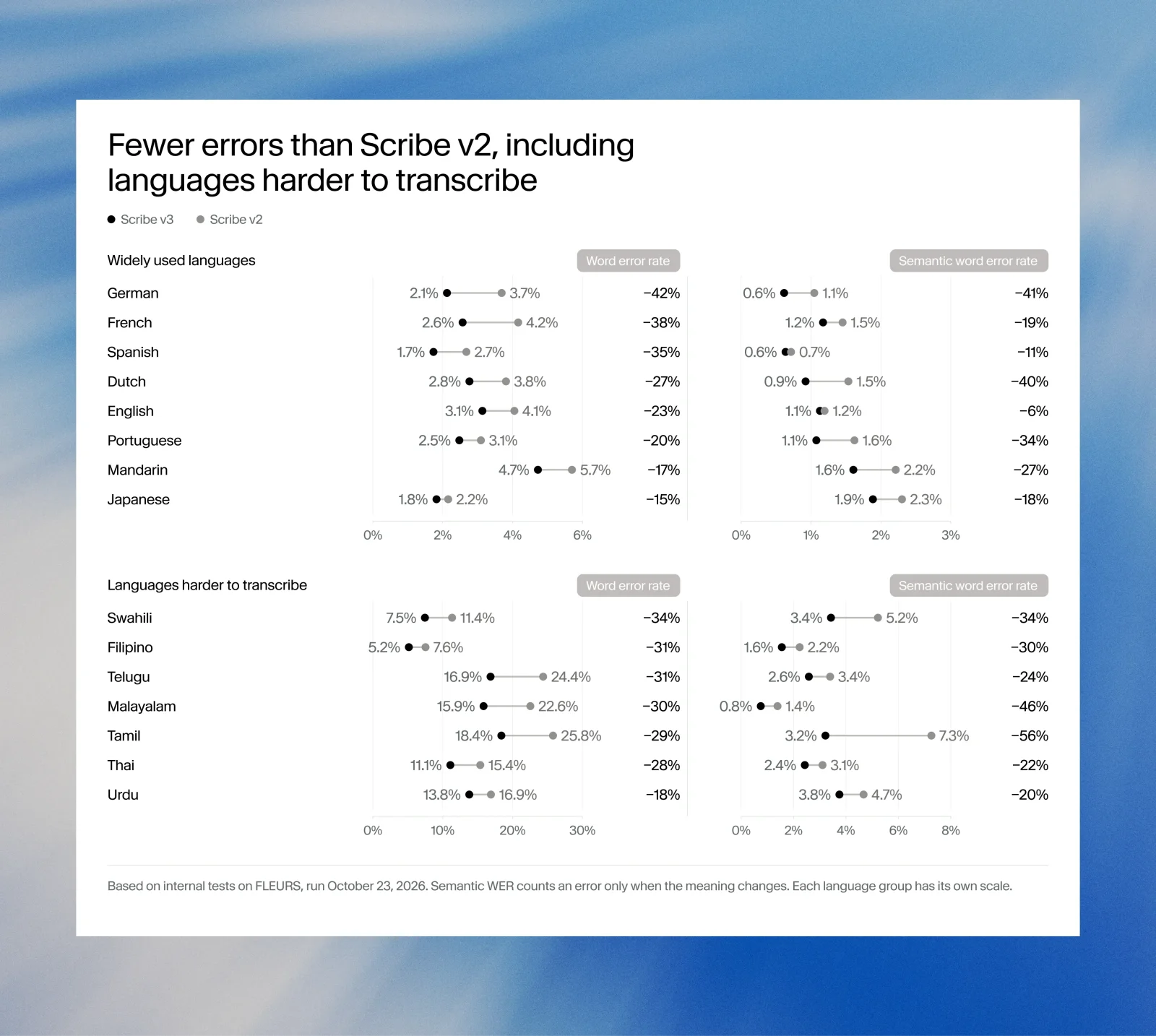 Scribe v3 word error rate improvements across languages versus Scribe v2
Image: ElevenLabs
Realtime and diarization
On the English slice of the messy dataset, Scribe v3 Live reports 3.1% diarization error after aligning words to references, versus 5.9% to 7.3% for other realtime models in the chart. ElevenLabs warns those aligned scores are not comparable to batch diarization tables because streaming models drop more words upfront.
For semantic WER across 102 languages, v3 Live claims 43% improvement versus v2 Realtime, with large jumps called out in Greek, Danish, Croatian, and Hindi.
Secondary outlets such as The Decoder note Artificial Analysis leaderboard checks showing Scribe v3 narrowly ahead on accuracy while some rivals remain faster and cheaper. Treat that as a shopping hint, not a universal price table, because ASR pricing shifts with region and commitment tiers.
Developer features beyond raw WER
Keyterm prompting accepts up to 1,000 terms so brand names and drug strings survive noisy audio. Keyterm library scales larger vocabularies the model consults on likely acoustic matches. Multilingual mode on v3 Live handles mid-sentence language switches, a pain point for India-centric contact centers ElevenLabs names explicitly.
Transcript edits accept plain-English formatting rules such as forcing YYYY-MM-DD dates. Number formatting toggles digits versus words. These sound cosmetic, but they reduce post-processing glue code in analytics pipelines.
Code and deployment path
Migration is intentionally boring: swap model IDs in existing ElevenAPI integrations. The blog snippet:
modelId: "scribe_v3_live"
commitStrategy: "turn_prediction"
For healthcare, ElevenLabs also mentions a medical-optimized v3 Live variant inside ElevenAgents, separate from the general API defaults.
If you already run Hugging Face speech-to-speech agents or browser Whisper via Transformers.js, Scribe is the managed accuracy tier when you do not want to host weights. If you need on-prem, ElevenLabs repeats private deployment availability.
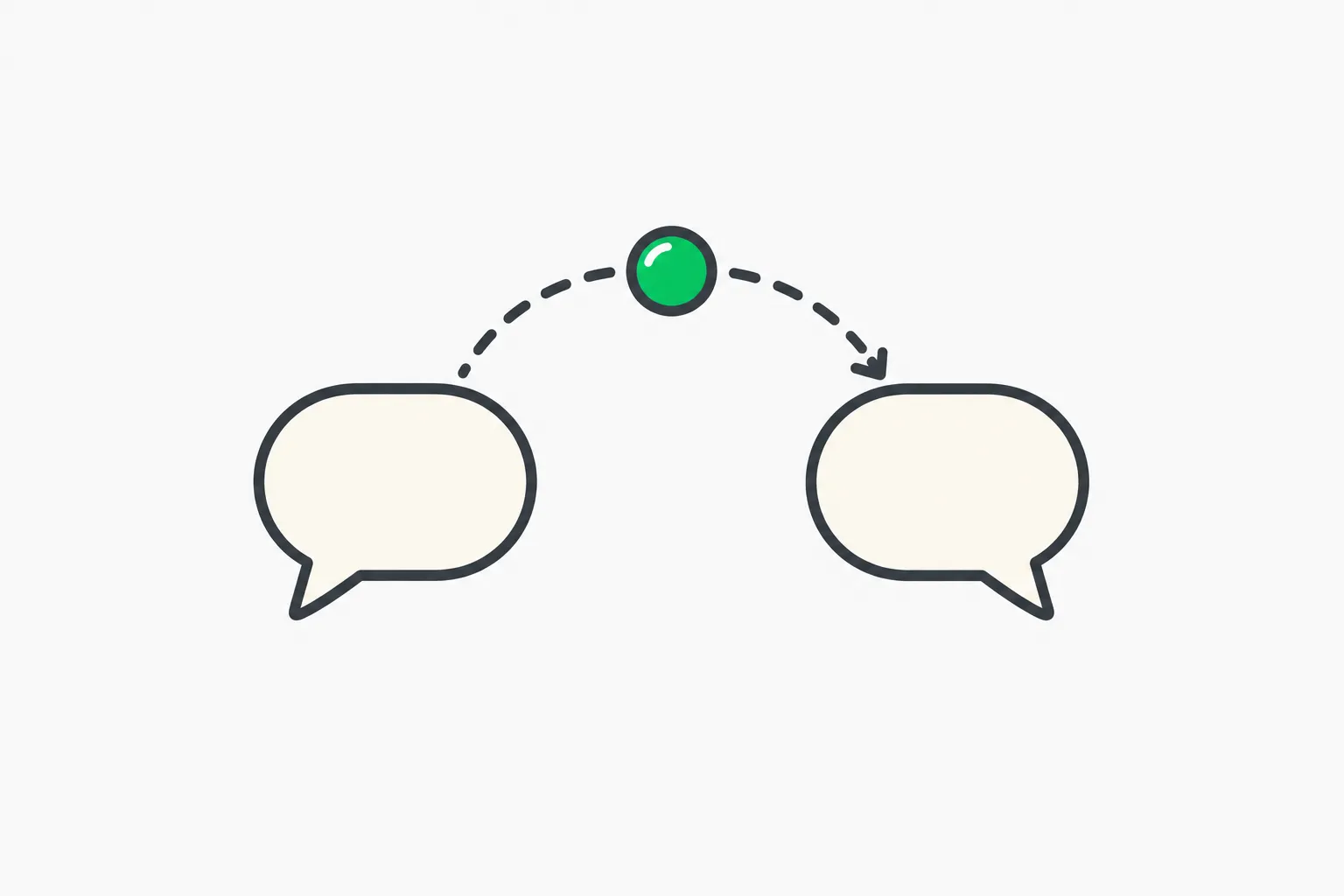 Speech turn-taking diagram illustrating ElevenLabs Scribe v3 Live conversational pause detection
Customer proof point: Eneco
ElevenLabs quotes Dutch utility Eneco, which serves two million homes and businesses, testing v3 Live on a production voice agent. Reported gains: 40% more correct Dutch postcodes on first try and 15% better house numbers. That is the kind of task-specific delta worth reproducing on your own holdout set rather than trusting headline percentages alone.
Corporate context: Nvidia and summits
Nvidia is an ElevenLabs investor, but Jensen Huang canceled the ElevenLabs Summit in New York on November 9 amid governance probes, as explainx.ai covered in Huang skips the summit. Huang resigned as Nvidia CEO on November 12 per Nvidia newsroom. None of that changes API model IDs, but it explains why investor stage time vanished while product launches continued.
Pricing and speed context builders should know
ElevenLabs did not publish a fresh per-minute table inside the November 10 blog post we fetched. For budgeting, compare against numbers explainx.ai already verified elsewhere:
| Service | Published streaming rate (approx.) | Notes |
|---|---|---|
| ElevenLabs Scribe v2 Realtime | $6.50 per 1,000 minutes | From MAI Transcribe comparison |
| Microsoft MAI streaming | $9.00 per 1,000 minutes | Same post; higher WER on some AA charts |
| OpenAI GPT live transcribe | ~$0.006–0.009 per minute band | See July transcribe launch |
Secondary summaries say Scribe v3 beats rivals on accuracy while Microsoft and xAI streams remain faster and roughly half the price in Artificial Analysis fixtures relayed by The Decoder. That trade is familiar: contact centers optimizing first-call resolution may pay for Scribe; high-volume IVR that only needs intent buckets may stay on cheaper streams.
ElevenLabs also argues qualitatively that error cost dominates sticker price. A one-hour meeting at 150 words per minute is about 9,000 words. Moving from 4% to 2% WER is 180 wrong words, or three per minute. Diarization error is measured in seconds of mis-attributed speech; each point is 36 seconds in the blog arithmetic. Use that framing when CFOs ask why you are not picking the cheapest ASR on the leaderboard.
India, code-switching, and enterprise residency
The launch post names India explicitly: customers wanted Hindi to match English when callers switch mid-sentence. Multilingual mode on v3 Live targets that failure mode, which also shows up in Otter 31-language expansion and in Gemini transcribe marketing.
For regulated buyers, repeat the November checklist:
- Isolated environments in EU, India, Singapore upon contract.
- Zero Retention Mode when you cannot store audio or text at rest.
- HIPAA BAA path for clinical documentation pilots.
- Private deployment when air-gapped hospitals or banks forbid shared SaaS.
Pair those controls with your own red-team recordings: accented digits, speaker overlap, and hold-music bleed remain where vendors inflate benchmark gains.
Understanding engine versus weights
If you are teaching speech pipelines, map Scribe v3 features to classical ASR components:
- Acoustic model (neural, undisclosed architecture) outputs tokens.
- Diarization head assigns speaker labels per frame cluster.
- Turn predictor consumes text context plus audio for commit decisions.
- Formatting layer applies keyterms and plain-English post rules.
That stack is why a one-line model ID change still forces QA: you are swapping steps 1–3 together, not dropping in a new tokenizer.
What to test before you switch
-
Latency budget. Vendor charts emphasize accuracy; measure time-to-final-token on your telecom audio.
-
Cost per minute. Compare v3 Live against OpenAI GPT live transcribe, Gemini transcribe tiers, and Grok voice ASR claims on identical clips.
-
Diarization on your rooms. Three-speaker meeting audio is where ElevenLabs claims the largest diarization gap.
-
Turn prediction on IVR digits. Replay recordings where callers pause on credit-card spans; count false commits.
-
Data residency. Pick region isolated environments if GDPR or India DPDP rules apply.
Related reading
- Meta Muse Voice Transcribe realtime launch
- Microsoft MAI Transcribe 2 streaming WER
- OpenAI GPT Live Transcribe and GPT-Transcribe
- Hugging Face speech-to-speech agent guide
- Huang cancels ElevenLabs Summit
- Otter.ai multilingual transcription expansion
Primary sources: ElevenLabs Scribe v3 announcement, November 10, 2026; ElevenLabs API reference for speech-to-text; The Decoder summary citing Artificial Analysis, November 12, 2026.