



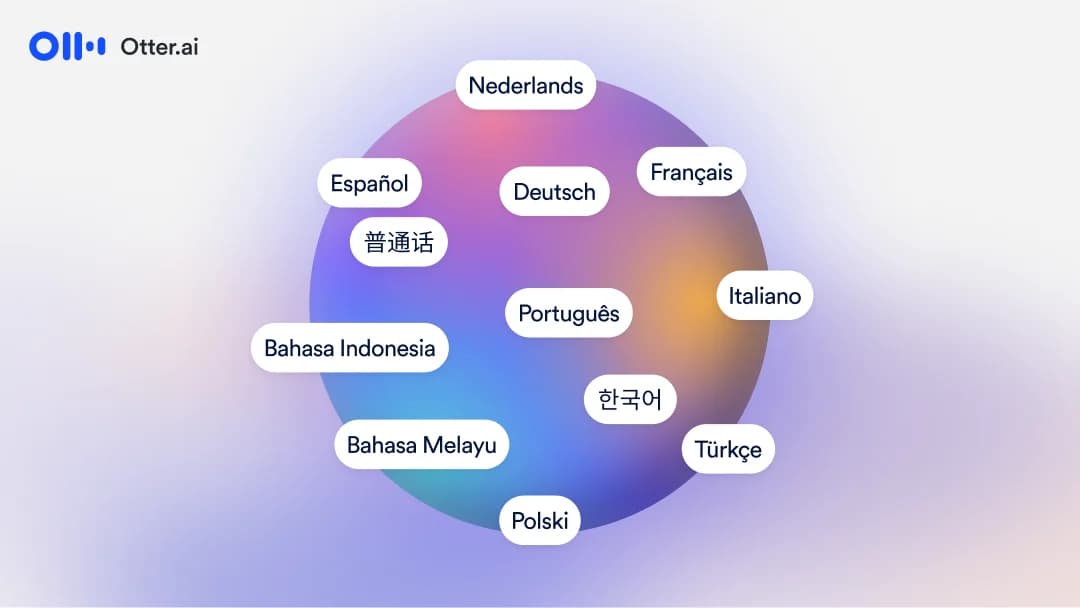
Otter.ai used Web Summit Lisbon on November 10, 2026 to announce its largest language expansion: 27 new languages, with 13 available immediately and 14 labeled coming soon, on top of the four it already shipped (English, French, Spanish, and Japanese). When the rollout completes, Otter plans 31 supported languages. The same official post previews multilingual transcription that keeps up when speakers code-switch inside one call.
For distributed teams, the change matters because Otter is not only adding locale flags in settings. It is wiring summaries, action items, AI Chat, speaker ID, search, and Work Mode follow-ups through the same language stack, so post-meeting artifacts stay in the language the meeting actually used.
TL;DR
| Question | Answer |
|---|---|
| Announcement date | November 10, 2026 (Web Summit Lisbon) |
| New languages | 27 added; 13 live now, 14 soon |
| Total at completion | 31 |
| Code-switching | Coming soon — auto-follow language changes mid-call |
| Extra fee? | No on existing Otter plans (per announcement) |
| Stack | In-house speech models on Otter infrastructure |
| English benchmark cited | ~96% accuracy on Open ASR Leaderboard (Otter claim) |
What Otter shipped on day one
Otter frames the rollout as a response to collaboration friction: its announcement cites Capterra's 2024 Collaboration and Productivity Survey finding 42% of international knowledge workers named language barriers among top collaboration challenges.
The 13 languages available at launch are:
- Mandarin Chinese (Simplified)
- German
- Italian
- Cantonese
- Korean
- Portuguese (Brazil)
- Russian
- Indonesian
- Malay
- Dutch
- Turkish
- Vietnamese
- Polish
The 14 coming soon include Swedish, Danish, Finnish, Arabic, Hindi, Thai, Hebrew, Norwegian, Greek, Macedonian, Persian, Czech, Hungarian, and Romanian.
Users select a supported language in Otter settings. Otter says the expansion hits desktop and mobile clients without a separate SKU.
Multilingual transcription and code-switching
The headline feature still in flight is multilingual transcription: Otter says it will track conversations as speakers move between supported languages in real time, with no manual setting changes when someone switches from English to Korean mid-sentence.
 Speech translation bridge connecting multilingual meeting audio to Otter transcripts
The vendor example is a sales call that hops English to Portuguese to Mandarin and back. That pattern is common in APAC and LATAM enterprise teams but painful for classic single-locale ASR, which either locks one locale for the whole file or forces an operator to toggle language tracks.
This sits next to Otter's October 2026 meeting-agent refresh (Work Mode briefs, Live Assist coaching, follow-through to email and CRM). Our Cicada open-source subtitle guide shows how builders stitch on-device or BYO-key ASR for similar problems; Otter's pitch is that hosted models plus calendar workflow remove integration work for non-engineering teams.
In-house ASR versus API wrappers
Otter stresses ownership of the speech stack: training, tuning, and inference on its own infrastructure, not a thin client over a third-party speech API. It also repeats a long-standing promise that audio is not sent to third parties for processing, extended to each new language as it goes live.
On accuracy, Otter cites ~96% average accuracy on the Open ASR Leaderboard for English benchmark testing. Treat that as a vendor benchmark, not a guarantee for your accent, domain jargon, or noisy room.
If you need full control of where audio leaves the machine, compare:
- Meetily — privacy-first local transcription posture
- Kalypta anti-AI notetaker blocking — how some teams block bots entirely
- Cicada — system-audio capture without a bot joining Zoom
Otter remains the opposite bet: a cloud notetaker optimized for sharing, search, and CRM hooks, not air-gapped capture.
Workflow features that follow the language
Otter says new languages run through the entire meeting loop, not just raw transcript text:
- Work Mode before calls pulls prior conversations and connected apps into a brief
- Live summaries, action items, speaker ID, AI Chat, and search during the meeting
- Work Mode after turns conversation into follow-up email and CRM updates in the meeting's language
The announcement includes a product graphic of Work Mode prep, Live Assist during, and Salesforce-style follow-up after — useful context for RevOps buyers comparing Otter to semantic caching for LLM apps on self-hosted note pipelines.
Otter CEO Sam Liang is quoted saying international companies already use Otter across time zones and that in-house speech recognition enabled the rollout with accuracy and private audio handling.
How to try it and what to verify
If you already pay for Otter:
- Open Settings and pick one of the newly listed languages for your workspace.
- Run a short test call with a native speaker; compare transcript quality to your prior English-only baseline.
- Watch for the multilingual / code-switching toggle when Otter marks it generally available (announced as coming soon on November 10).
If you evaluate build-versus-buy:
- Map data-processing agreements for audio stored on Otter cloud versus a Home Assistant MCP or local Cicada path.
- For voice-agent prototypes, pair Otter's webhook or export flow with Confucius4 streaming ASR research only if you need custom on-prem inference; Otter is rarely the training substrate.
Pricing: Otter's post says no additional cost for languages on current plans. Enterprise SKUs with minute caps or HIPAA add-ons may still layer fees — confirm in your admin console.
Competitive landscape in November 2026
 Meeting notes and live transcription workflow for multilingual enterprise calls
| Approach | Strength | Weakness |
|---|---|---|
| Otter hosted | Calendar-native notes, 31-language roadmap, Work Mode | Cloud audio; less model choice |
| Cicada (open source) | Bot-free system audio; BYO LLM/ASR | You operate keys and updates |
| Zoom / Teams native captions | Built into the call room | Variable quality; weaker note intelligence |
| Medium TK MCP notebooks | Private library + Claude via MCP | Not a live meeting transcriber |
None of these remove the verification tax on AI meeting output. Our piece on AI slop and the workplace clarity taxonomy applies here too: multilingual transcripts can be fluent and still mis-attribute an action item.
Otter's expansion also lands beside AWS Quick Skills for agents — different layer (skills catalog versus meeting capture), but both target enterprises standardizing AI workflows in Q4 2026.
Language-by-language rollout notes for admins
The day-one thirteen cover large employee populations many enterprises already staff:
| Language | Typical enterprise use (examples) |
|---|---|
| Mandarin (Simplified) | APAC HQ calls, vendor reviews |
| Cantonese | Hong Kong and Guangdong operations |
| Korean | Semiconductor and consumer electronics supply chain |
| Japanese | Already supported pre-rollout; now part of 31-language story |
| German / Italian / Dutch / Polish | EU distributed teams |
| Portuguese (Brazil) | LATAM sales and support |
| Russian | Regional subsidiaries (check sanctions and data policy separately) |
| Indonesian / Malay / Vietnamese / Turkish | Southeast Asia manufacturing partners |
Coming-soon fourteen add Nordic, Arabic, Hindi, Hebrew, Persian, and several Central European languages. If your MDM policy whitelists apps by locale, stage a pilot workspace before pushing settings globally — Otter applies language at the user or workspace level per its help patterns.
Accuracy expectations: Otter's 96% English Open ASR Leaderboard claim does not automatically transfer. For regulated industries, run side-by-side human transcription on ten calls per locale before relying on Otter for audit logs.
Data processing and retention questions
Otter reiterates in-house processing and no third-party audio forwarding for the new locales. That statement governs speech, not necessarily derived text flowing into Salesforce, Slack, or Google Workspace via integrations you enable.
Checklist for security reviewers:
- Data Processing Agreement language on new regions storing transcripts.
- Whether Work Mode briefs pull PII from CRM into prompts shown to all attendees.
- Retention windows — multilingual search may keep non-English content longer than monolingual archives if indices rebuild.
Compare Medium TK private libraries with MCP when counsel wants no vendor cloud at all. Compare Cicada when engineers want on-prem Whisper or Qwen-ASR with Otter-like UX.
What people are asking
Will Russian or Mandarin quality match English? Otter claims per-language tuning but publishes only the English Open ASR Leaderboard figure in this announcement. Pilot your highest-risk locales before rolling workspace-wide.
Is code-switching live yet? As of the November 10 post it is coming soon, not day-one.
Does Otter translate or only transcribe? This launch is transcription and downstream notes in supported languages, not a replacement for human interpretation in regulated settings (medical, legal deposition). For regulated interpretation, keep human lanes.
How does this interact with AI notetaker bans? Some orgs block bots; others block only cloud bots. If your security team cares about data residency, compare Otter's processing statement to Notion AI transcript exposure incidents we covered elsewhere — different vendor, same class of risk question.
Related on explainx.ai
- Cicada: open-source live subtitles and notes
- Meetily: privacy-first local meeting transcription
- Semantic caching for LLM apps
- Confucius4 stable-prefix streaming ASR
- Zonder Labs clarity taxonomy for AI writing at work
- Daily journaling without pasting into AI
- AWS Quick Skills agents catalog
Sources: Otter.ai announcement, Otter press index.
Language lists, Work Mode features, and accuracy claims reflect Otter.ai's November 10, 2026 announcement.