



Google DeepMind has added a set of Cheminformatics Skills to Google Antigravity, and says an agent using them can go from a literature search to proposed drug-like molecules with synthesis routes in about an hour. The company published the walkthrough on November 3, 2026, in a post on its blog. It frames the work as a way to remove data wrangling from a chemist's day, and it is careful to say the output is a set of hypotheses rather than finished medicines.
The demo uses real lung cancer drugs. The agent starts from crizotinib, a first-generation kinase inhibitor, and lorlatinib, a third-generation drug that is a cyclized (ring-closed) relative of it. It then retrieves thousands of compounds, analyzes them, and proposes new rigidified macrocycles. This post explains what was shown, how the agent is built, what it cannot do, and how to try it.
TL;DR: the questions readers ask first
| Question | Short answer |
|---|---|
| What is new? | A suite of Cheminformatics Skills for Google Antigravity, announced November 3, 2026 |
| What does it run on? | RDKit, plus connectors to ChEMBL and PubChem |
| What did the demo do? | Mined literature, ran matched molecular pair analysis, trained potency models, proposed macrocycles with synthesis routes |
| How fast? | About an hour, per DeepMind. It says a manual iteration takes multiple days |
| Is it a drug? | No. DeepMind says designs are testable hypotheses that need synthesis and lab validation |
| Can I use it? | Yes. Install the Science plugin in the Antigravity app. Enterprise sign-in with Google Cloud works |
| Is it free? | 10,000 scientists can apply for the top usage tier free for six months, subject to selection |
What are Cheminformatics Skills in Antigravity?
A skill, in agent terms, is a packaged set of instructions and tools that an agent loads when a task needs it. If the idea is new to you, our explainer on agent skills covers the format. DeepMind's version bundles domain best practice for chemistry so the agent does not have to rediscover it on each run.
The post says the skills turn Antigravity into "a collaborative science workbench" with full access to local tooling, for both computational chemists and bench chemists. The Science plugin is the entry point. The skills are grounded in RDKit, the open-source cheminformatics toolkit built over about two decades by a global community. They also connect to curated public resources from ChEMBL and PubChem.
DeepMind describes a deliberate division of labor. The language model handles orchestration, database navigation and scientific reasoning. Deterministic chemistry tools execute the molecular calculations. This matters because in chemistry a single changed atom or bond describes a different compound. The post says the task has "no margin for error", so molecule handling is done by code, not by model recall.
This is the second Antigravity science walkthrough from DeepMind in about three weeks. In October the team showed the platform helping biologists shortlist a candidate bacteriocin, which we covered in DeepMind's Antigravity antimicrobial peptide post. The pattern is the same: a general agent platform, a domain plugin, and a worked example from a real disease area.
The demo: rigidifying a floppy molecule
The walkthrough centers on a classic medicinal chemistry move called rigidification. A drug molecule often links substructures through rotatable bonds. Those bonds let it twist into many 3D shapes. To bind a protein target, the molecule has to lock into one shape, and losing that freedom costs entropy, which weakens binding.
Chemists respond by adding a bond that ties the substructures together, which limits movement and can raise potency. DeepMind calls this "paying the entropic cost in advance". Crizotinib has five major rotatable bonds. Lorlatinib is cyclized at its end, which, per the post, reduces its effective rotatable bond count to zero and gives higher potency among other effects.
Step 1: curate the data
The team asks the agent to search literature for these drugs and their analogues. The agent extracts molecules from documents, links each one to the data reported, and prepares them for analysis. Within minutes it retrieves thousands of compounds, removes irrelevant ones such as buffers and solvents, and writes a report that documents sources.
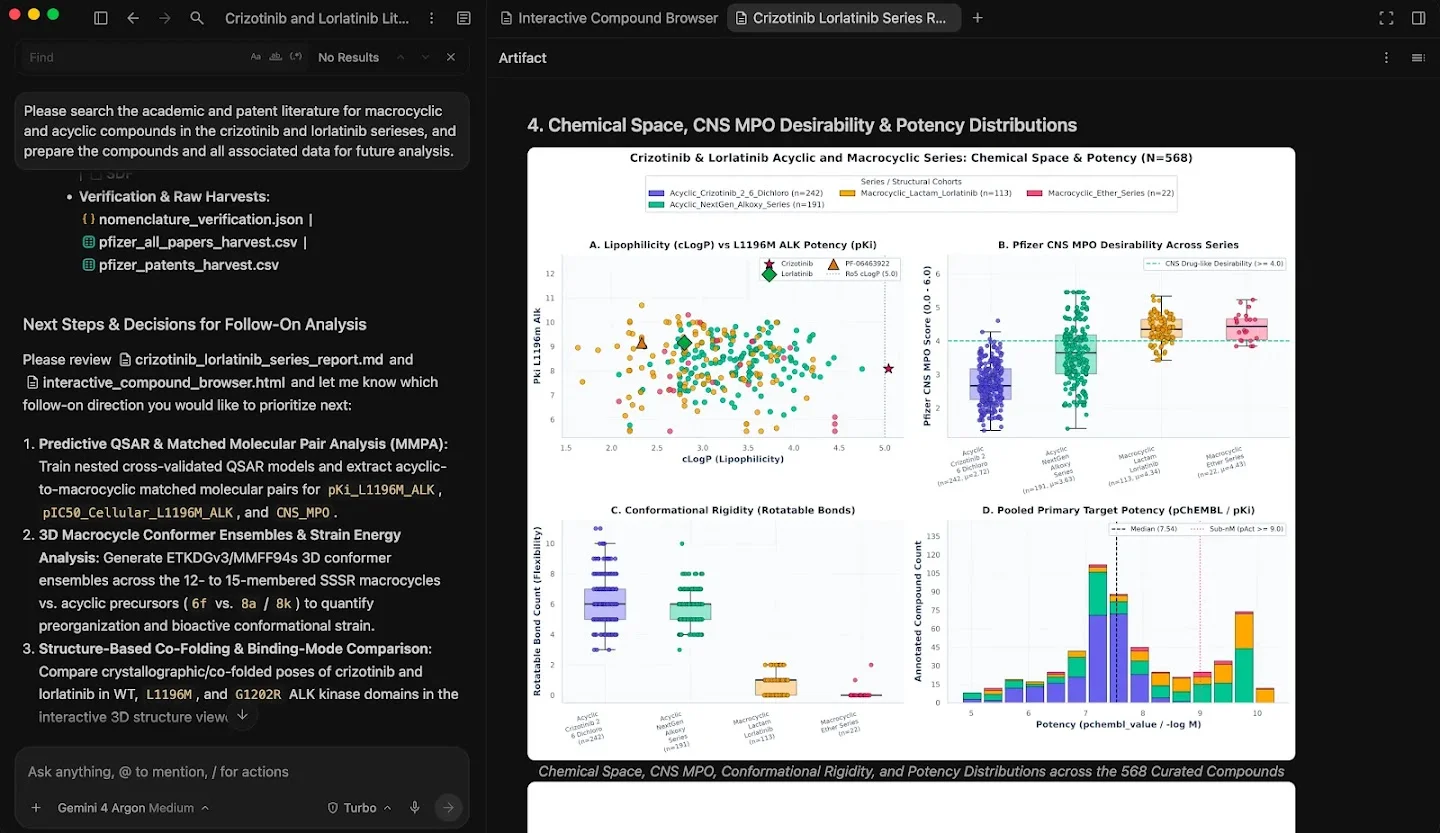 Google Antigravity cheminformatics skills dashboard showing 568 curated compounds across four charts
Image: Google DeepMind
The first report flags, for example, that the macrocycles are largely predicted to be brain-penetrant. That is relevant because this lung cancer often spreads to the brain. The agent also opens an interactive viewer. DeepMind's screenshot shows 568 curated compounds across four charts covering chemical space, CNS desirability, conformational rigidity and potency. Plotting cellular potency against rotatable bonds, colored by macrocycle status, shows that the most potent compounds are the most rigid.
Step 2: matched molecular pairs and potency models
Next the agent runs matched molecular pair analysis (MMPA). This technique compares pairs of molecules that differ by only one small change, so the effect of that change can be isolated. Here the change is cyclization. The agent had suggested the analysis on its own, since the dataset should hold many informative pairs. The results show that cyclization lowers rotatable bonds and generally raises potency, as chemists expect.
The agent also builds many potency models with different feature sets and model architectures and validates them on held-out data. The skills carry guidance on how to split data. The agent often uses chronological splits, training on older compounds to predict newer ones, when dates are available. It can fall back to scaffold splits, which test whether a model generalizes to new molecular frameworks. In the demo, the agent benchmarks models across four experimental read-outs using a scaffold split.
Step 3: design new macrocycles with routes
Finally the scientist asks for improved macrocycles. The agent recommends several designs, explains the medicinal chemistry reasoning, predicts each design's potency using the models it just trained, and suggests synthesis routes that match documented procedures. The skills let it manipulate and validate reactions, draw curved-arrow electron-pushing diagrams, and look up similar reactions in public databases.
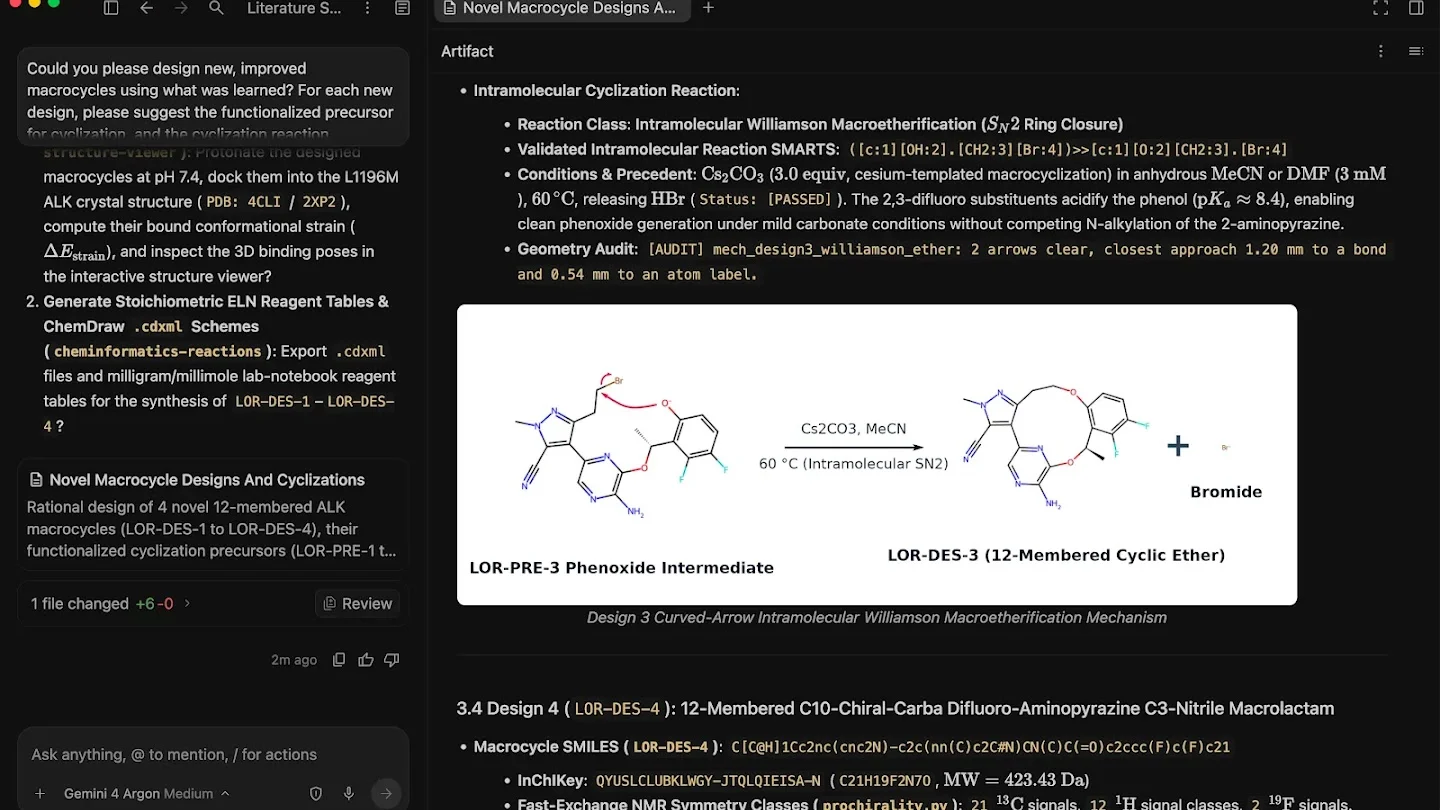 Antigravity agent proposing a cyclization reaction mechanism for a lorlatinib-like macrocycle design
Image: Google DeepMind
The screenshot above shows a proposed cyclization to a 12-membered cyclic ether, with a mechanism diagram. The agent can then hand designs to AlphaFold or to physics-based methods such as molecular dynamics, and results can be exported in formats that industry chemistry software loads.
What was claimed, and what was verified
DeepMind's headline claim is speed: an hour for a workflow that "typically takes multiple days". That figure comes from the lab's own post. We found no independent replication, and the post does not give a baseline study, a head count of chemists, or a measured time for a human doing the same task. Treat it as a vendor estimate.
The post is also candid about limits. In its words, sparse data, inter-lab assay noise and narrow dynamic ranges limit the predictive precision of even the most powerful models. It states that computational designs are testable hypotheses, not finished drugs, and that every proposed design must be synthesized and validated experimentally.
Three gaps are worth naming:
- No wet-lab result. The post does not report that any proposed macrocycle was made or tested.
- A known target. Lorlatinib is an approved drug and the literature on it is deep. The post does not show the agent on a new target with thin data.
- No head-to-head. There is no comparison against an expert chemist or against another agent stack, and no error rate on the retrieval step, where a wrong molecule would poison later analysis.
None of this makes the workflow less useful. It makes the claim narrow: the agent compresses the data work that precedes lab work.
How does this compare with other AI-for-science agents?
Several labs now ship science-specific agent setups. Anthropic's Claude science workbench takes a similar workbench approach for researchers, and its drug-development partnerships are covered in Anthropic's six drug-development partners. In the open-source world, the K-Dense scientific agent skills collection packages 177 research skills that run in several coding agents.
What sets DeepMind's release apart is the tight pairing of a skill suite with a first-party viewer and a stated tool split. The model never computes chemistry itself; RDKit does. That is the design most likely to hold up when an expert checks the output, and it is a good pattern to copy if you build your own science agent.
For readers new to the platform, our guides to Gemini 4 Argon use cases on Antigravity and the Antigravity model lineup explain what runs underneath. DeepMind's wider view of AI in research is in the DeepMind institute survey of AI in science.
How to try it
DeepMind gives three steps:
- Download the Google Antigravity app.
- Install the Science plugin to get the Cheminformatics Skills.
- If you are an Enterprise user, choose "Use Business Account" and sign in with your Google Cloud credentials.
DeepMind is also offering 10,000 scientists the highest usage tier of Antigravity free for six months, onboarded on a rolling basis. It says this is subject to eligibility, capacity and selection, and applications are open.
A sensible first test is to replay the lorlatinib exercise and check each stage against the literature. Ask the agent to list the source of every compound it keeps, then spot-check a sample of structures by hand. Ask it to state its split strategy and why. Treat any proposed synthesis route as a draft for a chemist to review.
What this means for builders
If you build agents, the release shows a repeatable recipe. First, encode domain best practice as skills rather than long prompts. Second, push exact work into deterministic tools. Third, give the user a shared, inspectable surface, here an interactive viewer, so a human can audit the agent's intermediate data. These choices cost little and improve trust.
If you work in drug discovery, the near-term value is in the early, tedious stages: data curation, baseline models and idea generation. The later stages, synthesis and assays, remain physical. A faster first loop only pays off if your lab can test the extra hypotheses it generates.
Frequently asked questions
Is the skill suite open source? The post does not say so. It says the skills are available on Antigravity today. It credits RDKit, which is open source, as the foundation.
Does it replace a computational chemist? DeepMind positions it as collaboration. The post describes the scientist asking, reviewing and iterating with the agent, and says the tool lets researchers "focus on the questions that really matter".
Which model powers the agent? The post does not name the model. It refers only to the underlying language model handling orchestration and reasoning.
Related reading
- DeepMind Antigravity antimicrobial peptide walkthrough
- Claude as an AI workbench for scientists
- Scientific agent skills: 177 research skills
- Anthropic's six drug-development partners
- DeepMind institute: bending the curve of discovery
- Top 10 Gemini 4 Argon use cases on Antigravity
- What are agent skills?
Details are accurate as of November 3, 2026. Antigravity features, eligibility and usage tiers can change.