



A gene test can tell you which of the 9 billion possible single-letter changes to your DNA you actually have. It has never been able to tell you, instantly, what most of them do — especially the 98% of the genome that doesn't code for a protein at all. On September 8, 2026, Google DeepMind changed that math with AlphaGenome Atlas: a precomputed, searchable map of the predicted molecular effect of every possible human DNA variant. The same day, Google Antigravity — Google's agent-first development platform — shipped it as an agent skill, so a researcher can point an AI agent at the dataset and get back ranked variants and structural plots instead of writing the query themselves.
TL;DR
| Question | Answer |
|---|---|
| What launched? | AlphaGenome Atlas — a 1-petabyte map of predicted effects for all 9 billion possible human DNA variants |
| When? | September 8, 2026 |
| What's new about the Antigravity integration? | An agent skill that connects Antigravity's agents directly to the Atlas dataset for variant prioritization and hypothesis generation |
| How do you rank a variant's impact? | The AVI (AlphaGenome Variant Impact) score — one number per variant, across coding and non-coding DNA |
| Is it free? | Yes, for non-commercial research, via web portal, API, or the Antigravity skill |
| Has it found anything real yet? | Yes — a DNM1 splice-site variant linked to epileptic encephalopathy, found by Broad Institute researchers and experimentally confirmed |
What AlphaGenome Atlas actually is
AlphaGenome, the underlying model, already predicted the molecular effects of a given DNA sequence change when you fed it one variant at a time — splicing outcomes, gene expression shifts, chromatin accessibility. Atlas takes that same model and runs it genome-wide, in advance, for every possible variant, then stores the results in a queryable 1-petabyte dataset — more than 30 times the size of the AlphaFold Database. That precomputation is the actual product: a researcher no longer needs to run a model job to ask "what does this variant do?" They query a number that's already sitting there.
The headline feature is the AVI score (AlphaGenome Variant Impact) — a single number per variant that combines predictions from AlphaGenome and Google's earlier AlphaMissense model, covering both the ~2% of the genome that codes for proteins and the ~98% that doesn't but still regulates when and how genes turn on. AVI scores decompose into interpretable feature categories — chromatin accessibility, splicing, evolutionary conservation — so a high score comes with an explanation of why, like "this disrupts a splice site" rather than just a number. Atlas also ships over 2,500 recurrent DNA sequence motifs mapped to genome locations, and dashboards showing predicted effects across multiple cell types and tissues.
Access is free for non-commercial research through three routes: a no-code web portal at alphagenome.google/atlas, the AlphaGenome API on GitHub for programmatic use, and — new as of this launch — the Google Antigravity skill. Commercial access via Google Cloud is described as forthcoming.
The Antigravity Atlas Skill: agents doing the querying
This is the part that matters for anyone tracking agent skills as a category, not just genomics. Google Antigravity announced that it has "integrated the new AlphaGenome Atlas Skill into our scientific workbench," with a demo showing researchers using AI agents to "quickly prioritize variants and generate structural plots and build testable hypotheses."
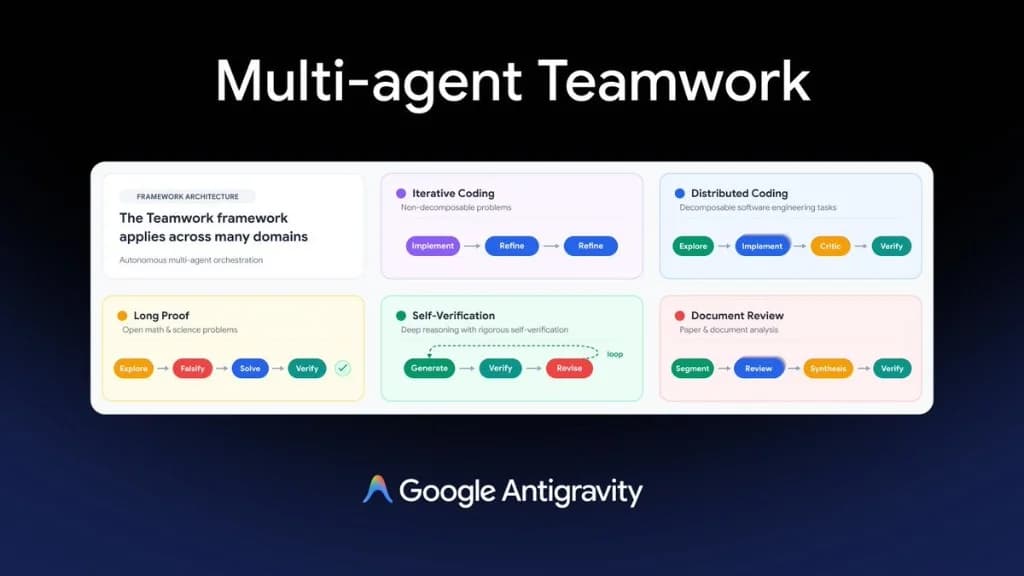
Concretely, the skill connects Antigravity's agents directly to the petabyte-scale Atlas dataset. Instead of a researcher manually pulling up the web portal, searching for a gene region, exporting a variant list, and writing their own script to rank it, an agent inside the workbench can run that whole loop — query the dataset, rank a batch of variants by AVI score, pull the feature attributions explaining the top hits, generate a structural plot, and hand back a starting hypothesis. It's the same shift explainx.ai has covered across Antigravity's other releases this year — from a multi-agent teamwork framework in August to a /boost deep-reasoning command for hard problems earlier this month — applied here to a scientific dataset instead of a codebase.
A real result that predates the skill
The genomics community didn't wait for the agent integration to find something useful. Broad Institute researchers Laura Covill and Anne O'Donnell-Luria used the AVI score to prioritize a list of uncharacterized rare-disease variants and identified one in the DNM1 gene — a gene strongly linked to epileptic encephalopathy. The AVI feature attribution pointed to an incorrect splice site created by the variant, causing an abnormally extended protein. Experimental validation confirmed the prediction, and the same prioritization approach surfaced nearby variants with similar effects. That case is the concrete proof point behind the pitch: a single interpretable score, applied genome-wide, turning a manual literature-and-lab hunt into a ranked shortlist.
It's also a preview of what the Antigravity skill is meant to compress into minutes: DeepMind's own framing is that connecting an AI assistant directly to the Atlas dataset moves researchers "from manual data searching to automated hypothesis generation." The DNM1 discovery happened with a human running the AVI ranking by hand; the pitch for the skill is that an agent can now run that same kind of search continuously across many candidate genes.
How this fits next to AlphaFold
It's worth being precise about what AlphaGenome Atlas is not: it isn't AlphaFold, and it isn't trying to replace it. AlphaFold predicts 3D protein structure from a sequence — what a protein physically looks like once it's built. AlphaGenome predicts what happens before that: whether a DNA change affects splicing, gene expression, or chromatin state, across both the protein-coding and non-coding genome. They're complementary layers of the same pipeline — AlphaGenome tells you a variant breaks a splice site; AlphaFold (or an AlphaFold-based tool) can then tell you what the resulting misfolded or truncated protein looks like. Sitting next to Atlas, that combination is a big part of why DeepMind keeps investing in genomics and drug-discovery tooling as an AI-for-science bet, alongside efforts like Anthropic's rare-disease research grants.
Why this is worth watching if you build with agent skills
Atlas is a genomics story, but the mechanism is a skills-ecosystem story: a petabyte-scale, domain-expert dataset, wrapped in an agent skill so a general-purpose harness can operate it competently without the researcher becoming a bioinformatics-pipeline engineer first. That's the same pattern explainx.ai tracks across the agent skills registry — a skill isn't just a prompt template, it's a bridge between an agent and a specialized system of record. Expect more of this: precomputed, queryable scientific datasets shipped as skills for whichever agent harness a lab already uses, rather than a bespoke research tool nobody outside that lab ever touches.
Related reading
Details in this post reflect Google DeepMind's and Google Antigravity's public announcements as of September 8, 2026. Dataset scale, scoring methodology, and access terms may be updated by Google after publication — check the linked official sources for the current state.
Update — October 6, 2026: New coverage — Gemma 4 + BOTANIC-1 for plant DNA variant ranking.