



Simon Willison has a simple claim about AI-made pictures: if you want to change them afterwards, have the model write code instead of painting pixels. In a post dated November 28, 2026, he says frontier language models released in the second half of 2026 are "much better at visual reasoning and creative design" than their predecessors, and that images defined in code are often more useful than those from dedicated image models.
This is an opinion backed by a hands-on test, not a lab announcement. That makes it a useful reference for anyone choosing between a text model and an image model for diagrams, posters and product assets.
Quick answers
| Question | Answer |
|---|---|
| What is the claim? | Code-written images (SVG and more) are more useful and editable than bitmap output |
| What was tested? | A 1970s-style SVG poster for the Kakapo recovery project, made with Gemini 4 Neon in Google AI Studio |
| Biggest advantage? | Everything stays editable: text, shapes, layers |
| What still favors image models? | Photorealistic images, per Willison |
| Any counterpoint? | He notes Ideogram 4.0 claims bounding-box layout control |
The test: a Kakapo poster in SVG
Willison used Gemini 4 Neon, which he says is getting buzz for 2D design skills, in Google AI Studio. His first prompt: create an SVG poster promoting the Kakapo recovery project, research details first, and make it look really cool in a 1970s graphic design style.
It took iteration. AI Studio does not render SVGs, so the model could not see its own visual mistakes unless Willison gave it screenshots. His follow-ups were practical: make the kakapo more realistic, especially the face, using image search for references; the text does not fit the pill shape, fix it; and a few more with screenshots of the problems. He exported the session transcript as Markdown because he could not find a way to share a session without a Google login.
His verdict: the final poster is pretty solid. The model ran Google searches to find the numbers on it, and he checked that they are correct. He also liked that it included red rimu tree fruit on a branch, which he notes is essential for the breeding season.
The point is not that the poster is a masterpiece. The point is that everything in it is editable. You can change the text directly in the SVG file, or open it in Inkscape or Adobe Illustrator or Boxy SVG and edit it visually.
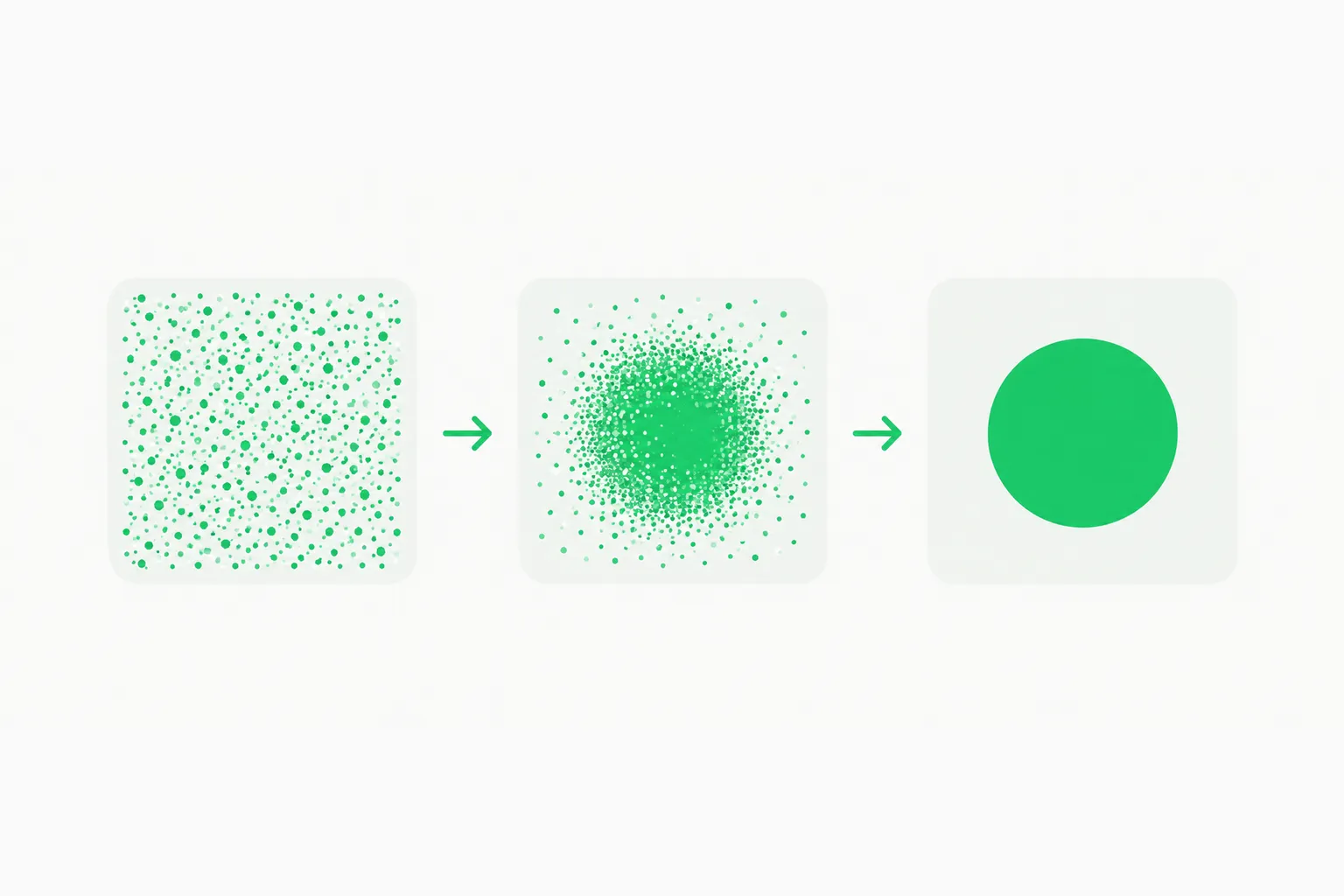 Noise resolving into a clean green shape, illustrating how bitmap image models generate pictures versus code-driven illustrations
Why code beats bitmaps for some jobs
Willison lists three weaknesses of image models that write pixels directly.
- Glitches on zoom. Weird artifacts show up when you look at details.
- Text drawn as shapes. Letters come from the model rather than a font system, so consistency is not guaranteed.
- Flat output. You can describe a change or annotate the picture, but you cannot grab one element or layer and move it.
He is fair about how far these models have come. Over roughly 15 months, LLM-driven image tools such as Google's Nano Banana and OpenAI's ChatGPT Images became competent at editing existing images and keeping details, so you can iterate over several turns without the image turning to mush. Our own coverage of ChatGPT Images 2 and Nano Banana 2.5 tracks that progress. The remaining gap is control, not quality.
It is not just SVG
Willison says SVG is his favorite, but not the only option. A model connected to a coding-agent environment can run code to make images. He lists generated image files, HTML and CSS, 2D HTML canvas, Blender scripts, WebGPU shaders and PDF: any mechanism that can be represented as a file or script output.
That ties to a trend he points to in games. One reason "vibe game development" has grown, he says, is that models such as Claude Opus 5.5, GPT-6 Astra and Gemini 4 Neon can make good-enough 3D models, textures and sprites purely by writing code. Tweaking, reusing and remixing those assets means asking the model for more code. For readers who build with these models, see our guides to Claude Opus 5.5 and prompting it.
The Anthropic angle
A notable section of the post is about product strategy. Willison says that after Nano Banana and ChatGPT Images he thought Anthropic had a serious gap: OpenAI and Google both had excellent image models, and Google still has video models in Veo and Omni, while OpenAI has shut down Sora. In his words, the business world still runs on PowerPoint, so an image generator looked like an expected enterprise feature.
His view changed. Claude can now produce visually compelling presentations and website designs, and Claude Design offers a full design-system platform, all built on code-driven images. He calls it another case of the bitter lesson: he was convinced a specialist image model was needed, and the text models just kept getting more capable until they could handle visual design by writing code. For background on that product, read our pieces on Claude Design from Anthropic Labs and the June Claude Design update.
The counterpoint: image models are adding control
Willison appended an update after publishing. Image generators are also gaining structure, and he gives Ideogram 4.0 as an example, which claims "bounding-box layout control" through structured JSON prompting. We cover the model in how to run Ideogram 4, and we looked at its vector-editing claims separately in Ideogram Vector 1: claimed versus verified.
This matters because the argument is about control, not about which model family is better in general. If an image model gives you layout boxes and editable regions, part of the code-driven advantage narrows. If a text model gets better at seeing its own output, as when it can render the SVG and spot mistakes, the other side gets stronger.
Which job suits which tool
A practical way to read the post is as a decision table. The rows are our reading of Willison's examples, not his own table.
| Job | Better default | Why |
|---|---|---|
| Explanatory diagram | Code (SVG or HTML) | Labels stay real text and parts can be moved |
| Editable poster | Code (SVG) | Text can be changed in the file or in a vector editor |
| UI component or visualization | Code | The output is already the format developers use |
| Game sprite, texture or 3D asset | Code, with a coding agent | Remixing means asking for more code |
| Photorealistic picture | Image model | Willison says these models still have their place |
| Fast edit of an existing photo | Image model | Nano Banana and ChatGPT Images keep details across turns |
The split follows one question: will anyone need to change this later? If yes, code gives you handles. If the picture is final and photographic, a bitmap model is the shorter path.
There is also a review benefit. A text file of SVG or HTML can be read, diffed and approved by a colleague. A bitmap cannot be reviewed line by line, so a team that wants an audit trail for brand assets gets one for free when the model writes code.
How to try it yourself
Treat these as starting points, adapted from Willison's own prompts:
- Poster: "Create an SVG poster promoting [subject]. Research details first. Make it look [style]." Then iterate with screenshots of problems.
- Fix text overflow: attach a screenshot and say "the text here does not fit the pill, fix it."
- Diagram: ask for an SVG or HTML diagram with named groups, so you can move parts. Our diagram design skill coverage shows one way to wire this into an agent.
- Let the model see: use an environment that renders the SVG, because a model that cannot see its output misses visual mistakes. Willison hit exactly this in AI Studio.
- Open it: Inkscape is a free vector editor that opens SVG.
Check facts the model inserts. Willison verified the numbers on his poster; do the same.
What this means for builders and teams
Builders. If your output needs to be revised, resized or localized, ask for code. A change request becomes a diff rather than a regeneration. For a product team, SVG icons and diagrams checked into a repo are reviewable in a pull request, which a bitmap is not.
Founders. The product-gap argument runs both ways. A lab without a famous image model may still serve design work if its text model draws well. Judge by the task, not the label.
Marketers. Editable posters mean last-minute copy changes without a new generation round. Photographic campaign imagery is still the job for image models, as Willison notes.
Teams that want to build these workflows can start with our AI builder workshop.
Limits of the argument
This is one writer's view and one test with one model. Willison does not publish a benchmark. His poster needed several rounds, and the environment he used could not render SVG, which slowed it down. Results with other models or prompts may differ, and a poster that looks good to one person may not suit another. The sensible reading is narrow: for editable, structured visuals, code is a strong default; for photos, it is not.
Details are as published by Simon Willison on November 28, 2026. Model names are as used in his post.