



TL;DR: A viral X comparison pits a rumored Gemini 4 Pro (Chatbot Arena) checkpoint against Claude Opus 5.5 on a 3D floatplane takeoff prompt — plus, as of September 28, a leaked benchmark table claiming 88.7 DeepSWE, 95.3 Terminal-Bench 2.1, 2M context, and $2.25/$11.25 pricing versus Opus and GPT-6 Astra. Google has not confirmed the model identity or the numbers; skeptics note the arena label might be Flash, not Pro. Treat demos and tables as hype signal until versioned APIs and reruns land.
This post is explainx.ai's read for builders: how to interpret the leak, what Opus 5.5 actually shipped for, and how it connects to Google's stated Gemini 4 post-training push two days earlier.
Update — October 1, 2026: Google shipped a named SKU. Official numbers plus Andon Labs' Vending-Bench 2 #3 result (simulated profit, including reported fake shipping mail) are in Gemini 4 Argon launch. DeepSWE is 77.9% (not the leak's 88.7), intro $2 / $10, 1M output, Fairwind-only access. The floatplane identity problem is unchanged: Argon is not "Gemini 4 Pro."
Update — September 27, 2026: The same rumor wave now includes an Astra comparison, a public lighthouse labeled Gemini 3.8 Flash, and a feed summary that flattens Kavukcuoglu's timing. The catalog is in Gemini 4 arena demos: the 3D jump, and what is still a rumor.
Update — September 28, 2026: A leaked benchmark table is circulating alongside the floatplane clips — agentic coding scores (DeepSWE, Terminal-Bench 2.1, OSWorld 2.0, GDPval-AA), a 2M-token context claim, and $2.25 / $11.25 per-million pricing versus Opus 5.5 and GPT-6 Astra. See the section below; numbers are unverified until Google publishes a model card.
Leaked benchmark table (September 28) — agent work, not WebGL
The floatplane video tests one-shot visual codegen. A separate rumor artifact tests software-agent benchmarks — the workloads that actually decide whether you route production coding agents to Google, Anthropic, or OpenAI.
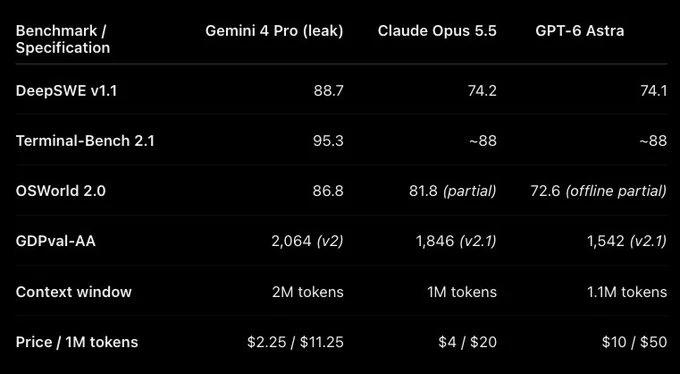 Leaked September 28, 2026 table comparing rumored Gemini 4 Pro against Claude Opus 5.5 and GPT-6 Astra on DeepSWE, Terminal-Bench, OSWorld, GDPval-AA, context window, and price
| Metric | Gemini 4 Pro (leak) | Claude Opus 5.5 | GPT-6 Astra |
|---|---|---|---|
| DeepSWE v1.1 | 88.7 | 74.2 | 74.1 |
| Terminal-Bench 2.1 | 95.3 | ~88 | ~88 |
| OSWorld 2.0 | 86.8 | 81.8 (partial) | 72.6 (offline partial) |
| GDPval-AA | 2,064 (v2) | 1,846 (v2.1) | 1,542 (v2.1) |
| Context window | 2M tokens | 1M tokens | 1.1M tokens |
| Price / 1M tokens (leak vs official) | $2.25 / $11.25 (leak) | $4 / $20 (ship) | $10 / $50 (ship) |
explainx.ai read (if the leak is directionally true)
- The story shifts from shaders to agents. DeepSWE and Terminal-Bench 2.1 measure repo repair and shell-driven work — closer to what Opus 5.5 buyers care about than a floatplane takeoff. A double-digit gap on DeepSWE would be a frontier-tier claim, not a demo trick.
- OSWorld footnotes matter. The table itself marks Opus and Astra scores as partial / offline partial. Do not treat OSWorld 86.8 as a clean head-to-head until harness versions and completion rules match.
- GDPval-AA is version-mixed. Gemini at v2 versus rivals at v2.1 is not a perfect apples-to-apples row — note the suffix before forwarding the screenshot.
- Price is the other half of the punch. Leaked $2.25 / $11.25 undercuts Opus's documented $4 / $20 and Astra's $10 / $50 while claiming higher agent scores. That combination is exactly what triggers Goodhart / contamination skepticism — impressive if reproduced on your harness, suspicious if it only exists on a dark-mode X card.
- 2M context is a product claim, not a vibe. Useful for long-repo agents only if latency, tool use, and retrieval quality hold at full window — something leaks never stress-test.
What would confirm or kill the table
- A Google model card with benchmark methodology links (harness commit, pass@k, tool access).
- Independent reruns on Terminal-Bench 2.1 with frozen Opus 5.5 and Astra endpoints — same as explainx.ai recommends in AI coding agent evals on real repos.
- API version strings on day one — not "Gemini 4 Pro" typed by a poster.
Until then, file the table next to the floatplane: strong priors for Google's comeback narrative, weak evidence for production routing.
What went viral
| Signal | Detail |
|---|---|
| Primary post | @AI_Screening / Pranav Reddy, ~6:17 AM UTC Sep 26, 2026 |
| Claim | "Gemini 4 Pro (in arena)" completely outperforms Opus 5.5 on floatplane physics |
| Engagement | ~58K views on the main clip in early metrics; Grok surfaced 105+ posts in its "Leaked Gemini 4 Pro Previews" story |
| Extra leaks cited in summaries | Moody vessel scene; T-Rex meme (detailed dinosaur vs pixelated) — secondary anecdotes, same evidentiary tier |
| Google statement | None tied to this specific video in public sources reviewed here |
The video format is familiar from 2025–2026 model-war Twitter: split-screen browser captures, dramatic music, a single natural-language prompt rendered as interactive 3D. The prompt class — realistic takeoff, water, reflections, physics — stress-tests one-shot visual codegen, not your repo's refactor backlog.
What "3D floatplane physics simulation" likely means technically
Without the exact prompt and artifacts, the sensible default is client-side WebGL (often Three.js or similar) emitted as HTML/JS:
- Floatplane ⇒ pontoons, hydrodynamic drag approximations, lift at speed.
- "Physics" in viral posts usually means believable motion (pitch, spray, camera follow), not a full CFD solve.
- Reflections ⇒ environment maps, planar water shaders, or screen-space tricks — exactly where a model that patterns-match shiny demos can look "mogging" another on first try.
That matters because explainx.ai built five multiplayer browser games with Opus 5.5 — ~29k lines, server-authoritative multiplayer, iterative human steering. The Opus story there is long-horizon engineering with screenshots, not one prompt → cinematic takeoff. Comparing the floatplane clip to that workflow is comparing trailer to production.
If Gemini 4 Pro (or whatever checkpoint this is) really does one-shot floatplanes better, the builder takeaway is narrow: better default shaders and motion curves on visual prompts — worth A/B testing in AI Studio previews, not worth rewriting your stack on a leak.
Identity problem: is it actually Gemini 4 Pro?
Arena-era leaks routinely mislabel models. On the same thread, @ai_for_success quoted the video with an explicit caveat: it is not 100% confirmed whether the model is Gemini 4 Pro or another Gemini Flash line.
Why that caution is rational:
- Blind arena entries hide vendor IDs until confirmed; community labels run ahead of official names.
- Google's public narrative is "Gemini 4 in post-training," not "Gemini 4 Pro GA in arena" (Kavukcuoglu, Sep 24, 2026).
- Flash-family models already ship rapid iterations (3.6, 3.8, cyber-tuned variants); a flashy visual could be a fast checkpoint, not the flagship Pro sellers expect in enterprise RFPs.
Until Google or LMSYS publishes a model card tied to this weight snapshot, call it "rumored Gemini 4-series arena model" in slack, not "Pro beats Opus."
Opus 5.5 as the baseline (what you're comparing against)
Claude Opus 5.5 landed September 22, 2026 — four days before the floatplane post. explainx.ai's launch benchmarks and pricing and GPT-6 Sol vs Opus 5.5 posts treat Opus as Anthropic's frontier coding and reasoning tier at $4/$20 per million tokens.
None of those official materials promise best-in-class one-shot WebGL spectacle. Anthropic's own Opus 5.5 prompting guide pushes whole-task delegation and updated multi-turn habits — aligned with large codebases, not single HTML files.
So if Opus looks weaker in a 30-second takeoff reel, that is consistent with:
- Different optimization target (enterprise coding vs demo shader),
- Unequal iteration (did each model get one shot? same system prompt?),
- Cherry-picked prompt favoring Google's aesthetic priors.
None of which proves Opus is "bad at 3D" — only that this clip is not a controlled eval.
Grok summary layer (read the disclaimer)
Grok's trending story compresses the X firehose into: cleaner acceleration, reflections, steadier flight; T-Rex meme; excitement vs "leaks may evolve." The last clause is the important one — Grok explicitly warns it may mistake and asks users to verify.
That is the same structural lesson as the week's Harvard exoplanet / Polymarket story: feed-native summaries accelerate belief faster than primary sources. Here the primary source is a social video, not a paper — even weaker epistemic footing.
How this fits Google's Gemini 4 timeline
Two days before the floatplane hype, Koray Kavukcuoglu said Google wants Gemini 4's first post-training build ASAP, skipping the shelved Gemini 3.5 Pro narrative. A visually dominant arena leak is on-message for Google morale ("comeback") and off-message for careful engineering ("wait for API docs").
If you are on Vertex or AI Studio:
- Do not block releases on rumor videos.
- Do keep a day-one eval folder: same floatplane prompt, your production stack prompts, regression tests from Artificial Analysis v4.2 if you track vendor indices.
- Do compare latency and price when a documented endpoint exists — the same discipline as September's multi-vendor launch week.
Skeptical reading checklist (copy-paste for your team)
- Exact prompt and system message for both panes — were they byte-identical?
- Model IDs from the arena session — screenshot metadata, not tweet text.
- Iteration count — one shot vs hidden retries.
- Runtime environment — same browser, GPU, frame cap?
- Checkpoint freshness — commenters already note non-final weights.
- Your workload — if you ship CRUD and agents, weight agent security and tool reliability above water shaders.
Secondary leaks in the same Grok bundle (lower weight)
Grok's September 26 story also mentions a moody vessel scene and a T-Rex meme comparison — detailed dinosaur render versus a pixelated Claude output in another informal side-by-side. Treat these exactly like the floatplane clip: uncontrolled prompts, unknown iteration counts, community-assigned model names. They are useful for sentiment ("Google comeback" replies, Flash-vs-Pro guessing) but should not enter your production routing matrix any more than a single Sora demo would.
If you are documenting leaks internally, store URL, date, prompt text, claimed model ID, and your own rerun hash when Google ships an API. That habit is how explainx.ai covered GPT-6 Sol vs Opus 5.5 without treating launch-day Twitter as ground truth.
What to do this week (action list)
- Freeze a "visual codegen" eval — floatplane or your own shader-heavy prompt — on Opus 5.5 today.
- Add Gemini 3.x Flash as a cheap baseline if you already pay for Google AI Studio.
- When Gemini 4 documentation lands, rerun the same prompt on the documented endpoint only.
- Log cost and latency per successful one-shot — viral videos rarely mention that Opus workflows often win on second-pass fixes in real repos.
- Ignore arena name strings until LMSYS or Google confirms SKU mapping.
Bottom line
The AI_Screening floatplane video and the September 28 benchmark table are a useful hype thermometer for Gemini 4 post-training: together they claim visual-spatial codegen and agent-benchmark leadership at under-Opus pricing. They are not proof that Gemini 4 Pro is GA, that scores will reproduce on your harness, or that Google has "won" September 2026.
Watch for official model cards, API version strings, and your own pinned evals. Until then, enjoy the floatplane — and keep shipping with the model whose docs, pricing, and regression curves you can actually audit.
Related reading
- Gemini 4 Argon official launch (Oct 1, 2026)
- Google fast-tracks Gemini 4 post-training (Sep 24, 2026)
- Claude Opus 5.5 launch benchmarks
- Five browser games built with Opus 5.5 — real codegen scope
- GPT-6 Sol vs Opus 5.5 comparison
- Harvard exoplanet radio vs AI hype pipeline
Arena leaks vs your CI pipeline
Production teams already separate "demo wow" from merge gates for human engineers; frontier models deserve the same split. A single WebGL floatplane clip is a qualitative preview — useful in Slack, dangerous in if (model == "gemini-4-pro") ship_feature(). Wire arena gossip into #research channels, not deployment runbooks. When Google publishes versioned Gemini 4 endpoints, promote the prompt into the same harness you use for Opus 5.5 game builds and record pass/fail on your tasks.
If you are a vibe coder choosing between subscriptions this week, do not upgrade on a video alone. Run one multi-file bugfix on each stack you already pay for; the floatplane tells you almost nothing about that workload.
Model names, arena labels, benchmark table figures, and view counts reflect public X posts and summaries through September 28, 2026. Google and Anthropic may ship different SKUs than community labels imply — verify against official release notes before changing production routes.