



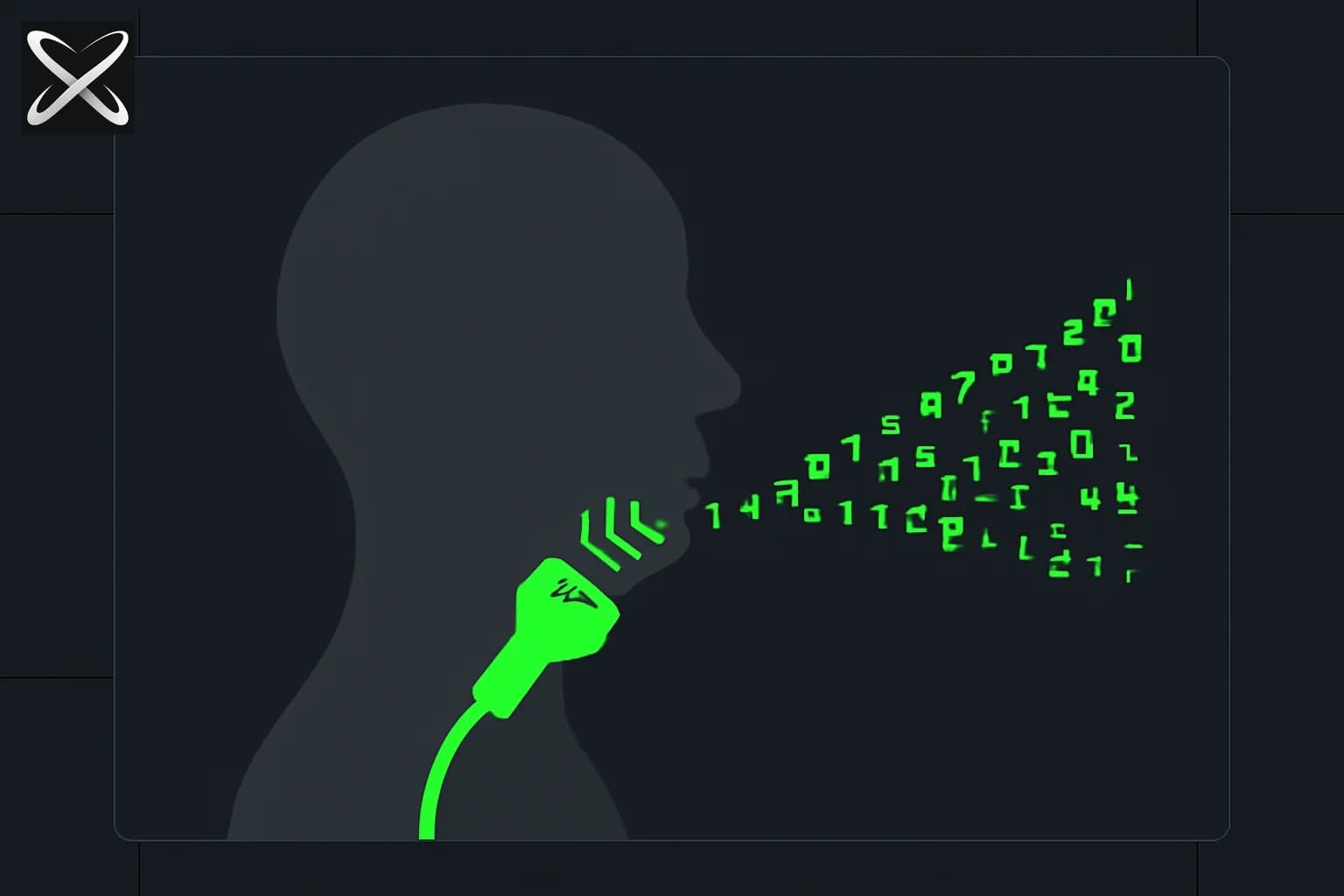
On September 15, 2026, at 12:51 AM, Polymarket's X account (@Polymarket) posted a short clip described this way: a brain implant allows a paralyzed woman with severely impaired speech to hold real-time conversations by translating her thoughts into an AI-generated voice. It spread fast, and it deserves a more careful read than the headline gives it.
A reply from @TradeCouncil333 pushed back on the framing in a way that is worth leading with, not burying: this is almost certainly not "reading thoughts." It is far more plausible that the system is reading residual throat or vocal-tract muscle activity, or motor-cortex signals correlated with attempted speech — even when the resulting sound is broken or inaudible — and using that signal to train a personalized decoder for that one user, which then drives an AI-generated voice.
That distinction matters. "Mind reading" implies a system pulling arbitrary private thoughts out of a brain. What is actually being described is a system trained to recognize one specific behavior — the neural or muscular pattern of trying to speak — for one specific person, and translating that pattern into sound. It's a narrower, more mechanical, and frankly more interesting engineering problem than telepathy.
TL;DR — What People Are Asking
| Question | Short answer |
|---|---|
| Is this mind reading? | No — most plausibly residual speech-motor signal decoding, not arbitrary thought reading |
| Is it Neuralink? | Not stated in the source post; unconfirmed which company or lab built this |
| What's confirmed? | Only what's in a short social post — no paper, no named lab, no metrics |
| Is the voice her real voice? | Genuinely unclear from the source; identity-preserving synthesis is possible but not confirmed here |
| Can the voice be customized? | Voice customization exists broadly in TTS today; unconfirmed whether this specific system offers it |
| Is this a new category of research? | No — it fits an active field: BCI-driven speech restoration for paralysis and locked-in conditions |
| Real-time capable? | Framed as real-time conversation in the post, but no latency numbers are given |
Why We're Hedging: The Sourcing Here Is Thin
Before going further, it's worth being explicit about what this post can and cannot claim. The entire public record for this specific demo, as of publication, is a short social media post plus community replies — not a peer-reviewed paper, not an official press release, not a named research group's own announcement. That means:
- We do not know which lab, hospital, or company built the system shown.
- We do not have word error rate, latency, training data volume, or any other performance metric.
- We do not know whether the implant is invasive (surgically placed electrodes) or non-invasive (external sensors).
- We do not know whether the synthesized voice was cloned from the woman's own pre-injury voice or generated generically.
None of that makes the underlying claim implausible — the category of research is real and well-documented, covered below — but a single viral clip is not sufficient grounds to attribute this to a specific company or paper. If you see this attributed elsewhere to a named lab, verify against that lab's own publication before repeating it.
The Corrected Framing: What's Actually Being Decoded
The "mind reading" framing that headlines default to obscures the real mechanism, which is closer to a brain-computer interface (BCI) reading an attempted speech signal, not a thought in the abstract sense. Two broad signal sources show up across this research category:
- Motor-cortex activity correlated with attempted speech. Even when a person cannot move their vocal tract at all, the brain regions that would normally command those muscles can still fire in patterns tied to the intention to say specific words or sounds. Invasive electrode arrays placed over or near these regions can pick up that pattern.
- Residual muscular activity in the throat, jaw, or vocal tract. Some paralysis leaves faint, uncoordinated, or inaudible muscle activity behind — the person is still "trying" to speak, and traces of that attempt reach the muscles even if no usable sound comes out. Surface sensors or fine-grained EMG-style recording can pick this up without needing a surgical implant at all.
Either way, the workflow is the same shape: record the signal, train a model on labeled examples of that signal paired with intended words for that specific person, then run the resulting decoder live and pipe its output into a voice synthesis system. That's a personalized decoder feeding a voice model — not a general-purpose thought reader.
Where This Fits: A Real, Active Research Category
This demo, whoever built it, sits inside a genuine and increasingly crowded field: BCI-based speech restoration for people with paralysis, ALS, locked-in syndrome, or anarthria. explainx.ai has covered several distinct approaches in this space:
- Invasive implants for mobility and control — Neuralink's telepathic wheelchair demo showed implant-decoded cursor control driving a powered wheelchair, the same broad category of surgically-implanted BCI, applied to a different effector (movement rather than speech).
- Non-invasive brain-to-text decoding — Meta FAIR's Brain2Qwerty v2 decodes full typed sentences from magnetoencephalography (MEG) signals with no surgery at all, at a 39% average word error rate across participants and 22% for its best subject. It's a text-output system rather than a voice one, but it's the closest documented example of the "personalized decoder, no scalpel" approach in this piece.
- Residual muscle signal decoding without any brain recording — Aleph Neuro's silent-speech system reads tongue movement via submental ultrasound while a speaker mouths words silently, then transcribes at 15.6% word error rate. This is structurally close to the "residual muscle activity" explanation offered for the viral demo, just using ultrasound instead of implanted or surface electrodes.
- Non-surgical oral and tongue interfaces — Augmental's MouthPad shows a different non-invasive assistive pattern: a custom mouthpiece translating tongue movement into computer control, aimed at similar independence goals for people with mobility impairments.
We cannot verify whether the specific woman in this demo is a participant in any of these programs, a different academic effort (such as the kind of work associated with UCSF's Chang Lab, which has published on speech-BCI research for years), or a company effort not yet named publicly. What's confirmed is only that the category — turning a paralyzed person's attempt to speak into synthesized audio in something close to real time — is an active and well-resourced research area, not a novel or unverified claim on its own.
What People Are Asking, and What's Genuinely Worth Debating
A few reactions in the replies deserve a straight answer instead of a dismissal.
"Isn't this just broadcasting someone's involuntary thoughts?" No — per the framing above, these systems are trained on a person's deliberate, cooperative attempts to say specific words during a calibration process. They are not passively surveilling background mental activity; they decode a targeted, intentional signal the user is actively trying to produce. A system like this has no mechanism for reading thoughts the user isn't trying to communicate.
"Can the output voice be configured — like a specific voice actor?" This is a fair and genuinely current product question. Modern text-to-speech and voice cloning models already support selecting or designing a target voice profile from a short reference clip or a text description, entirely independent of the input signal. Whether this specific BCI system exposes that kind of voice selection isn't stated in the source post, but the underlying TTS capability to do it is mature and widely deployed.
"Is it actually her own voice, or a generic AI voice?" This is the most important open question here, and it's a real, unresolved research problem across the field, not just a curiosity. If the person has pre-injury recordings of their own voice, a personalized voice model can be trained to approximate their pitch, cadence, and timbre — a form of identity-preserving voice synthesis. If no such reference audio exists, systems typically fall back to a generic or off-the-shelf AI voice, which restores communication but not vocal identity. Regulators are starting to take voice identity seriously in adjacent contexts too — see China's Supreme People's Court ruling that unauthorized AI voice clones violate personality rights — which underlines that "whose voice is this" is not a purely technical question even when the use case is assistive rather than commercial.
"Is this Neuralink?" As covered above: not confirmed. The post doesn't name a company or lab, and multiple groups — academic and corporate — are actively working on speech-restoration BCIs. Don't repeat "this is Neuralink" as fact based on a headline alone; it's speculation until a primary source says so.
The Applied-ML Problem Underneath the Headline
Strip away the framing debate and this is a concrete, fascinating applied machine learning problem, which is the part explainx.ai's builder audience should actually care about:
- Sequence modeling on noisy biosignals. Whether the input is EMG, MEG, or intracortical electrode data, the raw signal is high-dimensional, noisy, and highly individual. The decoder has to map a continuous stream of that signal to discrete linguistic units — phonemes, words, or sentences — much like an ASR system maps audio to text, except the "audio" here is a biological signal with far worse signal-to-noise ratio than a microphone.
- Personalization as a hard requirement, not an optimization. Unlike a general-purpose speech recognizer that ships once and works for anyone, these decoders have to be trained or fine-tuned per individual because injury patterns, signal quality, and even baseline neural or muscular activity vary enormously between people. This is fine-tuning at the level of "one model per patient," not "one model for a market segment."
- Low-latency inference under a conversational time budget. A demo described as "real-time conversation" implies the pipeline — signal capture, decode, and voice synthesis — has to complete within roughly the time a human expects a conversational turn to take, typically under a second or two. That's a much tighter latency budget than offline transcription, and it rules out large, slow decoding architectures unless they're heavily optimized or run on dedicated hardware.
- Voice synthesis as the last mile. Once text or phonemes are decoded, a TTS or voice-cloning model has to render them as audible, natural-sounding speech fast enough to keep the conversation flowing — the same class of problem covered in VoxCPM2's tokenizer-free TTS work, just plugged into a biosignal decoder instead of a text prompt.
None of these are solved problems in general; they're active research fronts with real trade-offs between accuracy, latency, invasiveness, and how much personalized training data a new user has to provide before the system becomes usable.
Honest Limitations of This Post
- The only source is a short X post plus replies — no paper, no named lab, no metrics.
- We cannot confirm whether the implant is invasive or non-invasive.
- We cannot confirm whether the demo shows a live unscripted conversation or a curated clip.
- We cannot confirm whose voice model, if any, was used, or whether it preserves the speaker's own vocal identity.
- We are deliberately not attributing this to Neuralink, UCSF, or any other specific group, because the source does not name one.
If a primary source — a lab website, a peer-reviewed paper, or an official company announcement — surfaces naming the team behind this specific demo, that's the point at which more specific claims become responsible to make.
Bottom Line
The most useful correction to make about this story isn't a technical nitpick — it's that "AI reads her thoughts" undersells how deliberate and cooperative this technology actually is, and oversells how invasive it is into a person's mental privacy. What's shown is a personalized decoder for attempted speech, feeding a voice synthesis system, built for someone who has lost the ability to speak but hasn't lost the intent to communicate. That's a narrower claim than "mind reading," and also a more genuinely impressive one: it's real applied ML, running in something close to real time, restoring something as basic as a spoken conversation.
Related on explainx.ai
- Neuralink telepathic wheelchair control — implant-decoded mobility
- Meta Brain2Qwerty v2 — non-invasive brain-to-text decoding
- Aleph Neuro's silent speech via ultrasound
- Augmental MouthPad — tongue-controlled interface
- Google SL2T — ASL-to-text on Pixel 11
- VoxCPM2 — tokenizer-free TTS and voice cloning
- China's top court on AI voice clones and personality rights
- What is fine-tuning an LLM? A complete guide
Sources: Polymarket (@Polymarket) on X, September 15, 2026, 12:51 AM · Reply from @TradeCouncil333 · General background on BCI speech restoration research (no specific lab confirmed for this demo)
This post is based on a single social media post and its replies, published September 15, 2026. No peer-reviewed source, official press release, or named research team has been identified for this specific demo as of publication. Specifics — company, lab, invasiveness, accuracy, and voice-identity handling — should be treated as unconfirmed until a primary source is available.
Update — October 3, 2026: Related: Neuralink's 50,000-hour pretraining post.