



Apple's second hardware launch under CEO John Ternus was a smart-home one, and the story is Siri AI. At its October 13 "Welcome Home" event, Apple announced HomeView, a $299 seven-inch smart display that ships November 13, a $299 Apple TV 4K, and a $149 HomePod mini 2. All three are pitched as places where the new Siri AI assistant lives. The catch: HomeView will not be sold in the European Union, and the HomePod mini 2 ships without Siri AI at all.
Update (October 13, 2026): how HomeView recognizes you
John Gruber of Daring Fireball asked Apple how HomeView can identify people with its Center Stage camera alone, given that HomeView has no Face ID. Apple's answer, as Gruber reports it: the home is presumed a safe space, but to be recognized by face or voice a person must have a "registered personal device" that supports Apple Intelligence and Siri AI, the device must be on the home's Wi-Fi network, and it must have been recently unlocked. Footnote 2 on Apple's newsroom post says personal context requests need a paired Apple Intelligence-enabled iPhone or iPad on the latest software with Siri AI turned on in a supported language. Gruber notes that an Apple Watch does not count. In effect, the phone or tablet acts as a second factor alongside the camera. This is Apple's description relayed by one writer; we have not tested it.
TL;DR: what Apple announced on October 13
| Question | Answer |
|---|---|
| What is HomeView? | A 7-inch Liquid Retina smart display with an A18 chip, a domed speaker base, a camera and Siri AI, from $299 |
| When does it ship? | November 13, 2026, pre-orders open now |
| Where is it sold? | US, Australia, Canada, India, New Zealand and the UK from October 13 pre-orders, Singapore from October 15, South Africa through authorized resellers; not in the EU |
| New Apple TV 4K | A19 chip, 128GB, Wi-Fi 7, Bluetooth 6, $299 (up from $199), ships November 13 |
| HomePod mini 2 | S10 chip, Sound Glow lighting, five colors, $149 (up from $129), ships October 30 |
| Does the HomePod mini 2 have Siri AI now? | No, it arrives in a future software update, English only at first |
| Why does Siri AI matter here? | Apple positions these products as a showcase for the Siri AI abilities it shipped last month |
Sources: Apple's HomeView page, CNBC, MacRumors on HomeView and MacRumors on the HomePod mini 2.
Watch: Ternus introduces HomeView
Apple CEO John Ternus posted the launch video on X. We could not view the clip from our research environment, so we have not described its contents beyond what Apple's own announcement states; watch it below.
What is Apple HomeView?
HomeView is Apple's first dedicated smart display. Per MacRumors' write-up of Apple's announcement, it pairs a 7-inch Liquid Retina display (True Tone, brightness from 0.3 to 500 nits) with a domed aluminum speaker base and a stainless steel hinge. The speaker system has two full-range drivers, a down-firing woofer and two force-cancelling passive radiators, and supports Spatial Audio and multiroom audio.
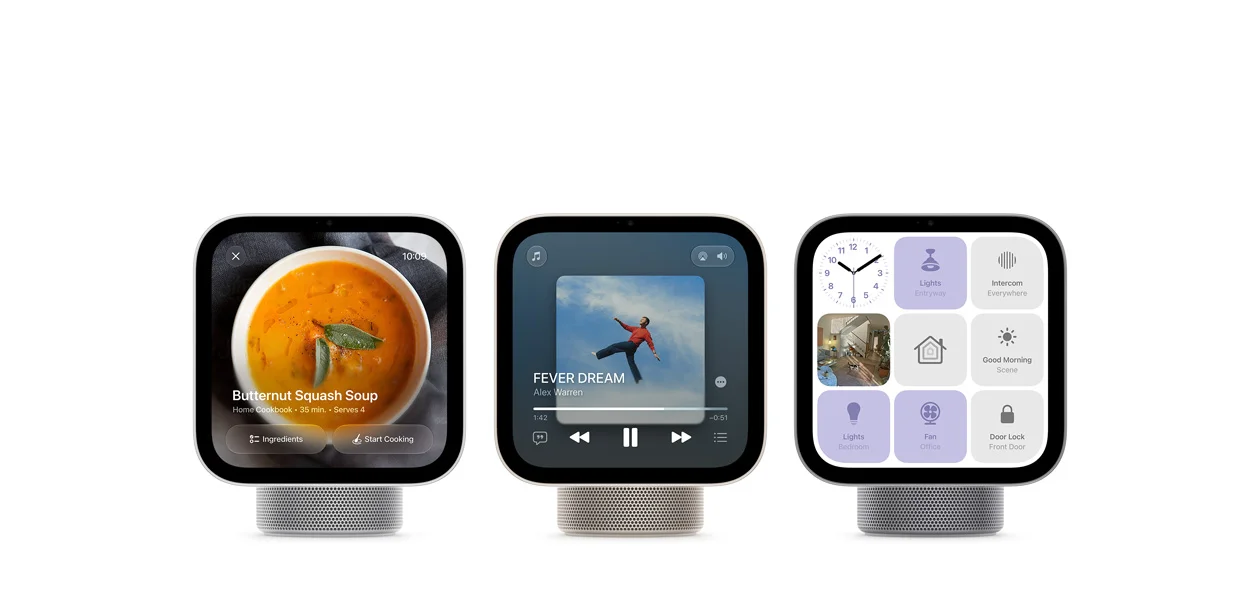 HomeView smart display in four colors, the Apple Siri AI home hub launching November 13
Image: Apple
HomeView smart display in four colors, the Apple Siri AI home hub launching November 13
Image: Apple
The interface changes with distance. From across the room it shows larger, simpler information, and it shows richer detail as you walk up. Apple lists several "faces": a Photos face, a Flow face that responds to movement, a Snoopy face that reflects time of day and weather, a Home Modular face for accessories, and a Home Camera face that can stream up to nine video feeds at once.
The headline feature is recognition. HomeView identifies up to six people by face and gives each their own home screen with apps and widgets. CNBC reports it shows information from Messages, Photos, Calendar and Reminders depending on who is standing in front of it, powered by Apple Intelligence. Apple adds that personal content only appears when the paired iPhone or iPad is present and recently unlocked. Apple says personal content stays private while shared photo albums and music remain available to everyone, guests included.
Greg Joswiak, Apple's chief marketer, described the design goal in Apple's statement: a device "designed to be shared by everyone in the home yet feel completely personal to each user."
It also handles FaceTime with Center Stage, Intercom messages across the home, and a cooking mode that converts web recipes into step-by-step instructions with hands-free timers and ingredient tracking. It acts as a home hub for notifications and automation, and CNBC notes it works with new locks, doorbells and cameras from LG Electronics and Schneider Electric.
Where does Siri AI fit in?
Siri AI is the reason the hardware exists. Apple's product page says Siri AI is "a personal assistant that helps you find what you need and get more done," available in English to start, with a footnote that usage limits may apply. MacRumors adds that with an Apple Intelligence-compatible iPhone or iPad, Siri AI can take actions across apps, surface information from Messages and Calendar, pull Apple Music playlists, and sync conversations across devices. Users can also adjust the expressiveness and pace of Siri's voice on their paired device.
Apple's page footnotes that usage limits may apply, and it does not spell out what they are. Even without an Apple Intelligence iPhone or iPad, Apple says HomeView still offers Siri AI's world knowledge, conversation and music discovery; the personal-context features need the paired device.
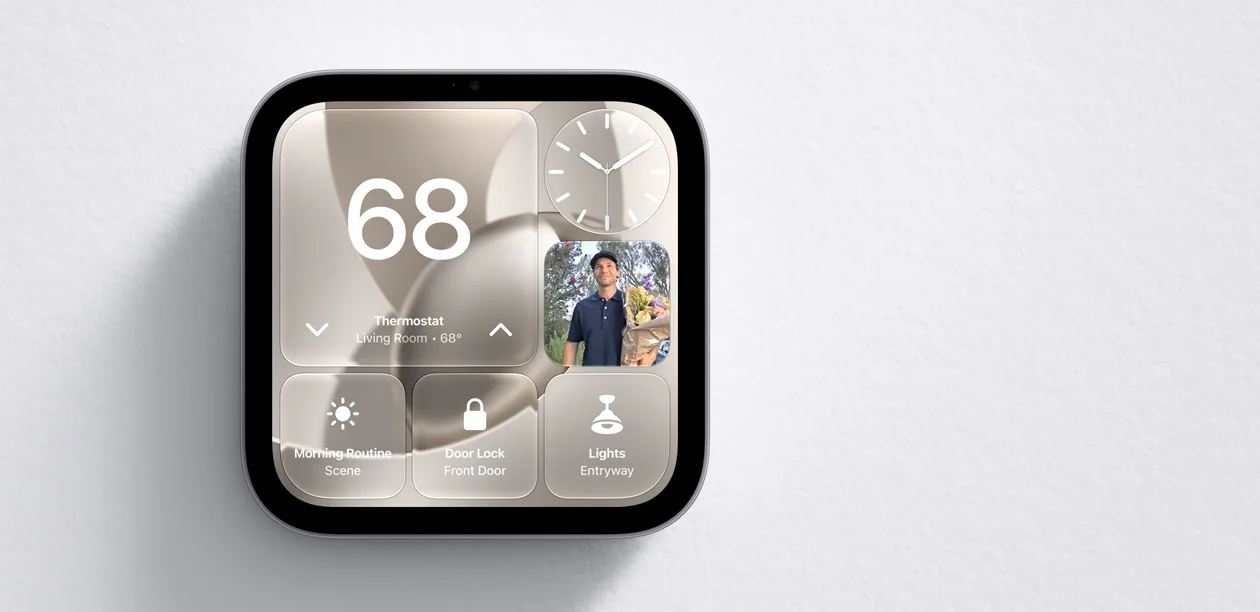 Apple HomeView smart home dashboard showing thermostat, door lock and camera feed controlled by Siri AI
Image: Apple
Apple HomeView smart home dashboard showing thermostat, door lock and camera feed controlled by Siri AI
Image: Apple
If you want the background on how Siri AI got here, our rundown of every AI feature from the September 9 event covers the iPhone side, and the iOS 27 code analysis on Model Delegation explains how Apple built Siri to hand work to outside models such as Claude or ChatGPT. Nothing announced on October 13 changes that picture: Apple did not say whether HomeView or the other devices can route to a third-party model.
Why is HomeView not available in the EU?
This is the part of the announcement that matters beyond the product itself. Apple said HomeView will not initially be sold in the European Union because Siri AI is currently unavailable on iOS there, and that it is "working constructively with the EU" on a path forward, as MacRumors reported and Techmeme summarized. MacRumors states plainly: "It is not available in the EU."
The reasoning is simple. HomeView leans on a paired iPhone or iPad for personal context. If those phones cannot run Siri AI in the EU, the hub would be a very expensive speaker with a screen. The same constraint touches the other two products: the HomePod mini 2's Siri AI needs an Apple Intelligence-enabled iPhone or iPad, and MacRumors forum commenters were already pricing the speaker at 169 euros for a single unit, which is a reader reaction rather than a verified Apple price.
The regulatory backdrop is the Digital Markets Act. As we covered in the Model Delegation analysis, the European Commission has said interoperability duties extend to Siri, and Apple has been building plumbing for third-party models partly for that reason. Apple has not said what specifically blocks Siri AI in the EU or when that could change. For a similar pattern of frontier AI arriving late or restricted in Europe, see our report on Anthropic's Mythos 5 and EU access.
What is confirmed: Apple will not sell HomeView in the EU at launch and says it is talking to regulators. What is not confirmed: any date, any legal mechanism, or whether a trimmed-down EU version is planned.
What Apple's product page adds: privacy, hardware and fine print
Apple's own HomeView page goes further than the launch coverage on several points.
Privacy architecture. Apple says the A18 chip contains Secure Exclaves that process camera and microphone feeds in a compartment the operating system and Apple cannot access, which is how HomeView recognizes each person's face and voice without exposing the recognition data. Personal content appears only when the paired iPhone or iPad is on the same Wi-Fi network, was recently unlocked, and HomeView recognizes the person by face. Siri AI requests that need server-side models go through Private Cloud Compute, which Apple says never stores data or makes it accessible to anyone, itself included. These are Apple's claims; independent verification has not been published.
Hardware details.
| Spec | Apple's page |
|---|---|
| Display | 7-inch (6.98 inches diagonal) Liquid Retina, True Tone, 0.3 to 500 nits |
| Camera | 12MP Center Stage, keeps people framed on FaceTime |
| Audio input | Four beamforming microphones |
| Audio output | Two full-range drivers, down-firing woofer, two passive radiators, Spatial Audio, AirPlay multiroom |
| Power | Wired only: USB-C cable and adapter included |
| Wall-mounted model | Space Gray and Silver, wired or plug-in mount options sold separately |
| Alerts | Detects smoke and carbon monoxide alarm sounds and notifies your iPhone, iPad or Apple Watch |
Fine print on Siri AI. The footnotes matter. Apple says Siri AI is available in beta in HomeView software version 27.2, in English to start, and that features relying on server-side models are subject to daily usage limits. It also says "expanded access to such features will be available for a fee in the future." Apple has not published the limits or the price of that expanded access, so treat the $299 as the hardware price, not the full cost of the AI.
Apple Home Collection. Apple says smart cameras, thermostats and a door lock designed with select brands will be easy to set up and use end-to-end encrypted data in Apple Home. The page marks them "coming later," with no dates or prices. HomeView also needs a HomeKit- or Matter-enabled accessory for smart-home control, and supports compatible third-party audio and video apps from your iPhone.
Apple TV 4K: A19 chip and a $100 price rise
The fourth-generation Apple TV 4K brings an A19 chip, 128GB of storage, Wi-Fi 7 and Bluetooth 6, according to the Verge coverage summarized by Techmeme (we could not open the Verge page). It ships November 13 at $299. CNBC reports the box jumped from $199, a second increase this year, and that it comes with a redesigned remote that can play a sound when lost.
Apple attributed the earlier hike to memory costs; CNBC quotes the context that Tim Cook had called memory costs "unsustainable." That is the same component squeeze that has been pushing up prices across AI hardware, a thread we followed in Nvidia's DGX Spark memory-driven price change and in the Qualcomm claim about 100B-parameter phone models, where memory is the limiting factor.
Four HomePod minis can be paired with the new Apple TV 4K for four-speaker surround sound that calibrates itself to the room, MacRumors reports. One reader on that site did the math: four speakers plus the box comes to roughly $900 before tax. That is a commenter's arithmetic, but it follows directly from the listed prices.
HomePod mini 2: $149, Sound Glow, Siri AI later
The HomePod mini 2 has an S10 chip for computational audio, which Apple says tunes dynamic range, loudness and acoustic performance in real time. A Sound Glow feature turns the top of the speaker into a lighting surface that reacts to bass and treble and pulls colors from the album art. It comes in pink, green, blue, white and midnight, ships October 30, and costs $149, up from $129.
Siri AI is the part to read carefully. Apple's release says it will arrive in English through a future software update in the US, Australia, Canada, India, New Zealand, Singapore, South Africa and the UK, with no date. It recognizes up to six users by voice and connects to their devices for personalized information such as Messages. The speaker also works as a home hub, supports Sound Recognition for smoke and carbon monoxide alarms, and works as a Mac speaker.
In other words, you can buy the HomePod mini 2 on October 30, but the AI that justifies calling it a new generation is promised, not shipped. That is a pattern readers will recognize from Siri AI's own history: Apple agreed in May to a $250 million settlement over the delayed Siri AI launch, with claims open through December 21, according to MacRumors' earlier reporting.
What it means for your home setup
Apple's smart-home strategy is now explicit: the home hub is a Siri AI surface, and Siri AI is gated by your phone, your region and your language.
| If you are... | What to expect |
|---|---|
| In the US, UK, Canada, Australia, India or NZ with an Apple Intelligence iPhone | HomeView and Apple TV 4K on November 13 are viable; HomePod mini 2 gets Siri AI after a later update |
| In the EU | HomeView is not sold; check back, since Apple says it is working with the EU |
| On Android | HomeView depends on an iPhone or iPad for personal context, so it is not a fit |
| Buying only for music | The HomePod mini 2 works today as a speaker without waiting for Siri AI |
| Privacy-sensitive | Face recognition plus a camera in the home is a trade-off; Apple's privacy page says personal content stays private, but read it before you decide |
The privacy question deserves independent scrutiny. Apple says camera and microphone data used for recognition is processed in Secure Exclaves on the A18 chip, out of reach of the operating system and Apple. Those are Apple's claims, and we have not tested units. Hands-on reviews will not land until shipments begin.
What we don't know yet
- The exact daily usage limits for server-side Siri AI features and the price of any expanded tier
- Whether HomeView or HomePod mini 2 can use third-party models (Claude or ChatGPT) the way iOS 27 code suggests Siri can
- When Siri AI reaches the EU, and whether HomeView follows
- Real-world accuracy of the six-person face recognition, especially for guests, children and low light
Our read
Apple is not competing on raw model quality here. It is competing on integration: your face, your phone's messages and calendar, your cameras and locks, in one product. The price hikes, the EU gap and the HomePod mini 2 waiting on software all show how much of the experience depends on Siri AI being ready. For builders, the lesson is the same one we keep seeing across AI hardware: the model is the product, and availability by region and device decides whether anyone gets to use it. Ternus's first months have been defined by that bet, and the iPhone Duo launch was the first half of it.
Related reading
Prices, dates and specs are accurate as of October 13, 2026 and come from Apple's announcements and the outlets cited above; confirm them on Apple's site before ordering.