



Mike Houser, who says he does not know how to code, posted Age of Dragon on November 10, 2026: a browser-based open-world RPG on a 12 by 12 km island, built in about four days with Claude Fable 5.2 and Opus 5.5, Three.js, Blender and a stack of generated assets. The video passed 150,000 views within hours.
The stats are large, and they are all self-reported. This post lays out what he claims, how the pipeline fits together, which numbers hold up, and what a builder can copy this week. It is the same direction we covered in friendslop browser games built with Opus 5.5, pushed from a single-room toy to a full world.
TL;DR: the questions people ask first
| Question | Short answer |
|---|---|
| What is it? | A browser open-world action RPG called Age of Dragon (AoD), shown in a 1:56 video and a five-part thread |
| Who made it? | Mike Houser, who says he quit his job two months ago and spent his last $1,400 |
| How fast? | About four days of building, per the thread |
| Which models? | Claude Fable 5.2 and Opus 5.5 for code and orchestration |
| How much code? | About 80,000 lines, 85,000+ tool calls, 21B+ tokens (all self-reported) |
| Is it playable? | The post describes it as running in the browser; we could not confirm a public build at the time of writing |
| Is "2x Skyrim" true? | It depends on the measure. Commonly cited figures for Skyrim's map are near 37 km², which would make 144 km² closer to 4x |
| What should I copy? | The art-first pipeline, one shared skeleton, and agents that drive Blender |
What did Houser actually claim?
The thread opens with a stat block. We have reproduced it as posted, with no independent check:
- World: a 12 × 12 km island, 6 regions, 79 places and 9 dungeons.
- Content: 34 quests, 56 unique enemies and 20 bosses.
- Art: 482 3D models and 694 animations.
- Audio: 544 voiced lines, 772 sound effects and 37 custom music tracks.
- Code: about 80,000 lines, 85,000+ tool calls and 21B+ tokens.
- Runtime: Three.js and Blender, with the game running in the browser.
He adds a personal story: he left his job two months earlier, with "no idea how to code," and now makes games with AI full time at Tesana. That last detail matters. He works for a company in this space, so the thread is also a showcase. It does not make the result fake, but it explains the tone.
The world: art first, then geometry
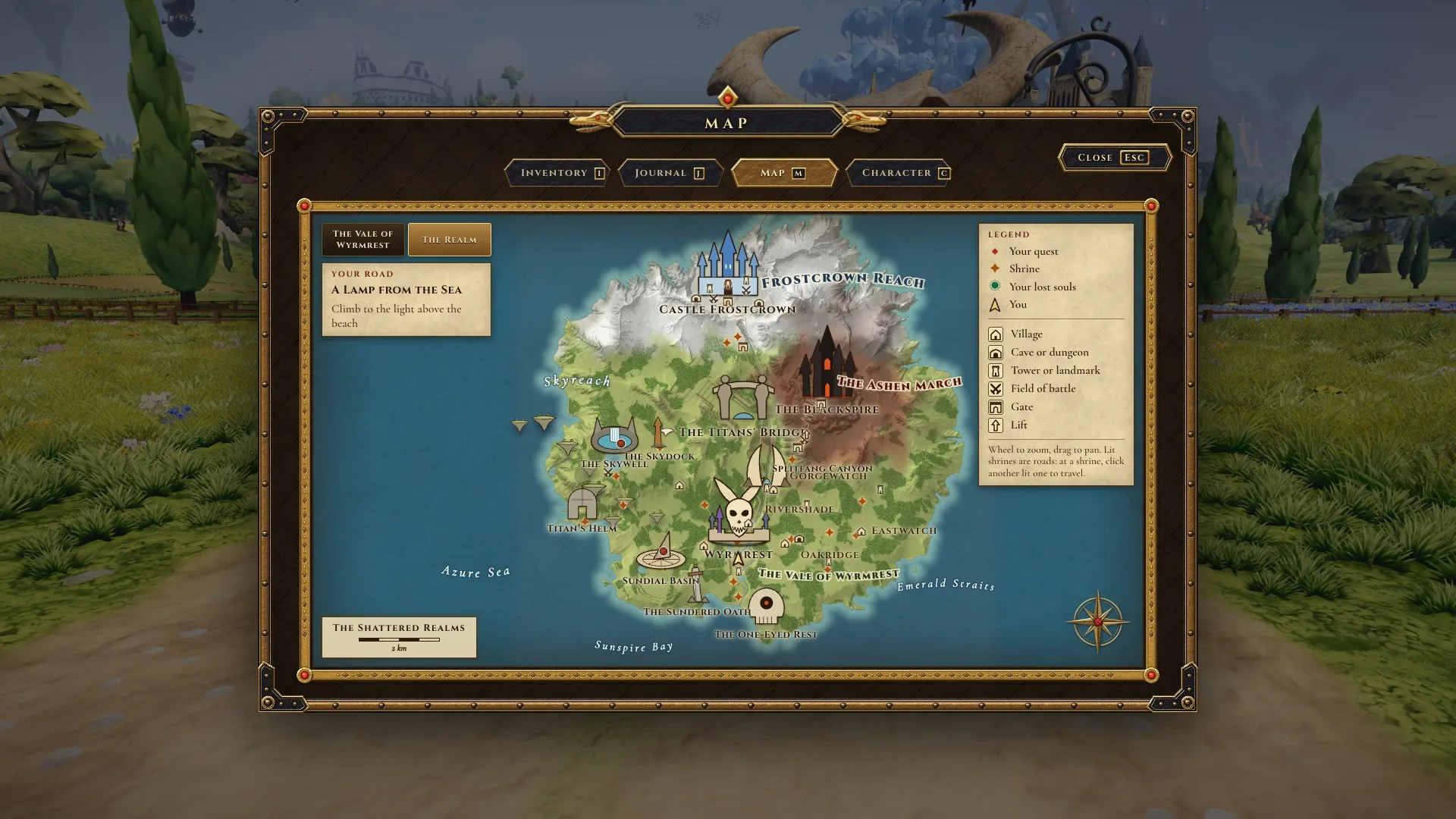 Age of Dragon in-game realm map showing regions, villages, dungeons and shrines on a 12 km island, an example of an AI-built open-world RPG
The in-game Realm map from Houser's thread, shown with credit. Image: Mike Houser, Age of Dragon.
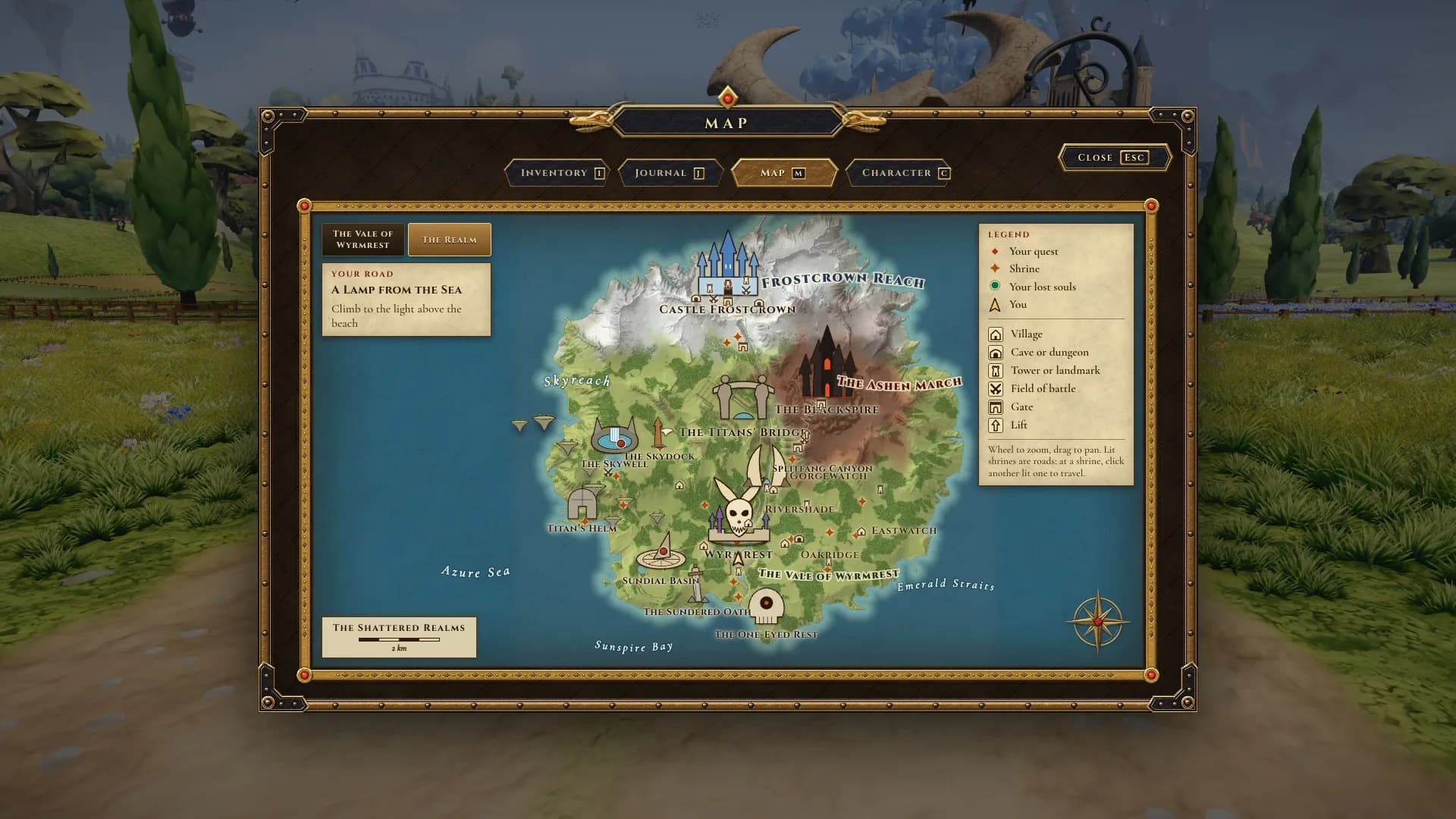
The map screenshot above is the most useful single frame in the thread. It shows named regions such as Frostcrown Reach and The Ashen March, a legend with villages, dungeons, shrines and gates, and a fast-travel rule: lit shrines act as roads. That is a real game UI with real systems behind it, not a prompt demo.
Houser says every landmark started as a painting or concept image and then became a place the player can walk to. This matches what we saw in our own image-to-3D character pipeline: the model is far more reliable when it has a fixed visual reference than when it has to invent geometry from a sentence.
Scale claims are the easiest to check:
| Claim | Arithmetic |
|---|---|
| 12 × 12 km | 144 km² |
| 45 minutes on foot | About 16 km/h, a sprint pace, so "crossing" likely means a straight run |
| Under 4 minutes on a dragon | About 180 km/h at minimum, a plausible flight speed in a game |
| Twice Skyrim | Needs Skyrim at about 72 km²; common fan measurements give roughly 37 km² |
None of this lowers the achievement. It does mean the headline "2x Skyrim" should read as "a large map," not as a measured ratio. Size of the map also says little about how dense or fun the space is.
How did a non-coder get 80,000 lines of working code?
The honest answer is that the human did not disappear. The work moved up a level. Houser describes directing, reviewing and correcting, and the numbers show a loop that ran for most of four days.
85,000 tool calls over four days works out to roughly 885 calls per hour if the agents ran around the clock. That only happens when agents loop on their own: write a module, run the game, read the console, fix the error, repeat. The pattern is the one we describe in our guide to vibe coding, taken to its limit.
The 21B token figure also deserves a note. Divided by 85,000 calls, it is about 247,000 tokens per call. That is far too high for new text. It is consistent with long contexts being re-read on each step, which is how agent sessions bill. If you want to estimate your own costs, our Opus 5.5 task cost breakdown shows how cache reads dominate a long session.
Which tools did each job?
Houser names a full stack. We have grouped it by role, because the roles matter more than the brands:
| Role | Tool he named | What it did |
|---|---|---|
| Code and orchestration | Claude Fable 5.2 and Opus 5.5 | Wrote the game, drove the other tools |
| Engine | Three.js | Browser rendering, no install |
| 3D models | Tripo | Image or prompt to game-ready models, 400+ in total, 20+ just for trees |
| Rigging and animation | Blender, driven by Claude | One shared skeleton, a mocap library retimed per body weight |
| Audio | ElevenLabs through fal | Voices, effects and music |
| Platform | Tesana | His current employer's tool |
Two details stand out. First, he says Claude rigged the creatures in Blender: "one shared skeleton, a mocap library retimed for each body's weight." His advice is to ask the model to use Blender and then "download blender and watch the magic happen." Second, he says all 400+ models came from one maximum-tier subscription. That keeps the cost per asset low, but it also ties the result to one vendor's output style.
 Sound effect concept showing a drop making ripples, an example of AI-generated game audio with 772 effects
Audio at scale
The audio numbers are the hardest to review: 544 voiced lines, 772 sound effects and 37 music tracks. Nobody can listen to all of it quickly, and generated audio drifts in tone across hundreds of files. If you try this, set a voice sheet per character before generating, the way a studio would. Our bunpav audio lab write-up covers a procedural alternative that avoids the review burden.
Why one shared skeleton changes the math
Animation is where most solo game projects stall. Each new enemy normally needs its own rig, its own clip set and its own test pass. Houser's approach removes most of that: one skeleton, with motion retimed for each body's weight.
This is a good example of an agent working inside a professional tool rather than replacing it. Blender scripts are Python, and models write Python well. The agent can import a mesh, fit the skeleton, bake clips and export, then the game loads the result. We hit the same pipeline shape in our rigging post, and the lesson there applies here: the hard part is cleaning up generated meshes before rigging, not the rigging step itself.
What are people asking about this?
We did not read every reply. These are the questions that usually follow a viral build like this, and the ones the thread leaves open:
- "Can I play it?" The thread describes a browser game, but we found no public link we could verify. Wait for a build before judging gameplay.
- "Is the quality real or just a flyby?" A camera flyby hides combat feel, pathing, bugs and load times. The map UI and quest list suggest real systems, but the video cannot prove balance or stability.
- "Who owns the assets?" Generated 3D models and audio have license terms set by each vendor. Check them before you sell a game. This is the same copyright question we raise in our vibe coding mistakes guide.
- "Is this the new normal?" It is a data point, not a baseline. The creator reports a heavy budget and a long review effort, and the result is one project.
What this means for what you build or pay
If you build games or interactive 3D, three takeaways are practical today.
- Start from art, not from a prompt. Fix a style, make concept images, then ask the model to turn each one into a place or a model. Consistency comes from the references.
- Give agents the tools professionals use. A model that can run Blender headless and read the error output beats a model that only writes code. See our notes on agent skills for game art in Blender and Unity.
- Budget for loops, not prompts. A world this size is thousands of small fix cycles. Price it with the cache-aware math above, and compare Fable 5.2 pricing against Opus 5.5 for the bulk steps.
If you only want to learn the workflow, start smaller. Build one region with five quests, one boss and a single skeleton. You will learn the same loop at one percent of the cost, and you will find your own bottlenecks.
What to be careful about
Treat the viral numbers like any other launch claim. We have not run the game, and the stats come from one thread by someone who also works for a vendor named in it. Four checks we would run before copying the workflow:
- Ask for a playable build and a frame-rate figure on a mid-range laptop.
- Look for the 80,000 lines in a public repository so the size and quality can be reviewed.
- Read each asset vendor's commercial license before shipping.
- Run a security pass on any agent that writes and executes code unattended for days.
The wider picture is encouraging for builders. A person without a coding background directed agents to a content-heavy 3D project in days, using tools you can also use. That is a real shift in who can make games. It is not yet proof that a full commercial title now takes four days.
Related reading
- Claude Fable 5.2 vs Opus 5.5: benchmarks, cost, routing
- Claude Opus 5.5 launch: benchmarks and pricing
- Friendslop browser games built with Opus 5.5
- Top 20 things built with Claude Fable 5.2
- AI image-to-3D rigged game character pipeline
- What is vibe coding?
- Opus 5 and the browser Call of Duty test
- Source: Mike Houser's Age of Dragon thread on X
Figures in this post come from the creator's public thread dated November 10, 2026, and were not independently verified. Details may change as a public build or repository appears.