



On October 3, 2026, Yann LeCun reposted a clip, roughly two years old, saying that despite everything AI can do, "we're still very far from matching human and animal intelligence," and that it was not going to happen in the next two years. The clip's framing: "Your cat understands the physical world better than today's most powerful AI systems."
LeCun's own comment on the repost: the video is two years old, and two years later we are still far from human-level AI. LeCun then asked a list of pointed questions. This post takes them one by one and checks each against what is publicly known, because a list of "where is my X?" is only persuasive if X really does not exist, and only decisive if X is the right test.
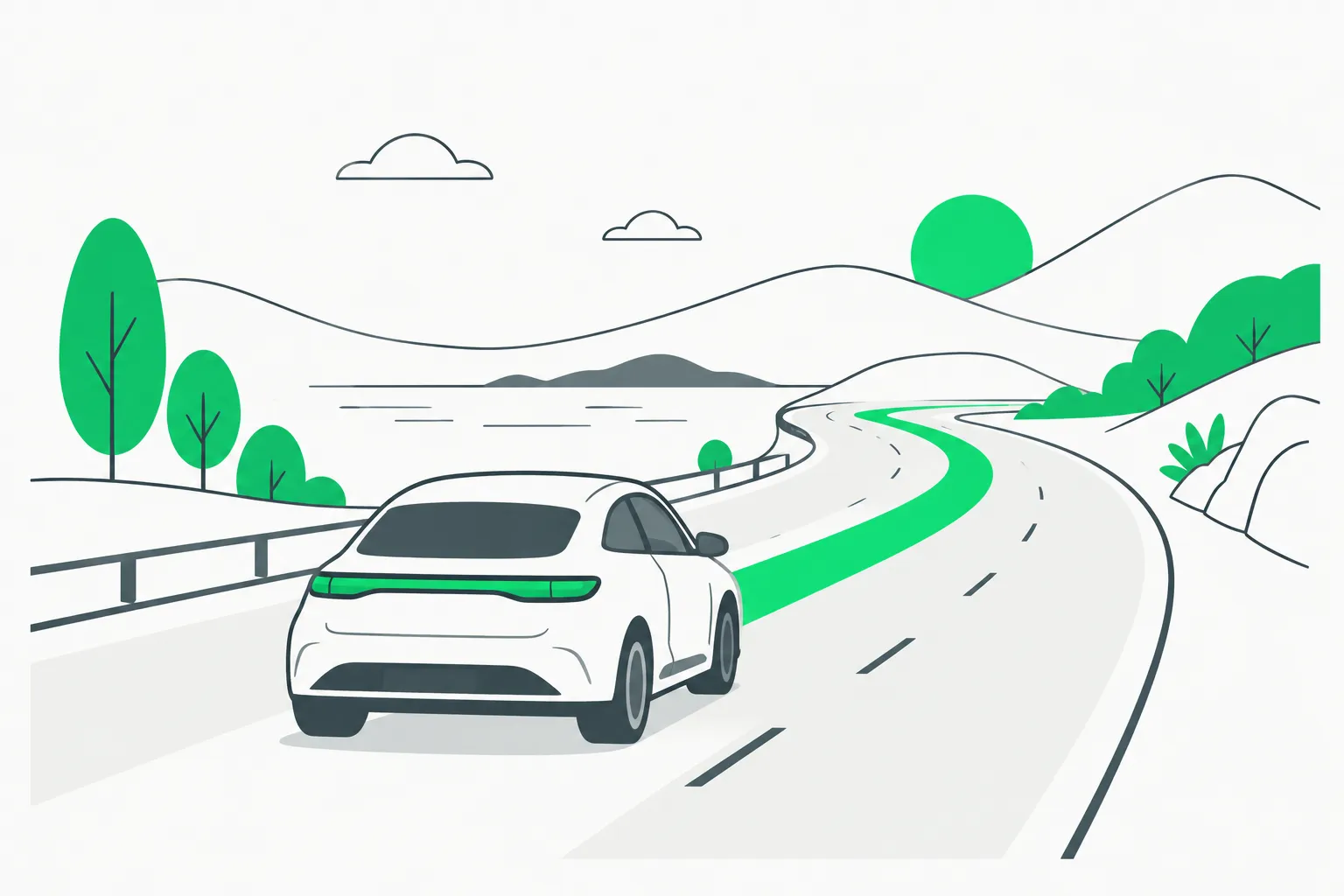 A car on a curving road with a green path ahead.
TL;DR — what people are asking
| Question | Short answer |
|---|---|
| What did LeCun claim? | Human-level AI is still far; physical-world competence is the gap |
| Does LeCun concede AI strengths? | Yes: math, coding and known-answer questions |
| Level-5 car? | None deployed. Waymo is Level 4; Tesla FSD is Level 2 |
| 20-hour driver? | Not demonstrated; self-driving still relies on massive data |
| Domestic robot / 8-year-old robot? | Impressive demos, no general household deployment |
| Strongest point | Sample efficiency and robustness in the physical world |
| Most contestable point | Using Level 5 as the bar, when Level 4 is already useful |
| LeCun's own bet | World models via JEPA at AMI Labs |
| Verdict | Directionally supported; the benchmarks LeCun picks are chosen to favor the thesis |
The challenges, one at a time
1. "Where is my Level-5 self-driving car?"
LeCun's parenthetical is accurate. Tesla's Full Self-Driving (Supervised) is rated SAE Level 2, meaning a driver must supervise and be ready to take over. Waymo operates at Level 4, meaning no driver, but only within defined areas and conditions. As of a September 2026 tracker, Waymo offered public rides in about 14 US metros with more than 500,000 paid rides a week, and Tesla has no vehicles permitted to operate at Level 4. No company has deployed Level 5, which means driving anywhere a human could, in any conditions.
Two things are worth keeping apart.
- The factual claim holds. No Level 5 exists.
- The choice of bar is generous to LeCun's thesis. Level 5 is a very high standard; many humans would not drive in every condition either. A Level-4 service that serves hundreds of thousands of paid rides a week is a real capability, not a parlor trick. Our earlier post on LeCun's debate over self-driving and physical agents covers that argument in depth.
The limits of Level 4 are visible, too. Waymo has paused service in Texas cities for weather and flood-related safety concerns during 2026, which is a reminder that Level 4 is bounded by its operating conditions. That is exactly the "messiness of the physical world" LeCun refers to.
2. "Where is the self-driving car that can teach itself to drive in 20 hours?"
This is the sample-efficiency argument, and it is LeCun's most durable point. A teenager learns to drive in tens of hours; self-driving systems rely on billions of hours of data and extensive engineering. LeCun adds that "we have billions of hours of training data and still can't successfully train a self-driving system by imitation learning."
The counterargument, which several replies and earlier threads raise, is that the teenager is not starting from zero. A 17-year-old brings roughly 17 years of embodied experience with objects, motion, intent and social behavior. That is LeCun's point restated: the missing ingredient is the learned model of the world that makes 20 hours enough. The disagreement is over whether that model can be built by scaling current methods or needs a different architecture.
3. "Where is my domestic robot? The robot that can do what an 8-year-old can do?"
Robots are improving visibly. Our coverage includes Figure's Helix 02 tidying a bedroom with collaborating humanoids, 1X NEO's 25-degree-of-freedom hands, and Xiaomi's robotics foundation model. These show real progress in manipulation and planning.
What does not yet exist is the thing LeCun asks for: a robot that learns a new task as quickly as an eight-year-old across the open-ended mess of a home. Demos tend to be curated, repeated and operating in limited settings. The question to ask of any robot demonstration is how many attempts, how much per-task data or teleoperation, and how often it fails in an unfamiliar room.
4. "AI has superhuman performance... in mathematics and coding"
This concession is real and checkable. Epoch's index puts Claude Opus 5.5 at 167 with 91 to 95 percent on FrontierMath tiers, Google's Cogentic system produced five solutions to open math problems, and Meta's Muse Spark reported six open-problem results. Whether you treat those as superhuman depends on the baseline, but the gap between that progress and household robotics is itself the shape of Moravec's paradox: things hard for humans, like formal math, turned out easier for machines than things easy for a child, like picking up a glass.
The strongest and weakest parts of the argument
Strongest.
- Sample efficiency. Humans and animals learn physical skills from small amounts of experience. Current systems mostly do not.
- Robustness. Systems that look excellent on average can fail in rare, strange conditions, which is why Level 4 comes with an operating domain.
- Persistence. The claim "not in two years" has now been tested against two years of reality, and the specific items LeCun lists remain unmet.
Weakest.
- Moving goalposts risk. Level 5 and eight-year-old-level generality are bars that no one expected to hit quickly, so failing them is weak evidence about whether the field is on track.
- Selective benchmarks. The list focuses on embodied tasks, which suit LeCun's thesis, and omits areas where progress has been fast.
- Unfalsifiable framing. "Far from human-level" needs a definition. If the test is "everything a human can do," it is true by construction for a long time; if the test is "most economically valuable cognitive work," the answer is less clear.
The replies in the thread show the same split. Some readers praise the candor about LLM limits; others note Tesla's supervised driving is not the best example, or ask when LeCun's own company will show results. One reply asked whether it matters if AI matches human intelligence at all, if it can act in an environment and repair itself. A fair summary is that the argument is usually about different goals: one side asks what systems can do economically, the other asks whether they understand the world.
AMI Labs: what the challenge to LeCun is
A commenter asked how LeCun's world-model startup is doing. The public facts, as of the sources reviewed: AMI Labs (Advanced Machine Intelligence Labs) was founded after LeCun left Meta, and in March 2026 reported a $1.03 billion seed round at a $3.5 billion pre-money valuation, described as Europe's largest seed round, co-led by Cathay Innovation, Greycroft, Hiro Capital, HV Capital and Bezos Expeditions. It aims to build world models based on JEPA, the Joint Embedding Predictive Architecture, for robotics, industrial and healthcare uses. The idea is to learn compact representations of the world and predict how it evolves, so an agent can plan by reasoning about consequences.
I found no verified public benchmark or product release from AMI Labs in the sources reviewed, so there is nothing yet to compare with the 20-hour driver or the eight-year-old robot. That is a fair criticism and a fair expectation: if LeCun's approach is right, the proof will be a system that learns physical tasks with far less data, not an argument. For background on the idea, see our explainer on what world models are and NVIDIA Cosmos 3 as an open physical AI world model.
A practical test for AGI claims
Whether you find LeCun or the critics more persuasive, you can apply the same questions to any claim that human-level AI is near or far.
- Which task, exactly? "Drive" is not a task; "drive in rain in a city it has never seen" is.
- How much data or practice? A system that needs billions of examples is not matching a person who needs twenty hours.
- What is the error rate, and what happens at the tail? Average performance hides rare failures.
- Where is the deployment? A demo is not a service. Count paid rides, units in homes, tickets resolved.
- What is the human baseline? Name the person: a 17-year-old, a novice nurse, a median coder.
- How was it measured, and by whom? Vendor-run versus independent.
- What would change your mind? Write the evidence down before the next release.
For a builder, the practical consequence is to keep two ledgers. On the cognitive side, AI is advancing quickly and you can rely on it for increasingly demanding digital work. On the physical side, plan for demos to outrun deployments, and test in your own environment. Our guides to loop engineering with coding agents and what superintelligence means give more vocabulary for the broader debate.
What people are asking
Was LeCun wrong two years ago?
On the specific claim in the clip, human-level AI not arriving within two years, the record so far supports the claim. On the broader claim that LLMs are a dead end, that remains disputed, because LLM-based systems keep gaining on tasks that once looked out of reach.
Does Level 4 count as solving self-driving?
It solves it within a domain. Whether that is "solved" depends on whether you need the car to go anywhere in any condition. It is certainly a large, useful capability.
Are humanoid robots about to change this?
Progress is real, but the gap between a demo and a robot that learns new household tasks quickly in unfamiliar homes remains. Watch deployments and failure rates.
Is this an LLM-versus-world-models fight?
Partly. LeCun argues text-trained models lack grounding in physical reality. Others argue scaling plus multimodal training will close the gap. Both camps are building world-model-like components, so the line is blurring.
Why does this matter for builders?
It tells you where to be skeptical. Be confident in using AI for code, math and knowledge work with verification; be conservative with claims about autonomous physical systems.
Honest limitations
- The tweet's quotes are from the post as shown; I could not verify the original two-year-old clip.
- Waymo and Tesla status comes from trackers and reporting that may lag; the Waymo ride counts are secondary.
- AMI Labs funding is from news coverage; I found no independent evidence of its technical progress.
- This post compares claims with public information and does not settle the AGI question.
Bottom line
LeCun's list is accurate on the facts: there is no Level-5 car, no 20-hour self-taught driver and no robot that learns like an eight-year-old. The bars are high and chosen to favor that thesis, and the strongest version of the point is about sample efficiency and robustness, not about whether AI is useful. The proposed answer, world models, has money behind it and no public results yet. Judge claims about AGI, from any side, with specific tasks, data budgets, error rates and deployments.
Related on explainx.ai
- LeCun on LLMs, physical agents and Moravec's paradox
- What are world models?
- NVIDIA Cosmos 3 physical AI world model
- Figure Helix 02 bedroom tidy demo
- 1X NEO hands and physical API
- Claude Opus 5.5 tops the Epoch index
- Google Cogentic's five math problems
- What is superintelligence?
Quotes and status reflect LeCun's October 3, 2026 post and public reporting as of that date. AMI Labs and self-driving figures come from secondary sources and may change.
Update — October 4, 2026: LeCun's Fortune interview on rogue AI, regulatory capture and AMI Labs: LeCun has "zero concerns" about rogue AI.