



Update: Nature Will's Natura-1 pairs a 50B model with 1M hours of human video for dexterous hands. Read our analysis.
On July 9, 2026, 1X Technologies published NEO's Hands | An API to the Physical World — not a gripper refresh, but a 25-DoF tendon-driven hand 1X will put on every NEO humanoid. CEO Bernt Børnich's thesis: match or beat human hands on dexterity, strength, safety, and reliability so data — not hardware — becomes the binding constraint on what humanoids can learn.
Same week as Colibrì streaming GLM-5.2 on disk and Perplexity's GLM orchestrator, 1X's bet is embodied: the model stack is only as good as what the fingertips can feel and do.
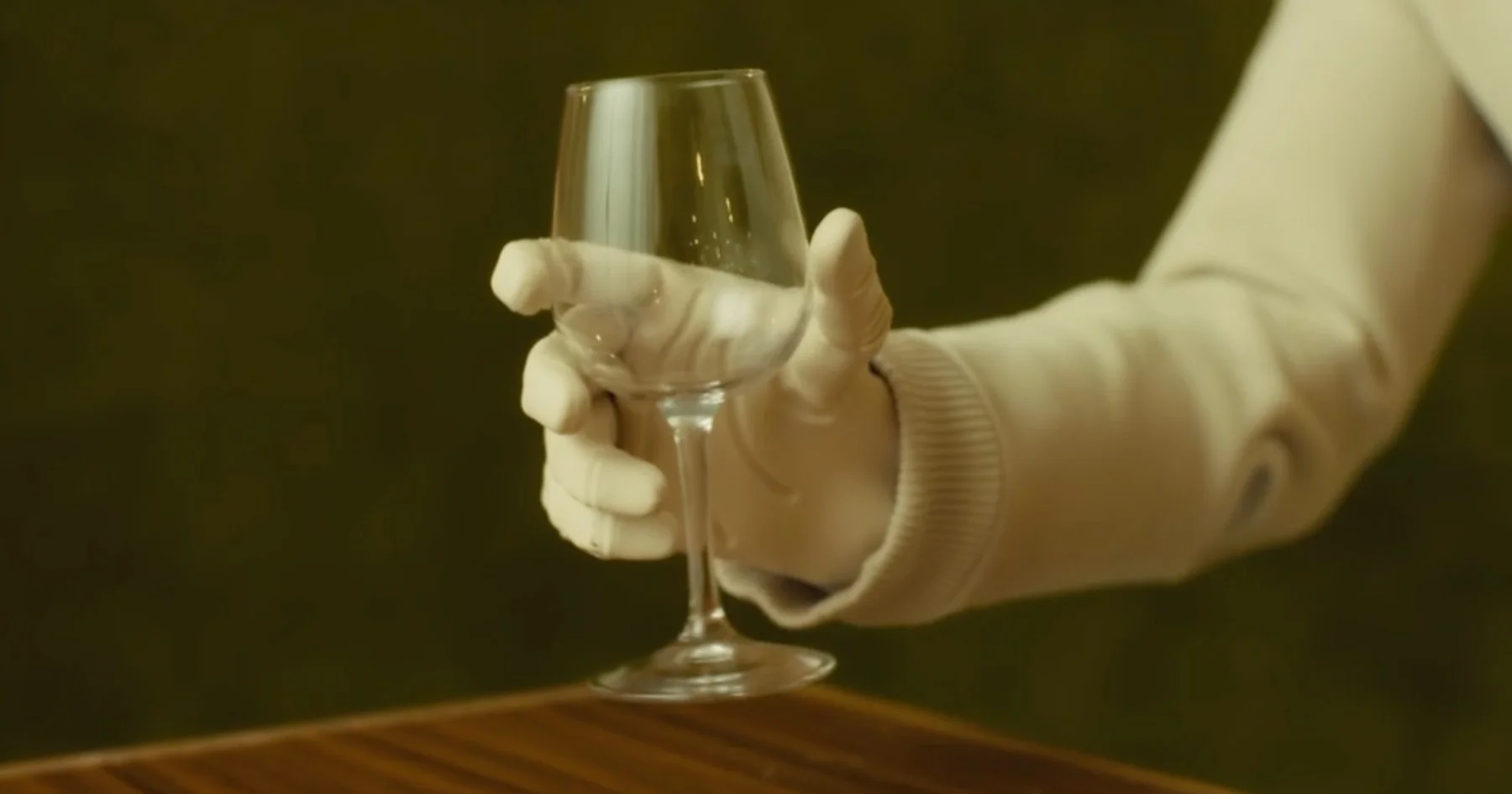 1X NEO 25-degree-of-freedom humanoid hand announcement hero
TL;DR — what people are asking
| Question | Answer (July 9, 2026) |
|---|---|
| What's new? | 25 DoF hands — 22 finger/palm + 3 wrist, all force-controlled |
| Transmission? | 1X Tendon Drive, ~5:1–15:1 (vs industry 100:1–200:1) |
| Sensing? | Force transparency + tactile normal/shear skin + proprioception |
| Strength? | 3.5 Nm thumb / 2.6 Nm MCP / 45N distal / 17.75 Nm wrist |
| Precision? | ±0.2 mm positioning |
| Durability? | IP68, food-safe, millions of test cycles |
| Scale? | Hundreds built; 10,000 hands in 2026 target |
| Ship on NEO? | Yes — standard on every unit, not optional end effector |
| Buy now? | Waitlist at 1x.tech |
"A humanoid is a computer whose API is its hands"
1X's headline framing is deliberately developer-centric:
A humanoid with a two-finger gripper exposes three verbs to developers: pick, place, push. Every application anyone writes on that platform is a composition of those three verbs, forever — executed blind.
Legs and perception get the robot to the world. Hands determine what it can do there and what it can know while doing it. That maps cleanly onto Yann LeCun's physical-agents argument: language models reason about text; manipulation requires closed-loop contact intelligence the way children learn — probe, feel, update.
Mistral Robostral Navigate showed how far map-less locomotion got in 2026. HN's instant reply to dexterity news: navigation ≠ pick up the arbitrary thing. Hands are the missing action space — exactly what 1X is shipping hardware for.
World-picture — five layers 1X stacks
1X describes dexterity as assembling a world-picture subsystem by subsystem:
| Layer | What it adds | Without it |
|---|---|---|
| Rigid gripper | Blind position control | Dark patch — act, barely perceive |
| + Force transparency | Contact returns through joints | No dynamic range in touch |
| + Fine motion | Pose, trace, pinch, in-hand rotate | No small-object regime |
| + Tactile & shear skin | Pressure, slip, contact location | Vision-only guesses on transparent/deformable objects |
| + Reflex & robustness | Re-grip slips; survive millions of touches | Too fragile to learn by probing |
The July post is 1X claiming all five layers ship together — not a lab prototype gripper swapped in for demos.
Force transparency — joints that read, not just write
Most industrial hands are write-only: command angle, hope contact matched intent, wrap external F/T sensors or cameras because 100:1+ gearboxes eat contact forces before they reach motors.
NEO hands use quasi-direct-drive tendons at ~5:1–15:1. All 25 DoF are natively force-controlled and backdrivable — push a finger, it yields, and reports effort. 1X calls this force transparency: the same path that applies force returns measurement.
Proprioception rides along: closed-loop joints always know configuration (eyes-closed fingertip touch test for robots).
Motors live in the forearm — human-analog — pulling proprietary tendons through the wrist so the hand stays light but can deliver multi-Nm grasps without overheating.
Twenty-five DoF — demos 1X shows (with clips)
1X lists household-scale tasks: LEGO, screws/coins, light bulbs, screwdrivers, in-hand rotation, zipping jackets, sorting grapes, pouring tea, USB-C, wine glasses, wiping surfaces, sign language, fruit picking, charging, cleaning, gaming.
Clips below are sourced from 1X's July 9 announcement (Mux-hosted), re-encoded to WebM for explainx.ai — © 1X Technologies.
Hero — cover sequence
LEGO assembly — fine manipulation
Zip jacket — textile + bilateral coordination
Lift — strength under load
Fruit picking — food-safe IP68 context
Force sensing — tactile heatmaps and gentle grasp
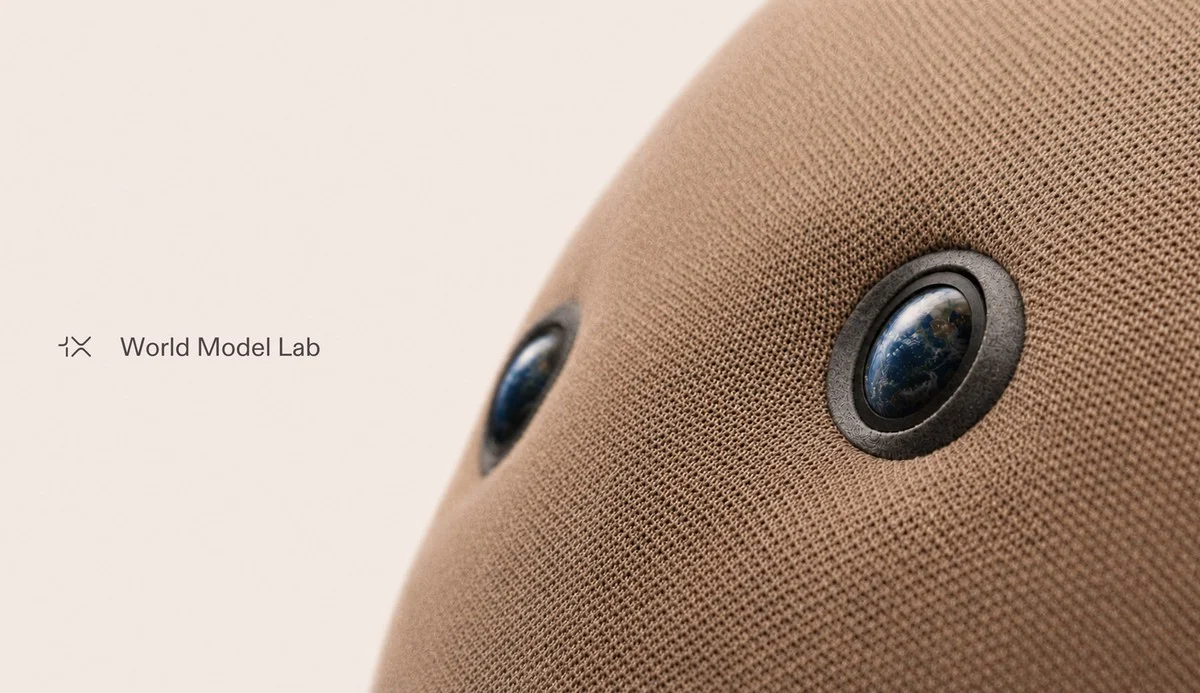 1X NEO tactile skin and force sensing visualization still
Published hardware numbers:
| Spec | Value |
|---|---|
| Thumb CMC peak torque | 3.5 Nm |
| Finger MCP peak torque | 2.6 Nm |
| Distal flexion force | up to 45 N |
| Wrist torque | 17.75 Nm |
| Positioning accuracy | ±0.2 mm |
| Sealing | IP68, food-safe |
| Wrist + finger DoF | 25 (22 actuated in hand + 3 wrist) |
Those specs target the small-object regime where most household labor actually lives — screws, chargers, grapes, not pallet boxes.
Tactile skin — the last half-millimeter
Vision fails on transparent, deformable, occluded objects. 1X co-designed functional skin with embedded sensors measuring normal force, contact location, and shear — slip detection fast enough to re-grip before objects fall.
The post shows pressure heatmaps on handshakes and origami grasps without crushing — evidence the control stack closes loop on contact, not just kinematics.
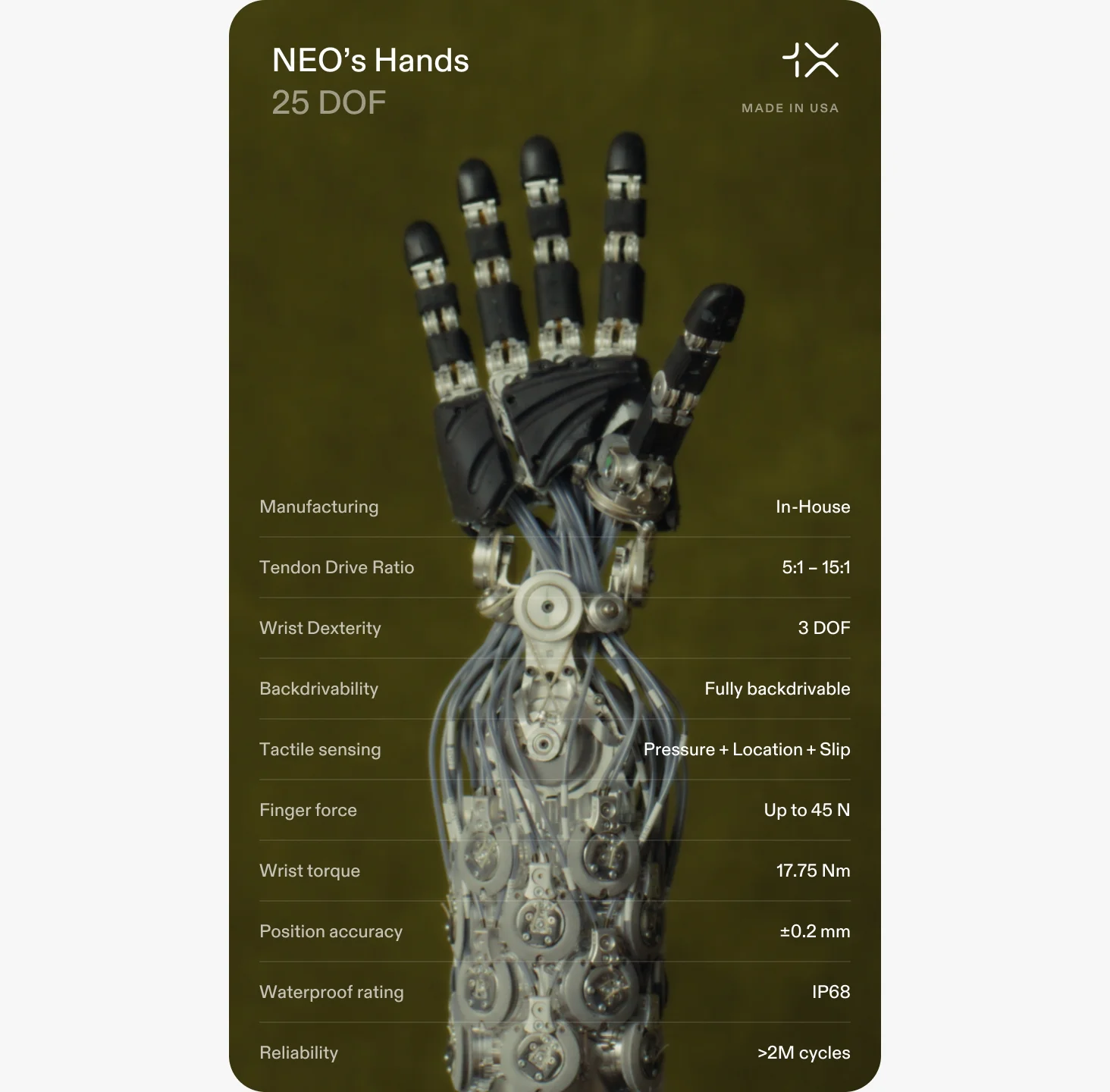 1X NEO 25 DoF hand product render
Safety by construction — backdrive, not brute lockout
1X pairs low gear ratios and low distal inertia with compliance: slow-motion tests show fingers yielding to slaps, hammers, closing drawers, and foam impacts. A hand that learns by touching everything must be gentle by physics — relevant anywhere humans and robots share space.
Hands are IP68 and food-safe — NEO can wash its own hands at a sink. That is a product requirement for home deployment, not a lab flex.
10,000 hands — why manufacturing is the strategy
The strategic number in the post is not peak torque — it is 10,000 hands in 2026:
A hand that can't be built at scale can't run experiments at scale, and without data at scale there is no embodied AGI.
1X claims hundreds already produced on a dedicated line with in-house motors, electronics, tendons, skin, and tactile stack. That contrasts with Figure AI's robot-outnumber-humans factory ramp — different scale story (whole humanoids per hour vs standardized hand modules), same data flywheel logic.
Every grasp becomes a labeled experiment: joint forces, tactile images, poses. That is the dataset Indian egocentric camera workers are manually collecting today — 1X wants the hand to generate rich labels natively during deployment.
June 2026 context: 1X launched its World Model Lab (Sam Sinha, head of world models) — pairing hardware that acts with models that predict physical consequences, adjacent to NVIDIA Cosmos 3 physical AI and world-model research on explainx.ai.
1X NEO hands vs Figure and grippers — honest comparison
| Dimension | 1X NEO hands (Jul 2026) | Typical parallel gripper | Figure 03 |
|---|---|---|---|
| DoF at hand | 25, force-transparent | 1–2 | 48+ whole-body; hand detail less public |
| Contact sensing | Native tendon + tactile skin | External F/T or vision only | Helix VLA + deployment sensors |
| Target market | Home NEO waitlist | Industrial arms | BMW factory pilots first |
| Production claim | 10K hands / year | N/A | ~1 robot / hour BotQ |
| Software API story | Hands = developer API | pick/place/push | Helix collaborative policies |
No independent benchmark yet compares 1X vs Figure on identical manipulation suites — treat demo reels as directional, not scored. The meaningful claim is hardware ceiling removal, not "NEO beats humans on every task today."
What to watch next
- Third-party evals — LEGO and USB-C demos are marketing-grade until independent labs score success rates
- Developer SDK — what APIs expose force, tactile, and proprioception streams to policies
- World Model Lab outputs — do 1X world models train on hand-native contact logs?
- Home pilot pricing — NEO waitlist conversion vs Figure BMW structured deployments
- Data ethics — in-home manipulation generates sensitive egocentric-like traces; compare to camera training labor debates
Who should care
Robotics engineers — first mass-produced force-transparent 25-DoF hand with published torque/accuracy tables and a 10K annual target.
Embodied AI researchers — contact-rich labels without only wearing head cameras.
Home robotics watchers — IP68, food-safe, self-hand-washing signals consumer intent, not warehouse-only.
Investors comparing humanoid bets — 1X vertical integration (motors → skin) vs Figure's whole-robot factory narrative.
AI policy folks — if hands unlock household tasks, labor displacement timelines get sharper than chatbot automation alone (survival guide context).
Related on explainx.ai
- Update — August 17, 2026: For a direct-drive counterpoint aimed at industrial precision rather than home compliance, see Xynova's Prima1 dexterous hand.
- Gemini Robotics 2 — DeepMind whole-body VLA / ER 2 (Jul 30)
- Figure AI: robots outnumber humans milestone
- Mistral Robostral Navigate — locomotion without grippers
- Indian workers filming tasks for humanoid training data
- NVIDIA Cosmos 3 — physical AI world models
- Yann LeCun — LLMs vs physical agents
- Figure Helix-02 collaborative humanoids
- What are world models?
- Technical AI concepts for business leaders — embodied AI section
Official: NEO's Hands — 1X Technologies · NEO waitlist
Specifications, production targets, and demo capabilities reflect 1X's July 9, 2026 announcement. Video and image assets are © 1X Technologies, re-hosted as WebM/WebP for explainx.ai readers. NEO availability and pricing may change — verify on 1x.tech.