




Yann LeCun told the Conference on Robot Learning (CoRL) crowd in Austin that large language models already rack up wins in math, code, biology, and security — and that JEPA-style world models are still the serious bet if your goal is human-level AI, not another chat app. Reporting from the November 2026 session reframes a line he has been repeating since leaving Meta's chief scientist role: scaling autoregressive text predictors is a dead end for general intelligence, even while it mints useful products.
If you build embodied agents, train robot policies, or choose a PhD topic, the talk matters because it comes from the Turing Award co-author of modern deep learning — in a room that cares about contact with the physical world, not leaderboard trivia.
TL;DR: what LeCun argued at CoRL
| Question | Short answer |
|---|---|
| Are LLMs useless? | No. CoRL summaries quote him listing hard math, industrial code, protein design, and vulnerability discovery as real LLM wins. |
| Is scaling LLMs enough for human-level AI? | He says no. He favors world models trained on sensory data that predict action consequences. |
| What architecture does he promote? | JEPA (Joint Embedding Predictive Architecture) via AMI Labs, his post-Meta company. |
| Did he literally say "do not work on LLMs"? | CoRL coverage emphasizes the JEPA contrast. The exact career slide appeared at Brown's 2026 Lemley Lecture: "IF YOU ARE INTERESTED IN HUMAN-LEVEL AI, DON'T WORK ON LLMs." |
| Should product engineers change stacks tomorrow? | Only if your roadmap assumes text-only pretraining reaches safe physical agents. Most shipping teams still need LLM tooling this year. |
What happened on stage at CoRL 2026?
CoRL coverage published November 13, 2026 describes LeCun in a joking tone listing LLM achievements — solving long-standing math problems, writing a large share of code in industry, designing proteins, and finding software flaws — then delivering the punchline that "JEPA is still smarter." The reported quote:
LLMs: they solve millennium-scale math problems, write 80% of code in industry, design proteins, and crack software. But JEPA is still smarter!
That framing is deliberate. He grants the economic and scientific utility of LLMs before arguing they will not close the gap to human-level capability. It is the same rhetorical move he used in our September 2026 JEPA defense and in the October "where is my Level-5 car" thread, but aimed at robot learning researchers who already worry about sim-to-real gaps.
CoRL is not a language-model venue. It is where people present policies, diffusion controllers, and dataset benchmarks for physical interaction. Putting JEPA beside LLMs there signals where LeCun thinks the next funding and talent should flow if robotics labs want systems that predict consequences instead of hallucinating plans.
How does this connect to his Brown lecture slide?
The clearest primary wording of the career warning is not from CoRL press rows; it is from Brown University's student newspaper, which attended the April 2, 2026 Lemley Family Leadership Lecture. The Brown Daily Herald reports a slide in all caps and red text:
IF YOU ARE INTERESTED IN HUMAN-LEVEL AI, DON'T WORK ON LLMs.
The same article quotes him defining intelligence as accomplishing new tasks without prior training, claims LLMs lack that form of generalization, and says "human-level AI will require real world data, sensory inputs, as opposed to just language or text." He repeats the domestic robot and 20-hour driving challenges we catalogued in Moravec paradox coverage.
Brown's news office adds the harsher industry line: "hundreds of billions invested" on the assumption that LLMs reach human intelligence is "complete BS." That is stronger than the CoRL joke, but the mechanism is identical — world models that forecast states after actions.
 Robot hand reaching toward a small globe, illustrating embodied AI and world-model learning at CoRL 2026
What is JEPA, and why does LeCun think it beats LLMs for AGI?
JEPA learns by predicting representations of the world, not every token or pixel. LeCun argues that autoregressive LLMs manipulate discrete language well but lack reliable action-consequence models. In the Brown Q&A summarized by lecture watchers, he said nearly all current systems cannot predict the results of their own actions, which makes agentic deployments intrinsically risky unless heavily sandboxed.
His commercial bet is AMI Labs, which MIT Technology Review describes as a contrarian move against LLM hype, focused on next-generation world models rather than bigger chatbots. That aligns with explainx.ai's world-model primer and with hardware-facing research like Berkeley–NVIDIA agentic robotics at prior CoRL cycles.
None of this means JEPA is product-ready. LeCun told Brown audiences AMI's models remain early stage. The argument is about research direction, not a shipping date you can paste into a roadmap.
Should you change your career plans?
Split the audience:
If you ship LLM features this quarter — copilots, RAG, eval harnesses, agent orchestration — LeCun's warning does not retire your stack. Our loop engineering guide and Claude Code reference exist because those tools already change how teams build. He is not saying coding models will disappear.
If you research general intelligence or safe physical agents — his advice is to study long-shelf-life fundamentals: representation learning on video, predictive state models, hierarchical planning, and sim-to-real discipline. Brown quotes him telling students that technological progress accelerates and careers will span multiple waves. That matches how robot foundation models and NVIDIA GR00T-era stacks are actually trained — lots of sensory data, not text-only pretraining.
If you are choosing between an LLM lab and a robotics lab — ask what success metric you care about. Beating benchmarks on text is an LLM path. Reliable contact-rich manipulation is not, at least in LeCun's taxonomy.
What developers are saying on Hacker News
A thin Hacker News thread (five points, two top-level comments as of this writing) still shows the emotional split.
- yt-sdb calls the disrespect "mind-boggling", citing a Reddit quip that LeCun is an "old man yells at cloud" while noting the irony: deep learning was ridiculed for decades before it won. The commenter frames today's JEPA push as possibly the same long-horizon bet.
- andsoitis responds with four words: "Show don't tell." That is the empirical challenge — world-model demos that clearly beat LLM-only agents in physical tasks.
Treat both comments as community temperament, not measured benchmarks. They do explain why LeCun's CoRL joke lands as provocation inside ML, not as neutral career counseling.
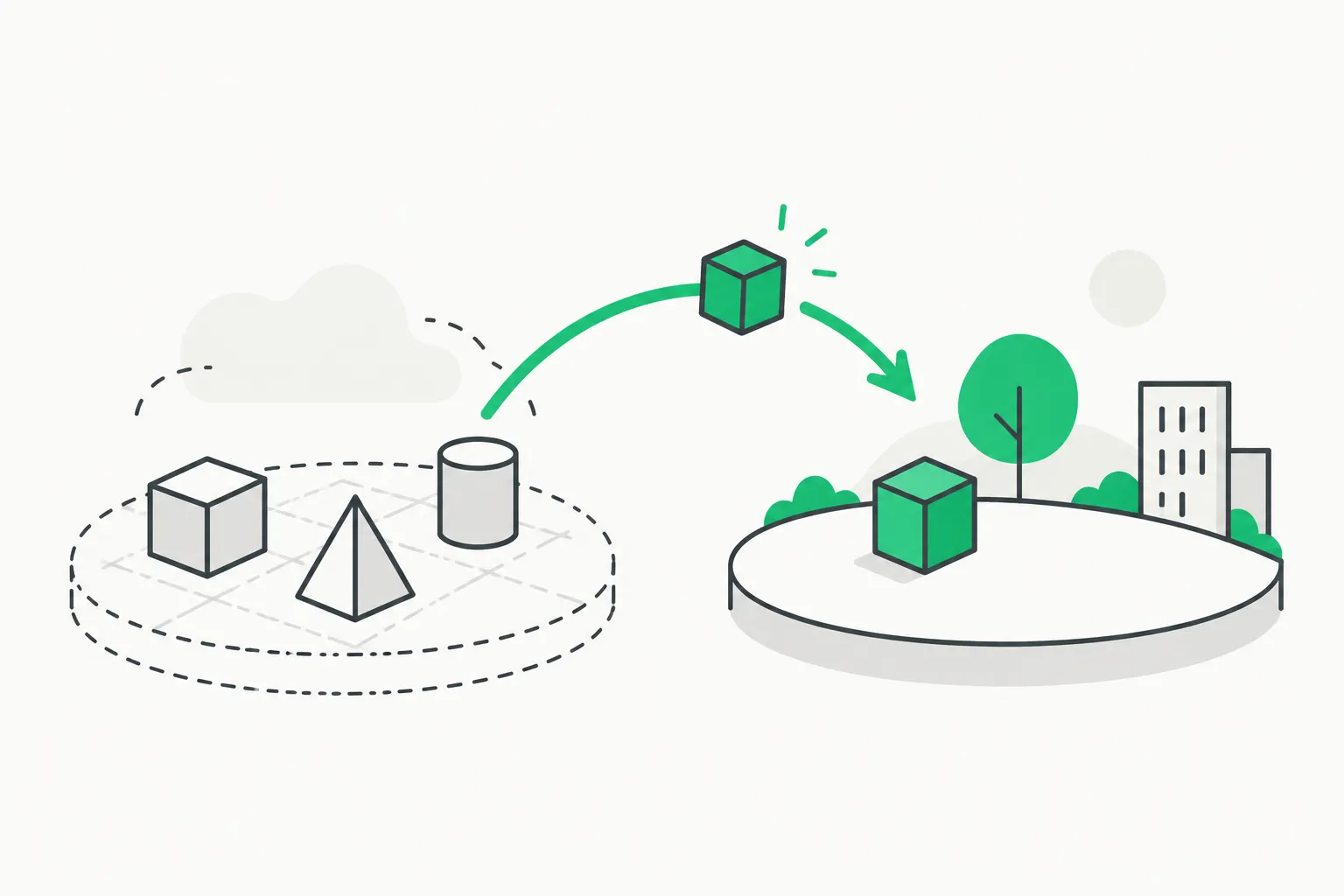 Two stages linked by an arrow, echoing sim-to-real gaps LeCun stresses at robotics conferences
What did LeCun say about education and hiring?
The Brown lecture reporting adds practical lines that CoRL summaries skip but hiring managers still repeat. LeCun told students that the idea education is useless in the AI era is "not true," noting demand for advanced STEM degrees. He advised studying subjects with a long shelf life because careers will likely span multiple job changes as technology accelerates.
He also framed hierarchical planning as an open problem: "Nobody knows how to do hierarchical planning," in the Brown Daily Herald's account. That is why his world-model pitch is not merely "use video instead of text." It is a claim that multi-step physical goals need planners that reason over predicted futures, not autoregressive story completion.
For teams recruiting at CoRL, the implication is subtle. A candidate who only fine-tunes chat models may excel at product velocity but not at contact-rich control. A candidate who trains video JEPA variants or simulation-backed policies aligns with LeCun's stated bottleneck. Neither profile is worthless; they optimize for different risk registers.
How to test AGI claims without picking a cult
LeCun's own October 2026 checklist — Level-5 consumer autonomy, household robots, 20-hour driving learners — is one falsification menu. You can add yours:
- New task generalization without retraining on that exact task distribution.
- Consequence prediction before acting in a physical or cybersecurity environment.
- Hierarchical plans that survive contact with noisy sensors.
When a lab claims human-level AI, map the claim to one of those buckets. If the demo is text-only, LeCun would classify it as powerful but not the target he cares about.
What this means for what you build or pay
Investors and hiring managers should hear CoRL as positioning for AMI Labs and FAIR alumni networks, not as a signal that OpenAI or Anthropic revenue collapses next month. Students should hear fundamentals over framework churn. Robotics teams should keep borrowing LLM planners while investing in world models and simulators where failures are expensive.
LeCun has been wrong before about timelines — he has also been early about conv nets and self-supervised learning. The actionable read is narrower: do not let chat benchmarks substitute for physical-world evals if your product touches the real world.
Related reading
- LeCun's 2023 LLM-not-AGI claim and Schmidhuber's JEPA dispute
- Level-5 cars and domestic robots: LeCun's 2026 evidence check
- Moravec paradox and physical agents
- What are world models?
- Agentic robotics at CoRL with Berkeley and NVIDIA
- Runway Praxis-1: video-to-robot open weights
- Loop engineering for coding agents
Primary reporting on the CoRL stage remarks comes from conference-week coverage published November 13, 2026; career-slide wording comes from Brown University's April 2026 Lemley Lecture as reported by the Brown Daily Herald and Brown News, accurate as of November 15, 2026.