




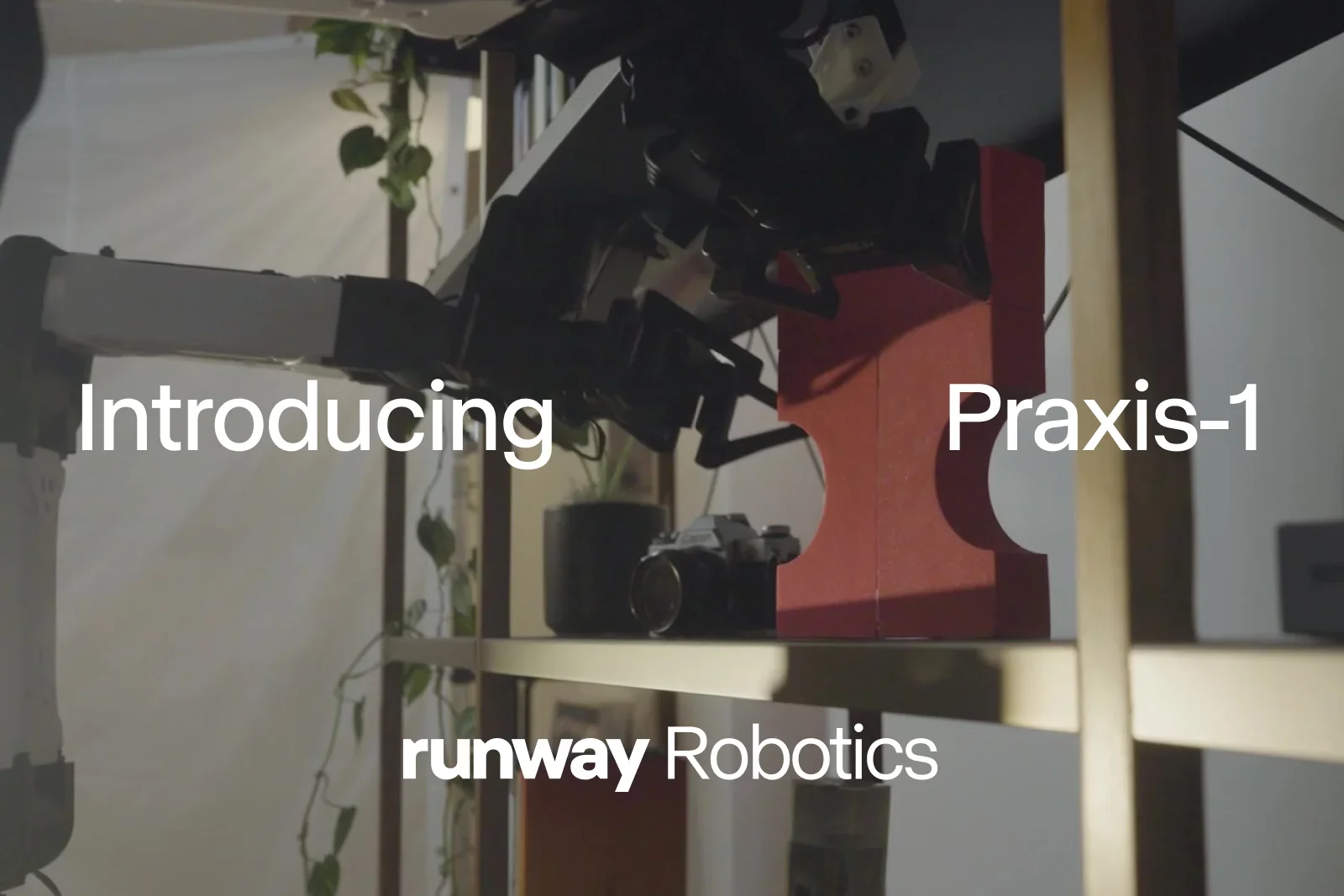
Runway released Praxis-1 as open weights under the Apache 2.0 license on November 11, 2026, with inference code on GitHub and checkpoints on Hugging Face. The model turns Runway's large-scale video pretraining into a world action model that outputs both the next video chunk and the next action chunk for robot arms.
If you have been comparing academic world action models like SWAM or Verne's smaller open checkpoint, Praxis-1 is the production-scale entry: 27B parameters, mixture-of-experts, and a public RoboLab-120 score that Runway says leads open-weight robot foundation models.
TL;DR
| Item | Detail |
|---|---|
| License | Apache 2.0, including commercial use |
| Architecture | 27B MoE diffusion transformer; video backbone plus action expert |
| RoboLab-120 | 46.2% success (555 / 1,200 episodes), per Runway's Nov 2026 table |
| Checkpoints | praxis-1-droid (single arm), praxis-1-yam (bimanual), SO-101 variants, NVFP4 quant versions |
| Integrations | Hugging Face, LeRobot, vLLM-Omni, hosted inference on Runway Reactor |
| Minimum sim rig | 80 GB GPU, Python 3.12, CUDA 13 per README quick start |
What Runway shipped
Runway's company post frames Praxis-1 as the same family it previewed in September 2026, now fully open with weights and training code. Launch partners named in the announcement include Noble Machines, Standard Bots, and Ultra, running the model on a legged humanoid, a six-axis industrial arm, and a dual-arm warehouse robot respectively.
The research page explains the design: a video foundation model predicts the near future in short chunks, and a smaller action expert reads internal activations to produce robot commands. Each control step yields paired video and action outputs, so the policy reasons about what the scene should look like next and how to move to get there.
 Runway Praxis-1 world action model card from the open-weight robotics launch
Image: Runway
That is a different bet from frontier LLMs wired into robot APIs, where a general model issues tool calls. Praxis-1 stays in the continuous control lane, closer to NVIDIA Cosmos and Isaac sim stacks and LeRobot policy servers.
Benchmarks: RoboLab-120 and real Franka tasks
Runway cites NVIDIA RoboLab-120, a simulation suite of 120 tabletop pick-and-place tasks for policies trained on real DROID data. Under the protocol Runway describes (10 trials per task, 1,200 total episodes), it reports 46.2% success for the DROID-finetuned Praxis-1 checkpoint.
| Model (Runway table, Nov 2026) | RoboLab-120 success |
|---|---|
| Praxis-1 | 46.2% |
| FLUX 3 Action | 42.9% |
| Cosmos3 Nano | 36.8% |
| π0.5 | 28.0% |
The research post also shows real Franka FR3 contact-rich tasks after the same DROID fine-tune, and bimanual YAM demos such as placing a mug upside down, boxing items, and clearing bottles. Runway positions those clips as evidence the sim leaderboard transfers to hardware, though your mileage will depend on calibration, cameras, and safety tooling.
RoboLab itself is built to stress generalization: tasks vary along visual, procedural, and relational axes so policies cannot memorize a single synthetic domain. That matters because many teams, including explainx.ai readers following LIBER-0 versus GPT-6 Astra zero-shot claims, want numbers that survive scene perturbations, not just clean-table repeats.
Architecture in plain language
 Praxis-1 video pretraining architecture diagram from Runway research
Image: Runway
The GitHub README breaks the stack into four cooperating parts:
| Component | Role |
|---|---|
| Video backbone | Denoises video latents; exposes hidden states to the action head |
| Action expert | 16-block cross-attention module that denoises actions at 15 Hz |
| Wan2.2 VAE | Frozen autoencoder mapping pixels to latents |
| Qwen3.5-2B text encoder | Supplies language conditioning |
On each call, the policy ingests a task string, two camera streams (exterior and wrist on the DROID rig), up to three prior executed chunks as context, and current proprioception. It returns robot pose targets for roughly 1.4–1.6 seconds and a matching predicted video of the same horizon.
Runway describes the base model as a 27B mixture-of-experts diffusion transformer, sharing DNA with its consumer video models. The robotics fine-tune keeps that video pretraining instead of training actions from scratch, which is why Runway markets Praxis-1 as bridging generative video and embodied control.
How to try Praxis-1 yourself
The fastest path Runway documents is simulation first, then hardware fine-tunes.
Simulation quick start
The README documents a clone-and-run flow with uv, PyTorch 2.13, and FlashAttention 4 on CUDA 13. Core steps:
- Clone
runwayml/praxis-1-ossand create a Python 3.12 virtual environment. - Install torch, causal-conv1d, flash-attn, and editable
praxis-simpackages. - Download Wan2.2 VAE, Qwen3.5-2B, and
runwayml/praxis-1-droidcheckpoints from Hugging Face (afterhf auth login). - Run
scripts/run_sim.pywithconfigs/sim_droid.yamlfor tasks likeblock_in_bowl, with a viewer on port 8000.
That path needs 80 GB of GPU memory for full-precision simulation in Runway's recipe. If you only have smaller cards, start with NVFP4 checkpoints (praxis-1-droid-nvfp4) or hosted Reactor inference while you plan a fine-tune.
Hardware and fine-tuning
Runway ships multiple checkpoints:
praxis-1-droid— single-arm DROID-style cameras.praxis-1-yam— bimanual YAM arms with top and wrist views.praxis-1-so101— SO-100 / SO-101 follower arms for hobby rigs.
praxis/train/README.md walks through full fine-tuning and LoRA on one 80 GB GPU, using DROID as the reference dataset. For collectors, that pairs naturally with LeRobot v0.7 interactive rollouts and Cosmos-backed remote policy servers.
Runway also lists vLLM-Omni integration for batched inference and LeRobot native support on Hugging Face, lowering glue code if you already standardize on Hugging Face's robotics tooling.
 Open-weight release illustration for Praxis-1 robotics developers
Deployment spectrum: data center to Jetson Thor
Runway's announcement emphasizes one checkpoint running across H100/B200 training clusters, RTX 5090 / RTX PRO 6000 workstations, and Jetson Thor on-robot. NVFP4 variants target edge deployment where a 27B MoE would otherwise be impractical.
That range matters for teams debating cloud VLA APIs versus on-robot policies. Frontier LLM agents need constant connectivity and tolerate seconds of latency; Praxis-1's marketing pitch is real-time chunks at 15 Hz with local inference options. The trade-off is model size and ops complexity versus the flexibility of prompting a general model.
If you are documenting safety cases, note Runway's demos are lab videos, not certified industrial deployments. Pair any policy with e-stops, workspace limits, and logging, the same way CORL agentic robotics research teams treat learned controllers.
How Praxis-1 fits the open robotics stack in late 2026
Several threads collide this month:
- Open weights — Praxis-1 joins Verne V0.5 and SWAM in publishing checkpoints, but Praxis-1 is the largest and most video-centric.
- General models on robots — OpenAI's restructuring bets that GPT-6 Astra can command arms without a dedicated robotics team. Praxis-1 is the opposite bet: specialized world models with explicit video rollouts.
- Data tooling — LeRobot and NVIDIA sim assets keep lowering the cost to collect and replay demonstrations that fine-tunes like Praxis-1 expect.
Builders should pick based on latency, hardware, and task distribution. Use Praxis-1 when you need a downloadable policy with video foresight and DROID-compatible cameras. Use agentic frontier models when language flexibility matters more than control frequency.
Limits Runway acknowledges
The research post is candid about planning: Praxis-1 does not yet autonomously plan long action sequences without chunk-wise replanning. Contact-rich failures still appear in clips. RoboLab-120 scores under 50%, which is state of the art among open models in Runway's table but far from solved manipulation.
Training data mixing is also opaque outside the DROID fine-tune description. Runway does not publish full dataset manifests with the weights. Treat leaderboard numbers as Runway-reported unless you reproduce them with praxis/sim/EVAL.md on your cluster.
Licensing is permissive (Apache 2.0), but weight download terms on Hugging Face still require accepting model cards and following Runway's usage policies for hosted Reactor endpoints.
Checklist before you fine-tune on your own arm
Teams that already run SLA-style spatial VLAs or smaller 8B world models should still budget time for Praxis-specific plumbing.
Camera layout must match a checkpoint: DROID wants exterior plus wrist feeds at the resolutions documented in praxis-1-oss, while YAM bimanual runs need three views. Mismatched intrinsics break both video prediction and action chunks.
Control frequency is 15 Hz with overlapping chunks. If your arm driver expects joint deltas at a different rate, add a resampler and log dropped frames so you can tell policy error from transport jitter.
Memory planning starts at 80 GB for the reference sim recipe. NVFP4 weights exist precisely because full MoE attention is heavy; profile a short rollout before you promise a factory pilot date.
Dataset contracts should mirror DROID-style language labels and success bits if you want comparable RoboLab numbers. Human-scale egocentric corpora help for pretraining, but Runway's public leaderboard score is tied to a DROID fine-tune, not zero-shot transfer from internet video alone.
Safety means treating diffusion policies like any learned controller: hard joint limits, workspace bounding boxes, and human e-stops. The model imagines video futures; it does not certify collision-free motion.
Walking through that checklist on a spare SO-101 or Franka rig before you touch production hardware saves weeks of debugging “why does the wrist camera tensor not match.”
What to watch next
Three signals will show whether Praxis-1 becomes a default baseline:
- Community fine-tunes on SO-101 and custom arms appearing on Hugging Face with reproducible eval logs.
- RoboLab-120 leaderboard updates if competitors ship higher open-weight scores.
- Integration depth with LeRobot datasets and NVIDIA Isaac releases, where sim-ready assets shorten the sim-to-real gap.
Related reading
- SWAM world action model from SJTU
- Verne V0.5 open weights claim check
- LeRobot v0.7 policy streaming
- OpenAI robotics team restructuring
- LIBER-0 vs GPT-6 Astra zero-shot
- Sources: Runway announcement, Runway research, praxis-1-oss GitHub
Release dates, benchmark table figures, and hardware requirements are accurate as of November 14, 2026 per Runway's posts and GitHub README.