



Xing4 is the newest technical report in the TeleChat line from Xingchen AGI Lab, published as arXiv 2611.22115 on November 17, 2026 and trending atop Hugging Face daily papers on November 18. It is not a consumer chat launch. It is a systems plus agent-training story: how a 285B-parameter run was staged on 8,192 Ascend 910C accelerators and how TeleGym wires environment rollouts into policy optimization.
What is Xing4 in one sentence?
Xing4 extends TeleChat with architecture search, MindSpore HyperParallel pretraining, and agentic post-training aimed at reasoning and tool use on Huawei Ascend — China's parallel stack to Nvidia CUDA clusters blocked or throttled by export rules.
Ascend 910C at 8,192 cards: what the paper claims
The abstract — mirrored on Hugging Face papers — lists concrete scale claims builders can verify only inside the PDF tables:
| Layer | Claim in abstract | Builder read |
|---|---|---|
| Hardware | 8,192 Ascend 910C cards | Cluster-scale pretrain, not laptop fine-tune |
| Model | 285B parameters | Frontier dense/sparse mix per arch section |
| Framework | MindSpore HyperParallel | Topology-aware hybrid sharding |
| Host tuning | CPU affinity and core isolation | Reduces scheduler jitter on long jobs |
| Optimizer | Distributed optimizer execution | Standard at this scale; details in paper |
explainx.ai does not have independent tokens-per-day measurements for this run. Treat throughput numbers as author-reported until third parties reproduce on Ascend racks. For earlier 910B co-design narratives, see DeepSeek and Huawei chip posts.
Architecture knobs the authors stress
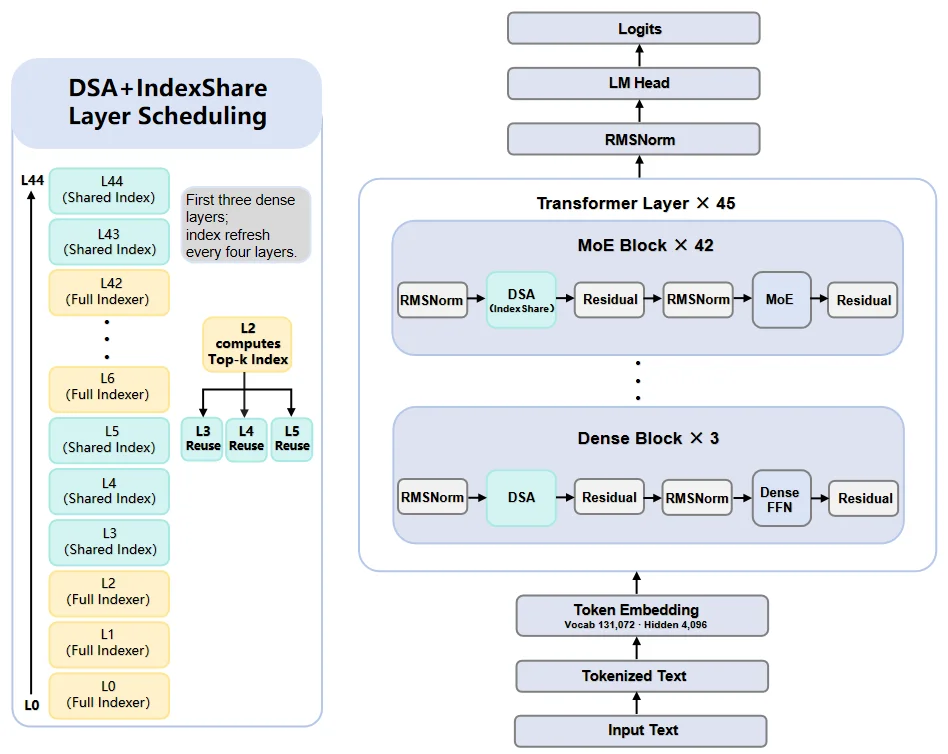 Xing4 285B MoE architecture with MLA, DSA, and speculative decoding
Image: Xingchen AGI Lab
Frontier labs now tune four coupled levers named in the abstract:
- Sparse activation — more capacity without paying full FLOPs every token.
- Attention design — memory bandwidth is the bottleneck on long agent trajectories.
- Depth vs width — trades routing complexity against parallel efficiency on Ascend meshes.
- Speculative decoding — inference-side speed that training stacks must not break.
That list mirrors what Western posts document for sparse attention co-design and speculative decoding guides, but here the target silicon is Ascend, not Blackwell.
MindSpore HyperParallel: why the OS story matters
The paper anchors pretraining on MindSpore HyperParallel with:
- Topology-aware hybrid sharding
- Coordinated long-sequence workloads
- Activation memory management
If you only read model cards, you miss why Chinese frontier teams publish 138-author systems reports: export controls push full-stack ownership — chip, compiler, parallel framework, and agent gym — because they cannot assume NCCL on H100 will be available next quarter.
That is the same strategic line as Tencent HY4 on domestic supply chains, but Xing4 goes deeper on pretraining mechanics than a product blog.
TeleGym: agent post-training as infrastructure
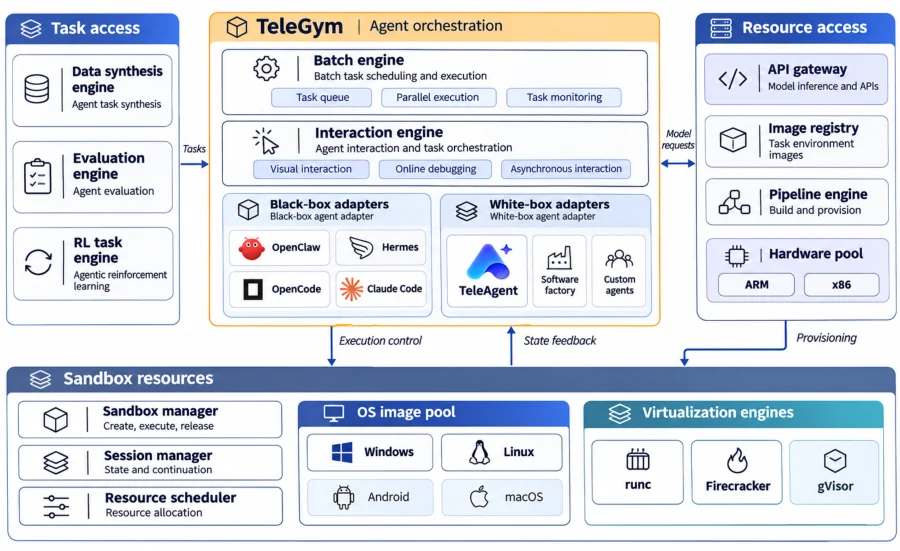 TeleGym platform architecture for agent rollouts and policy optimization
Image: Xingchen AGI Lab
TeleGym is the second half of the report. The abstract describes a unified agent execution platform that connects:
- Execution in environments
- Evaluation hooks
- Trajectory construction
- Policy optimization
Operational details that matter for agent builders:
- Disaggregated asynchronous execution — rollouts do not block on slow tools uniformly.
- Bounded oversampling — controls cost when tasks have heavy tails.
- Partial rollout — keeps long-horizon trajectories usable across policy updates.
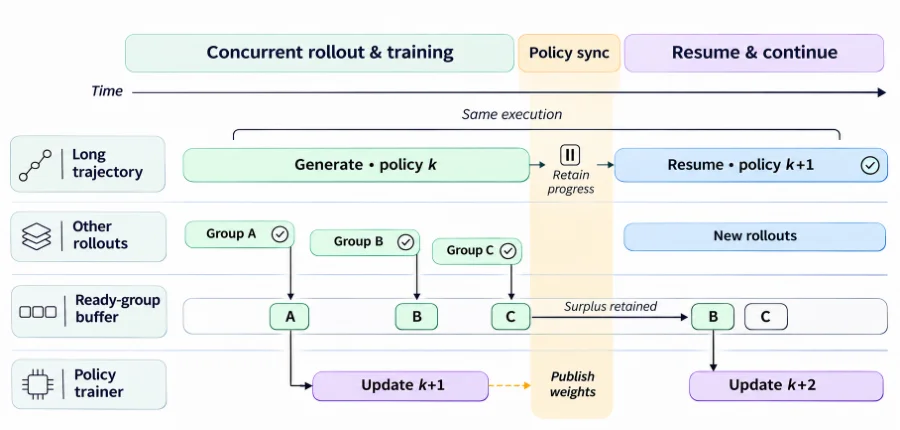 Partial rollout across policy updates in TeleGym
Image: Xingchen AGI Lab
Western readers should compare TeleGym's shape — not its branding — to SWE-CoWork's colleague simulator, Together compiler agents, and AWS phased agentic roadmap. Everyone is building harnesses that survive heterogeneous step times.
Weights, licensing, and what you can run today
On November 18, 2026, the Hugging Face paper page shows zero models and zero datasets citing 2611.22115. There is no public weight drop in the same bundle as the PDF.
Practical takeaway: Read Xing4 for architecture and training recipes; do not plan a Friday fine-tune until a model card lands with license terms. When weights appear, check whether inference requires Ascend-only kernels or ships CPU/GPU ports.
How Xing4 fits export-control geography
U.S. rules pushed advanced Nvidia sales out of direct China channels; Southeast Asian neocloud routing became a compliance battleground covered in Megaspeed reporting and congressional curb pushes.
Xing4 is the onshore response: train frontier-scale models where Ascend 910C supply is domestic. Whether that closes the quality gap with GPT-6.2 or Claude Opus 5.5 is an eval question, not settled in the abstract.
Ascend 910C vs H100: what searchers should expect
Search demand clusters on 910C vs H100 and 910C price. Public English sources in this report do not ship a reproducible MLPerf-style apples-to-apples table in the abstract.
Use three rules when you compare:
- Split training vs inference — Xing4 emphasizes pretrain plus agent post-train, not serving QPS.
- Split chip vs framework — MindSpore HyperParallel numbers do not automatically transfer to vLLM on H100.
- Split claimed vs verified — treat peak FLOPs as vendor math until an independent lab reruns the same config.
Who should read this paper?
| Audience | Why bother |
|---|---|
| Agent platform engineers | TeleGym's async rollout design is portable as a checklist |
| Training infra leads | Sharding plus host isolation patterns apply beyond Ascend |
| Policy readers | Documents China's alternate frontier stack under export pressure |
| Model shoppers | Wait for weights; abstract alone does not change your API picker |
TeleGym vs Western agent gyms: a checklist
Use this table when you map TeleGym to your internal platform:
| Design choice | TeleGym (per abstract) | Typical Western RLHF stack |
|---|---|---|
| Rollout executor | Disaggregated async workers | Often synchronous env step loops |
| Task duration spread | Bounded oversampling | Fixed episode caps |
| Policy refresh | Partial rollouts across updates | Full episode discard on version bump |
| Hardware target | Ascend plus MindSpore | CUDA plus PyTorch or JAX |
None of these rows say which side wins on sample efficiency. They tell platform engineers what to ask vendors when buying an agent training cloud: do you preserve trajectory fragments across policy versions, and how do you bill long-tail tool calls?
Long-sequence memory on Ascend clusters
The abstract highlights coordinated management of long-sequence workloads and activation memory. Agent post-training pushes context lengths beyond chat pretraining defaults — tool transcripts, game boards, and code trees all inflate activations.
If you operate hybrid clouds, assume Ascend-optimized checkpoints will not drop into vLLM on H100 without a conversion project. Budget engineering quarters, not weekend quant jobs, when a lab publishes Ascend-only training recipes.
Sparse activation and speculative decoding together
Sparse MoE layers reduce active parameters per token; speculative decoding reduces latency per user request. Training stacks must co-design both or risk deployment surprises: a model cheap to train on paper may still thrash memory when agents spawn parallel rollouts.
Read Xing4's architecture section alongside NVIDIA sparse attention research and our KV cache explainer when you size inference for agent harnesses.
What to watch after the paper drop
Signals that Xing4 moved from report to product:
- A Hugging Face model org under Xingchen-AGI with license text
- TeleGym or MindSpore agent env repos with reproducible launch scripts
- Third-party tokens per day claims on Ascend 910C at 285B scale
- Government or telecom deployment posts referencing TeleChat branding
Until then, cite arXiv 2611.22115 only — not aggregator summaries.
CPU affinity and why host noise still matters at 8k GPUs
Large Ascend jobs remain host-bound for orchestration, dataloader fan-out, and logging. The abstract's CPU affinity and core isolation line is easy to dismiss as datacenter trivia. It is not. Scheduler jitter on the head node can desynchronize collective steps enough that effective MFU diverges from slides even when chips are nominal.
Western labs learned the same lesson on Slurm clusters running NCCL attribution failures. Xing4 is evidence Chinese frontier teams document host tuning beside model diagrams — a sign the race is systems-complete, not weights-only.
TeleChat lineage and open-weight expectations
TeleChat branding signals state-linked telecom research continuity. Readers hunting open weights should compare releases to Tencent HY4 plans and K2 Horizon fleets: some reports ship checkpoints, others stay paper-first.
When weights land, read licenses before fine-tune: Ascend-only inference clauses have appeared in other domestic model cards. Plan compliance before you port weights into a US-hosted vLLM cluster.
MindSpore vs PyTorch for agent researchers
You do not need Ascend hardware to extract design patterns from Xing4. Agent teams on CUDA can still copy TeleGym's async partial-rollout story when their env step latencies vary by orders of magnitude — a common pain in browser agent harnesses and MCP-heavy workflows. The chip stack differs; the scheduling problem does not.
Related reading
- DeepSeek Huawei Ascend co-design claims
- Tencent HY4 open-weights plan
- China model distillation Reuters probe
- Nvidia sparse attention co-design
- Speculative decoding explainer
- SWE-CoWork agent organizational benchmark
The author list spans well over a hundred names — typical for national-lab scale systems reports. That scale signals institutional commitment, not a weekend fine-tune drop.
If you benchmark Ascend clusters in procurement, ask vendors for reproducible job configs matching the paper's HyperParallel topology notes. Slides without config hashes rarely survive peer review in your own internal bake-offs.
Daily paper rank #1 on Hugging Face (November 18) reflects researcher attention, not a weight release. Treat rank as a literature signal, same as citation velocity on arXiv — not as proof the model beats your current API default.
Reading gets you the idea. Building it with feedback gets you the skill.