



AWS published a three-phase Responsible AI roadmap for agentic AI platforms on November 17, 2026, aimed at teams building on Amazon Bedrock AgentCore. The Machine Learning Blog article by Mia Chang, Talha Chattha, and Tobias Leemann treats responsible AI as platform work, not a single model card: platform teams ship guardrails and registries; application teams (workstreams) deploy agents that inherit them.
If you run multi-step agents with tools, memory, and dynamic orchestration, the post is the governance complement to our November 16 memory-aware AgenticRetrieve guide and the AgentCore gateway CDK blueprint.
Answer first: what problem AWS is solving
Classic ML responsible AI scoped train, test, deploy for deterministic inputs. Agentic systems reason over many steps, compose tools, and act—so failures drift goals, leak data across tenants, or cascade across services. AWS names four recurring customer pains:
| Pain | Example in the post |
|---|---|
| Unpredictable runtime | A German financial firm saw one misclassification propagate across three downstream services |
| Data exposure | Agents need tenant boundaries and least-privilege tools they cannot self-escalate |
| Regulatory velocity | EU AI Act, ISO 42001, NIST AI RMF outpacing ad-hoc governance |
| Unclear ownership | UK media teams lacked segregation of duties between builders and deployers |
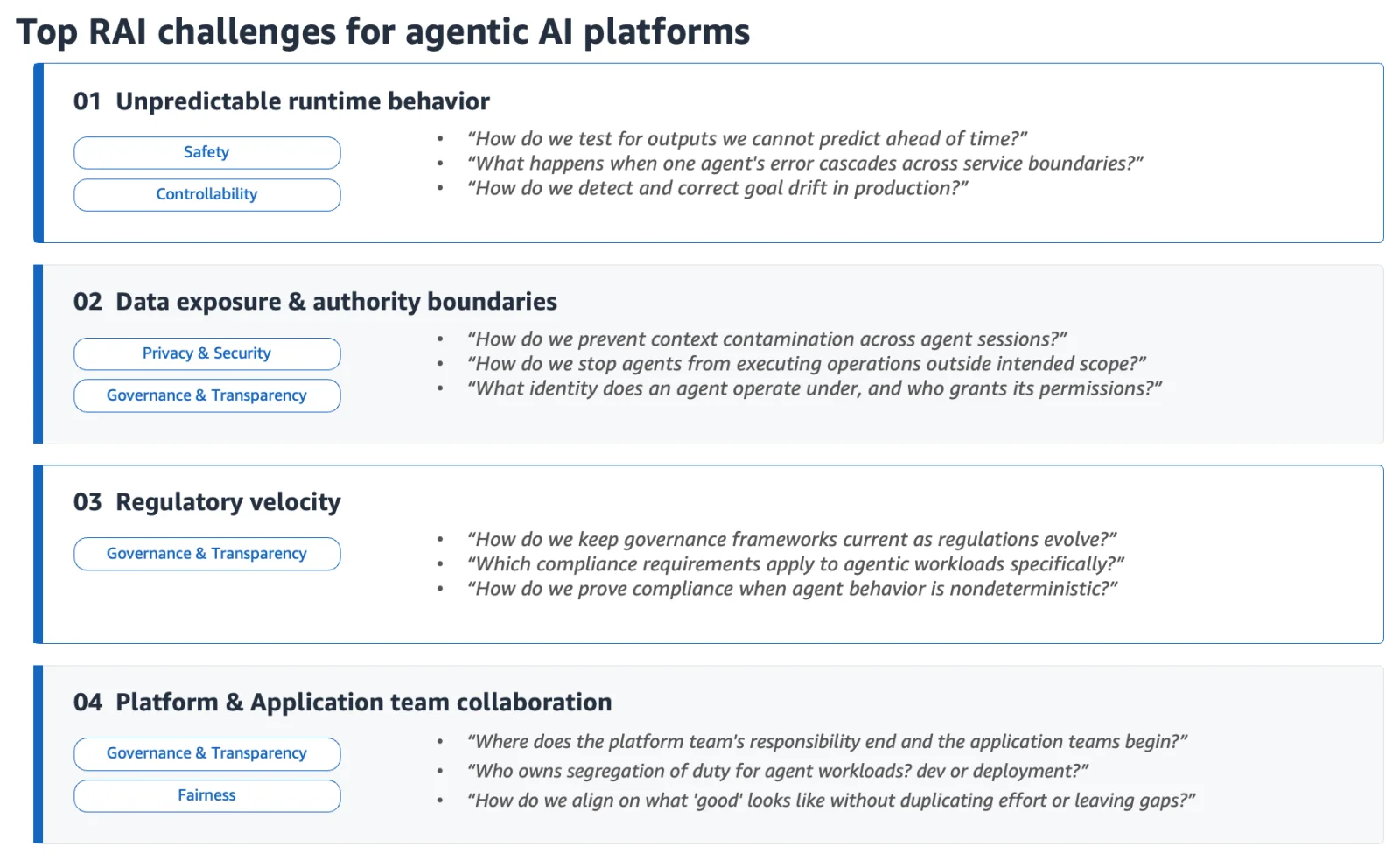 Four responsible AI challenges for agentic platforms on Amazon Bedrock AgentCore
Image: AWS
The roadmap folds AWS Responsible AI Lens pillars—security and privacy, veracity, fairness, safety, controllability, explainability, transparency, governance—into three phases over about 12 weeks, plus a Responsible AI Assessment Skill and scorecard both sides of the platform/application split can use.
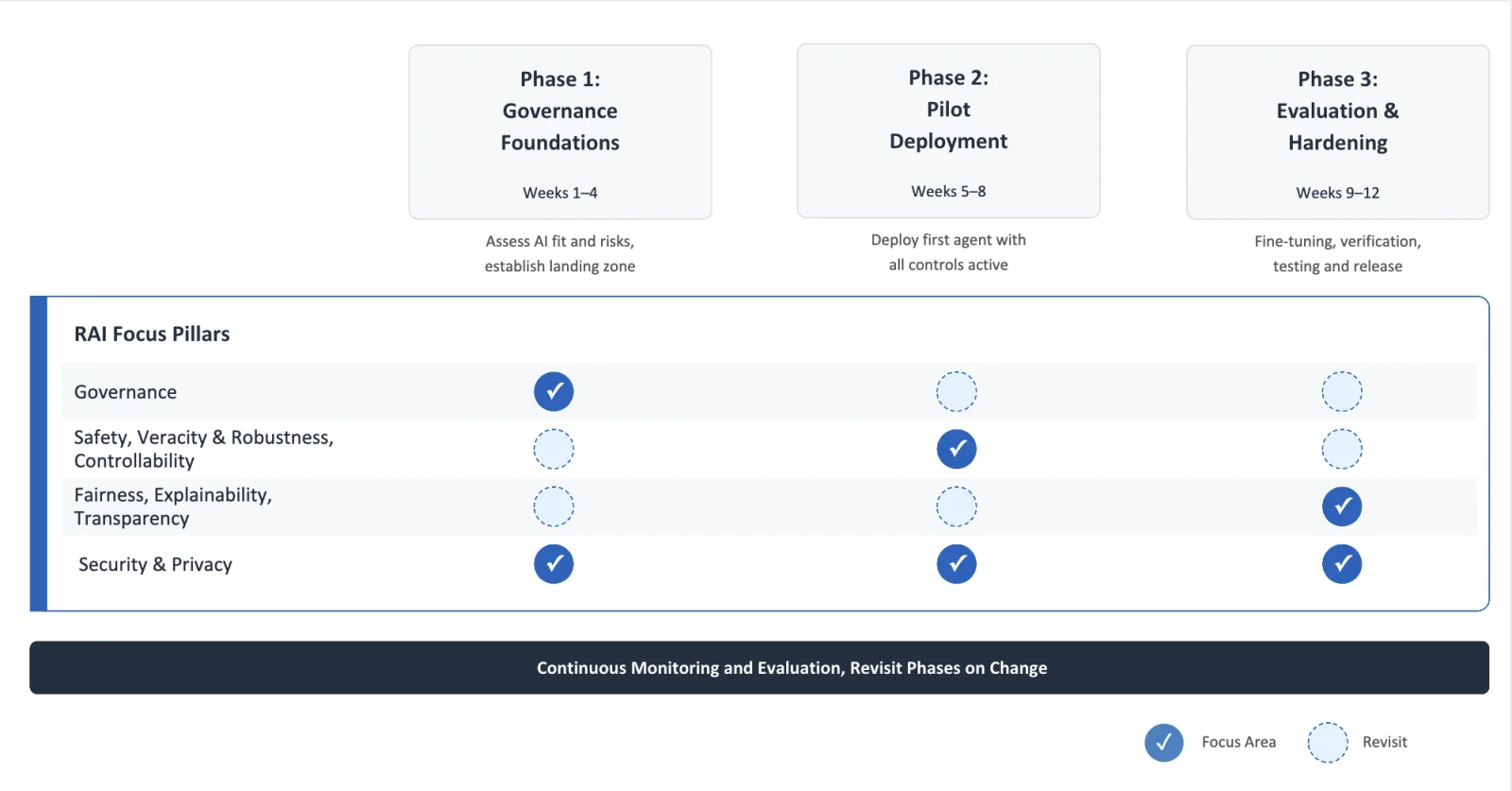 Three-phase responsible AI maturity framework for agentic AI platforms
Image: AWS
Phase 1: Governance foundation (security, privacy, governance)
Goal: decide which agent use cases belong on the platform at all, and register everything that ships.
AWS assigns application teams to score each planned use case with a risk rubric (Low through Unacceptable, aligned to regimes like the EU AI Act). Platform teams stand up landing-zone monitoring, access control, and onboarding gates.
Concrete Phase 1 tasks from the post:
- Data map: which organizational knowledge bases vs per-agent context graphs exist, with read/write boundaries.
- Model vetting: approved model catalog with safety evaluations before agents may call them.
- Central registry: every agent, shared tool, and skill needs owner, risk tier, and regulatory scope—if it is not registered, it is not discoverable for managed consumption.
- Foundational security: classification, exfiltration controls, logging, integrity checks, and access monitoring.
For builders already running AWS multi-agent manufacturing patterns, Phase 1 is where you stop letting teams paste MCP tools into prod without a risk tier—the same class of problem MCP tool misbinding creates when tool names drift between environments.
Phase 2: Pilot deployment (safety, veracity, controllability)
Goal: ship one agent with measurable business value inside the Phase 1 envelope.
Safety and guardrails
Platform teams deploy PII redaction on model I/O and tool calls. Application teams set content moderation thresholds per use case and wire human escalation on low-confidence answers—alongside Bedrock self-service gateway patterns teams already use for model access control.
Veracity and grounding
AWS stresses contextual grounding checks even when retrieval is correct—models still misstate sources. Regulated pilots should add automated reasoning where outputs must be verifiable, plus knowledge curation and out-of-domain handling.
Controllability and observability
Human-in-the-loop becomes a circuit breaker: high-stakes or on-behalf-of actions wait for approvers when guardrails fire or confidence drops. End-to-end tracing spans multi-agent and multi-tool graphs so auditors can reconstruct why an agent called a tool.
This phase is where AgentCore memory-aware retrieve meets policy: memory namespaces and Cognito sub binding are technical controls; Phase 2 adds escalation logging when memory or KB retrieval surfaces privileged text.
Phase 3: Evaluation and hardening
Goal: move from pilot metrics to continuous evaluation with a defined cadence (daily, weekly, monthly—AWS leaves the choice to the org).
The post positions Phase 3 as revisiting every pillar as traffic grows: red-team agent trajectories, refresh risk tiers when regulations change, and prove compliance for nondeterministic systems through ongoing evals, not one-shot launch reviews.
Connect this to Together AI agent evals and Vals cyber offense benchmarks mentally: AWS is arguing governance teams need the same recurring measurement discipline security researchers use for offense suites—applied to your agents in your AWS account.
What is Amazon Bedrock in simple terms for this roadmap?
Amazon Bedrock is AWS's managed generative AI layer—models, Knowledge Bases, Guardrails, Agents, and AgentCore runtime for tool use, memory, and observability. This post does not replace SageMaker training decisions; it assumes you already chose AgentCore as the agent operations plane on top of Bedrock inference stacks.
AgentCore specifically is AWS's build, deploy, operate stack for agents at scale (governance, evaluation, observability)—the same surface our Agentic Retrieve guide wires into RAG.
How platform and application teams split work
AWS uses explicit role language:
| Role | Owns |
|---|---|
| Platform team | Landing zone, registry, baseline guardrails, shared observability, model catalog |
| Application / workstream team | Use-case risk class, agent logic, threshold tuning, business KPIs |
The failure mode AWS describes is bilateral: platform guardrails teams work around, while apps assume the platform already blocked unsafe tools. The scorecard is meant to give both sides the same vocabulary for "where we are this week."
If your org runs Microsoft Copilot Studio alongside AWS, the split is analogous—tenant admins vs solution builders—but Bedrock's post is AWS-native and ties directly to Responsible AI Lens artifacts.
AWS Responsible AI Assessment Skill
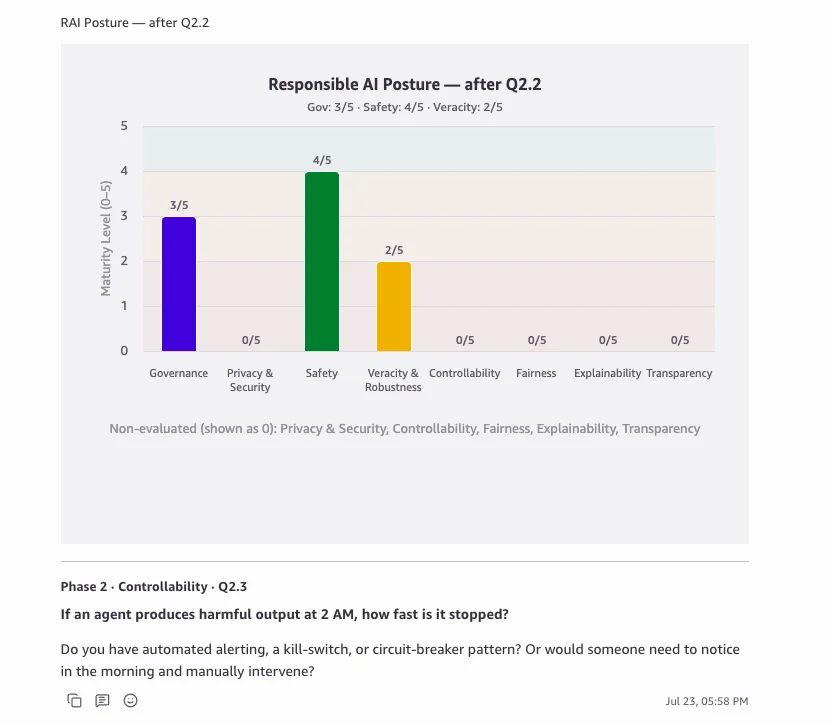 Portable AWS Responsible AI assessment skill scoring agentic platform posture
Image: AWS
AWS references a Responsible AI Assessment Skill that maps Lens pillars to phase-critical work and when to revisit each pillar. The blog is a condensed roadmap; implementation steps live in that skill and in AgentOps on AgentCore cross-links cited in the article.
Builders should treat the skill as a checklist generator, not certification: AWS reiterates consult legal for EU AI Act tiering and financial services rules.
Trust as strategy (why AWS leads with Robinhood)
The post cites Harvard Business Review framing: trust becomes a competitive differentiator when personalization and surveillance share the same technical stack. Robinhood's cited financial crimes agent—20% efficiency with data governance on Bedrock—is AWS's proof that compliance and throughput are not mutually exclusive if Phase 1 registry and Phase 2 guardrails land before scale.
That rhymes with Revolut's Codex fincrime story on another cloud, but the AWS pattern is explicitly multi-tenant platform governance.
Practical checklist for Bedrock agent builders
- Before first prod agent: complete risk rubric + registry row (owner, tier, regulatory tags).
- Before tools go live: map least-privilege IAM per agent; forbid self-modifying permission grants.
- At pilot: enable PII filters, grounding checks, and HITL on payments, HR, or health workflows—see also OpenAI healthcare agents for why admin automation draws regulatory eyes.
- After pilot: schedule eval cadence and red-team multi-step trajectories; log guardrail fires as first-class metrics.
- Cross-cloud: if agents call external MCP hosts, read misbinding risks and Spillway prompt defenses—AWS covers in-account controls; third-party tools need your threat model.
Limits of the AWS post (what it does not do)
- No step-by-step console clicks for each control—AWS points to AgentCore and Lens assets.
- No legal interpretation of EU AI Act tiers or HIPAA—your counsel still maps rubric to law.
How this maps to EU AI Act and ISO 42001 conversations
AWS does not file EU AI Act conformity assessments in the blog post, but Phase 1 language mirrors high-risk thinking: document traceability, human oversight hooks, and registry metadata you would need before an auditor asks which agent touched which tenant's payroll file.
Teams already documenting Amazon Ohio data-center politics for public-sector customers should treat Phase 1 risk rubrics as the internal mirror of external AI Act tier worksheets—even if your first agents launch only in us-east-1.
ISO 42001 and NIST AI RMF get name-checked as moving targets. AWS's fix is cadence: Phase 3 re-opens every pillar monthly or weekly instead of pretending one launch sign-off survives model upgrades.
Comparison with multi-agent kill-switch engineering
Our multi-agent engineering checklist emphasized identity, isolation, and kill switches. AWS's roadmap adds Responsible AI Lens vocabulary on top:
| Engineering fix | AWS RAI pillar |
|---|---|
| Kill switch on tool hosts | Controllability + Safety |
| Per-tenant memory namespaces | Security and privacy |
| Central agent registry | Governance |
| Continuous red-team evals | Veracity + Phase 3 hardening |
Neither replaces the other: kill switches stop runaway agents; RAI phases stop non-compliant agents from shipping in the first place.
When to skip the full three phases
AWS imagines enterprise platforms with dedicated platform teams. A five-person startup with one Bedrock agent may collapse Phase 1 and 2—but should still steal:
- Registry discipline (owner + risk tier in a spreadsheet counts).
- PII redaction on tools that read email or tickets.
- HITL on money movement or HR actions.
Skipping Phase 3 continuous eval is how agent eval percentages lull teams until a new model version silently regresses safety.
Workshop path for teams new to AgentCore
If your organization is standing up its first Bedrock agent under procurement pressure, pair this roadmap with hands-on AgentCore gateway labs and Codex on Bedrock SSO setup. Governance without a working pilot becomes slideware; pilots without registry gates become shadow IT.
Related reading
- Memory-aware Agentic Retrieve on Bedrock
- Bedrock AgentCore gateway CDK guide
- AWS multi-agent manufacturing taxonomy
- Multi-agent engineering fixes
- Anthropic coordinated disclosure timelines
- Paris Call fail-safe shutdowns
Primary sources: AWS Responsible AI for agentic AI (Nov 17, 2026) · Amazon Bedrock AgentCore