



Update: Nature Will's Natura-1 pairs a 50B model with 1M hours of human video for dexterous hands. Read our analysis.
Related — October 6, 2026: Reka previewed a 19B model that outputs video and robot actions in one network. See Rho-1 explained.
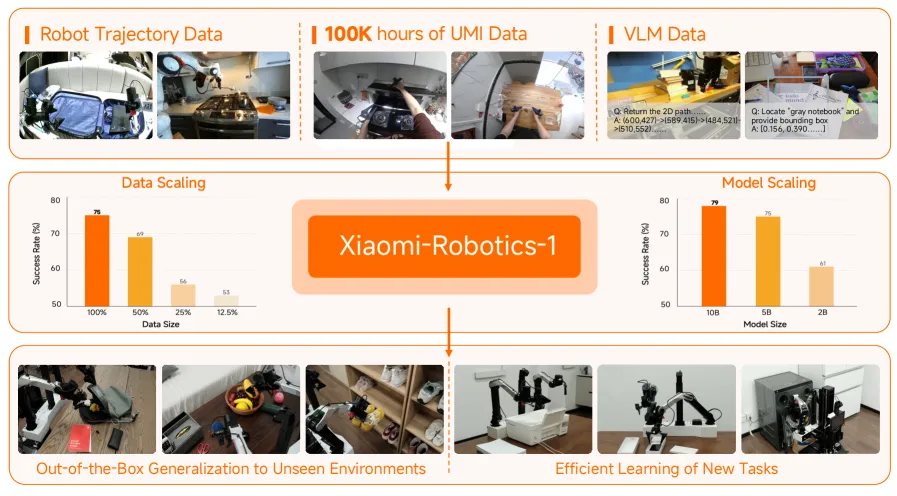 Xiaomi-Robotics-1 overview — UMI pre-training to robot post-training
Update — August 22, 2026: Generalist AI's GEN-1.5 reports a different adaptation endpoint from large-scale robot pretraining — one-shot in-context learning via physical prompting (59% success across 10 tasks, no fine-tuning).
Update — August 11, 2026: Dyna Robotics pushed the same idea a full order of magnitude further with DYNA-2, a world-action model pre-trained on 1M+ hours of egocentric human video with zero robot data — and published fitted scaling exponents to go with it: DYNA-2 and the robotics scaling law claim.
Robotics finally gets an LLM-shaped scaling recipe — and Xiaomi's bet is that the missing ingredient was never just bigger DiTs, it was data that does not require a robot in the room.
On July 16, 2026, Xiaomi Robotics published Xiaomi-Robotics-1 (XR-1, arXiv:2607.15330): a ready-to-use vision-language-action (VLA) foundation model pre-trained on over 100,000 hours of embodiment-free UMI trajectories, then post-trained on roughly 10,000 hours of cross-embodiment robot data (including 7,200+ hours collected in real homes).
This is the policy-model sibling to last week's Xiaomi-Robotics-U0 world model — U0 synthesizes multi-view scenes; XR-1 acts. explainx.ai maps the two-stage recipe, the scaling charts, few-shot adaptation vs π0.5, and what is still TBA (weights).
TL;DR — what people are asking
| Question | Answer |
|---|---|
| What is XR-1? | Xiaomi's scaled VLA — UMI pre-train → robot + instruction post-train |
| How much data? | 100K+ h UMI pre-train; ~10K h post-train (7.2K+ h in-house homes) |
| Why UMI? | Handheld grippers + cameras → real-world motion without teleop robots |
| Does it scale? | Yes — lower action error + higher real-robot success as data/size grow |
| Few-shot vs π0.5? | 75% vs 40% at under 10 h/task; 85% vs 53% at under 40 h |
| Sim SOTA? | Leads RoboCasa / RoboCasa365 / VLABench / RoboDojo on project-page table |
| Weights? | "Will be released" — watch the project page |
The bottleneck XR-1 claims to break
Language and vision models rode empirical scaling laws. Robotics mostly did not — because high-quality teleop is slow, costly, and embodiment-bound. Xiaomi's thesis: pre-train action generation on UMI (Universal Manipulation Interface) trajectories that scale like video, then spend a modest real-robot budget aligning embodiment and instructions.
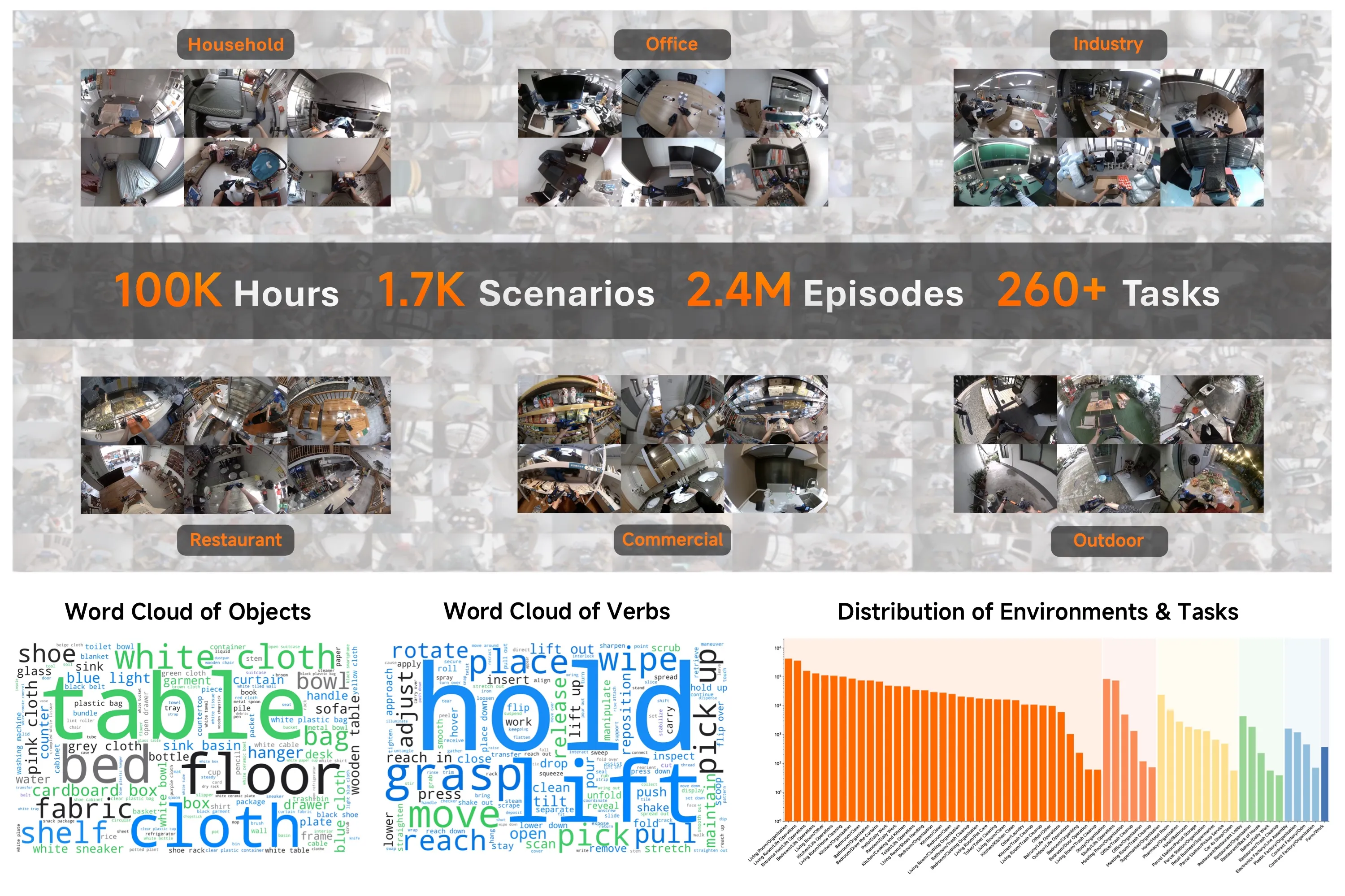 Pre-training data overview — 100K hours UMI across 1,700+ scenarios
Source: Xiaomi-Robotics-1 project page
Pre-train corpus highlights:
- 100,000+ hours of embodiment-free UMI trajectories
- 1,700+ scenarios — household, commercial, industrial, outdoor
- Auto-label pipeline: fixed-length clips → VLM captions of scene state transitions (grippers + interacting objects), not full manual task narration
- Paper notes: Qwen3.5-27B captions; producer–consumer pipeline labeled the corpus in roughly two weeks
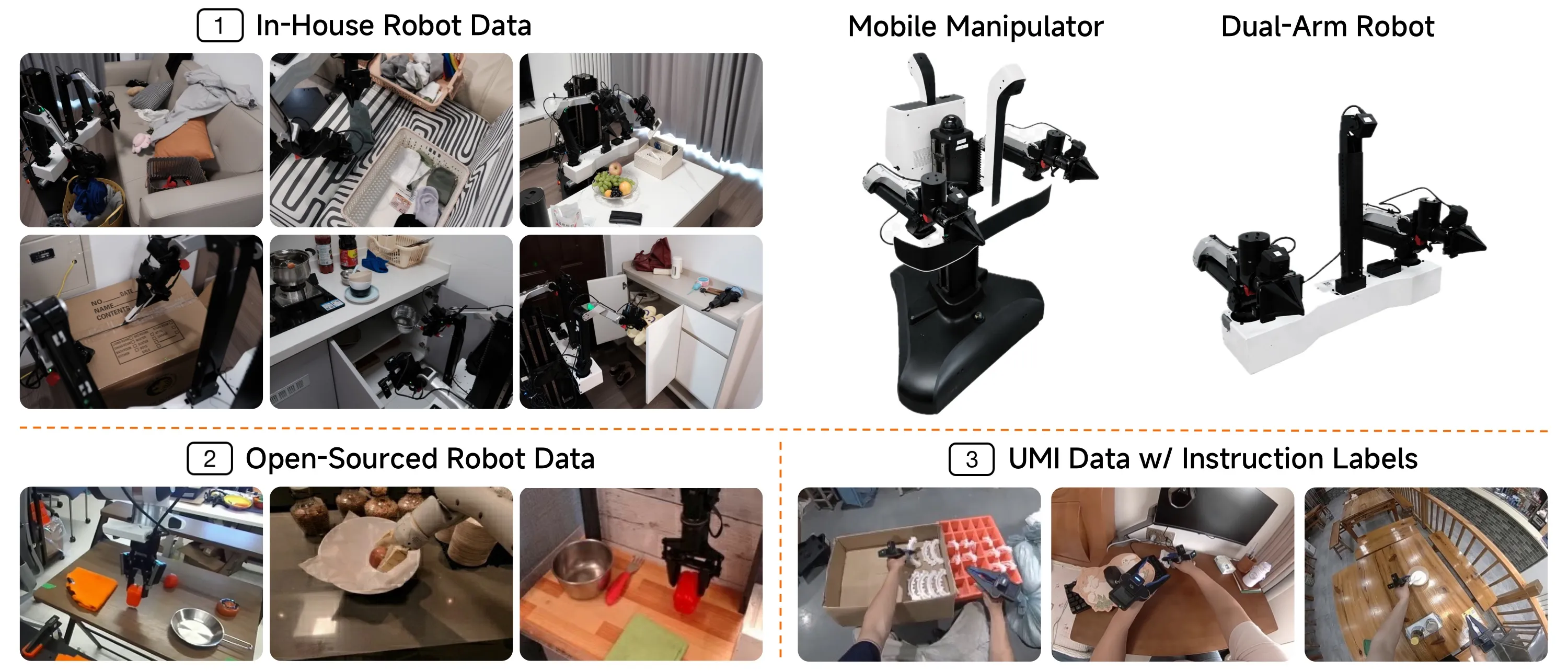 Post-training data — in-house robots, open-source, instruction-labeled UMI
Post-train corpus (~10K hours cross-embodiment):
- 7,200+ hours in-house mobile manipulators / dual-arm robots in real homes (sofa tidy, shoe cabinet, kitchenware…)
- 1,000+ hours manually instruction-labeled UMI (imperative prompts, not just state transitions)
- Filtered open-source (Bridge V2, RT-1, DROID per paper)
- Sampling skew heavily toward in-house robot data (paper ratio ~8.5 of 10 parts)
Method — pre-train breadth, post-train alignment
Architecture (paper): Mixture-of-Transformers — pretrained Qwen3-VL + a thinner DiT that generates action chunks via flow matching, conditioned on robot state and the VLM KV cache. The VLM also predicts action chunks via Choice Policies to speed convergence. Scaling variants in the paper: roughly 2B / 5B / 10B.
| Stage | Goal | Language conditioning |
|---|---|---|
| Pre-training | General action generation from UMI | "Drive the scene toward this state transition" |
| Post-training | Embodiment + instruction following | Natural imperative robot prompts |
After post-training, XR-1 is evaluated in unseen environments with unseen object instances — the transfer question, not just train-set regurgitation.
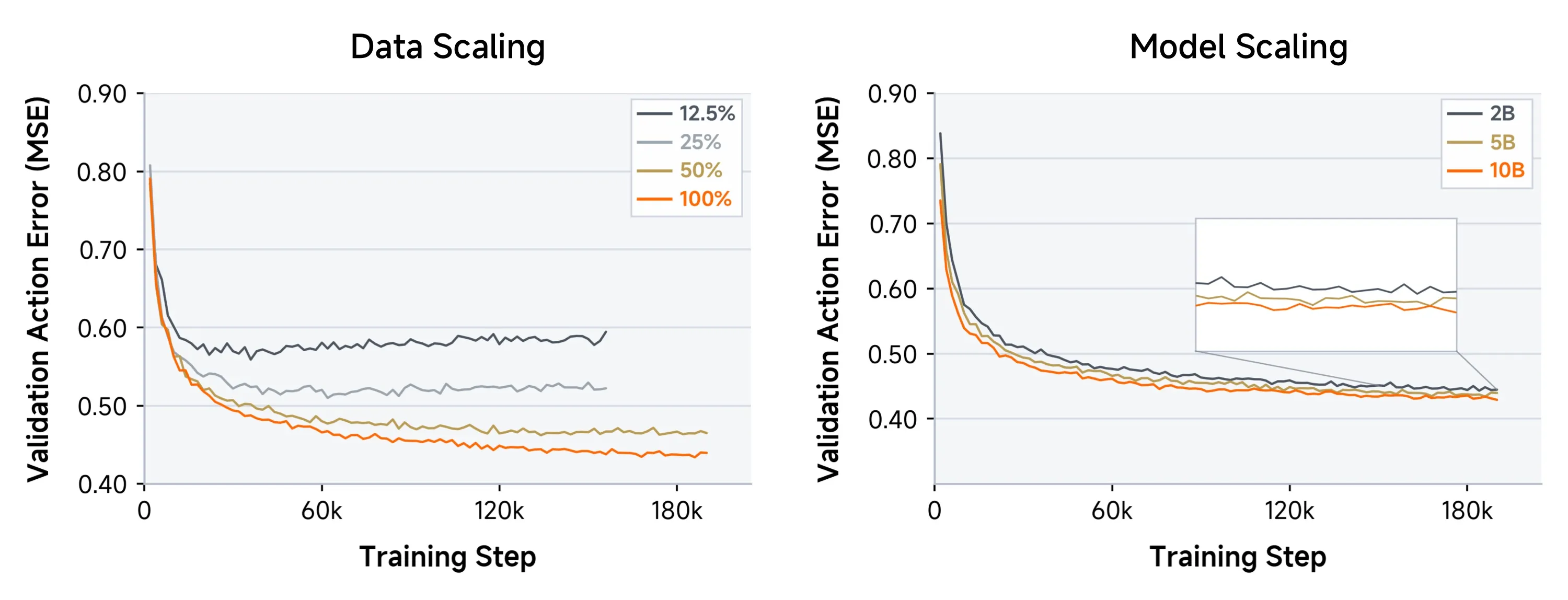 Pre-train scaling — validation action error vs data and model size
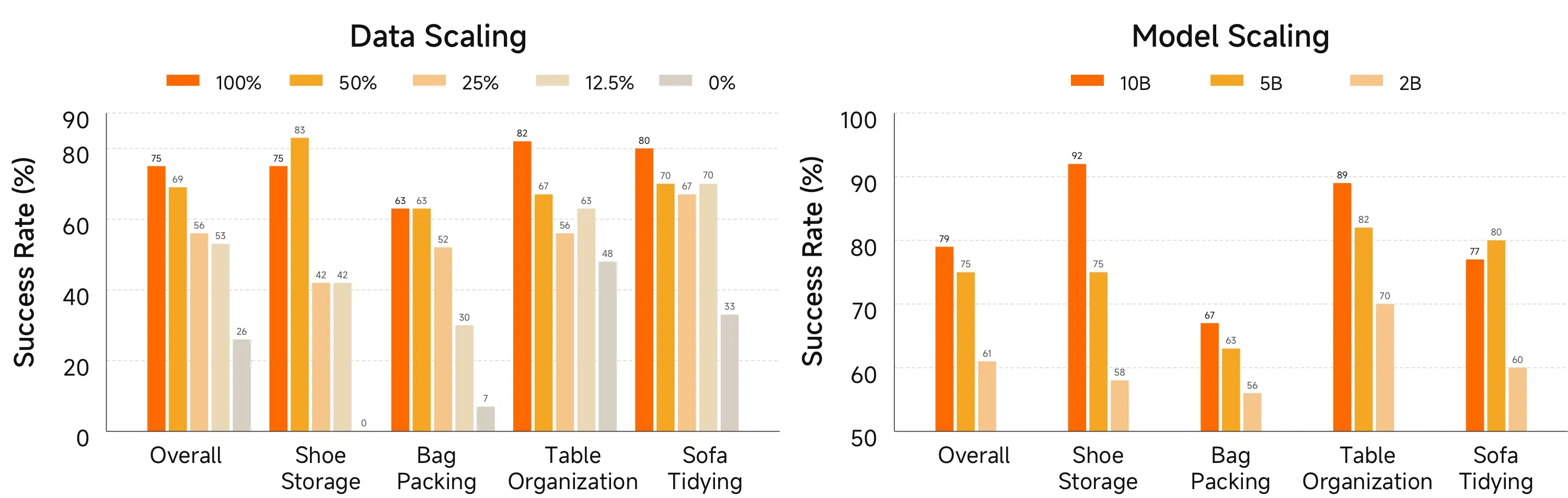 Post-train scaling — real-robot success vs pre-train data ratio and model size
Scaling takeaways Xiaomi emphasizes:
- Pre-train: validation action MSE falls as UMI data and model size grow (clean LLM-like curves).
- Post-train: real-robot success rises with stronger pre-trains — no saturation claimed in published sweeps.
- Paper ablation on a ~20K-hour subset: data volume moves the needle more than model size at multi-billion scale — capacity is not the primary bottleneck once you have billions of parameters; diverse hours are.
That pairs with physical-AI data stories we already cover — HIW-500 Unitree humanoid datasets, Indian camera-wearers training humanoids, and NVIDIA Cosmos / SIGGRAPH physical AI.
Applications — few-hour adaptation and sim leaderboards
Efficient adaptation vs π0.5
XR-1 specializes to complex real tasks from a few hours of demos per task: phone packing, printer refilling, laundry loading, box packing.
| Task | under 10 h/task — XR-1 | under 10 h — π0.5 | under 40 h — XR-1 | under 40 h — π0.5 |
|---|---|---|---|---|
| Phone packing | 70 | 30 | 80 | 40 |
| Printer refilling | 70 | 20 | 60 | 20 |
| Laundry loading | 80 | 40 | 100 | 50 |
| Box packing | 80 | 70 | 100 | 100 |
| Overall | 75 | 40 | 85 | 53 |
Success rate (%). Source: Xiaomi project page table (July 2026). XR-1 = Xiaomi-Robotics-1.
Nearly doubling π0.5 at the under-10-hour budget is the headline product claim for anyone paying teleop operators by the hour.
Simulation benchmarks (project page)
| Benchmark | XR-1 | 2nd best | Rel. gain |
|---|---|---|---|
| RoboCasa | 74.5 | 72.6 | +2.6% |
| RoboCasa365 | 57.4 | 46.6 | +23.2% |
| VLABench | 59.1 | 53.2 | +11.1% |
| RoboDojo | 13.93 | 8.80 | +58.3% |
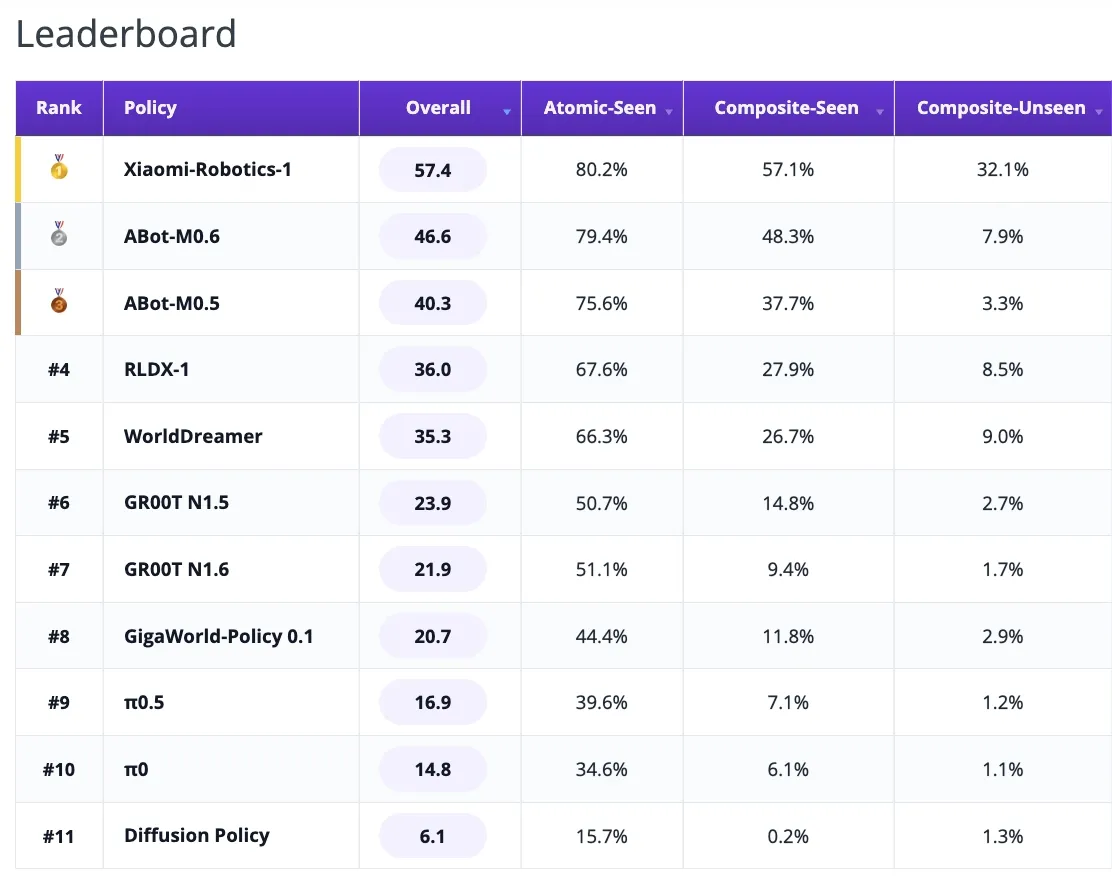 RoboCasa365 leaderboard — Xiaomi-Robotics-1
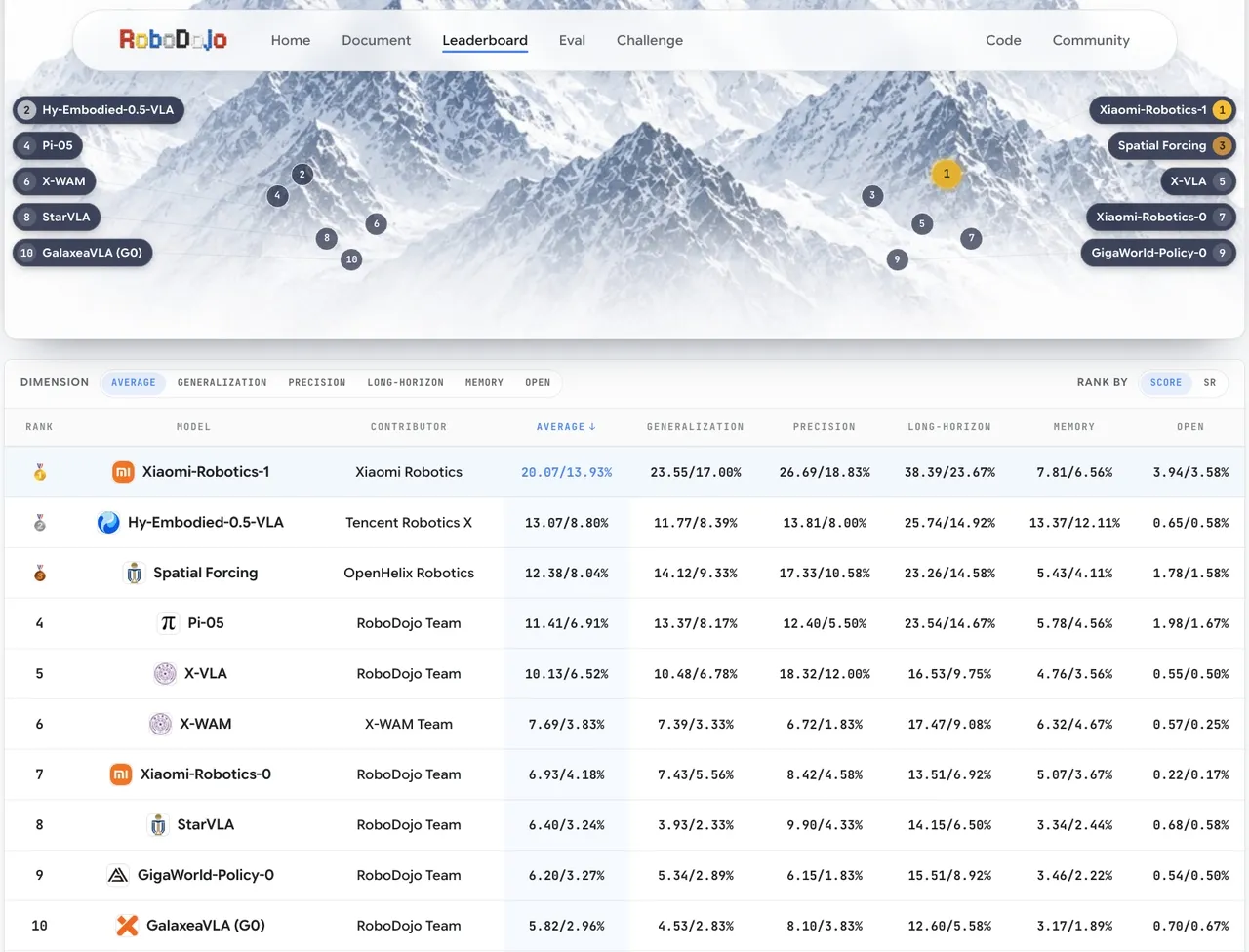 RoboDojo leaderboard — Xiaomi-Robotics-1
Leaderboards as shown on the project page (dated around July 15, 2026). The arXiv abstract quotes RoboCasa365 57.6% and a RoboDojo average score of 20.07 vs prior 13.07 — confirm metric definitions in the PDF tables before citing a single number.
How XR-1 fits Xiaomi's robotics stack
| Model | Role | Rough date |
|---|---|---|
| Xiaomi-Robotics-0 | Earlier VLA | Feb 2026 |
| Xiaomi-Robotics-U0 | 38B world / embodied synthesis (boosts π0.5 OOD with synthetic data) | Jul 13, 2026 |
| Xiaomi-Robotics-1 | Scaled foundation policy (100K h UMI → real robots) | Jul 16, 2026 |
U0 answers "how do we augment visual training data?" XR-1 answers "how do we pre-train action at language-model scale?" Both attack the same scarce resource: diverse real-world contact experience.
Related motion and physical-AI coverage: MotionBricks on Unitree G1, 1X Neo 25-DoF hands, LingBot-Map streaming 3D, LeCun on physical agents.
How to Read the XR-1 Results
XR-1 reports many numbers from different sources, and they answer different questions. Separating them makes the claims easier to weigh.
Data scale. The 100,000-plus hours of UMI pre-training and about 10,000 hours of post-training come from the project page and paper. Note that the post-training mix leans heavily on in-house robot data, so the recipe lowers the pre-training barrier without removing the need for real-robot hours.
Real-robot adaptation. The comparison with π0.5 (75% versus 40% under 10 hours per task, 85% versus 53% under 40 hours) is Xiaomi's own table across four tasks. Box packing shows the ceiling effect: both models reach 100% at the larger budget. Independent replication will show how general the gap is.
Simulation leaderboards. These are dated mid-July 2026, and the arXiv abstract quotes slightly different RoboCasa365 and RoboDojo figures than the project page. Check the metric definitions before citing a single number.
Scaling claims. The ablation that data volume matters more than model size at multi-billion scale comes from a roughly 20,000-hour subset. Treat it as the authors' finding on their setup.
Availability. Weights are described as forthcoming, so any plan that depends on them should wait for a checkpoint.
Honest limits
- Weights/code TBA — paper promises release; do not plan a production stack on vapor until checkpoints land.
- In-house robot hours still matter — UMI breaks the pre-train wall; post-train still burns thousands of real-robot hours.
- Auto-labels ≠ human intent — state-transition captions are precise for motion learning but are not the same as goal-directed task language (hence the instruction-alignment stage).
- π0.5 comparison is Xiaomi's published table — independent replication will decide how general the few-hour gap is.
- Sim leaderboards move weekly — treat SOTA as dated mid-July 2026.
What to do if you build robot policies
- Separate pre-train scale from post-train alignment — copy the recipe even if you cannot match 100K hours.
- Instrument data-hour ROI, not only parameter count — Xiaomi's own ablations privilege diversity of hours.
- Watch the project page for weights — robotics.xiaomi.com/xiaomi-robotics-1.html.
- Pair with world-model augmentation — see U0's π0.5 OOD lift for synthetic episode mixing.
- Read the luggage-packing uncut on the project page before believing demo reels.
Related on explainx.ai
- Update — September 13, 2026: What Is Egocentric Data Collection for Robots? — explains the UMI-style technique behind this post's pre-training data, its real limits, and how it differs from simulation and teleoperation.
- Update — September 8, 2026: XPeng launches IRON — a production line XPeng says uses robots to build humanoid robots autonomously.
- China Opens Its First School for Robots — Shanghai & Hangzhou academies
- FLUX 3 × mimic — Self-Flow video-action at Audi
- DYNA-2 — 1M hours of human video and the robotics scaling law claim
- Xiaomi-Robotics-U0 — world model + π0.5 OOD boost
- NVIDIA SIGGRAPH 2026 — Cosmos Edge & physical AI
- NVIDIA MotionBricks — real-time motion / Unitree G1
- HIW-500 + Bitrobot — Unitree LeRobot dataset
- Indian workers wearing cameras to train humanoids
- 1X Neo 25-DoF hands
- What are world models?
- Yann LeCun — physical agents & Moravec
- FLUX 3 and FLUX-mimic — Black Forest Labs' unified video/robotics bet
Sources: Project page · arXiv:2607.15330 · HTML v1
Figures and tables reflect Xiaomi's July 16, 2026 project page and arXiv:2607.15330. Benchmark ranks and weight availability can change — verify the project page and paper PDF before citing production numbers.