



explainx.ai published a direct position on why open-source and open-weight AI matters. A fair follow-up is harder: if openness matters, why do our workshops, bootcamps, prompts, and guides spend so much time on Claude, Cursor, ChatGPT, and other closed products?
Because education should optimize for transferable capability and real outcomes, not ideological purity. Closed models often provide the quickest route to frontier-quality work. Open weights reveal the infrastructure, economics, privacy, and portability that a polished chat box hides. Students need both mental models.
TL;DR: how we split the curriculum
| Question | explainx.ai's answer |
|---|---|
| Why closed models? | Fast onboarding, frontier capability, polished tools, supported workflows |
| Why open weights? | Control, local use, cost visibility, deployment skill, vendor independence |
| What should transfer? | Task framing, context, tools, evals, source judgment, security, and review |
| What stays vendor-specific? | Product UI, plan limits, model picker, hooks, deployment and policy details |
| Do we claim one class always wins? | No. Model class follows the learning outcome and constraints |
| What evidence do we use here? | The public course/module inventory and platform architecture—not invented private usage data |
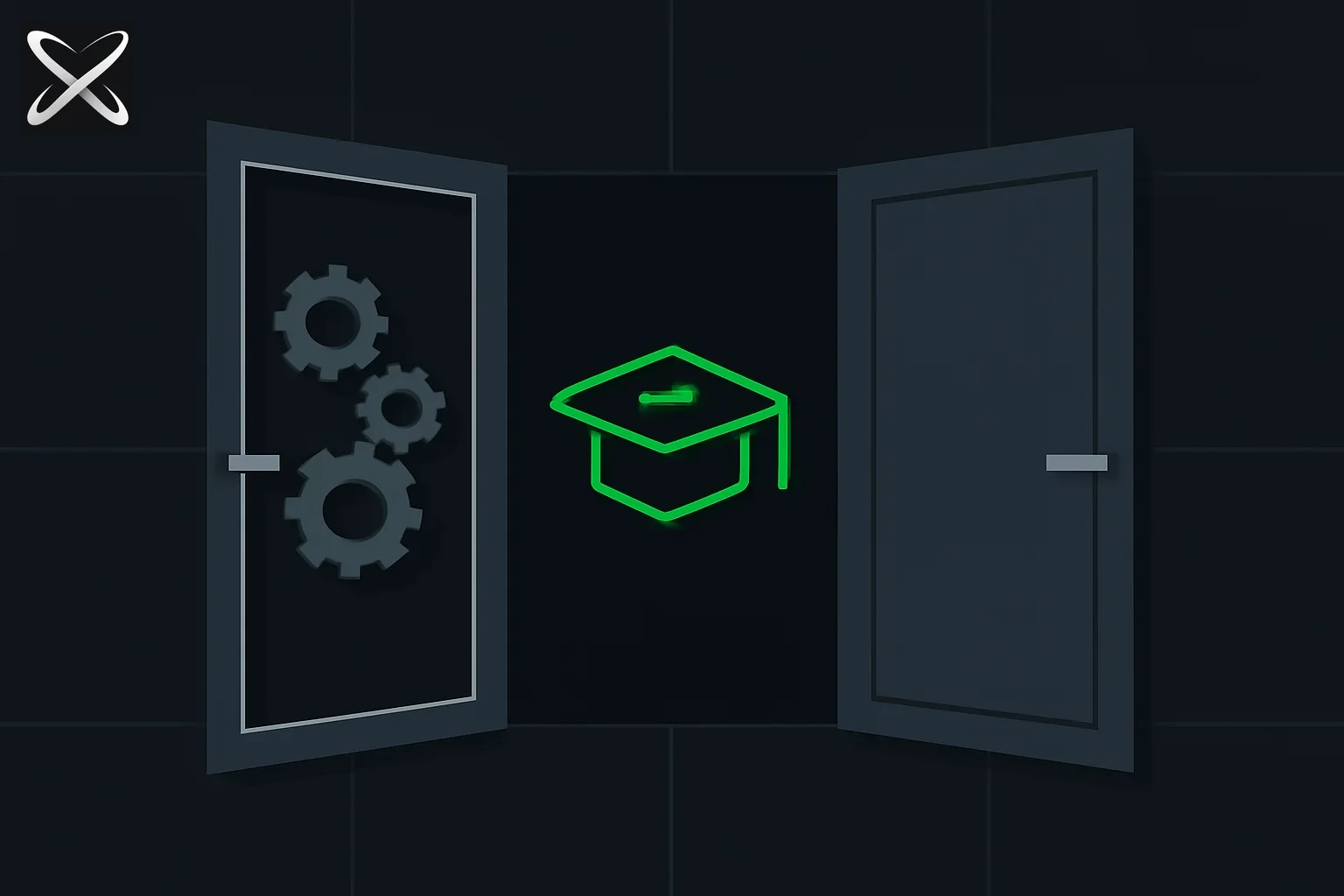 Why explainx.ai teaches both open and closed models — a transparent gear-filled door and a sealed opaque door both leading to a graduation cap
The principle: teach the shortest path to the learning outcome
If a beginner needs to learn how to turn source material into a decision memo, asking them to first choose a quantization, install a runtime, size memory, and debug GPU kernels adds unrelated cognitive load. A hosted Claude or ChatGPT workflow lets them practice the actual lesson: specify the decision, supply evidence, detect omissions, revise, and take responsibility.
If the lesson is data residency, latency, model routing, or cost at volume, the hosted abstraction becomes the obstacle. Students need to run a model, inspect tokenization and memory, compare quantization, and see what changes when the provider is swapped.
“Open versus closed” is therefore not one course debate. It is a dependency decision for each module.
What our current modules actually emphasize
The public apps/web curriculum gives a clear, auditable picture. The AI Builder Bootcamp starts with fundamentals, then teaches Claude Projects and Artifacts, web research, skills and MCP, Python automation with Claude Code, and full-stack building. Other programs use Cursor, Claude, v0, and Vercel to ship portfolio projects. The platform also hosts skills, MCP servers, loops, workshops, prompts, and tests.
That mix creates four teaching layers:
| Layer | Typical surface | Why it is there |
|---|---|---|
| Work practice | Claude, ChatGPT, Gemini, Perplexity | Learn research, writing, analysis, and review quickly |
| Building practice | Claude Code, Cursor, Codex, agent harnesses | Work inside real projects with tools and verification |
| Portable architecture | Skills, MCP, prompts, evals, loops | Move procedures and integrations across model vendors |
| Deployment/control | APIs, open weights, Ollama/llama.cpp, routing | Learn privacy, cost, hosting, and model selection |
The first two layers can be product-specific without making the underlying education vendor-locked. The last two deliberately challenge lock-in.
Where closed models are the right teaching tool
Beginner knowledge work
Projects, files, deep research, artifacts, voice, and office integrations remove setup. Students can experience the complete workflow and learn to critique output. Our AI for consultants and analysts guide focuses on deliverables rather than APIs for this reason.
Frontier long-horizon tasks
Closed frontier systems often lead on difficult coding, document, computer-use, and agent tasks. A lesson on reviewing a multi-file change is more useful when the agent can usually perform the change. Students should learn the frontier workflow that employers are deploying now.
Supported enterprise controls
Organizations may require contractual data terms, identity, admin policy, audit, regional inference, and support. Open software alone does not automatically provide those operational guarantees. Teaching procurement includes reading the closed vendor's contract and architecture.
Consistent classroom onboarding
A cohort with different laptops, RAM, operating systems, and technical confidence can start a hosted product quickly. Local inference performance would otherwise dominate the session and obscure the intended skill.
Where open weights are the right teaching tool
Privacy and offline workflows
Students can keep sensitive material on a controlled machine or network, subject to the rest of the security design. They learn that privacy depends on telemetry, storage, tools, and access—not merely the model file.
Quantization and hardware reality
Running a 4-bit model makes parameter count, memory, context cache, and tokens per second tangible. Our top 10 laptop open-weight models exists because “open” is not actionable until a reader knows what fits.
Cost and routing
Open models reveal that not every task needs frontier intelligence. Classification, extraction, formatting, and simple retrieval may run locally; a hard synthesis can escalate to a hosted model. Our model-selection energy guide connects the same choice to electricity.
Architecture and debugging
With accessible weights, runtimes, prompts, and logs, students can isolate model behavior from harness behavior. They learn why a system fails rather than attributing every outcome to a brand.
Sovereignty and continuity
A downloadable model can remain usable if a vendor changes price, policy, availability, or product direction. The June Fable suspension in our AI ban scorecard is an unusually vivid lesson: hosted capability inherits policy and service risk.
The curriculum matrix: which class for which module?
| Learning objective | Start with | Add next | Why |
|---|---|---|---|
| Write and research at work | Closed chat product | Second vendor for verification | Lowest setup, immediate review practice |
| Build a first web app | Closed coding agent | Open harness or second model | Frontier success first, portability second |
| Understand agent skills/MCP | Any compatible harness | Test on 2+ hosts | Procedure and protocol should transfer |
| Learn RAG | Hosted API or strong local model | Compare both | Focus on retrieval quality, then deployment trade-offs |
| Handle sensitive offline data | Open weight/local runtime | Controlled hosted option if approved | Locality is part of the requirement |
| Optimize cost/energy | Routed open + closed stack | Measure task-level utility | One model cannot reveal routing economics |
| Evaluate models | Multiple snapshots/classes | Private task set | Comparison is the learning goal |
| Enterprise governance | Approved closed platform and/or self-hosted open | Threat model both | Controls, contracts, and operations differ |
What we refuse to teach as a durable skill
We do not want students to leave thinking “the skill is knowing where a button lives.” Product navigation matters today, but it decays. Durable instruction ties the button to a concept:
- A Project is a way to manage stable context and reusable work.
- MCP is a protocol boundary for tools and data.
- A skill is a packaged procedure, not vendor magic.
- A loop is repeated execution with a stop condition and verification.
- A model picker is a quality, latency, cost, and policy decision.
- A context window is capacity with cumulative pricing, not memory in the human sense.
When a product changes, the student can map the old concept to the new interface.
The evidence boundary: what usage data we do and do not have
The repo contains public indicators such as course structures, prompt banks, platform directories, and enrollment figures used across the site. Those show what explainx.ai teaches and how the ecosystem is organized. They do not form a controlled comparison proving that students using open models learn 20% faster, or that one vendor produces better career outcomes.
We will not manufacture an “our usage data says” claim from heterogeneous site activity. A valid model-class study would need the same tasks, learner profiles, instruction, review rubric, time window, and outcome measures. Until then, the honest first-party evidence is curriculum design plus observed operational trade-offs.
This stance matches our benchmark fact-check: claim only what the measurement supports.
Portability is taught, not promised
An MCP server may connect to multiple hosts, but tool schemas, authentication, approval flows, and model behavior still vary. A SKILL.md can travel, but each harness decides when and how it loads. A prompt that works on Claude may need different structure on Gemini or a small local model.
Students should test portability explicitly:
- Define a task and acceptance rubric.
- Run it on the taught product.
- Move the procedure and data to a second model class.
- Record what broke: context, tools, syntax, quality, policy, or speed.
- Refactor the workflow so vendor-specific assumptions sit at the edge.
That exercise is more educational than declaring a workflow “vendor agnostic” because it uses an open protocol.
Why closed models still benefit from an open-model mindset
The open-model mindset asks: can we inspect inputs, control data, export procedures, reproduce outcomes, and change providers? Apply those questions even when the answer uses a closed model.
A Claude Code lesson should save instructions in the repository, use tests, expose tool permissions, and record model assumptions. A ChatGPT research lesson should save sources and acceptance criteria outside the conversation. A Gemini lesson should distinguish Google integration value from model capability. This keeps the work portable even when the model is not.
Why open models still need enterprise discipline
Downloading weights does not solve access control, malicious prompts, vulnerable dependencies, model licenses, evaluation, monitoring, backups, or incident response. “We self-host” can become a false sense of safety. The open stack needs the same rigor we teach for closed APIs—and often more operations expertise.
Our position is neither neutral coverage nor a split-the-difference slogan. We support open ecosystems because they create competition, auditability, sovereignty, and learning access. We teach closed systems because students deserve access to the best practical workflows available today. The curriculum's job is to make students capable when either choice changes.
Related on explainx.ai
- Mojo Is Now Fully Open Source — What It Means for AI Kernel Writing — the same vendor-lock-in argument playing out at the compiler layer, not just the model layer
- Why explainx.ai supports open-source AI
- Top 10 open and closed-source agent harnesses
- Top 10 open-weight models for a laptop
- What are agent skills?
- What is MCP?
- Complete AI Builder Bootcamp guide
This curriculum read reflects public explainx.ai code and course structures on July 26, 2026. Product names, model access, and module details evolve. No unpublished vendor-normalized learner outcome dataset is claimed in this article.